Jean-Marc Ferré | Flickr (CC BY-NC-ND 2.0)
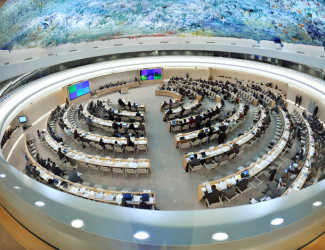
A general view of participants at the 16th session of the Human Rights Council in Geneva, Switzerland.

Special Focus

AWID is an international, feminist, membership organisation committed to achieving gender equality, sustainable development and women’s human rights

Human Rights Council (HRC)

The Human Rights Council (HRC) is the key intergovernmental body within the United Nations system responsible for the promotion and protection of all human rights around the globe. It holds three regular sessions a year: in March, June and September. The Office of the UN High Commissioner for Human Rights (OHCHR) is the secretariat for the HRC.

The HRC works by:

  • Debating and passing resolutions on global human rights issues and human rights situations in particular countries

  • Examining complaints from victims of human rights violations or activist organizations on behalf of victims of human rights violations

  • Appointing independent experts (known as “Special Procedures”) to review human rights violations in specific countries and examine and further global human rights issues

  • Engaging in discussions with experts and governments on human rights issues

  • Assessing the human rights records of all UN Member States every four and a half years through the Universal Periodic Review

Learn more about the HRC


AWID works with feminist, progressive and human rights partners to share key knowledge, convene civil society dialogues and events, and influence negotiations and outcomes of the session.

With our partners, our work will:

◾️ Monitor, track and analyze anti-rights actors, discourses and strategies and their impact on resolutions

◾️ Raise awareness of the findings of the 2017 and 2021 OURs Trends Reports.

◾️Support the work of feminist UN experts in the face of backlash and pressure

◾️Advocate for state accountability
 
◾️ Work with feminist movements and civil society organizations to advance rights related to gender and sexuality.
 

Related Content

Snippet - WITM To share - ES

Para compartir tu experiencia con el financiamiento de tu organización.

Main image
AWID-CSW_header.png
Body

Snippet FEA Tanta Gente sem casa (ES)

A graphic with green feather patterns on a beige background, text on it in Portuguese says “Tanta Gente sem casa. tanta casa sem gente” which means "So many people without a home,  so many homes without people"

"Tanta gente sin hogar, tantos hogares sin gente."

Snippet - WITM Start the survey 1 - EN


Globe

 The survey is available in: Arabic, English, French, Portuguese, Russian and Spanish!


Snippet FEA Introducing Carmen Silva Ferreira (FR)

Nous avons l’énorme plaisir de vous présenter Carmen Silva Ferreira.

Née à Bahia, dans le nord-est du Brésil, Carmen est une immigrante, militante sociale et mère de 8 enfants.

Carmen a connu l'itinérance à l'âge de 35 ans, après avoir émigré seule à São Paulo. Cela l'a amenée à devenir une ardente défenseuse des communautés vulnérables, marginalisées et invisibles les plus touchées par la crise du logement. Elle est finalement devenue l'une des fondatrices de MSTC en 2000.

En tant qu'organisatrice politique visionnaire et actuelle dirigeante du MSTC, le travail de Carmen a révélé la crise du logement de la ville de São Paulo et inspiré d'autres personnes sur différentes façons d'organiser et de gérer les occupations.

Carmen a été fermement à l'avant-garde de diverses occupations. L'une d'elles est l’Ocupação 9 de Julho, qui sert désormais de scène à la démocratie directe et d'espace où chacun·e peut être soigné·e, entendu·e, apprécié·e et travailler ensemble.

Carmen a longtemps été célébrée pour son audace à redonner vie à des bâtiments abandonnés au cœur de São Paulo.

Pour en savoir plus sur sa vie, vous pouvez la suivre sur Instagram!

Snippet - WITM about research - ES

Acerca de la investigación ¿Dónde está el dinero?

La encuesta mundial ¿Dónde está el dinero? es un pilar fundamental de la tercera edición de nuestra investigación orientada a la acción: ¿Dónde está el dinero para las organizaciones feministas? (abreviadamente, ¿Dónde está el dinero? y WITM). Los resultados de la encuesta se desarrollarán y analizarán en mayor profundidad mediante conversaciones exhaustivas con activistas y donantes, y se contrastarán con otros análisis e investigaciones disponibles acerca del estado del financiamiento para las organizaciones feministas y por la igualdad de género en todo el mundo.

El informe completo ¿Dónde está el dinero para las organizaciones feministas? se publicará en 2026.

Para conocer más información acerca de cómo AWID ha arrojado luz sobre el dinero destinado en favor y en contra de los movimientos feministas, consulta nuestra historia ¿Dónde está el dinero? y nuestros informes anteriores aquí.

Snippet FEA LINES OF ACTION (EN)

What are they working on?

Illustration of a hand with a pencil writing on white paper

Human and ethnic-territorial rights

Ensuring the defense of human rights and Nature’s rights through alliance-building with local, national, regional and global actors and organizations.

A person holding a plant in a pink pot in their hands

Sustainable development

Ensuring all economic, cultural and environmental activities contribute to sustainable development, food security and income generation, while respecting the self-determination and self-government of Afro-descendant communities.

Three women sitting next to each other

Education and training

Carrying out training for women and empowering them to carry out women’s rights advocacy in different political, social and economic spaces.

For more information, see here!

What is the purpose of the WITM survey?

The key objective of the WITM survey is to shine light on the financial status of diverse feminist, women’s rights, gender justice, LBTQI+ and allied movements globally. Based on this, we hope to further strengthen the case for moving more and better money, as well as shift power, to feminist movements.

Our Companion Sites

The Young Feminist Wire

An online community for and by young feminists working on women’s human rights, gender equality and social justice around the world.

Visit the site

The Observatory on the Universality of Rights (OURs)

The platform is the go-to place for information and resources on safeguarding the universality of rights in international and regional human rights spaces.

Visit the site

The Young Feminist Fund-FRIDA

Provides funding for young feminist-led initiatives. It aims to strengthen the capacity of young feminist organizations to leverage resources for their work and to increase donors’ and allies’ commitments to resourcing young feminist activism.

Visit the site

Online Directory of Urgent Responses for WHRDs

A go-to site to learn about the urgent responses undertaken to protect women human rights defenders and to find tools and resources to support the work and wellness of WHRDs.

Visit the site

IM-Defensoras (Mesoamerican Initiative for Women Human Rights Defenders)

A regional initiative created to prevent, respond, document and make public all cases of violence against women human rights defenders in the Mesoamerican region.

Visit the site

The WHRD International Coalition

The WHRD IC is a resource and advocacy network for the protection and support of women human rights defenders worldwide.

Visit the site

Post-2015 Women´s Coalition

A Coalition of feminist, women´s rights, women´s development, grassroots and social justice organisations working to challenge and reframe teh global development agenda. 

Visit the site

Women´s Major Group on Development

The role of the Women’s Major Group is to assure effective public participation of women’s non-governmental groups in the UN policy processes on Sustainable Development, Post2015 and Environmental matters. 

Visit the site

Women Working Group on Financing for Development

An alliance of women’s organizations and networks to advocate for the advancement of gender equality, women’s empowerment and human rights in the Financing for Development (FfD) related UN processes.

Visit the site

Snippet FEA Metzineres (ES)

Metzineres

Paseando por el barrio del Raval en Barcelona, ​​puede que te encuentres con Metzineres, una cooperativa feminista por y para mujerxs que consumen drogas y que sobreviven múltiples situaciones de vulnerabilidad.

Imagínate un lugar libre de estigma, donde lxs mujerxs puedan consumir drogas de manera segura. Un lugar que brinda seguridad, apoyo y acompañamiento a mujerxs cuyos derechos son sistemáticamente vulnerados por la guerra contra las drogas y que sufren violencia, discriminacion y represión como consecuencia.

Justo afuera de la entrada, lxs transeúntes y visitantes son recibidxs con una enorme pizarra que describe consejos, trucos, deseos y dibujos de personas que usan drogas. También hay un calendario que cuenta con una serie de actividades auto-gestionadas por la comunidad de Metzineres. Ya sean talleres de peluquería y cosmética, radio, teatro, comidas comunales ofrecidas a la comunidad o clases de defensa personal, ¡siempre hay algo que hacer!

La cooperativa proporciona sitios de consumo seguros, así como servicios que cubren las necesidades básicas de las personas. Hay camas, espacios de almacenamiento, duchas, baños, lavadoras y una pequeña terraza al aire libre donde la gente puede relajarse o hacer un poco de jardinería.

Metzineres opera dentro de un marco de reducción de daños, que intenta reducir las consecuencias negativas del uso de drogas. Pero la reducción de daños es mucho más que un conjunto de prácticas: es una política anclada en la justicia social, la dignidad y los derechos de las personas que consumen drogas.

¿Podría haber varias respuestas a la encuesta ¿Dónde está el dinero? en nombre de una agrupación en particular?

No. Solicitamos una sola respuesta a la encuesta por agrupación.