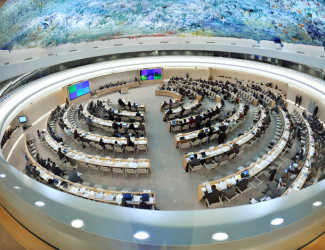
Jean-Marc Ferré | Flickr (CC BY-NC-ND 2.0)
A general view of participants at the 16th session of the Human Rights Council in Geneva, Switzerland.

Special Focus

AWID is an international, feminist, membership organisation committed to achieving gender equality, sustainable development and women’s human rights

Human Rights Council (HRC)

The Human Rights Council (HRC) is the key intergovernmental body within the United Nations system responsible for the promotion and protection of all human rights around the globe. It holds three regular sessions a year: in March, June and September. The Office of the UN High Commissioner for Human Rights (OHCHR) is the secretariat for the HRC.

The HRC works by:

  • Debating and passing resolutions on global human rights issues and human rights situations in particular countries

  • Examining complaints from victims of human rights violations or activist organizations on behalf of victims of human rights violations

  • Appointing independent experts (known as “Special Procedures”) to review human rights violations in specific countries and examine and further global human rights issues

  • Engaging in discussions with experts and governments on human rights issues

  • Assessing the human rights records of all UN Member States every four and a half years through the Universal Periodic Review

Learn more about the HRC


AWID works with feminist, progressive and human rights partners to share key knowledge, convene civil society dialogues and events, and influence negotiations and outcomes of the session.

With our partners, our work will:

◾️ Monitor, track and analyze anti-rights actors, discourses and strategies and their impact on resolutions

◾️ Raise awareness of the findings of the 2017 and 2021 OURs Trends Reports.

◾️Support the work of feminist UN experts in the face of backlash and pressure

◾️Advocate for state accountability
 
◾️ Work with feminist movements and civil society organizations to advance rights related to gender and sexuality.
 

Related Content

Ursula K Le Guin

Ursula was an American novelist who worked mainly in the genres of fantasy and science fiction.

She found fame with The Left Hand Of Darkness, which imagines a future society where people are ambisexual – they have no fixed sex. It explores the effects of gender and sex in society, and was one of the first major feminist science fiction books. Ursula was inspiring in her subversive and original writing, and also for the themes of feminism and freedom she held so dearly.

In a 1983 address at Mills College in California, she told graduates: “Why should a free woman with a college education either fight Macho-man or serve him? Why should she live her life on his terms? I hope you live without the need to dominate, and without the need to be dominated.”


Ursula K Le Guin, USA

O questionário está disponível durante quanto tempo?

O questionário está disponível até o final de julho de 2024. Queira preencher o mesmo dentro deste prazo para garantir que as suas respostas são incluídas na análise.

Main image
banners-10.png
Body

Exposition Pleasure Garden

Cette œuvre est la collaboration photographique et illustrative réalisée par Siphumeze et Katia pendant le confinement. Elle se penche sur les récits de sexe et de plaisir des queers noirs, le bondage, le sexe protégé, les jouets, la santé mentale et le sexe et bien d'autres choses encore. Elle a été créée pour accompagner l'anthologie Touch.

Mental Health
Mental Health (Santé mentale)
Sex and Spirtuality
Sex and Spirtuality (Sexe et spiritualité)
Orgasm
Orgasm (Orgasme)

À propos des artistes

Siphumeze Khundayi portrait

Siphumeze Khundayi est une créatrice d'art, photographe et animatrice qui s'intéresse aux moyens créatifs de réunir le dialogue et la pratique artistique en relation avec l'identité queer africaine. 

Elle est directrice créative de HOLAAfrica!, un collectif panafricaniste féministe en ligne.

Ses travaux de performance en solo et collaboratifs ont été présentés dans un certain nombre de festivals et d'espaces théâtraux tels que le festival Ricca Ricca au Japon.

Elle a mis en scène deux productions nominées aux Naledi Awards en 2017 et 2018. Elle a aussi mis en scène un spectacle qui a remporté un prix Standard Bank Ovation en 2020.
En tant que photographe, elle a participé à une exposition de groupe intitulée Flowers of my Soul (Fleurs de mon âme) en Italie, organisée par le Misfit Project. Elle a produit trois publications pour HOLAAfrica et a été publiée dans le deuxième volume, pour lequel elle a fourni la couverture: As You Like des Gerald Kraak Anthologies.

katia portrait

Katia Herrera est une artiste visuelle numérique de 21 ans originaire de la ville bruyante de Saint-Domingue, en République dominicaine. Bien que Herrera soit une introvertie autoproclamée, ses œuvres d'art sont remarquablement fortes dans un monde qui tente de faire taire les voix des personnes noires. Avec des titres comme Black Woman (Femme Noire), You Own the Moon (La Lune t’Appartient), Earth Goddess (Déesse de la Terre), Forever (Pour Toujours) et Universe Protector (Protecteur.rice de l’Univers), l'héritage de Herrera sera marqué par sa volonté passionnée de mettre en lumière l'endurance et la persévérance des Noir·e·s d'hier et d'aujourd'hui, afin de contrer le discours selon lequel la peau noire ne devrait être associée qu'à l'esclavage.

L'une de ses œuvres la plus belle et la plus vivante, Universe Protector, dépeint l'âme noire comme une entité divine pleine de force, de puissance et de grandeur. C’est dans sa jeunesse que son amour du graphisme a été stimulé grâce à l'art de ses parents et le Photoshop qu'ils avaient téléchargé sur leur ordinateur pour leur photographie professionnelle.

Snippet FEA Get Involved Story 4 (FR)

ENGAGEZ-VOUS!

Vous pouvez suivre le syndicat Réseau Solidarité sur Facebook et Twitter

Pour soutenir le travail de Réseau Solidarité Solidarity, faites un don ici

Vous pouvez suivre le syndicat OTRAS sur Twitter, Instagram y Facebook

Pour soutenir le travail de OTRAS, faites un don ici

FRMag - United against violence (FR)

Ensemble contre la violence

par Karina Ocampo

C’est dans un recoin caché du Chiapas, au Mexique, que nous sommes arrivées, femmes et dissidentes sexuelles, pour organiser nos actions. (...)

Lire

< illustration : « La muerte sale por el Oriente » [la mort se lève à l’Est], par Sonia Madrigal

Liliana Bodoc

Liliana fue una maestra argentina, una tejedora y una escritora muy reconocida.

Su trilogía La saga de los confines recibió varios premios y es única en el género fantástico por su uso y reimaginación de la mitología de los pueblos indígenas de América del Sur.

El compromiso de Liliana con el feminismo se expresaba en las diversas, ricas y fuertes voces de mujeres en su escritura y especialmente en su extensa obra para lectorxs jóvenes. También tomó posición públicamente en favor del aborto, la justicia económica y la equidad de género.


Liliana Bodoc, Argentina

Snippet - Home page promo WITM - ES

«¿Dónde está el dinero para las organizaciones feministas?»

Sobre la base de nuestros 20 años de historia movilizando más y mejor financiamiento para el cambio social encabezado por los feminismos, AWID te invita a responder la nueva edición de nuestra encuesta insignia, WITM

¡RESPONDE LA ENCUESTA! Obtén más información

Nicole Barakat

nicole barakat -verge exhibition april 2018
We transcend time and place, Hand cut found paper (2017)
nicole barakat -verge exhibition april 2018
We will remember who we are and We will persist Cotton embroidered hand cut lamé on wool silk cloth (2018)
nicole barakat -verge exhibition april 2018
​​We will return home, Silk embroidered hand cut lamé on cotton velveteen (2018)
verge march 18 - document photography
We will heal in the now, Hand cut silk, wool, lamé, cotton, direct digital print silk satin on linen (2018)


we are infinite

An exhibition by Nicole Barakat, embodying her reconnection with the diaspora of objects from her ancestral homelands in the South West Asia and North Africa (SWANA) region.
 
Barakat presents a collection of textile works as manifestations of her practice of engaging with displaced, and often stolen objects held within Western museum collections including the Louvre, British Museum and Nicholson Museum. 
 
To by-pass the gatekeepers and breach the vitrines holding these ancestral objects, Barakat reclaims pre-colonial, non-linear, receptive forms of knowing that are often devalued and dismissed by colonial and patriarchal institutions - engaging with coffee cup divination, dream-work, intuitive listening and conversations with the objects themselves (source).

About Nicole Barakat

Nicole Barakat portrait
Nicole Barakat is a queer femme, SWANA artist born and living on Gadigal Country (so-called Sydney, Australia). She works with deep listening and intuitive processes with intentions to transform the conditions of everyday life. Her work engages unconventional approaches to art-making, creating intricate works that embody the love and patience that characterises traditional textile practices. 

Her works include hand-stitched and hand-cut cloth and paper drawings, sculptural forms made with her own hair, cloth and plant materials as well as live work where she uses her voice as a material. 

Nicole’s creative practice is rooted in re-membering and re-gathering her ancestral knowing, including coffee divination and more recently working with plants and flower essences for community care and healing. 

Snippet FEA Intro Acknowledgments (EN)

We would like to thank the Amar.ela collective of women feminists activists and creatives who made this series possible, and especially Natalia Mallo (the team’s octopus) for her support and accompaniment throughout this journey.

We also extend our deepest gratitude and admiration to all the collectives and people who participated in this project, and we thank them for sharing their time, wisdom, dreams and hopes with us. We thank you for making this world a more just, feminist and sustainable one.

We hope the rest of the world will be as inspired by their stories as we are.

FRMag - Esmeralda takes over the Internet

Esmeralda takes over the Internet : How social media has helped Romani women to reclaim visibility

by Émilie Herbert-Pontonnier

Remember Esmeralda? The exotic "Gypsy" heroine born under the pen of the French literary giant Victor Hugo and popularized by Disney studios with their Hunchback of Notre Dame. (...)

Read

< artwork: “Si las marronas lo permiten” by Nayare Soledad Otorongx Montes Gavilan

Anna Campbell (şehid Hêlîn Qerecox)

Anna a grandi à Lewes, dans le Sussex (Royaume-Uni). Après avoir décidé de ne pas poursuivre sa licence d’anglais à l'Université de Sheffield, elle a déménagé à Bristol et est devenue plombière.

Elle a passé une grande partie de son temps à défendre les personnes marginalisées et défavorisées, à assister à des rassemblements antifascistes et à offrir son soutien aux femmes de la Dale Farm lorsqu'elles furent menacées d'expulsion. Végétalienne et amie des animaux, elle a participé à des missions de sabotage de chasses et son nom est honoré sur le monument commémoratif « Arbre de vie » de l’organisation PETA. Anna s'est rendue à Rojava en mai 2017 pour lutter en faveur du renforcement du pouvoir des femmes, de la pleine représentation de toutes les ethnies et de la protection de l'environnement.

Anna est décédée le 15 mars 2018, après avoir été atteinte par une frappe aérienne turque dans la ville d'Afrin, dans le nord de la Syrie. Anna se battait auprès des forces de protection des femmes (YPJ) quand elle a été tuée.


Anna Campbell (şehid Hêlîn Qerecox), UK

Forum Homepage Banner

Register for the Forum!

When people come together on a global scale, as individuals and movements, we generate a sweeping force. Join us in Bangkok, Thailand and online in December 2024.

Learn more Register

Tendencias anti-derechos en los sistemas regionales de derechos humanos

Chapter 6

En la Comisión Africana y en el Sistema Interamericano, los actores antiderechos impulsan nociones esencialistas de cultura y género para impedir el avance de los derechos y socavar las responsabilidades. Como vemos, los actores anti-derechos están ejerciendo su influencia sobre los sistemas regionales de derechos humanos, así como en los espacios internacionales.

2019 JUN 27 Meeting of the Summit Implementation Review Group in Colombia
© Juan Manuel Herrera/OAS/Flickr
2019 JUN 27 Reunión del Grupo de Revisión de la Implementación de Cumbres en Colombia

La Comisión Africana de Derechos Humanos y de los Pueblos ha comenzado a definir a los derechos sexuales y de las mujeres como un menoscabo a su capacidad de ocuparse de los «derechos reales» y como contrarios a los «valores africanos», con lo cual se establece un precedente anti-derechos preocupante. La anulación del estatus de observador de la Coalición de Lesbianas Africanas es un ejemplo de esta tendencia y muestra la forma en que el espacio para el involucramiento feminista panafricanista está siendo restringido.

En la Organización de Estados Americanos (OEA) y en el Sistema Interamericano de Protección de los Derechos Humanos, las estrategias anti-derechos incluyen la oenegización de grupos religiosos, la utilización de discursos seculares, y la cooptación de marcos de discriminación. La influencia antiderechos se ha materializado de diversas maneras, que incluyen la intimidación de activistas trans y la obstrucción de la introducción de lenguaje progresista en las resoluciones.

Índice de contenidos

  • Silenciamiento de feministas en el Sistema Africano de Derechos Humanos
  • Grupos anti-derechos en América Latina: Asamblea General de la Organización de Estados Americanos (OEA) y el Sistema Interamericano de Protección de los Derechos Humanos

Leer el capítulo completo

Snippet - GII Intro (FR)

Investissement à impact de genre et émergence de fausses solutions :

une analyse pour les mouvements féministes

L'investissement à impact de genre est désormais considéré comme une solution contre les inégalités de genre. Et pourtant, comme le montre notre rapport, il fait partie du problème. Les institutions publiques et privées en font la promotion en tant que moyen pour parvenir à l'égalité de genre et pour accroître les ressources des femmes et des filles.

Mais en aucun cas, ces affirmations ne sont étayées par des preuves.

Au contraire, l’investissement à impact de genre constitue plutôt une nouvelle version de vies et de sociétés soumises à une même logique financière, qui continue de façonner les profondes inégalités de notre monde.

Avec ce rapport, l'AWID offre aux lecteurs·rices - féministes, défenseur·euse·s de la justice de genre et autres parties prenantes de l'investissement à impact de genre - une analyse critique et des preuves étayées pour comprendre l’investissement à impact de genre, ses récits et les implications économiques et politiques qu’il a pour les mouvements féministes.

FRMag - Let the invisible be visible

Hagamos que lo invisible sea visible: manifiesto de unx fisicoculturista de género fluido en Hong Kong

por Siufung Law

«¡97…! 98… ¿dónde está 98? ¡98! ¡Por favor, vuelve a la formación!... ¡99! ¡100!...» La dama detrás del escenario le pedía incesantemente a cada atleta que formara una fila en el espacio húmedo, transpirado y abarrotado detrás de escena. (...)

Leer

< arte: «When They See Us» [Cuando nos ven], Lame Dilotsotlhe

Kagendo Murungi

Kagendo is remembered fondly by family and friends as a fierce African feminist activist, artist, and filmmaker.

She dedicated over 20 years to advocate for the rights and dignity of African LGBTIQ and gender non conforming people.

Kagendo’s colleagues remember her as someone with a jovial personality, fierce conviction, and love for life. Kagendo died due to natural causes at her home in Harlem on December 27th, 2017.

On Kagendo’s passing Kenyan writer and activist Shailja Patel noted “Kagendo's lifelong commitment to connecting the dots between all oppressions, showing how colonialism fostered homophobia on the African continent, making Kenya a country where queer Kenyans and free women could live and thrive.”


Kagendo Murungi, Kenya