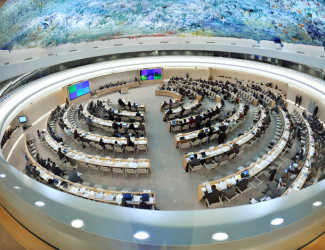
The Human Rights Council (HRC) is the key intergovernmental body within the United Nations system responsible for the promotion and protection of all human rights around the globe. It holds three regular sessions a year: in March, June and September. The Office of the UN High Commissioner for Human Rights (OHCHR) is the secretariat for the HRC.
The HRC works by:
Debating and passing resolutions on global human rights issues and human rights situations in particular countries
Examining complaints from victims of human rights violations or activist organizations on behalf of victims of human rights violations
Appointing independent experts (known as “Special Procedures”) to review human rights violations in specific countries and examine and further global human rights issues
Engaging in discussions with experts and governments on human rights issues
Assessing the human rights records of all UN Member States every four and a half years through the Universal Periodic Review
AWID works with feminist, progressive and human rights partners to share key knowledge, convene civil society dialogues and events, and influence negotiations and outcomes of the session.
With our partners, our work will:
◾️ Monitor, track and analyze anti-rights actors, discourses and strategies and their impact on resolutions
◾️Support the work of feminist UN experts in the face of backlash and pressure
◾️Advocate for state accountability
◾️ Work with feminist movements and civil society organizations to advance rights related to gender and sexuality.
Related Content
Snippet FEA Sabrina Sanchez Bio (FR)
Nous vous présentons Sabrina Sanchez, incroyable femme trans, migrante, travailleuse du sexe, organisatrice, transféministe et l'une des fondatrices du syndicat OTRAS.
Originaire de Mexico, elle a émigré en Espagne il y a 17 ans après avoir obtenu son diplôme en communication et a commencé à travailler comme travailleuse du sexe.
Il ne fallut pas longtemps avant qu'elle ne s'implique dans l'activisme trans et l'activisme des travailleur·euses du sexe à Barcelone. Après avoir rejoint l'Association des Professionnel·les du Sexe (Asociación de Profesionales del Sexo, Aprosex), elle a commencé à travailler dans son secrétariat et a fondé le syndicat espagnol des travailleur·euses du sexe OTRAS.
Mereani Naisua Senibici, also called ‘Sua’, was a longstanding member of the Fiji Young Women’s Christian Association (YWCA) movement.
She worked with diverse groups of women in multi-racial, rural and urban settings and was committed to supporting and promoting women’s and young women’s rights.
In the Lautoka YWCA, she worked with women of Indian descent, and was a leading figure in the sports development and participation of women and of trans athletes in Lautoka.
“Sua is greatly loved by Fiji YWCA members for her dedication and long-time support towards all that the organisation endeavoured to do.” - Tupou Vere
Mereani was part of the House of Sarah (HoS), an initiative of the Association of Anglican Women (AAW), launched in 2009 and aimed at raising awareness of the issues around gender-based violence, as well as providing support to women who face violence. She started as a dedicated volunteer and offered support to women throughout the Pacific.
“A people’s person and an all-rounder in women's empowerment and movement work at community level. Rest in Peace, Sua.” - Tupou Vere
Si la Conférence de Doha a permis d’aller au-delà de Monterrey du point de vue de l’égalité des genres, ses résultats restent insuffisants dans ce domaine. Dans une déclaration , le WWG on FfD (Groupe de travail des femmes sur le FdD) a souligné le fait que les engagements en faveur de l’égalité des genres figurant dans la Déclaration de Doha ne prendraient sens que si les questions systémiques qui sous-tendent la pauvreté et l’inégale répartition du pouvoir et des ressources dans l’économie politique mondiale étaient fermement traitées.
Да. Ваши ответы будут удалены по окончании обработки и анализа данных и будут использованы исключительно в исследовательских целях. Данные НИКОГДА не будут переданы за пределы AWID и будут обрабатываться только сотрудниками AWID и консультантками(-тами), работающими с нами над проектом «Где деньги?». Для нас ваша конфиденциальность и безопасность– приоритет. С нашей политикой конфиденциальности можно подробно ознакомиться здесь.
A Film Series on Feminist Realities from Africa and the African Diaspora
by Gabrielle Tesfaye
When I created my short animation film, The Water Will Carry Us Home, my mind was plugged into a magical world of fearless resilience and ancestral mermaids who transformed their deepest scars into a new generation of life. Set during the time of the transatlantic slave trade, I was pulled to show this history of African enslavement in a different way than it has ever been told on screen. I wanted to give my ancestors the commemoration they never received. I was motivated to reclaim the history that continues to paint us as helpless victims. Essentially, I wanted to tell the truth. To reclaim and reimagine our history and perspective, means to simultaneously heal our generational traumas that exist today. It is this important work that so many women through the African continent and the African diaspora are doing today, igniting our collective Feminist Realities.
In the making of the film I researched religiously, and in what was written, I saw what was not. There were many times I felt I was hitting a wall trying to find something that was not there, and it was in those voided places that I realized the storytellers of today are filling the voids. I found the most useful stories in contemporary art, film, and African diaspora folklore.
“... a truly unique, raw and representation of feminist power in action.”
The Water Will Carry Us Home carried itself around the world into the hearts of the Diaspora. It also led me here, as the curator of the African and Diaspora film screenings of AWID’s Co-Creating Feminist Realities initiative. Whilst curating this collection of films, I looked for stories that were completely unique, raw and representational of feminist power in action. Consisting of three shorts and one feature, they reveal stories through many communities in Africa and the diaspora, including Ethiopia, Uganda, The Democratic Republic of Congo, South Africa and Kenya. These films reposition African women as what they truly are- self governing and empowered through the unfiltered lens of their work.
“An incredibly beautiful, attentive, finely observed telling of the connection between Africa and its Diaspora formed form the trans Altantic slave trade. The visual universe it creates is just gorgeous… an echo of the fusion of spiritual traditions and non-linear time that speak to how we are still experiencing the moments of the past that formed 'new' worlds of diaspora blackness.”
- Jessica Horn, PanAfrican feminst strategist, writer and co-creator of the temple of her skin
Our short documentary film, Women Hold Up the Sky, created by the WoMin African Alliance, tells the story of women activists in Uganda and the Democractic Republic of Congo who are actively reclaiming their land rights, threatened by mining and other extractives in their homes. The film not only exposes the corruption of extractivism, but finally shares what we have been missing on screen - how grassroots African women are actively organizing, strategizing, and analyzing within their communities to create women-centred and community-driven alternatives. Margaret Mapondera of WoMin explains it beautifully, that they are the “custodians of lands, forests, waters, rivers and territories; the ways in which women hold and transmit the stories / herstories of our past and our futures; the powerful and transformative ways of being that women embody in their relationships to each other, to the environment and in themselves.”
“A refreshing and much-needed piece of cinema highlighting the many ways African women are coming together to create women-led and community-driven alternatives… The fight is on and
women hold the key.”
Pumzi, created by critically acclaimed director Wanuri Kahiu, bridges Africa and science fiction around climate and environmentalism. Pumzi imagines a futuristic world where humankind has been forced to settle on another planet. While Pumzi seems afro-futuristic and new for Africa on the surface, Kahiu reveals the truth that science fiction and fantasy is something that has always existed in African storytelling, but never recognized. Kahiu creates a world where women are truth seekers and heroes who pioneer us into a new world, the opposite of images that position Africans as victims of war and destruction. Instead, Pumzi writes the narrative of African women being their own saviors and problem solvers, who stop at no cost to follow the cryptic visions they channel in their dreams.
“A pioneering African sci-fi film, situating women as scribes of the future and opening up our visions about other worlds, other universes we might occupy as Africans - always an important exercise as we imagine our way out of present crises.”
- Jessica Horn, PanAfrican feminst strategist, writer and co-creator of the temple of her skin
Our feature film of the program, Finding Sally is set in 1970’s Ethiopia during the time of The Red Terror war, documenting the striking history of director Tamara Mariam Dawit’s activist aunt, Sally Dawit. Throughout the film we learn of Sally’s incredible journey as a young and courageous woman activist navigating one of the most violent times of Ethiopian history. Sally’s story not only reveals the gravity of this time, but the reflection of her own personal evolution as a young woman. Dawit was intentional to tell the film through the lens of women, untouched by male voices. Due to so much Ethiopian history being told by men, the making of this powerful story preserved its reality of honoring the feminist perspective. Dawit explains, “Women in revolution and war are often only included as someone's spouse or someone who did cooking or typing work. I wanted to look at the activism around the revolution only through the memories and voices of women.” Finding Sally demonstrates the reclamation of history sought by current filmmakers today. It is an igniting of feminist power and our connected realities throughout time.
“The responsibility falls on us, to remember these women that came before us and their brilliant work so they are not forgotten like the thousands of women already forgotten while fighting the good fight. Sally is such a woman and may she never be forgotten.”
These films have became a part of my own psyche, empowering me to continue building powerful alternatives towards justice from within. They affirm that I am a woman among a world of women, holding up the skies and actively building indestructible Feminist Realities. These films are more than stories of African women - they are globally relatable, inspiring and set the example of Feminist Realities for all of us around the world.
Gabrielle Tesfaye:
Gabrielle Tesfaye is an interdisciplinary artist versed in painting, animation, film, puppetry and interactive installation. Her work is rooted in the African diaspora, Afro-futurism, ancient art practices and cultural storytelling.
Follow us on Social Media to receive news about upcoming events and screenings:
"La vida se trata ... de vivir en alegría – despertarse con objetivos, sentir tu propia energía creativa, responder a tu llamada." - Sylvia Robinson
Sylvia Robinson, una incansable organizadora y líder comunitaria, fue la fundadora y directora ejecutiva de Emergence Community Arts Collective [Colectivo de Artes Comunitarias de Emergencia] (ECAC, por sus siglas en inglés ), en Washington DC.
Este centro y espacio de performance combina la educación, el compromiso cívico, las artes, los servicios sociales y espirituales y las prácticas ambientales sostenibles. Sylvia lo concibió como un hogar donde " hubiera equilibrio y sinergia con las actividades que la gente necesitaba para sostener la vida".
También fue una de lxs co-fundadorxs del Georgia Avenue Community Development Taskforce [Grupo de Trabajo de Desarrollo Comunitario de la Avenida Georgia], un grupo vecinal que trabaja por la justicia social y la organización de la comunidad en el noroeste de DC, para asegurarse de que esta tenga una voz en la reurbanización y gentrificación del área.
"Estamos pidiendo viviendas asequibles. Estamos pidiendo que los pequeños negocios que han estado aquí desde siempre no sean aniquilados por nuevos comercios. Estamos pidiendo espacios verdes y espacios para que la gente se pueda reunir y socializar. Estamos pidiendo mejoras en el paisaje urbano – mejores calles y mejor iluminación en los tramos de carretera." - Sylvia Robinson sobre el Grupo de Trabajo
Antes de convertirse en organizadora y después de recibir un título en informática, Sylvia trabajó en sistemas de control de tráfico aéreo por más de una década. Después se dedicó al asesoramiento en materia de drogas y alcohol, a través de lo cual se involucró cada vez más en el trabajo comunitario.
"Involucrarme con la comunidad era mi vocación". - Sylvia Robinson
Sylvia nació en Washington D.C. el 14 de agosto de 1961, y falleció el 18 de septiembre de 2017, después de una batalla contra el cáncer.
"El espíritu y el legado de Sylvia seguirán inspirando a esta comunidad durante muchos años." - ECAC
The 1st drafting session on the outcome document for the 3rd Financing for Development Conference
In January 2015 a series of drafting sessions towards the final outcome document started at UN headquarters in New York.
Prior to the first drafting session the co-facilitators of the Addis conference preparatory process presented an elements paper for the so-called “zero-draft” outcome document, as the basis for the intergovernmental negotiations of the outcome document.
Desejam recolher quantas respostas ao questionário?
O nosso objetivo é alcançar um total de 2000 respostas, quase o dobro do último questionário WITM em 2011.
Snippet FEA Title Main (ES)
Las Economías Feministas
QUE AMAMOS
FRMag - Freeing the Church
Liberar a la Iglesia, descolonizar la Biblia para las mujeres de Papúa Occidental
por Rode Wanimbo
«Señor, somos indignas. Somos las que pecaron, porque Eva comió el fruto en el Edén. Solo somos mujeres que cultivan batatas, cuidan cerdos y dan a luz niñxs. Creemos que tú moriste en la cruz para liberarnos. Gracias, en el nombre de Jesús, amén». (...)
< arte: «Offerings for Black Life» [Ofrendas para las vidas negras], Sokari Ekine
#MeToo in China
En China, el movimiento #MeToo [«Yo También»] se encendió en enero de 2018, empujado por el ímpetu del movimiento #MeToo de todo el planeta. Fue una respuesta a los problemas culturales y sistémicos relacionados con el género y el poder dentro de China. Las bases del movimiento habían sido establecidas durante décadas, y los muchos años de debate y promoción de la igualdad de género, finalmente, hicieron erupción con tremenda fuerza en toda la sociedad. El movimiento #MeToo fue impulsado fundamentalmente por jóvenes, que incluyen a innumerables mujeres anónimas y sus aliadxs, en busca de oportunidades para hacer realidad el principal «sueño chino»: transformar a China en un país con igualdad de género.
En China, el contexto para el movimiento #MeToo es extremadamente adverso: el Estado de derecho, la justicia y la transparencia de las acciones gubernamentales y la libertad de expresión no pueden darse por descontados, pero estos son precisamente los objetivos por los cuales lucha el movimiento. Ha sido, desde el principio, una lucha intensa, y cada víctima o activista que se visibiliza corre enormes riesgos: desde ser silenciadx o humilladx o de sufrir represalias hasta poner en peligro su seguridad. Todos los éxitos del movimiento #MeToo han sido logrados por quienes son lo suficientemente valientes como para asumir los costos de manifestarse y desafiar la censura.
La exhibición «#MeToo in China» fue inaugurada en 2019 y recorrió cinco ciudades. Su objetivo es dar mayor prominencia a las experiencias personales de lxs víctimas y lxs activistas, para inspirar al público a unirse a la lucha a través del contacto con estas historias. La exposición misma se ha convertido en parte de la lucha #MeToo: ha debido enfrentar desafíos en su itinerario por toda China y, en más de una ocasión, fue amenazada con la clausura.
Maritza Quiroz Leiva était une activiste sociale, leader communautaire et défenseure des droits des femmes afro-colombienne. Comptant parmi les 7,7 millions de Colombien·ne·s déplacé·e·s internes par 50 années de conflit armé, Maritza a dédié son travail de plaidoyer au soutien des droits des autres, particulièrement au sein de la communauté afro-colombienne ayant souffert deviolations et déplacements similaires.
Maritza était responsable adjointe du Conseil de victimes Santa Marta et une voix importante pour celles et ceux qui défendaient la justice dans leur communauté, réclamant réparation pour la torture, les enlèvements, les déplacements et les violences sexuelles subis par les victimes tout au long du conflit armé. Elle aégalement été active au sein du mouvement pour la redistribution des terres et la justice foncière en Colombie.
Le 5 janvier 2019, Maritza a été tuée par deux personnes armées qui se sont introduites à son domicile. Elle avait 60 ans.
Foro de Mujeres sobre Financiación para la Igualdad de Género
Este Foro se realizó el 10 de julio de 2015 en Adís Abeba y reunió a feministas, mujeres de las bases, activistas de género, académicas/os y representantes de organizaciones/redes por los derechos de las mujeres, además de recibir aportes específicos de representantes de la ONU y otras/os hacedoras/es de políticas públicas.
Los objetivos del Foro de Mujeres son: compartir información actualizada sobre el estado de las más recientes negociaciones en torno a la FpD; analizar colectivamente el panorama de la FpD y su seguimiento; acordar una postura en común sobre los derechos de las mujeres; y formular estrategias para participar de manera significativa y sustantiva con una perspectiva feminista en la Conferencia sobre la FpD en Adís Abeba.
El WWG organizó el Foro de Mujeres en colaboración con FEMNET, el African Women’s Development Fund [Fondo para el Desarrollo de las Mujeres Africanas, AWDF en inglés] y la Post-2015 Women’s Coalition [Coalición de Mujeres por el Post-2015] con el apoyo de ONU Mujeres.
Foro de las OSC en la Conferencia Internacional sobre la FpD
El Foro de las OSC en la Conferencia sobre la FpD tuvo lugar en Adís Abeba el 11 y 12 de julio de 2015 con los siguientes objetivos: informar a las OSC participantes sobre el estado del proceso oficial y coordinar la participación de la sociedad civil en la tercera Conferencia sobre la FpD; redactar colectivamente una Declaración del Foro de OSC, así como los mensajes de las OSC para las Mesas Redondas de la Conferencia sobre la FpD, los eventos paralelos organizados por el Grupo de las OSC y cualquier otra oportunidad que pueda surgir; planificar y organizar las futuras áreas de participación de las OSC en el proceso de Financiación para el Desarrollo más allá de la tercera Conferencia sobre la FpD.
Tercera Conferencia Internacional de la ONU sobre la Financiación para el Desarrollo
La tercera Conferencia Internacional de la ONU sobre la Financiación para el Desarrollo se realizó en Adís Abeba, Etiopía, del 13 al 16 de julio de 2015 y estuvo centrada en: evaluar los progresos realizados en cuanto a la aplicación del Consenso de Monterrey (2002) y la Declaración de Doha (2008); abordar temas nuevos y emergentes, incluso en el contexto de los recientes esfuerzos multilaterales por promover la cooperación internacional para el desarrollo, teniendo en cuenta el panorama actual y en permanente evolución de la cooperación para el desarrollo, la interrelación entre todas las fuentes de financiación para el desarrollo, las sinergias entre objetivos de la financiación en las tres dimensiones del desarrollo sostenible (económica, social y ambiental) y la necesidad de apoyar el desarrollo de la agenda de Naciones Unidas más allá de 2015; así como revitalizar y fortalecer el proceso de seguimiento a la financiación para el desarrollo.
La Agenda de Acción de Addis Ababa fue adoptada el 15 de julio de 2015 por jefes de estado, de gobierno y altos representantes ante las Naciones Unidas.
Sin embargo, los países en desarrollo, las organizaciones de la sociedad civil y, más específicamente, las organizaciones de mujeres consideran que la Agenda de Acción de Addis Ababa no logró cumplir su cometido. El Grupo de Trabajo de Mujeres expresó su fuerte decepción y demandó cambios estructurales en la gobernanza económica mundial y la arquitectura para el desarrollo. Puedes leer aquí la reacción al documento final. Cientos de organizaciones y redes de la sociedad civil de todo el mundo también expresaron sus profundas preocupaciones y reservas. Puedes leer aquí la respuesta al documento final.