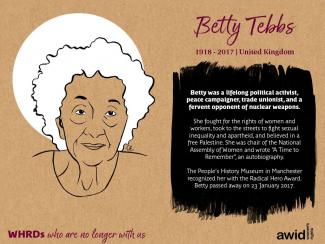
Betty Tebbs
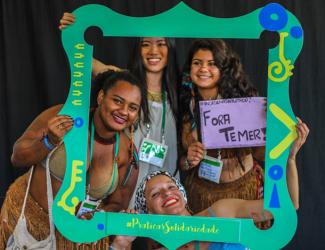
Young feminist activists play a critical role in women’s rights organizations and movements worldwide by bringing up new issues that feminists face today. Their strength, creativity and adaptability are vital to the sustainability of feminist organizing.
At the same time, they face specific impediments to their activism such as limited access to funding and support, lack of capacity-building opportunities, and a significant increase of attacks on young women human rights defenders. This creates a lack of visibility that makes more difficult their inclusion and effective participation within women’s rights movements.
AWID’s young feminist activism program was created to make sure the voices of young women are heard and reflected in feminist discourse. We want to ensure that young feminists have better access to funding, capacity-building opportunities and international processes. In addition to supporting young feminists directly, we are also working with women’s rights activists of all ages on practical models and strategies for effective multigenerational organizing.
We want young feminist activists to play a role in decision-making affecting their rights by:
Fostering community and sharing information through the Young Feminist Wire. Recognizing the importance of online media for the work of young feminists, our team launched the Young Feminist Wire in May 2010 to share information, build capacity through online webinars and e-discussions, and encourage community building.
Researching and building knowledge on young feminist activism, to increase the visibility and impact of young feminist activism within and across women’s rights movements and other key actors such as donors.
Promoting more effective multigenerational organizing, exploring better ways to work together.
Supporting young feminists to engage in global development processes such as those within the United Nations
Collaboration across all of AWID’s priority areas, including the Forum, to ensure young feminists’ key contributions, perspectives, needs and activism are reflected in debates, policies and programs affecting them.
Primera sesión para redactar el Documento Final de la tercera Conferencia Internacional sobre la Financiación para el Desarrollo

Le Forum international de l'AWID est à la fois un événement communautaire mondial et un espace de transformation personnelle radicale. Rassemblement unique en son genre, le Forum réunira nos mouvements féministes, de défense des droits des femmes, de justice de genre, LBTQI+ et alliés, dans toute leur diversité et leur humanité, afin de nous connecter, nous apaiser et nous épanouir.
Le thème du Forum – S’élever ensemble – nous invite à nous engager pleinement, à nous connecter les un·e·s aux autres de manière ciblée, bienveillante et courageuse. Nous pourrons ainsi ressentir le battement du cœur des mouvements mondiaux et agir ensemble pour relever les défis de notre époque.
For the first time, the AWID Forum offered three modes of participation:
 |
 |
 |
|
En présentiel au Queen Sirikit National Convention Center à Bangkok, Thaïlande |
En ligne dans un espace virtuel (capacité : 3 000 participant·e·s) |
Via des centres névralgiques (Hubs) connectés dans un espace transfrontalier |
Plus de 4000 personnes ayant participé au 15e Forum international de l'AWID en 2024 ont créé une force radicale pour résister aux oppressions, vers la guérison et la libération collectives. Restez à l'écoute pour plus d'articles du forum et les prochaines mises à jour !
En 2020, le conseil d’administration de l’AWID a pris la décision difficile d’annuler le 14ème Forum international de l’AWID, qui devait avoir lieu du 20 au 23 septembre 2021 dans la ville de Taipei.
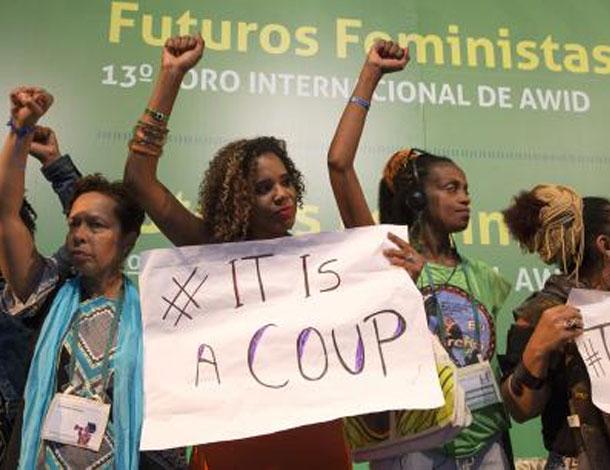
Compte tenu de la complexité du monde d'aujourd'hui, le Forum de l'AWID 2016 ne s'est pas concentré sur un « problème » particulier mais a plutôt exploré comment créer des moyens efficaces de travailler ensemble !
Malgré le contexte difficile dans lequel s’est déroulé le Forum de 2016 (l’épidémie de Zika, la grève au ministère des Affaires étrangères brésilien, la destitution de la présidente Dilma Rousseff et l’instabilité qui a suivi), il a rassemblé plus de 1800 participant-e-s issu-e-s de 120 pays et territoires de toutes les régions du monde.
Téléchargez le rapport d’évaluation
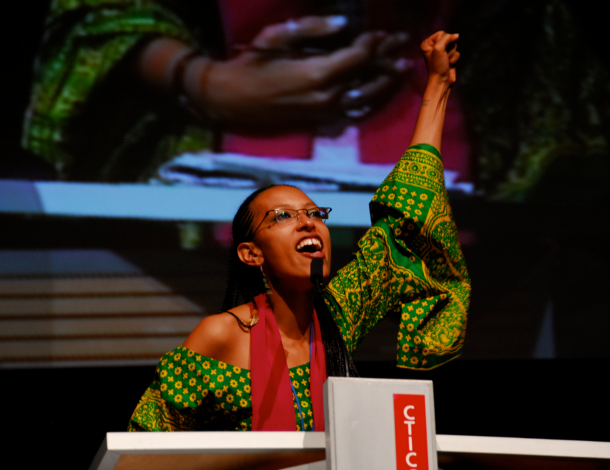
Le 12e Forum de l’AWID s’est tenu à Istanbul en Turquie en 2012, avec pour thème central Transformer le pouvoir économique pour avancer les droits des femmes et la justice. Ce Forum fut le plus important et le plus diversifié de l’histoire, rassemblant quelque 2 239 activistes pour les droits des femmes en provenance de 141 pays différents. Parmi elles-eux, environs 65 % venaient de pays du Sud, près de 15 % étaient des jeunes femmes de 30 ans et moins, alors que 75 % participaient au Forum pour la première fois.
Le Forum s’est focalisé sur la transformation du pouvoir économique pour faire progresser les droits des femmes et la justice en proposant plus de 170 activités incluant des ateliers de formation en économie féministe, en passant par toute une séries d’ateliers de discussion et autres tables rondes solidaires autour de 10 grandes questions cruciales.
Dans l’élan du Forum, nous avons transformé la page qui lui était dédiée en un outil multimédia en ligne qui intègre également les contenus générés par les participant-e-s sur toutes les composantes du Forum.
Visitez l'archive web du Forum 2012
The global survey is a key pillar of the third iteration of our action-oriented research: “Where is the Money for Feminist Organizing?” (in short, Where is the Money or WITM). The results of the survey will be further elaborated and explored through in-depth conversations with activists and funders and cross-referenced with other existing analysis and research on the state of funding for feminists and gender equality globally.
The full “Where is the Money for Feminist Organizing” report will be published in 2026.
 To learn more how AWID has been shining a light on money for and against feminist movements check out the work of our Resourcing Feminist Movements Initiative here.

Forum des femmes sur le financement de l’égalité des genres
La troisième Conférence internationale des Nations Unies sur le financement du développement
Nous Sommes la Solution es un movimiento de mujeres rurales por la soberanía alimentaria en África Occidental. Originalmente fundada como una campaña contra la agricultura hiper-industrializada, Nous Sommes la Solution se ha convertido en un movimiento de más de 500 asociaciones de mujeres rurales de Burkina Faso, Senegal, Ghana, Gambia, Guinea Bissau, Malí y Guinea.
Este movimiento liderado por mujeres está construyendo y fortaleciendo la soberanía alimentaria y de semillas en África Occidental. Alimentan a las comunidades, fortalecen las economías locales, amplían el conocimiento de las mujeres agricultoras y mitigan los efectos devastadores de la crisis climática a través de las prácticas agroecológicas. También organizan talleres, foros y transmisiones de radio comunitarias para compartir sus mensajes, conocimientos tradicionales y prácticas agroecológicas en las comunidades rurales.
En colaboración con universidades y centros públicos de investigación, Nous Sommes la Solution trabaja para restaurar las variedades indígenas de arroz (un alimento esencial de África Occidental) y promover economías alimentarias locales basadas en principios agroecológicos para influir en la formulación de políticas nacionales, mientras apoya a las mujeres en la creación de asociaciones agrícolas y su acceso a la propiedad y gestión colectiva de las tierras agrícolas.

English body
The 14th Forum theme is “Feminist Realities: our power in action”.
We understand Feminist Realities as the different ways of existing and being that show us what is possible, despite dominant power systems, and in defiance and resistance to them. We understand these feminist realities as reclamations and embodiments of hope and power, and as multi-dimentional, dynamic and rooted in specific contexts and historical moments.
Read more about Feminist Realities
AGROÉCOLOGIE ET SOUVERAINETÉ ALIMENTAIRE EN TANT QUE RÉSISTANCE |
Aujourd'hui, la production alimentaire industrielle à grande échelle utilise des plantations à culture unique, des organismes génétiquement modifiés et d'autres pesticides qui détruisent la terre et les connaissances des communautés locales. |
L'agroécologie est une résistance à l'agriculture hyper-industrialisée qu’utilisent les multinationales. L'agroécologie donne la priorité à l'agriculture à plus petite échelle, aux cultures multiples et à la production alimentaire diversifiée, tout en centrant les connaissances et pratiques traditionnelles locales. L'agroécologie va de pair avec les revendications de souveraineté alimentaire, ou le "droit des peuples à une alimentation saine et culturellement appropriée produite par des méthodes écologiquement rationnelles et durables, et leur droit de définir leurs propres systèmes alimentaires et agricoles" (Via Campesina, Déclaration de Nyéléni).
Le rôle des femmes, des communautés indigènes et rurales et des personnes racialisées des pays du Sud Global est essentiel dans la préservation des systèmes alimentaires.
Les agroécologistes féministes s'efforcent aussi de démanteler les rôles de genre oppressifs et les systèmes patriarcaux intégrés à la production alimentaire. Comme le montrent les héroïnes de Nous Sommes la Solution, elles génèrent une agroécologie libératrice en renforçant la résilience des communautés, en autonomisant les femmes paysannes et agricultrices tout en en préservant les traditions locales, les territoires et les connaissances des communautés productrices de nourriture.

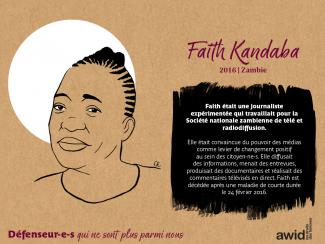
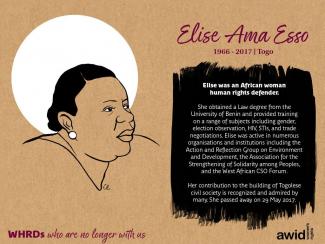
Estas defensoras lucharon por los derechos sobre la tierra, de las mujeres y de los pueblos indígenas; haciendo frente a las industrias extractivas, escribiendo poesía y promoviendo el amor. Una de ellas desapareció hace ya 19 años. Únete a nosotras para recordar y honrar a estas defensoras de derechos humanos, su trabajo y su legado, compartiendo los memes aquí incluidos; y tuiteando las etiquetas #WHRDTribute y #16Días.
Por favor, haz click en cada imagen de abajo para ver una versión más grande y para descargar como un archivo.


No, we appreciate your work but are not asking for responses from individuals at this time.
We have always worked towards ensuring that our Forums are co-developed with partners, movements and our priority constituencies.
For our upcoming Forum, we aim to deepen and strengthen that spirit and practice of co-creation and collaboration. We also recognize the need to improve the balance between the inclusion of many voices and experiences with room for participants and staff to breathe, take pause and enjoy some downtime.
This Forum will be different in the following ways: