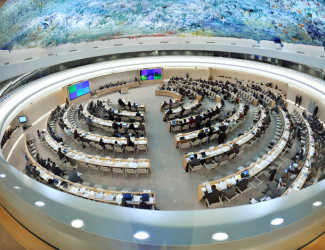

The Human Rights Council (HRC) is the key intergovernmental body within the United Nations system responsible for the promotion and protection of all human rights around the globe. It holds three regular sessions a year: in March, June and September. The Office of the UN High Commissioner for Human Rights (OHCHR) is the secretariat for the HRC.
The HRC works by:
Debating and passing resolutions on global human rights issues and human rights situations in particular countries
Examining complaints from victims of human rights violations or activist organizations on behalf of victims of human rights violations
Appointing independent experts (known as “Special Procedures”) to review human rights violations in specific countries and examine and further global human rights issues
Engaging in discussions with experts and governments on human rights issues
Assessing the human rights records of all UN Member States every four and a half years through the Universal Periodic Review
AWID works with feminist, progressive and human rights partners to share key knowledge, convene civil society dialogues and events, and influence negotiations and outcomes of the session.
With our partners, our work will:
◾️ Monitor, track and analyze anti-rights actors, discourses and strategies and their impact on resolutions
Salir del clóset en el momento culminante de mi vida: El Foro de Feminismos Negros
Muchxs participantes experimentan los Foros de AWID como un singular espacio de libertad, donde son acogidxs y celebradxs tal como son. En un mundo donde incluso lxs feministas más privilegiadxs a menudo encuentran que no encajan del todo, para aquellas personas cuyas identidades son criminalizadas o de alguna manera condenadas en sus contextos cotidianos esta experiencia de libertad y celebración puede ser profundamente transformadora (y reparadora). La historia de cómo OluTimehin Kukoyi (que participaba por primera vez) vivió el Foro de Feminismos Negros y el Foro de AWID de Bahía (2016) ilustra esto con mucha potencia.
Our collective power, wisdom, and commitment have no boundaries, but our bank accounts do.
Data snapshots are based on the responses of 1,174 feminist, women’s rights, LGBTQI+, and allied organizations (hereafter referred to as “feminist and women's rights organizations”) from 128 countries to the Where is the Money for Feminist Organizing? survey. These snapshots reflect experiences from 2021–2023, analyzed in the context of defunding trends unfolding in 2024–2025.
Here’s what you need to know about the current state of resourcing for feminist organizing.
«No adhiero al concepto de “Tercer Mundo”. Hago películas para que las personas (no importa de qué raza o color sean) puedan entenderlas. Para mí, solamente existen explotadores y explotadxs, eso es todo. Hacer una película significa tomar una posición.» - Sarah Maldoror
Sarah Maldoror, una cineasta francesa descendiente de una familia de las Indias Occidentales, fue una pionera del cine panafricano. Sus inquietudes políticas ocupaban el centro de su trabajo, junto con su permanente involucramiento en los movimientos de descolonialización.
La innovadora Sambizanga (1972), su «película revolucionaria», sigue la lucha de liberación anticolonial de lxs militantes de Angola y capta la perspectiva de una mujer en el momento histórico en que se encuentra.
«Para muchxs cineastas africanxs, el cine es una herramienta revolucionaria, una educación política para crear consciencia. Se inscribe en la evolución de un Tercer Cine, que se orienta a descolonizar el pensamiento y promover cambios radicales en la sociedad.» - Sarah Maldoror
A lo largo de su carrera, Sarah (junto con otrxs artistas africanxs y caribeñxs) cofundó, en 1956, la primera troupe de teatro negra de Francia. Realizó alrededor de cuarenta películas, incluidos importantes documentales que difundieron la vida y la obra de artistas negrxs, entre lxs cuales se encuentra su amigo y poeta, Aimé Césaire, quien le escribió:
«A Sarah Maldo
que, cámara en mano,
lucha contra la opresión, la alienación
y se planta de cara
frente a la estupidez humana.»
Sarah estaba también dedicada a lograr que las mujeres africanas se apropiaran más del proceso de filmación. En una entrevista, señaló:
«Las mujeres africanas deben estar en todos lados. Deben estar en las imágenes, detrás de la cámara, en la sala de edición, y participar en todas las etapas de la realización de una película. Ellas deben ser quienes hablen sobre sus problemas.»
Sarah dejó un legado formidable para que sea continuado.
Nacida el 19 de julio de 1929, Sarah falleció el 13 de abril de 2020 debido a complicaciones por el coronavirus.
Thank you for taking a step further to change the world!
Your generous contribution will help us support feminist movements across the globe working to achieve gender justice and women’s human rights worldwide.
You can also support our work as an AWID Member. Find out how here.
Snippet - COP30 - 6th International Rights of Nature Tribunal - EN
6th International Rights of Nature Tribunal: A New Pledge for Mother Nature
Where frontline organizers lead and corporations are held accountable.
📅 Tuesday, November 11, 2025
📍 Online and at the Universidade Federal do Pará, Belém
María Digna Montero était une défenseuse Garifuna (d’origine africaine et autochtone) du droit à la terre et membre de l’Organisation fraternelle noire hondurienne (OFRANEH), une organisation communautaire oeuvrant à protéger les communautés Garifunas, leurs droits, leur culture, leurs ressources et leur territoire ancestraux.
María a également enseigné dans l'école locale et été membre du groupe de travail sur l'éducation bilingue interculturelle de l'OFRANEH.
Le 12 octobre 2019, jour de la Résistance autochtone, des inconnus ont tiré à plusieurs reprises sur María, alors qu’elle se trouvait dans l’arrière-cour de sa maison.
Elle est l'une des six défenseuses Garifunas à avoir été assassinées entre septembre et octobre 2019 et selon OFRANEH, ces crimes n’ont fait l’objet d’aucune enquête de la part des autorités. Dans une déclaration officielle, l'organisation a également souligné le lien entre la violence à l’encontre des dirigeants Garifunas et le développement des industries extractives qui exploitent les ressources naturelles de leurs communautés, affirmant que cette violence s’inscrivait dans une "stratégie d'intimidation et d'expulsion systématique" menée par l'État hondurien.
“La tension accrue et les risques croissants pour la sécurité et les droits humains des dirigeants des communautés et des territoires ancestraux sont le résultat de la dépossession, du déplacement et de la criminalisation des communautés et des mégaprojets d'extraction promus par l'État en collaboration avec les entreprises nationales et internationales". - Communiqué de l'OFRANEH, 12 octobre 2019
Intro to tweets snippet FR
Comme ces tweets le montrent, sextoter comme une féministe est à la fois sexy, drôle – et chaud. Mais sans jamais perdre de vue son engagement en faveur de l’équité et de la justice.
Considera este calendario como un obsequio, que te llega a ti y a 9500 afiliades de nuestra comunidad feminista mundial. Un obsequio de esperanza, conexiones renovadas, acción y comunidad en un momento de inmensas injusticias y violencias.
Que estas historias te recuerden que a través de las fronteras y a lo largo de las luchas, somos muches, somos fuertes y, en conjunto, construimos los mundos que merecemos.
Mientras les líderes se reúnen en Brasil, es fundamental que los movimientos feministas, sobre todo los de la mayoría global, contemos con espacios autónomos para encontrarnos, elaborar estrategias y trastocar.
En estos nodos interpelamos el elitismo de las conversaciones sobre el clima, nos centramos en las vivencias y apuntamos a construir el poder colectivo más allá de las fronteras. Se ofrece un contrapeso crítico a las negociaciones internacionales jerárquicas y a menudo excluyentes. En los nodos buscamos promover las soluciones nacidas de la comunidad, amplificar las demandas feministas y garantizar que los principios feministas de los cuidados y la solidaridad sean los que den forma a la agenda por el clima. No se trata únicamente de tener presencia en la COP30, se trata también de reconfigurar las conversaciones sobre la justicia climática en términos feministas.
Lorena Borjas, a trans Latina woman and activist, lived and worked in the Jackson Heights neighborhood of Queens, New York City. In those streets, she looked after her community for years, advocating for trans and immigrant rights, supporting survivors of human trafficking and abuse, campaigning for sex workers’ rights and those of people living with HIV and AIDS.
Lorena was strong and tireless in her fight to support, defend, and have the back of those most marginalized and discriminated by transphobia, misogyny and racism.
“She pushed us to shine authentically, to become a scream of subversion that says, ‘I am here, and I deserve happiness, too.’” - Cecilia Gentili, a trans activist and Lorena’s friend
Having faced numerous traumas and hardships herself, as a trans immigrant woman and victim of human trafficking, Lorena pulled knowledge and emotional memory from the well of her experiences in order to help build and strengthen the community she was part of and which was part of her. Some of the ways she did this was to organize and mobilize support ranging from providing condoms and connecting trans women to different services, to setting up an HIV testing clinic in her own home.
"She was such a beautiful soul who helped others when her journey was difficult and painful as an immigrant, as a trans immigrant. She believed the trans community needed love, acceptance, and compassion, and she gave it all.” - Luchia Dragosh, QPTV Supervising producer of a documentary about Lorena
In more than 25 years of activism, she also founded the Lorena Borjas Community Fund together with Chase Strangio (lawyer and trans rights activist). The Fund helps the many different members of her community (and especially trans persons) dealing with immigration challenges to avoid the cycle of arrest-jail-deportation.
Lorena passed away in March 2020 of complications from COVID-19.
Her enormous and beautiful legacy will be taken forward through the streets of Queens by the network and community she co-created.
“We will pick up her work where she left it, work that is essential to the well-being of “mis pajaras” as she called the trans girls of Queens under her wing.” - Cecilia Gentili
Tributes:
"Lorena brought light to us when we were living through a very dark time here in New York. She brought us light when we were dealing with the crack epidemic, when we were dealing with the AIDS crisis, dealing with changes in immigration policies." - Cristina Herrera, founder and CEO of Translatina Network and Lorena’s friend
"Lorena has done more than anyone else I know to shine a light on the epidemic of trafficking in transgender communities and to help other trans women escape exploitation." - Lynly Egyes (represented Borjas on behalf of the Transgender Law Center)
Our 2012 Annual Report provides key highlights of our work during the year to boldly, creatively and effectively contribute to the advancement of women’s rights and gender equality worldwide.
Enjoy viewing videos, photos, and stories about our contributions.