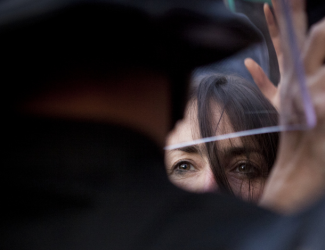
« Je sais maintenant que nous sommes toutes et tous simplement des enfants de l’univers. »
Le parcours de Menke Meijer a été semé d’embûches. « On m’a mis une quantité inimaginable de bâtons dans les roues, de nombreuses personnes ont tenté de m’arrêter. Mais ils ont seulement réussi à me faire déployer davantage d’énergie pour aller encore plus loin », déclare-t-elle. Son existence a été faite de force, de dévouement, de vision, de patience, de libération et, pour cela, elle a dû surmonter de multiples obstacles.
« Je dirais que je me bats sur deux fronts : le premier étant la lutte pour l’égalité de genre et le second, la lutte contre toute une histoire de colonisation et de racisme. »

Femme de la nation métis (lien en anglais) et « d’origine très pauvre », Menke a été confrontée à de nombreux obstacles, le défi le plus grand qu’elle ait eu à relever étant « le simple fait d’être une femme et, dans certains cas, d’être une femme aborigène ». Elle a souffert du sexisme et du racisme. La stigmatisation et les dangers qui prennent leur source dans le racisme ont pavé le chemin qui lui a permis de se positionner et de définir son identité de femme aborigène. « Les membres de ma famille étaient réticent-e-s à parler de nos origines » mais finalement, grâce aux efforts déployés par Menke, ils/elles ont « commencé à s’ouvrir sur ce sujet ». Pendant ses études universitaires de premier cycle et des cycles supérieurs, Menke a choisi de suivre tous les cours existants sur le thème des peuples des Premières Nations du Canada, dans le but d’en apprendre davantage sur ses origines.
« J’ai travaillé dur pour me décoloniser par moi-même et pour aider ma famille à se réapproprier son identité. »
Pour accomplir ce travail, Menke a notamment dû prendre des décisions, parmi lesquelles la plus grande et la plus importante a été « la décision de poursuivre (s)es études ». Elle était consciente du fait que ce choix « étaient un pari risqué, parce que les prêts étudiants créent un lourd endettement ». Mais elle savait aussi que, en comparaison avec les emplois au salaire minimum qu’elle avait occupés, le chemin qui s’ouvrait devant elle serait beaucoup plus gratifiant.
« J’ai fait le choix de vivre mes passions, quel qu’en soit le prix. Cela m’a changée dans le sens positif du terme, et cela a changé ma vie. »
Menke a obtenu une licence en histoire à l’Université Concordia de Montréal, et a remporté la bourse Gordon Ritchie, une récompense fondée sur le mérite. Mais, en étudiant l’esclavage, les guerres et les génocides, elle s’est sentie frustrée. En plus de se plonger dans les livres, elle voulait « agir ». Elle a donc décidé de préparer un master en études de la paix et des conflits à l’Université de Waterloo, son mémoire de master portant principalement sur les thèmes suivants : le genre dans les conflits et la consolidation de la paix, le genre dans l’aide humanitaire et, plus particulièrement, les femmes en Chine.
« Je suis la première femme des deux branches de ma famille à être titulaire d’une licence universitaire et d’un master. J’ai brisé les barrières du genre et de la race. Je ne me suis jamais sentie aussi vivante et aussi accomplie. Je me sens libérée. »
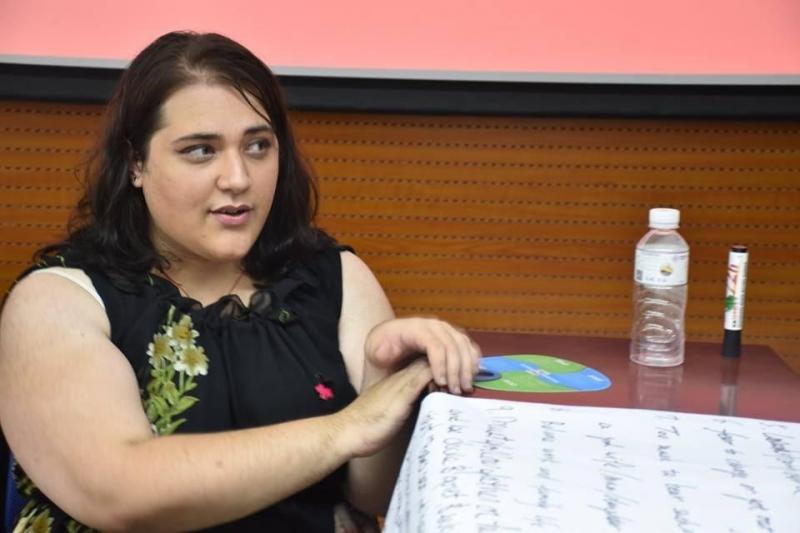
En Chine, Menke a effectué un stage de cinq mois au sein de l’ONU Femmes, « une expérience extraordinaire dans un environnement extraordinaire », déclare-t-elle. Pendant cette période, elle a été invitée par la Tsinghua University de Beijing à s’exprimer lors d’un événement Lean In destiné aux étudiant-e-s de MBA. Par le biais de sa propre histoire, elle a évoqué les moyens de forcer les « barrages » qui empêchent les femmes de poursuivre leurs études. Elle a notamment partagé sa propre histoire en ces mots : « j’ai été élevée dans la pauvreté par une mère célibataire. J’ai dû surmonter de nombreux obstacles pour parfaire ma formation. »
Dans son travail sur les moyens de surmonter des difficultés multiples et de tendre vers le changement, Menke a été motivée par la colère, celle qu’elle a ressentie face aux difficultés qu’elle a elle-même dû surmonter. « Le peur peut détruire, mais elle peut aussi être source de création. Les défis auxquels j’ai été confrontée m’ont mise en colère, mais ils m’ont aussi poussée à tendre vers le meilleur. »
C’est précisément parce qu’elle tend vers le meilleur que Menke a de nombreux rêves « pour toutes les femmes, qu’elles soient blanches, noires, asiatiques ou de n’importe quelle couleur, peu importent leurs convictions religieuses et leur chemin de vie. » Menke veut que « le monde reconnaisse les femmes », car « rien n’est plus touchant que de s’entendre dire qu’on est juste un être humain ».
Quelques éléments complémentaires au sujet de Menke
Elle a eu la possibilité de faire partie de l’équipe qui a contribué à la création du Global Peace Centre Canada (GPCC) de Waterloo, un projet mené à l’initiative du directeur du programme de master en études de la paix et des conflits, Ziauddin Yousafzai (le père de Malala Yousafzai). La vision et la finalité du GPCC sont la paix et l’éducation pour tous les garçons et toutes les filles.
Menke est née en Colombie-Britannique, a grandi à Québec et vit maintenant dans l’Ontario, au Canada.
Lisez la nouvelle écrite par Menke
Menke a écrit une nouvelle intitulée « Feeding Wolves » (Nourrir les loups). Elle est basée sur sa vie de femme de la nation métis et sur le vécu des peuples aborigènes du Canada. À ce sujet, Menke a déclaré : « seuls trois des personnages sont des femmes… il s’agit d’un parti pris volontaire car je voulais aller plus loin que de simplement traiter du patriarcat, un thème encore très présent dans la société coloniale. Je voulais montrer que les femmes sont absentes du récit. »