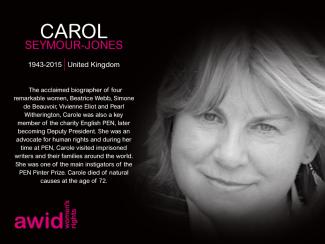
Carole Seymour-Jones
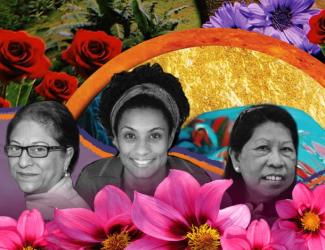
AWID’s Tribute is an art exhibition honouring feminists, women’s rights and social justice activists from around the world who are no longer with us.
This year’s tribute tells stories and shares narratives about those who co-created feminist realities, have offered visions of alternatives to systems and actors that oppress us, and have proposed new ways of organising, mobilising, fighting, working, living, and learning.
49 new portraits of feminists and Women Human Rights Defenders (WHRDs) are added to the gallery. While many of those we honour have passed away due to old age or illness, too many have been killed as a result of their work and who they are.
This increasing violence (by states, corporations, organized crime, unknown gunmen...) is not only aimed at individual activists but at our joint work and feminist realities.
The portraits of the 2020 edition are designed by award winning illustrator and animator, Louisa Bertman.
AWID would like to thank the families and organizations who shared their personal stories and contributed to this memorial. We join them in continuing the remarkable work of these activists and WHRDs and forging efforts to ensure justice is achieved in cases that remain in impunity.
“They tried to bury us. They didn’t know we were seeds.” - Mexican Proverb
It took shape with a physical exhibit of portraits and biographies of feminists and activists who passed away at AWID’s 12th International Forum, in Turkey. It now lives as an online gallery, updated every year.
To date, 467 feminists and WHRDs are featured.
Un réseau complexe et mouvant d’acteur·rice·s antidroits exerce aujourd’hui une influence croissante dans les espaces internationaux et nationaux, ainsi qu’au niveau des politiques locales. Les antidroits pénètrent les espaces multilatéraux de collaboration entre pays, dans le but de les transformer et les saboter de l’intérieur. C’est en s’appropriant le langage des droits et de la justice pour travestir leurs véritables intentions qu’ils et elles parviennent à acquérir une certaine légitimité.
Ce rapport est le deuxième d’une série sur les droits humains, produite par l’Observatoire sur l’universalité des droits (OUR). Outre une analyse des principales parties antidroits, de leurs discours, stratégies et impacts, ce rapport inclut des nouvelles féministes pleines d’inspiration et des exercices de renforcement des connaissances qui nous permettront d’assurer notre résistance collective.
Les conséquences sur nos droits sont déjà importantes, mais il est encore possible de réagir. Nous pouvons toutes et tous participer à la résistance face aux programmes antidroits et récupérer nos droits.
Rejoignez l’appel à l’action collective dès aujourd’hui!
A closer look at actual budgets reveals major income diversity and inequality.

AWID es parte de un impresionante ecosistema de movimientos feministas que trabajan para alcanzar la justicia de género y la justicia social en todo el mundo. Al acercarse nuestro 40° aniversario estamos celebrando todo lo que hemos construido a lo largo de estos últimos cuarenta años. Como organización global de apoyo a los movimientos feministas, sabemos que nuestro camino hacia adelante es trabajar con feminismos apasionados, reconociendo tanto la multiplicidad de los feminismos como el valor de un impulso por la justicia apasionado y sin reservas. El estado del planeta y de los movimientos feministas requiere conversaciones y acciones valientes. Esperamos con ansia trabajar junto con nuestrxs afiliadxs, asociadxs y donantes para crear los mundos en los que creemos,celebrar los logros y expresar la verdad ante el poder, al servicio de los movimientos feministas a nivel global.
El Calendario Feminista 2023 es un regalo para los movimientos. Presenta las obras de arte de algunxs de nuestrxs maravillosxs afiliadxs de AWID.
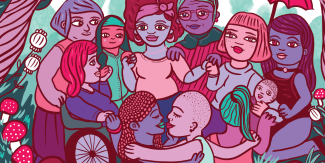
¡Consíguelo en tu idioma preferido! |
Escoge la calidad de imagen |
| English | Descarga para impresión | Versión digital |
| Français | Descarga para impresión | Versión digital |
| Español | Descarga para impresión | Versión digital |
| Português | Descarga para impresión | Versión digital |
| عربي | Descarga para impresión | Versión digital |
| Русский | Descarga para impresión | Versión digital |
AWID no ofrece descuentos para grupos, pero sí ofrece descuentos en la inscripción a sus afiliadxs. (Haz clic aquí para obtener más información sobre cómo sumarte a la membresía)
Activiste sociale et de l’environnement équatorienne, Gloria Chicaiza était une fervente défenseuse du droit à la terre et à l’eau. Elle s’est opposée au statu quo en luttant contre un modèle de développement fondé sur l’extraction et a oeuvré sans relâche pour la justice écologique et les droits des communautés affectées par l’exploitation minière.
Dans divers endroits de l’Équateur, Gloria a participé à des actions de résistance en faveur de la protection de l’écosystème. Avec passion et dévouement, Goria a apporté son soutien au mouvement autochtone et environnemental, à ces communautés et organisations qui s’opposent aux projets miniers et protègent leurs territoires et leurs projets de vie collectifs. Elle est intervenue au sein de forums locaux et internationaux contre la criminalisation des dissident·e·s et des résistant·e·s, contre les pressions et la violence exercées à l’encontre des activistes communautaires, en particulier des femmes défenseuses des droits humains, et pour soutenir les efforts déployés par les communautés en faveur de la souveraineté alimentaire et de la durabilité.
Elle était la coordonnatrice de la justice minière à Acción Ecológica, membre du Réseau latino-américain des femmes défenseuses des droits sociaux et environnementaux, et membre du conseil d'administration de l'Observatoire latino-américain des conflits miniers.
En octobre 2010, Gloria a été accusée par la société minière Curimining/Salazar Resources S.A. (dont le siège est à Vancouver, au Canada) d’avoir commandité un acte de terrorisme, de sabotage et d’association illégale dans le but de commettre un crime. Acción Ecológica a estimé qu’il s’agissait là de “représailles pour son travail de dénonciation concernant l’impact des activités minières dans le pays”.
En 2015, Gloria a facilité la coordination d’une délégation, composée de 25 femmes autochtones d’Amérique latine, affectée au Dialogue sur le changement climatique de la COP 20 des Nations Unies.
Gloria est décédée le 28 décembre 2019 des suites de complications liées à une transplantation pulmonaire. On se souvient d’elle pour ses actes de résistance et son travail acharné.
"Le moyen le plus rapide de parvenir à la durabilité reste encore la résistance.” - Gloria Chicaiza (2010 interview)
“Pour GLORIA. GLORIA Eau. GLORIA Terre. GLORIA Mère. GLORIA Révolution. GLORIA Soeur. GLORIA Ciel. GLORIAmie. GLORIAstrale. Merci de nous avoir entrelacé·e·s.” -Liliana Gutierrez
“Merci Glorita, d’avoir nourri l'espoir, d’avoir préservé la solidité de la structure, d’avoir tissé des liens avec la communauté, pour les mains unies, pour la solidarité, merci Glorita de t’être tenue à nos côtés dans les moments les plus difficiles. Merci de nous avoir appris que tout au long de la vie, personne ne se fatigue.” (Chakana News)
“Gloria Chicaiza appréciait ne pas sortir du lot et s’y épanouissait. Et aussi humble qu'elle fût, elle avait une capacité inouïe à mener et garder un rythme régulier et étourdissant, un pouls de vie qui guidait, mobilisait et inspirait les communautés et les réseaux dans la protection de la Terre Mère. Elle a dénoncé toutes les formes de violence contre les “cuerpos-territorios” (les corps comme territoires). Elle soutenait le “buen vivir" (“bien vivre”). - Gabriela Jiménez, coordonnatrice des partenariats en Amérique latine, KAIROS
“Merci Gloria Chicaiza, nous sommes sûr·e·s que depuis l’infini, tu continueras à soutenir notre combat. Toi qui as continué de te battre en dépit de ta santé défaillante. Tu continueras de vivre dans les forêts et les eaux que tu as défendues avec tant de courage. Tu vivras dans nos coeurs.” - La communauté d’Intag en Équateur
In the African Commission and the Inter-American System, anti-rights actors push essentialist notions of culture and gender to hamper progress on rights and undermine accountability. As we see, anti-rights actors are exerting influence in regional human rights systems, as well as international spaces.
Les organisations féministes et de défense des droits des femmes ne dépendent pas uniquement des financements institutionnels, elles s’autofinancent. Nos mouvements sont animés par la passion, la solidarité, l’engagement politique et le soin collectif.
Ces ressources autonomes et autogénérées sont souvent invisibles dans les budgets, mais elles sont le pilier de notre action collective.
By joining AWID, you are becoming part of worldwide feminist organizing, a collective power that is rooted in working across movements and is based on solidarity.
Join AWID as an individual for free
Join AWID as an individual by paying a nominal amount
Ayant conscience des nombreuses difficultés que les déplacements impliquent, nous vous fournirons davantage d’informations et de détails sur les modalités de voyage jusqu’à Bangkok lorsque les Inscriptions ouvriront, au début de l’année prochaine.

Aïssata Kane, also fondly known as “Yaye Kadia” (Mother Kadia), was a feminist with a lifelong committment in advocating for African and especially Mauritanian women’s rights.
In her career as a politician, she was appointed Minister of Family Protection and Social Affairs in 1975, the first time a woman held such a position and in which Aïssata fervently worked to improve the status of women in her country.
This work included advancing girls’ and women’s education, fighting against the practice of force-feeding of young women, lobbying for an inclusion of a marital rights provision, and advocating for a female representation quota to be created in the Parliament.
“[Aïssata] realized all her passions with humility, courage and determination. She didn’t want to disturb anyone by her fight on all these fronts at the same time.” Ball Halimata Dem, Aïssata’s niece
She founded the National Union of Women of Mauritania (UNFM), co-creating and publishing Marienou for them, a magazine dedicated to the emancipation of Mauritanian women. Aïssata also directed several sub-regional and local organizations, including as the President of the International Association of Francophone Women (AIFF) and as a resolute ecologist, she was President of the Association for the Protection of the Environment in Mauritania (APEM).
In 2018 she received the Pioneer Woman Award. It honors her work in advancing Mauritania’s women’s status and recognizes her strong leadership and sense of innovation.
Aïssata passed away on 10 August 2019.

¿Quieren sumarse al creciente número de personas que le están diciendo «basta» a la infiltración de lxs actores anti-derechos en la ONU?
Modèles de gouvernance alternative comme moyens de sortir de la crise climatique.
📅 Mercredi 12 novembre 2025
📍 Seminario Mar Nossa Sra Da Assunção, Pará, Brésil
Site web en anglais
Esta política rige para todas las páginas alojadas en https://www.awid.org/ y para cualquier otro sitio web bajo el control de AWID (el «Sitio web») y para las suscripciones a estos sitios. No se aplica a páginas alojadas por otras organizaciones distintas a AWID, hacia las cuales podemos dirigir un hipervínculo y cuyas políticas de privacidad pueden ser diferentes. Por favor, lee la siguiente política para que puedas comprender nuestra política de privacidad en cuanto a su naturaleza, propósito, uso y divulgación de tu información personal e identificable que es recogida a través de este sitio web.
En general, puedes navegar este sitio web sin enviarnos información personal. Sin embargo, en algunas circunstancias, te pediremos esa información personal.
Cuando te encuentras en el sitio web y se te pide información personal, estás compartiendo esa información sólo con AWID.
1.1.1 La información que nos das para recibir actualizaciones de AWID:
Cuando te registras para usar el sitio (por ejemplo, te suscribes para recibir correos electrónicos o para solicitar membresía) nos das la información necesaria acerca de ti, como tu nombre, país, idioma, para recibir actualizaciones por correo electrónico. Nos das esta información a través de formularios seguros y es almacenada en servidores seguros.
1.1.2 La información de pago que nos das para hacerte miembrx o para anotarte en algún evento:
Además, puede ser necesario que nos des información sobre el pago cuando te haces miembrx o cuando te anotas para eventos. AWID no almacena en sus servidores ninguna información relativa a tarjetas de crédito y usa portales seguros para procesar la información relativa a pagos.
1.1.3 La información opcional que decidiste darnos (con consentimiento)
Cuando te comunicas con AWID o nos das información opcional a través de formularios en el sitio web o utilizas el sitio para comunicarte con otrxs miembrxs, recogemos información sobre tu comunicación y cualquier otra información que elijas dar.
1.1.4 Información que nos das a través de los formularios de contacto o cuando te comunicas directamente con nosotrxs
Cuando te comunicas con nosotrxs, recogemos tu comunicación y toda otra información que decidas darnos.
Además, cuando interactúas con el Sitio web, nuestros servidores pueden llevar un registro de actividad que no te identifica personalmente («Información no personal»). Por lo general, recogemos las siguientes categorías de información no personal:
Para más información sobre las cookies, por favor consulta All about cookies.
Si no deseas recibir cookies puedes cambiar fácilmente tu navegador web para que rechace las cookies o notificarte cuando recibes una nueva cookie. Puedes mirar aquí cómo hacerlo.
AWID utiliza la información que recogemos acerca de ti para:
Si te has subscrito a los boletines electrónicos de AWID o a nuestras actualizaciones por correo electrónico o si te has hecho miembrx, te enviaremos comunicaciones regularmente en la forma especificada en el área correspondiente del sitio web. Puedes cancelar la suscripción de cualquiera de los boletines electrónicos o actualizaciones de correo electrónico en cualquier momento siguiendo los pasos indicados para ello en nuestros correos.
Es importante para AWID que tu información de identificación individual sea precisa. Siempre estamos buscando cómo hacer más fácil que puedas revisar y corregir la información que AWID tiene acerca de ti en nuestro sitio web. Si cambias tu dirección de correo electrónico, o si cualquier otra información que tengamos es incorrecta o desactualizada, por favor escríbenos a esta dirección.
Con excepción de lo explicado más abajo, AWID no revelará ninguna información personal acerca de ti que sea identificable, y no venderá ni alquilará a tercerxs listados conteniendo tu información. AWID podrá revelar información cuando tenga tu permiso para hacerlo o bajo circunstancias especiales, por ejemplo cuando crea de buena fe que la ley se lo exige.
De manera permanente implementamos y actualizamos las medidas administrativas, técnicas y de seguridad física para proteger tu información de accesos no autorizados, pérdida, destrucción o alteración. Algunas de las salvaguardas que usamos para proteger tu información son cortafuegos, encriptación de datos y controles de acceso a la información. Si sabes o tiene razones para creer que tus credenciales de membresía a AWID se han perdido, han sido robadas, malversadas o comprometidas de alguna forma o en caso de que sepas o sospeches de uso no autorizado de tu cuenta de membresía a AWID, por favor ponte en contacto con nosotrxs a través de nuestra página.
Esta política puede cambiar periódicamente. La política modificada será publicada en este sitio web y al final del texto se actualizará la fecha de Última actualización. Se enviará un correo electrónico con la actualización de la política revisada y si no estás de acuerdo con ella tendrás la opción de cancelar tu suscripción o suscripciones con nosotrxs. También puedes escribirnos aquí. ¡Agradecemos tus opiniones!
Última actualización: mayo de 2019
Asking ourselves the same question, we believe there are no simple answers. For many participants the AWID Forum might be one of the few international trips they undertake in their life. The pandemic taught us the possibilities but also the limitations of virtual spaces for movement-building: there is nothing like in-person connection. Movements need cross-border connections to build our collective power in the face of the threats we face, notably the climate crisis. We believe that the upcoming AWID Forum can be a strategic space to hold these conversations and to explore alternatives to international travel. The hybrid element of the Forum is an important part of this exploration.