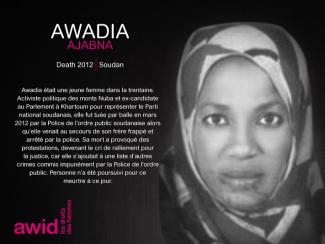
Awadia Ajabna

In September 2016, the 13th AWID international Forum brought together in Brazil over 1800 feminists and women’s rights advocates in a spirit of resistance and resilience.
This section highlights the gains, learnings and resources that came out of our rich conversations. We invite you to explore, share and comment!
One of the key takeaways from the 2016 Forum was the need to broaden and deepen our cross-movement work to address rising fascisms, fundamentalisms, corporate greed and climate change.
With this in mind, we have been working with multiple allies to grow these seeds of resistance:
And through our next strategic plan and Forum process, we are committed to keep developing ideas and deepen the learnings ignited at the 2016 Forum.
AWID Forums started in 1983, in Washington DC. Since then, the event has grown to become many things to many peoples: an iterative process of sharpening our analyses, vision and actions; a watershed moment that reinvigorates participants’ feminisms and energizes their organizing; and a political home for women human rights defenders to find sanctuary and solidarity.
Les Femmes Maintiennent les Soins | Les Soins Soutiennent la Vie | La Vie Soutient l'Économie | Qui s'Occupe des Femmes ? | Pas Une de Moins1 | Ensemble | Déjeuner du Dimanche
1Nenhuna a menos se traduit littéralement par « pas une femme de moins » ou « ni una menos » en espagnol - un célèbre slogan féministe en Amérique latine qui a émergé en Argentine en réponse à l'augmentation de la violence sexiste.
Elina est une jeune avocate des droits humains afro-dominicaine et féministe intersectionnelle, engagée à utiliser sa voix et ses compétences pour construire un monde plus juste, empathique et inclusif. Elle a commencé la faculté de droit à 16 ans, convaincue que cela lui donnerait les outils nécessaires pour comprendre et promouvoir la justice sociale. Après un JD (doctorat en droit) en République dominicaine, elle a poursuivi un LL.M. (maîtrise en droit) en droit international public et droits humains au Royaume-Uni en tant que boursière Chevening. Seule femme latino-caribéenne de sa classe, elle a obtenu son diplôme avec distinction.
Elina a travaillé à l'intersection des droits humains, du genre, de la migration et de la politique et ceci à plusieurs niveaux : des instances étatiques aux collectifs de base aux organisations internationales. Elle a aidé à plaider des cas de violence sexiste devant la Cour interaméricaine des droits de l'homme. En tant que membre du Groupe consultatif des jeunes du FNUAP, elle a contribué au renforcement des droits sexuels et reproductifs en République dominicaine. Elle a codirigé la première campagne d'Amnesty International sur les droits des travailleur.euse.s du sexe dans les Amériques, développant des partenariats solides avec des organisations dirigées par des travailleur.euse.s du sexe et utilisant la position d'Amnesty pour amplifier la voix des femmes défenseurs des droits humains et des travailleur.euse.s du sexe. Elina fait partie de Foro Feminista Magaly Pineda et de la Global Shapers Community. Elle parle espagnol, français et anglais.
Grâce à la richesse de son expérience, Elina apporte à l’AWID de solides compétences de gouvernance et de planification stratégique et un savoir-faire éprouvé en matière de mécanismes des Nations Unies et des droits humains régionaux. Elle affirme également très clairement sa détermination à continuer de faire de l’AWID une organisation inclusive pour toutes les femmes, et particulièrement les jeunes féministes et celles des Caraïbes. C’est avec la diversité de ces apports qu’Elina rejoint une sororité de féministes internationales qui ont du mordant. Elle pourra continuer à y développer son leadership féministe, pour ne plus jamais se sentir seule dans cette voie.
I have belonged to you for as long as I can remember. As a young girl, I did not know there was a word -feminist- for us people, who aspire to overcome and dismantle the patriarchy, who seek refuge in the arms of inclusion and intersectionality, who treat people as equals regardless of their gender, race, sexuality, religion, and ethnicity, who are constantly learning to do better, to be better and to use their privilege to uplift others.
When I was 14, my middle school French teacher, a 6ft tall thirty-year-old man, assaulted a female student in my class in front of all of us. The student, who was a childhood friend of mine, and several girls in my class went to the headmaster to report him, parents got involved, and the entire class of 30 students vouched for the girl. But all our attempts to hold him accountable failed and the administration covered up the girl’s story and he never got fired or persecuted. The girls in my class and I were outraged so we did what every young raging feminist would do. WE EGGED HIS CAR! and though the eggs get washed off easier and the paint we used to write “Pig” and “Khamaj '' -scumbag- needed to get scrubbed off. I will never forget how that made us girls feel. Liberated, enraged, happy, close-knit, and in power. The same feeling replicates in every feminist setting I have been in ever since. The teen feminist in me grew up to join Women Deliver, AWID, Unootha, facilitate feminist workshops at university, and even get persecuted for my feminist affiliation at 19, but that’s another story for another letter.
Feminist movements and spaces offer me safety and empowerment. They are the mothers we wished we had and the link we needed to connect and organize ourselves despite our differences against a common enemy that has been undermining everyone, patriarchy. It is through you that I learned to be resilient and to gather my strengths and skills and direct them towards uplifting others and bringing to light the marginalized and giving a voice to the voiceless.
What I love most about you, feminist movements is that you mess up sometimes, you disregard and marginalize as well, you have bias as does every other movement but what makes you different is that you always strive to be better. Accountability is not something you’re afraid of and you are an ever-changing collective that reflects how altruism and philanthropy in the effort of gender equity change as time passes.
May you always grow, may you do better, may you always rage, may you always roar, may you always love, may you always speak different tongues, and may you always be in power.
Love, light, and rage,
Lina

Yes! Please read the Call for Activities and apply here. Deadline is 15 January 2024
Veena Singh is a Fiji Islander, feminist, and woman of colour. Born and raised in a small rural town in Fiji, she draws strength from her rich mixed heritage (her mother is an Indigenous Fijian woman and her father is Fijian of Indian descent). Veena’s identity and lived experiences deeply inform her commitment to justice, equity, and inclusion. With over two decades of experience in human rights, gender equality, community development, and social inclusion, Veena is a passionate advocate for shifting power to create transformative change and for building an “economy of kindness”. Her work spans diverse areas including community development; women, peace and security; social policy; human rights; and policy advocacy.
Veena is deeply committed to advancing inclusion, peace and justice, sexual and reproductive health and rights (SRHR), climate justice, transitional justice, and human rights. She brings a wealth of experience working across grassroots networks, international organizations, and government institutions, always centering community and locally led approaches and feminist principles.
Outside of her ‘office life’, Veena is an environmental advocate, mental health champion, and writer. She is a mum to 11 cats, a saree wearer, and a lover of snail-mails and postcards. A thoughtful observer of feminist movements in Fiji and the Pacific, Veena is on a personal journey to “decolonise the mind and the self through radical self-reflection.” Above all, she is driven by a desire and dream to produce relatable, resonant writing that connects with the Pacific diaspora and amplifies voices from the margins.
Je suis ravie de te faire part d’un de mes rendez-vous les plus remarquables en tant que féministe en situation de handicap. C’était le 30 mai 2014. L’Organisation nationale des puissantes dames porteuses d’un handicap visuel (NOVEL) participait aux festivités de la Fashion Week 2014 des Philippines, au profit de notre campagne de plaidoyer pour les cannes blanches. Deux dames aveugles défilaient sur le podium pour promouvoir la canne blanche comme symbole de l’égalité des genres, de l’autonomisation, de l’inclusion totale et de la participation égale des femmes et des filles porteuses de handicap visuel au sein de la société.
J’étais extrêmement nerveuse au moment de leur passage devant la foule, en tant que porte-parole de notre projet auprès des productions Runway (j’avais douloureusement attendu cette approbation pendant une année entière), sachant qu’elles n’étaient pas des mannequins, elles avaient été nommées Madame Philippines Vision et la première dauphine 2013 de Madame Philippines sur Roues, Signe et Vision par Tahanang Walang Hagdanan, Inc. (« Maison sans marches »). Elles n’avaient pas pu participer à leur séance d’orientation et s’étaient entraînées la veille au soir sans pouvoir le faire avec des mannequins professionnelles. Avant que ne commence le spectacle, je les avais appelées pour booster leur confiance et prier ensemble que Dieu les guide. Lorsqu’elles ont quitté le podium, j’ai pris une grande respiration alors que les larmes coulaient sur mes joues. Je me sentais euphorique parce que nous y étions parvenues malgré toutes les difficultés! Notre message au monde disant que les femmes et les filles en situation de handicap visuel pouvaient marcher en toute dignité, liberté et indépendance sur la même base d’égalité que les autres, grâce à notre appareil d’aide – les cannes blanches – qui était passé! On a parlé de nous sur les réseaux sociaux ainsi que sur les chaînes de télévision.
Ma vie de féministe en situation de handicap a débutcé comme un moyen de réparer mon manque de confiance et de trouver une autre trajectoire de réussite pour ma vie après avoir survécu à une vicieuse attaque à l’acide en 2007, alors que j’attendais le véhicule qui devait me ramener chez moi depuis le bureau. Mes yeux ont été fortement touchés, au point où je suis devenue une femme malvoyante.
Ce progrès n’est pas sans coût, tout comme il n’est pas parfait. Les activistes féministes, les groupes et les activistes se retrouvent face aux difficultés typiques rencontrées dans les contextes conservateurs et affectés par des conflits. Mais l’impact du mouvement des jeunes féministes au Soudan mérite d’être encensé. Dépasser les obstacles internes des différences de culture, de religion et des conflits historiques est un défi en soi, que les jeunes féministes au Soudan semblent relever activement. La création d’écoles féministes au Darfour et dans le Kordofan révèle la trajectoire unique du travail des jeunes féministes au Soudan, dont nous pouvons tirer des enseignements.
Je n’avais jamais pensé que ma vie pourrait être aussi joyeuse et pleine de sens avant de rencontrer les femmes leaders du mouvement pour le genre et le handicap, qui n’ont cessé depuis d’exercer une influence positive sur moi. Leurs mots d’encouragement m’ont plu et sont devenus la musique la plus douce à mes oreilles. Mon cœur brisé bondit comme un oiseau qui prend son envol à chaque fois que je pense à elles et au féminisme qui m’a encouragée à contribuer pour que les choses changent pour nos sœurs en situation de handicap qui sont invisibles et pour celles qui continuent à être discriminées. Jusqu’à ce jour, je suis consumée par le désir d’être avec le mouvement. Je ne peux cacher mon excitation chaque fois que je soumets des propositions de projets à différentes parties prenantes pour l’autonomisation, le développement et la promotion de nos sœurs en situation de handicap. Ou à chaque fois que j’interviens dans des conversations locales, nationales et internationales pour faire entendre nos voix, même lorsque cela est à mes dépens.
De manière inattendue, j’ai été choisie pour représenter notre pays à l’assemblée générale de l’Union mondiale des aveugles (UMA) en 2012 en Thaïlande, bien que je venais d’arriver dans le mouvement en faveur du handicap. Cette même année, j’ai été la seule femme élue au comité de l’Union philippine des aveugles (UPA). J’ai eu envie de me rapprocher de nos sœurs ayant un handicap visuel et de les informer sur leurs droits et afin qu’elles connaissent les questions transversales. En 2013, nous avons officiellement lancé NOVEL pour soutenir l’autonomisation de nos sœurs en situation de handicap, constituer des coalitions de mouvements de plurihandicap et de mouvements de femmes et promouvoir le développement inclusif du genre du handicap.
Ma participation en tant que copersonne pour les ressources des femmes en situation de handicap dans notre soumission au rapport alternatif à la CEDAW en 2016 avec les groupes de femmes marginalisées, coordonné par Women’s Legal and Human Rights Bureau (WLB), m’a ouvert de nombreuses portes et également permis de travailler avec différentes organisations de femmes et de participer aux Journées internationales de l’inclusion de Berlin en 2017, aux côtés de trois leaders philippines en situation de handicap; journées au cours desquelles nous avons fait part de nos bonnes pratiques, et principalement de notre engagement auprès de mouvements des femmes d’autres pays.
Ma trajectoire en tant que féministe en situation de handicap a été une véritable montagne russe émotionnelle pour moi. J’en ai retiré beaucoup de joie et un sentiment de valeur lors du travail pour la promotion de nos sœurs en situation de handicap pour une participation totalement inclusive, égale et efficace dans la société, mais je me suis également sentie frustrée et en colère lorsque j’ai tout donné et que j’ai essuyé des remarques négatives. Malgré tout, c’est ce que je ressens parce que je suis amoureuse du mouvement.
Je vois mon avenir dans le travail en solidarité avec le mouvement afin de veiller à ce que nos sœurs, en situation de handicap ou non, puissent profiter de, et participer également et entièrement dans la société.
Plein d’amour,
Gina Rose P. Balanlay
Féministe en situation de handicap
Philippines
Please refer to the Call for Activities for this information, including the section “What you need to know”.
What if we perceived land and Nature not as private property to exploit, but as a whole to live in, learn from, and harmoniously coexist with? What if we repaired our relationships with the land and embraced more sustainable alternatives that nurture both the planet and its communities?
Nous Sommes la Solution (We Are the Solution, NSS) is one of many women-led movements striving to do this. This is their story.
Con más de 30 años de experiencia en finanzas, Christine ha dedicado su carrera a fomentar misiones sin fines de lucro en todo el mundo. Sus contribuciones incluyen desempeñarse como tesorera en la junta de una ONG . Se sumó a AWID en 2007 como Fiscalizadora y, en 2023, asumió el rol de Directora de Finanzas. En su tiempo libre, disfruta de viajar, la jardinería y el senderismo.
The body is a powerful entity. As women, our bodies are controlled, oppressed and policed from the womb. The way we look, move, dress, walk, speak, gesture, laugh. I often wondered at what drives patriarchal fears around the power of female bodies. Where I come from sex work and sex workers were whispered of with simultaneous contempt, disgust, fascination, pity and condemnation.
Where I come from sex work and sex workers were whispered of with simultaneous contempt, disgust, fascination, pity and condemnation.
I first encountered sex work and sex workers at age 22. Simple conversations, sitting in circles, chatting over coffee and tea, we explored each other’s lives, experiences, thoughts and feelings.
For sex workers, sex work was the most worthwhile choice out of all other options to pay bills, to support family, to have more flexible working hours, to have sex. Just as I chose my job as the most worthwhile, to pay bills, to support family, to have more flexible working hours.
These individuals, women and men, taught me that I made my own decisions about my body… where I focus its life and energy, whether I use it for pleasure or pain, whether I trade it in or give it freely, and how I want to feel about my body. The awareness was as exciting as it was empowering.
Crear | Résister | Transform: a festival for feminist movements – 2021… you accompanied me through a series of life-changing moments (!!!)
We call these ‘events,’ though in truth, to me, your feminist learning spaces are, where I take a little of what’s inside me, a little of what your speakers say and some from the discussions to go deeper into our understanding.
Sharing… Partaking… Immersing…
in strength, in vulnerability, in pleasure.
Simply being the transformative feminist that I am, without pretentions, without misgivings…
Welcoming the transformative feminist that I have always been, without even knowing the term or acknowledging it in such a manner or in such terms…
Finding home for the fiercely transformative feminist living within me…
Despite the anger, rage and frustration of not being treated as equals and being treated with ‘less __ than,’
I did not always consider myself a feminist nor did I recognise myself within the feminist movement or discourse… Truly, I appreciate doors being held open, chairs being pulled out to be seated, acknowledgement as a woman, of my femininity.
At times I dismissed the patriarchy with annoyance, at times, I responded with frustration and anger but I did not address it… I did not notice its sinister, insidious toxicity… I was privileged enough to be able to work through it, to survive it, to overcome it, to excel in spite of it… I did not question enough, challenge enough, push my boundaries enough… I did not do enough…
connecting with sex workers, exploring sexuality, and the women for peace and security...
Until I became fully aware and understood the implications of both privilege and oppression that was intersectional.
Until I realised what it meant to fight for gender justice and not simply ‘equality for all.’
Practitioner and facilitator no longer, I am a transformative feminist practitioner and facilitator.
Being a feminist means that I will act
Plunging into uncertain, fragile, complex (and possibly quite violent) future…
I am deeply grateful for you and I promise to remain fierce in addressing and redressing problematic issues around gender, race, ethnicity, social class, sexual orientation and ability, and remain present and faithful to the struggle for inclusion, equity and justice.
Khin Khin

Contarás con todos los materiales estándar para talleres y presentaciones: rotafolios, marcadores, notas autoadhesivas, así como proyectores y equipos audiovisuales. Cualquier material adicional será responsabilidad de lxs organizadorxs de la actividad. El equipo de logística de AWID estará disponible para responder preguntas y aconsejar.
Ekaete Judith Umoh is an international disability rights advocate and inclusive development expert with astute analysis of issues regarding gender, disability and inclusive development. Her dream is to see increased visibility of women and girls with disabilities in the global feminist movement, as well as in all development efforts around the world.
Ekaete enjoys activism and politics, and went on to become the first elected female President of the Joint National Association of Persons with Disabilities (JONAPWD) in Nigeria, where she led Organizations of Persons with disabilities in the struggle to sign the Nigerian Disability Bill into Law in 2019, after over 17 years of consistent advocacy. Thereafter, she joined CBM Global as a pioneer Country Director and led her team for about 3 years, contributing towards ending the circle of poverty and disability in Nigeria. Aside from disability activism, Ekaete has served as consultant to several development agencies, providing technical assistance on disability inclusion in program and project design.
¿Cómo reaccionas cuando parece que el mundo desciende sobre ti? Tidinha se encontró en una situación en la que logró ser escuchada al cuestionar la elección de la sede, y al mismo tiempo descubrió visiones y sueños compartidos y se dio cuenta de que no está sola.