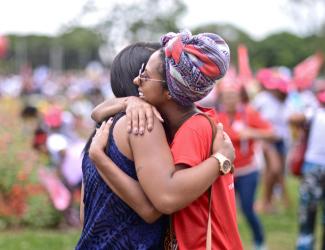
Sabriya Simon
Marcha da Mulheres Negras 2016

Priority Areas

Supporting feminist, women’s rights and gender justice movements to thrive, to be a driving force in challenging systems of oppression, and to co-create feminist realities.

Co-Creating Feminist Realities

While we dream of a feminist world, there are those who are already building and living it. These are our Feminist Realities!

What are Feminist Realities?

Feminist Realities are the living, breathing examples of the just world we are co-creating. They exist now, in the many ways we live, struggle and build our lives.

Feminist Realities go beyond resisting oppressive systems to show us what a world without domination, exploitation and supremacy look like.

These are the narratives we want to unearth, share and amplify throughout this Feminist Realities journey.

Transforming Visions into Lived Experiences

Through this initiative, we:

  • Create and amplify alternatives: We co-create art and creative expressions that center and celebrate the hope, optimism, healing and radical imagination that feminist realities inspire.

  • Build knowledge: We document, demonstrate & disseminate methodologies that will help identify the feminist realities in our diverse communities.

  • Advance feminist agendas: We expand and deepen our collective thinking and organizing to advance just solutions and systems that embody feminist values and visions.

  • Mobilize solidarity actions: We engage feminist, women’s rights and gender justice movements and allies in sharing, exchanging and jointly creating feminist realities, narratives and proposals at the 14th AWID International Forum.


The AWID International Forum

As much as we emphasize the process leading up to, and beyond, the four-day Forum, the event itself is an important part of where the magic happens, thanks to the unique energy and opportunity that comes with bringing people together.

We expect the next Forum to:

  • Build the power of Feminist Realities, by naming, celebrating, amplifying and contributing to build momentum around experiences and propositions that shine light on what is possible and feed our collective imaginations

  • Replenish wells of hope and energy as much needed fuel for rights and justice activism and resilience

  • Strengthen connectivity, reciprocity and solidarity across the diversity of feminist movements and with other rights and justice-oriented movements

Learn more about the Forum process

We are sorry to announce that the 14th AWID International Forum is cancelled

Given the current world situation, our Board of Directors has taken the difficult decision to cancel Forum scheduled in 2021 in Taipei. 
Read the full announcement

Find out more!

Related Content

Teresia Teaiwa

Described by the Guardian as one of Kiribati’s national icons, Teresia was a fearless advocate who worked closely with feminist groups in Fiji.

She used her research to address the issues of feminism and gender in the Pacific, as well as being co-editor of the International feminist Journal of Politics. Her influence spanned the academic frontier as well as social justice movements in the Oceania region.


Teresia Teaiwa, Fiji

Mariam Mekiwi | Snippet EN

Mariam Mekiwi Portrait

Mariam Mekiwi is a filmmaker and photographer from Alexandria and living and working in Berlin.

Dora Nkem Akunyili

Dora was born in Benue State, Nigeria. She was a globally acclaimed pharmacist, technocrat, erudite scholar and community leader.

Dora’s revolutionary work created a paradigm shift in the Nigerian public service when she served as Director General of National Agency for Food and Drugs Administration and Control (NAFDAC) from 2001-2008. She spearheaded reforms in policy and regulatory enforcement that radically reduced the measure of fake drugs that plagued the Nigerian pharmaceutical sector during her tenure.

Having exemplified the reality of a courageous, competent woman who challenged the ills of a dominantly patriarchal society and drove change, she became an icon for women’s empowerment. She was appointed the Minister of Information and Communication between 2008 and 2010.

She died after a battle with cancer and is survived by her husband, six children and three grandchildren.


Dora Nkem Akunyili, Nigeria

การเข้าร่วมมีราคาเท่าไร

กรุณาคำนวณค่าใช้จ่ายโดยรวมถึงค่าเดินทางมายังกรุงเทพมหานคร ค่าที่พัก ค่าเบี้ยเลี้ยง ค่าวีซ่า ค่าสนับสนุนในการเข้าถึงต่างๆ และอื่นๆ ยังไม่รวมถึงค่าลงทะเบียนที่จะมีการประกาศเร็วๆนี้ โรงแรมในบริเวณสุขุมวิท กรุงเทพฯ มีราคาตั้งแต่ 1,700-6,800 บาทต่อคืน สำหรับการพักสองคน

โดยหากเป็นสมาชิก AWID จะได้รับส่วนลดค่าลงทะเบียน หากคุณยังไม่ได้เป็นสมาชิก เราขอเชิญชวนให้คุณสมัครสมาชิกและเข้าร่วมชุมชนเฟมินิสต์ระดับโลก

Hospital | Content Snippet EN

“Now might be a good time to rethink what a revolution can look like. Perhaps it doesn’t look like a march of angry, abled bodies in the streets. Perhaps it looks something more like the world standing still because all the bodies in it are exhausted—because care has to be prioritized before it’s too late.” 
- Johanna Hedva (https://getwellsoon.labr.io/)

Hospitals are institutions, living sites of capitalism, and what gets played out when somebody is supposed to be resting is a microcosm of the larger system itself. 

Institutions are set out to separate us from our care systems – we find ourselves isolated in structures that are rigidly hierarchical, and it often feels as if care is something done to us rather than given/taken as part of a conversation. Institutional care, because of its integration into capitalist demand, is silo-ed: one person is treating your leg and only your leg, another is treating your blood pressure, etc. 

Photographer Mariam Mekiwi had to have surgery last month and documented the process. Her portraits of sanitized environments – neon white lights, rows after rows of repetitive structures – in a washed-out color palette reflect a place that was drained of life and movement. This was one of the ways Mariam kept her own spirit alive. It was a form of protest from within the confines of an institution she had to engage with.

The photos form a portrait of something incredibly vulnerable, because watching someone live through their own body’s breakdown is always a sacred reminder of our own fragility. It is also a reminder of the fragility of these care systems, which can be denied to us for a variety of reasons – from not having money to not being in a body that’s considered valuable enough, one that’s maybe too feminine, too queer or too brown.  

Care experienced as disembodied and solitary, that is subject to revocation at any moment, doesn’t help us thrive. And it is very different from how human beings actually behave when they take care of each other. How different would our world look like if we committed to dismantling the current capitalist structures around our health? What would it look like if we radically reimagined it?

Navleen Kumar

"She was not a person. She was a power."
- a fellow activist remembering Navleen Kumar

Navleen Kumar was a fervent land rights and social justice activist in India.

With commitment and integrity, she worked for more than a decade to protect and restore the lands of Indigenous people (adivasi) in Thane district, an area taken away by property and land developers using such means as coercion and intimidation. She fought this injustice and crime through legal interventions at different courts, realizing that manipulation of land records was a recurrent feature in most cases of land acquisition. In one of the cases, that of the Wartha (a tribal family), Navleen found out that the family had been cheated with the complicity of government officials.

Through her work, she helped restore the land back to the Wartha family and continued to pursue other cases of adivasi land transfers.

“Her paper on the impact of land alienation on adivasi women and children traces the history and complexities of tribal alienation from the 1970s, when middle class families began to move to the extended suburbs of Mumbai as the real estate value in the city spiralled.

Housing complexes mushroomed in these suburbs, and the illiterate tribals paid the price for this. Prime land near the railway lines fetched a high price and builders swooped down on this belt like vultures, to grab land from tribals and other local residents by illegal means.”
-Jaya Menon, Justice and Peace Commission 

During the course of her activism, Navleen received numerous threats and survived several attempts on her life. Despite these, she continued working on what was not only important to her but contributed to changing the lives and realities of many she supported in the struggle for social justice. 

Navleen was stabbed to death on 19 June 2002 in her apartment building. Two local gangsters were arrested for her murder. 

มีหัวข้อที่เราควรหลีกเลี่ยงที่จะส่งเป็นกิจกรรมหรือไม่

AWID ฟอรัม ตลอดมาเป็นพื้นที่ที่ไม่กลัวการสนทนาที่จำเป็น หรือหัวข้อที่ท้าทาย เรายินดีรับข้อเสนอเหล่านี้เมื่อผู้จัดกิจกรรมสามารถรักษาพื้นที่สำหรับผู้เข้าร่วมด้วยความเคารพ ปลอดภัย และอย่างระมัดระวัง

Snippet Kohl - Panel | Liberated Land & Territories | AR

Speech bubble: Panel liberated land and territories

حلقة نقاش | الأرض والمناطق المُحرَّرة: محادثة عموم أفريقية 
مع لوام كيدان ومريامة سونكو ويانيا صوفيا غرسون ڤالنسيا ونوسمة سيزاني

YOUTUBESOUNDCLOUD

Diana Isabel Hernández Juárez

Diana Isabel Hernández Juárez was a Guatemalan teacher, human rights defender and environmental and community activist. She was the coordinator of the environmental program at Our Lady of Guadalupe Parish on the South coast of the country. 

Diana dedicated her life to co-creating environmental awareness, working especially closely with local communities to address environmental issues and protect natural resources. She initiated projects such as forest nurseries, municipal farms, family gardens and clean-up campaigns. She was active in reforestation programmes, trying to recover native species and address water shortages, in more than 32 rural communities.

On 7 September 2019, Diana was shot and killed by two unknown gunmen while she was participating in a procession in her hometown. Diana was only 35 years old at the time of her death.
 

เกี่ยวกับวีซ่า

เราตระหนักดีถึงอุปสรรคในทางปฏิบัติและความทุกข์ทางอารมณ์ในการเดินทางระหว่างประเทศ โดยเฉพาะอย่างยิ่งจากซีกโลกใต้ โดย AWID กำลังทำงานร่วมกับ TCEB (สำนักงานส่งเสริมการจัดประชุมและนิทรรศการของประเทศไทย) เพื่อสนับสนุนผู้เข้าร่วมฟอรัมในการขอวีซ่า ข้อมูลอื่นๆเกี่ยวกับการขอวีซ่าจะถูกนำเสนอในช่วงที่เปิดให้ลงทะเบียน รวมถึงสถานที่และวิธีการขอวีซ่า

#5 - Sexting like a feminist Tweets Snippet AR

تقديم تحليل كفء للأجساد البحثيّة، يستوجب بالضرورة تسخيرًا شاملا لكافّة الأدوات الحميميّة…

Image of a tweet. Text says: I prefer an intersectional approach, namely the tongue and finger method.

أفضّل المقاربة التقاطعيّة لما تشتمل عليه من مداعبة ممنهجة باللسان والأصابع

Mirna Teresa Suazo Martínez

Mirna Teresa Suazo Martínez was part of the Garifuna (Afro-descendent and Indigenous) Masca community, living on the North Caribbean coast of Honduras. She was a community leader and a fervent defender of the Indigenous territory, a land that was violated when the National Agrarian Institute of Honduras gave territorial licenses to people outside of the community. 

This deplorable deed resulted in repeated harassment, abuse and violence against the Masca, where economic interests of different groups met those of Honduran armed forces and authorities. According to the Black Fraternal Organization of Honduras (OFRANEH), the strategy of these groups is to evict and exterminate the Indigenous population.

“Masca, the Garifuna community located next to the Cuyamel Valley, is part of the area of influence of one of the supposed model cities, a situation that has triggered territorial pressures along the Garifuna coast.” - OFRANEH, 8 September 2019

Mirna Teresa, president of the Board of Trustees of the Masca Community in Omoa, was also firmly rejecting the construction of two hydroelectric plants on the river that carries the same name as her community, Masca.

“The Garífuna community attributes the worsening of the situation in their region to their opposition to tourist exploitation, the monoculture of African palm and drug trafficking, at the same time that it seeks to build an alternative life through the cultivation of coconut and other products for self-consumption.” - Voces Feministas, 10 September 2019 

Mirna Teresa was murdered on 8 September 2019 in her Restaurant “Champa los Gemelos”. 

She was one of six Garifuna women defenders murdered between September and October 2019 alone. According to OFRANEH, there was no investigation by the authorities into these crimes.

“In the case of the Garífuna communities, a large part of the homicides are related to land tenure and land management. However, squabbles between organized crime have resulted in murders, such as the recent ones in Santa Rosa de Aguán.” - OFRANEH, 8 September 2019

CFA 2023 - breadcrumbs Menu _ FAQ_en

Our partners

This project is built in collaboration with:

Logo for African Women's Development and Communication Network
Logo for Rutgers Center for Women's Global Leadership

Snippet - CSW68 - Follow Socials - EN

Follow us!

Through in-person events, lives on our socials, an exhibit booth and more; we are showing up to convene, amplify and support the voices and participation of our members, partners and allies.

Together we will Reclaim Feminist Power by uplifting feminist alternatives and visions around economies that center collective systems of care and nurture both the planet and people.

Follow us on social media for more details on how to participate! Be part of the conversations using the hashtags #AWIDatCSW68 and #ReclaimFeministPower.

Instagram | Facebook | LinkedIn | X (Twitter)

Snippet - WITM About the survey - EN

ABOUT THE SURVEY

  • GLOBAL & DIVERSE: Reflecting on resourcing realities of feminist organizing at a global scale and disaggregated by region
  • CONTEXTUALIZED: Centering voices, perspectives and lived experiences of feminist movements in all their richness, boldness and diversity in their respective contexts
  • CO-CREATED: Developed and piloted in close consultations with AWID members and movement partners
  • COMPLEMENTARY: Contributing to and amplifying existing evidence on the state of resourcing for feminist, women’s rights and gender justice organizing by activists, feminist funders and allies
  • MULTI-LINGUAL: Accessible in Arabic, English, French, Portuguese, Russian and Spanish.
  • PRIORITIZING PRIVACY & SECURITY: We are committed to maintaining the confidentiality and integrity of your data. Read our Privacy Policy to learn more about the measures we take to ensure the protection of your information
  • ACCESSIBLE: Accessible to people with a diverse range of hearing, movement, sight, and cognitive abilities, taking approximately 30 minutes to complete
  • REPLICABLE: Replicable by movements in their respective contexts; WITM survey tools and datasets will be publicly available to support more feminist research and collective advocacy.

Could there be multiple responses to the WITM survey on behalf of a specific group?

No, we are asking for just one completed survey per group.

How will you present and process the data collected via the survey?

The data will be processed for statistical purposes to shed light on the state of resourcing for feminist movements globally and will only be displayed in an aggregate form. AWID will not publish information about a particular organization or display information that would allow an organization to be identified by its location or characteristics, without their prior consent.

AWID in 2016: Co-Creating Feminist Futures

AWID is pleased to share our 2016 Annual Report.

2016 was an incredible year for AWID, we convened the 13th International AWID Forum in Bahia, Brazil, a space for strategizing and alliance building with feminists and other justice movements, which was attended by over 1800 participants from 120 countries and territories across the globe.

We know that women’s rights and feminist movements are key actors in creating sustainable transformative change. Within our movements, organizing, resisting and responding to the challenging context is sharpening, and in our increasingly connected world, the potential for collective action across diverse movements has dramatically grown.

This is the crucial work that AWID seeks to amplify and support every day.


What we achieved in 2016

We expanded solidarity and joint action across diverse movements

A highlight of 2016 was our ground-breaking 13th International Forum with the theme: “Feminist Futures: Building Collective Power for Rights and Justice”, where we harnessed the thinking and energy of nearly 500 partners, presenters, panelists, moderators, artivists, writers, facilitators, IT innovators, and performers, many of them leaders in their movements. We also supported the convening of the first and historical Black Feminisms Forum (BFF) organised by a working group of Black Feminists from across the world.

We strengthened knowledge of issues and strategies

We contributed to collective advocacy

AWID, in partnership with other feminist and women’s rights organisations, engaged in advocacy and dialogue to explore better solutions for women’s rights agendas including our work with the Count Me In! consortium .

We increased the visibility of movements

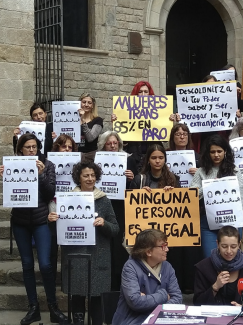
The experiences of women with disabilities, Black and Afro-descendant women, sex workers, Indigenous women, trans and intersex people, domestic workers and how their lives are impacted by multiple oppressions and violence were placed front and center of the Forum process.

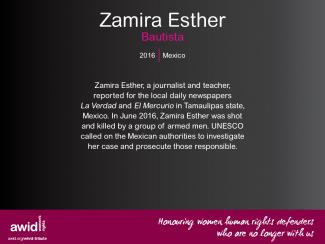
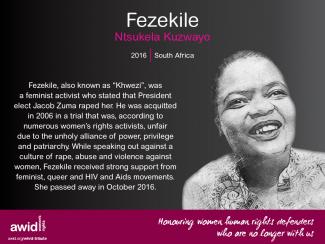
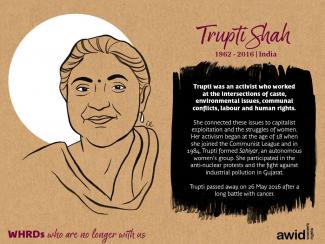
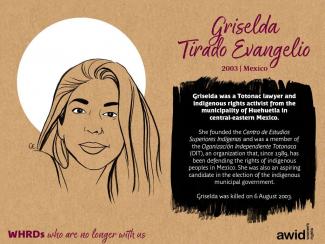
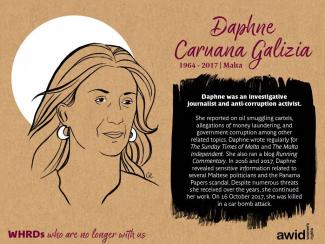
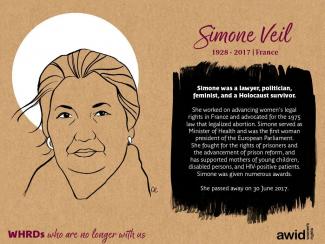
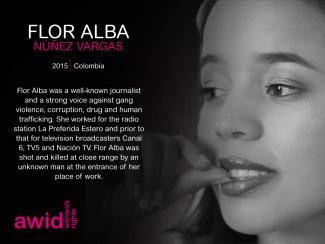
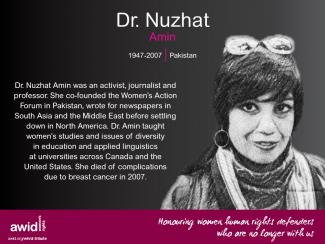
We also launched the 2016 WHRD Tribute to commemorate defenders who are no longer with us, during the 16 Days of activism, and thanks to the contributions from our members,

We drove attention to groups and issues that do not usually receive adequate mainstream media coverage through our partnership with The Guardian and Mama Cash.


Our members


Snippet - WITM Who should - AR

من يجب أن يجيب على الاستطلاع؟

الاستطلاع هذا مخصّص للمجموعات، المنظمات والحركات التي تعمل بالأساس أو فقط على حقوق النساء، أفراد مجتمع الميم - عين، والحقوق الجندرية، في جميع السياقات، على جميع المستويات، وفي جميع المناطق. إن كان واحد من هذه المبادئ اساسًا لمجموعتكم/ن، تنظيمكم/ن أو شبكتكم/ن، أو أي نوع تنظيم آخر، إن كان مسجلاً أم لا، جديداً أو طويل العمر، ندعوكم/ن للإجابة على الاستطلاع.

exclamation mark

*في الوقت الحالي، لا نطلب من الأفراد أو الصناديق النسوية أو النسائية تعبئة الاستطلاع.


تعرف على المزيد حول الاستطلاع: راجع/ي الأسئلة الشائعة

راجع/ي الأسئلة الشائعة