Advancing Universal Rights and Justice
Uprooting Fascisms and Fundamentalisms
Across the globe, feminist, women’s rights and gender justice defenders are challenging the agendas of fascist and fundamentalist actors. These oppressive forces target women, persons who are non-conforming in their gender identity, expression and/or sexual orientation, and other oppressed communities.
Discriminatory ideologies are undermining and co-opting our human rights systems and standards, with the aim of making rights the preserve of only certain groups. In the face of this, the Advancing Universal Rights and Justice (AURJ) initiative promotes the universality of rights - the foundational principle that human rights belong to everyone, no matter who they are, without exception.
We create space for feminist, women’s rights and gender justice movements and allies to recognize, strategize and take collective action to counter the influence and impact of anti-rights actors. We also seek to advance women’s rights and feminist frameworks, norms and proposals, and to protect and promote the universality of rights.
Our actions
Through this initiative, we:
- Build knowledge: We support feminist, women’s rights and gender justice movements by disseminating and popularizing knowledge and key messages about anti-rights actors, their strategies, and impact in the international human rights systems through AWID’s leadership role in the collaborative platform, the Observatory on the Universality of Rights (OURs)*.
- Advance feminist agendas: We ally ourselves with partners in international human rights spaces including, the Human Rights Council, the Commission on Population and Development, the Commission on the Status of Women and the UN General Assembly.
- Create and amplify alternatives: We engage with our members to ensure that international commitments, resolutions and norms reflect and are fed back into organizing in other spaces locally, nationally and regionally.
- Mobilize solidarity action: We take action alongside women human rights defenders (WHRDs) including trans and intersex defenders and young feminists, working to challenge fundamentalisms and fascisms and call attention to situations of risk.
Related Content
I am a young feminist. How can I engage in AWID’s work?
Young feminist activists are at the heart of AWID’s work.
In fact, 38% of our members are under the age of 30.
We believe that young feminists are both the present and the future of the struggle for women’s rights. We promote young leaders in the global women’s rights movement and our Young Feminist Activism program cuts across all aspects of our work.
At the same time, by defining young feminist activists as one of our Priority Areas, we contribute new analysis to current debates and ensure that young feminist activists are able to articulate their priorities and voice their concerns.
سؤالي لم تتم الإجابة عليه هنا
لمزيد من الأسئلة، يرجى استخدام نموذج الاتصال. سنستمر في تحديث هذه الوثيقة بناءً على الاستفسارات التي نتلقاها منك!
2013: The sixth High-level Dialogue reviews progress of MDGs
The Sixth High-level Dialogue on Financing for Development, 7-8 October 2013 focused on reviewing the progress of MDG’s, and identifying gaps to be addressed in discussions on the new development framework.
A report by the MDG’s Gap Task Force launched during the session pointed to the failure to meet MDG 8 (Global Partnership for Development) as a major factor in the challenges to meeting the MDGs. The report showed that more focus should be given to developing stronger global partnerships that would ensure binding commitments for the new development framework post 2015.
Snippet - CSW68 - AWID at CSW Post - EN

What will be different about this Forum?
We have always worked towards ensuring that our Forums are co-developed with partners, movements and our priority constituencies.
For our upcoming Forum, we aim to deepen and strengthen that spirit and practice of co-creation and collaboration. We also recognize the need to improve the balance between the inclusion of many voices and experiences with room for participants and staff to breathe, take pause and enjoy some downtime.
This Forum will be different in the following ways:
- We will have far less organized Forum activities because we want people to have time to engage, experience, process, talk to each other, etc. This is key to communicate: you can come to the Forum, be very engaged and active and not facilitate any organized activity (or “session”).
- We will have Open Spaces - at least one whole afternoon without any organized activities - but also physical spaces available throughout the Forum for people to self-organize meetings, etc.
- We have a Content and Methodology Committee made up of feminists from different regions with expertise on participatory methodologies to support us and all those leading activities at the Forum to use creative and engaging formats for the Forum activities.
Snippet - WITM Why now_col 2 - EN
Resourcing feminist movements is fundamental to securing a more just and peaceful present and liberated future.
While funders committed significantly more money to gender equality over the last decade, still only 1% of philanthropic and development funding has actually been moved to directly resource feminist-led social change.
In solidarity with movements that continue to be invisibilized, marginalized and without access to core, long-term, flexible and trust-based funding, the WITM survey highlights the actual state of resourcing, challenges false solutions, and points to how funding models must change for movements to thrive and meet the complex challenges of our times.
I am an individual activist, not working with any group, organization and/or movement at this moment, should I still fill the survey?
No, we appreciate your work but are not asking for responses from individuals at this time.
Do I have to respond to all questions at once or can I come back to complete it later?
If you wish to save your responses and come back to the survey later, you are able to do this whenever needed. KOBO will save your draft responses on the top left corner of the survey page and reload your record when you return to the survey. Just make sure to continue from the same computer and browser.
Snippet - WITM Who should - RU
КОМУ СТОИТ ПРОЙТИ ЭТОТ ОПРОС?
Опрос предназначен для групп, организаций и движений, работающих исключительно или главным образом по вопросам защиты прав женщин, ЛГБТКИ+, гендерной справедливости во всех контекстах, на всех уровнях и во всех регионах. Если одно из этих направлений является основным видом деятельности вашей группы, коллектива, сети или любого другого типа организации – независимо от того, зарегистрирована она или нет, недавно создана или существует уже давно, мы приглашаем вас принять участие в этом опросе.

* На данном этапе мы не ожидаем ответов от частных лиц или женских и феминистских фондов.
Узнайте больше об опросе:
загляните в часто задаваемые вопросы
Snippet - WITM To make - PT

Para dar ênfase à complexidade do financiamento de várias formas de organização feminista;
Snippet - WITM About the survey - PT
Sobre o inquérito
- GLOBAL E DIVERSO: Reflete sobre as realidades de financiamento da organização feminista em escala global e separadas por regiões
- CONTEXTUALIZADO: Dá enfâse às vozes, perspetivas e experiências vividas dos movimentos feministas com toda a sua riqueza, coragem e diversidade, nos seus respetivos contextos
- CRIADO EM COLABORAÇÃO: Desenvolvido e testado em colaboração conjunta com membres da AWID e parceires do movimento
- COMPLEMENTAR: Contribui para os testemunhos existentes e aprofunda os mesmos sobre o estado de financiamento para a organização feminista, de direitos das mulheres e de justiça de género por ativistas, financiadores feministas e aliados
- MULTILINGUE: Disponível em árabe, inglês, francês, português, russo e espanhol.
- CONFIDENCIAL: Damos prioridade à sua privacidade e ao seu anonimato. A AWID jamais divulgará informações sobre uma organização específica ou informações que permitam identificar uma organização através da respetiva localização ou características. A nossa política de privacidade detalhada está disponível aqui.
- ACESSÍVEL: Acessível para pessoas com uma variedade diversificada de habilidades auditivas, de movimento, visuais e cognitivas, sendo que demora aproximadamente 30 minutos a ser realizado.
- REPRODUZÍVEL: Pode ser reproduzido através dos movimentos nos seus respetivos contextos; ferramentas de inquérito e conjuntos de dados estarão disponíveis publicamente para abranger mais inquéritos e advocacia coletiva.
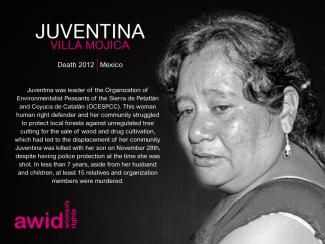
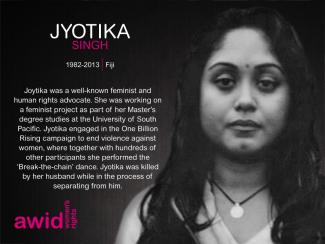
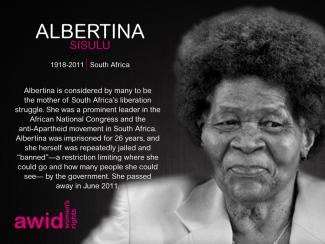
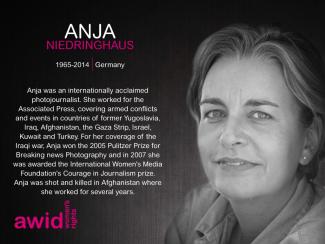
Courageous WHRDs in the Media
These 21 Women Human Rights Defenders (WHRDs) worked as journalists and more widely in the media sector in Mexico, Colombia, Fiji, Libya, Nepal, United States, Nicaragua, Philippines, Russia, Germany, France, Afghanistan, and the United Kingdom. 17 of them were murdered and in one case the cause of death is still unclear. On this World Press Freedom Day, please join us in commemorating the life and work of these women by sharing the images below with your colleagues, friends and networks using the hashtags #WPFD2016 and #WHRDs.
The contributions of these women were celebrated and honoured in our Tribute to Women Human Rights Defenders (WHRDs) Who Are No Longer With Us.
Please click on each image below to see a larger version and download as a file


Snippet - WITM FAQ - PT
Perguntas Frequentes
Research methology
Over eight years, we did four global surveys and built a research methodology.
In 2013, we published three global reports. These reports confirm that women’s rights organizations are doing the heavy lifting to advance women’s rights and gender equality by using diverse, creative and long-term strategies, all while being underfunded.
Our 2010 global survey showed that the collective income of 740 women’s organizations around the world totaled only USD 104 million. Compare this with Greenpeace International, one organization with a 2010 budget of USD 310 million1. Imagine the impact these groups could have if they were able to access all the financial resources they need and more?
AWID’s WITM research has catalyzed increased funding for women’s rights organizing. WITM research was a driving force behind the Catapult crowdfunding platform, which has raised USD 6.5 million for women’s rights. The Dutch Government cited WITM research as a reason for its unprecedented MDG 3 Fund of EU 82 million. WITM research has also led to the creation of several new funds: FRIDA – The Young Feminist Fund, the Indigenous Women’s Fund, Fundo Elas, the Mediterranean Women’s Fund and the Rita Fund.
Funding trends analyses
While the WITM research has shed important light on the global funding landscape, AWID and partners have identified the need to dig deeper, to analyze funding trends by region, population and issue. In response, organizations are now using AWID’s WITM research methodology to do their own funding trends analyses. For example, in November 2013, Kosova Women’s Network and Alter Habitus – Institute for Studies in Society and Culture published Where is the Money for Women’s Rights? A Kosovo Case Study.
At the same time, AWID continues to collaborate with partners in Where is the Money for Indigenous Women’s Rights (with International Indigenous Women’s Forum and International Funders for Indigenous Peoples) and our upcoming Where is the Money for Women’s Rights in Brazil? (with Fundo Elas).
Several organizations have also conducted their own independent funding trends research, deepening their understanding of the funding landscape and politics behind it. For example, the South Asian Women’s Fund was inspired by AWID’s WITM research to conduct funding trends reports for each country in South Asia, as well as a regional overview. Other examples of research outside of AWID include the collaboration between Open Society Foundations, Mama Cash, and the Red Umbrella Fund to produce the report Funding for Sex Workers Rights, and the first-ever survey on trans* and intersex funding by Global Action for Trans* Equality and American Jewish World Service.