Mass demonstration in Madrid on International Women's Day
Multitudinaria manifestación en Madrid en el día internacional de la mujer
Priority Areas
Supporting feminist, women’s rights and gender justice movements to thrive, to be a driving force in challenging systems of oppression, and to co-create feminist realities.
Across the globe, feminist, women’s rights and gender justice defenders are challenging the agendas of fascist and fundamentalist actors. These oppressive forces target women, persons who are non-conforming in their gender identity, expression and/or sexual orientation, and other oppressed communities.
Discriminatory ideologies are undermining and co-opting our human rights systems and standards, with the aim of making rights the preserve of only certain groups. In the face of this, the Advancing Universal Rights and Justice (AURJ) initiative promotes the universality of rights - the foundational principle that human rights belong to everyone, no matter who they are, without exception.
We create space for feminist, women’s rights and gender justice movements and allies to recognize, strategize and take collective action to counter the influence and impact of anti-rights actors. We also seek to advance women’s rights and feminist frameworks, norms and proposals, and to protect and promote the universality of rights.
Our actions
Through this initiative, we:
Build knowledge: We support feminist, women’s rights and gender justice movements by disseminating and popularizing knowledge and key messages about anti-rights actors, their strategies, and impact in the international human rights systems through AWID’s leadership role in the collaborative platform, the Observatory on the Universality of Rights (OURs)*.
Advance feminist agendas: We ally ourselves with partners in international human rights spaces including, the Human Rights Council, the Commission on Population and Development, the Commission on the Status of Women and the UN General Assembly.
Create and amplify alternatives: We engage with our members to ensure that international commitments, resolutions and norms reflect and are fed back into organizing in other spaces locally, nationally and regionally.
Mobilize solidarity action: We take action alongside women human rights defenders (WHRDs) including trans and intersex defenders and young feminists, working to challenge fundamentalisms and fascisms and call attention to situations of risk.
PLEASE READ THIS TERMS OF USE AGREEMENT (THE “TERMS OF USE”) CAREFULLY. THIS WEBSITE AND ITS SUBDOMAINS (COLLECTIVELY, THE “WEBSITE”), THE INFORMATION ON THE WEBSITE, AND THE SERVICES AND RESOURCES AVAILABLE OR ENABLED VIA THE WEBSITE (EACH A “SERVICE” AND COLLECTIVELY, THE “SERVICES”), ARE CONTROLLED BY ASSOCIATION FOR WOMEN’S RIGHTS IN DEVELOPMENT (“AWID”). THESE TERMS OF USE ALONG WITH ALL SUPPLEMENTAL TERMS THAT MAY BE PRESENTED TO YOU FOR YOUR REVIEW AND ACCEPTANCE (COLLECTIVELY, THE “AGREEMENT”), GOVERN YOUR ACCESS TO AND USE OF THE SERVICES. BY COMPLETING THE REGISTRATION PROCESS, BROWSING THE WEBSITE, OR OTHERWISE ACCESSING OR USING ANY OF THE SERVICES, YOU REPRESENT THAT (1) YOU HAVE READ, UNDERSTAND, AND AGREE TO BE BOUND BY THE AGREEMENT, (2) YOU ARE OF LEGAL AGE TO FORM A BINDING CONTRACT WITH AWID, AND (3) YOU HAVE THE AUTHORITY TO ENTER INTO THE AGREEMENT PERSONALLY OR ON BEHALF OF THE LEGAL ENTITY IDENTIFIED DURING THE ACCOUNT REGISTRATION PROCESS, AND TO BIND THAT LEGAL ENTITY TO THE AGREEMENT. THE TERM “YOU” REFERS TO THE INDIVIDUAL OR SUCH LEGAL ENTITY, AS APPLICABLE. IF YOU, OR IF APPLICABLE, SUCH LEGAL ENTITY, DO NOT AGREE TO BE BOUND BY THE AGREEMENT, YOU, AND IF APPLICABLE, SUCH LEGAL ENTITY, MAY NOT ACCESS OR USE ANY OF THE SERVICES.
PLEASE BE AWARE THAT SECTION 1.4 (AWID COMMUNICATIONS) OF THE AGREEMENT BELOW CONTAINS YOUR OPT-IN CONSENT TO RECEIVE COMMUNICATIONS FROM US.
PLEASE NOTE THAT THE AGREEMENT IS SUBJECT TO CHANGE BY AWID IN ITS SOLE DISCRETION AT ANY TIME. WHEN CHANGES ARE MADE, AWID WILL MAKE A COPY OF THE UPDATED AGREEMENT AVAILABLE AT THE WEBSITE AND UPDATE THE “LAST UPDATED DATE” AT THE TOP OF THESE TERMS OF USE. IF WE MAKE ANY MATERIAL CHANGES TO THE AGREEMENT, WE WILL PROVIDE NOTICE OF SUCH MATERIAL CHANGES ON THE WEBSITE AND ATTEMPT TO NOTIFY YOU BY SENDING AN E-MAIL TO THE E-MAIL ADDRESS PROVIDED IN YOUR ACCOUNT REGISTRATION (IF WE HAVE ONE ON FILE). ANY CHANGES TO THE AGREEMENT WILL BE EFFECTIVE IMMEDIATELY FOR NEW USERS OF THE SERVICES AND WILL BE EFFECTIVE FOR EXISTING REGISTERED USERS UPON THE EARLIER OF (A) THIRTY (30) DAYS AFTER THE “LAST UPDATED DATE” AT THE TOP OF THESE TERMS OF USE, OR (B) YOUR CONSENT TO AND ACCEPTANCE OF THE UPDATED AGREEMENT IF AWID PROVIDES A MECHANISM FOR YOUR IMMEDIATE ACCEPTANCE IN A SPECIFIED MANNER (SUCH AS A CLICK-THROUGH ACCEPTANCE), WHICH AWID MAY REQUIRE BEFORE FURTHER USE OF THE SERVICES IS PERMITTED. IF YOU DO NOT AGREE TO THE UPDATED AGREEMENT, YOU MUST STOP USING ALL SERVICES UPON THE EFFECTIVE DATE OF THE UPDATED AGREEMENT. OTHERWISE, YOUR CONTINUED USE OF ANY OF THE SERVICES AFTER THE EFFECTIVE DATE OF THE UPDATED AGREEMENT CONSTITUTES YOUR ACCEPTANCE OF THE UPDATED AGREEMENT. PLEASE REGULARLY CHECK THE WEBSITE TO VIEW THE THEN-CURRENT AGREEMENT. YOU AGREE THAT AWID’S CONTINUED PROVISION OF THE SERVICES IS ADEQUATE CONSIDERATION FOR THE CHANGES IN THE UPDATED AGREEMENT.
If AWID becomes aware of any possible violations by you of the Agreement, AWID reserves the right to investigate such violations. If, as a result of the investigation, AWID believes that criminal activity has occurred, AWID reserves the right to refer the matter to, and to cooperate with, any and all applicable legal authorities. AWID is entitled, except to the extent prohibited by applicable law, to disclose any information or materials on or in the Services, in AWID’s possession in connection with your use of the Services, to (i) comply with applicable laws, legal process or governmental request; (iii) enforce the Agreement, (iv) respond to your requests for customer service, or (vi) protect the rights, property or personal safety of AWID, its Registered Users or the public, and all enforcement or other government officials, as AWID in its sole discretion believes to be necessary or appropriate.
You may choose to have the arbitration conducted by telephone, based on written submissions, or in person at a mutually agreed location. Any judgment on the award rendered by the arbitrator may be entered in any court of competent jurisdiction.
Entire Agreement. The Agreement is the final, complete and exclusive agreement of the parties with respect to the subject matter hereof and supersedes and merges all prior discussions between the parties with respect to such subject matter.
USE OF THE SERVICES. The Services, and the information and content available on them, are protected by applicable intellectual property laws. Unless subject to a separate license between you and AWID, your right to use any and all Services is subject to the Agreement.
1.1 License to the Services. Subject to your compliance with the Agreement, AWID grants you a non-assignable, non-transferable, non-sublicensable, revocable, non-exclusive license to use the Services in the manner permitted by the Agreement.
1.2 Updates. You understand that the Services are evolving. You acknowledge and agree that AWID may update the Services with or without notifying you.
1.3 Certain Restrictions. The rights granted to you in the Agreement are subject to the following restrictions: (a) you shall not license, sell, rent, lease, transfer, assign, reproduce, distribute, host or otherwise commercially exploit any of the Services; (b) you shall not frame or utilize framing techniques to enclose any trademark, logo, or other parts of the Services (including images, text, page layout or form); (c) you shall not use any metatags or other “hidden text” using AWID’s name or trademarks; (d) you shall not modify, translate, adapt, merge, make derivative works of, disassemble, decompile, reverse compile or reverse engineer any part of the Services except to the extent the foregoing restrictions are expressly prohibited by applicable law; (e) you shall not use any manual or automated software, devices or other processes (including but not limited to spiders, robots, scrapers, crawlers, avatars, data mining tools or the like) to “scrape” or download data from any web pages contained in the Services (except that we grant the operators of public search engines revocable permission to use spiders to copy materials from the Website for the sole purpose of and solely to the extent necessary for creating publicly available searchable indices of the materials, but not caches or archives of such materials); (f) except as expressly stated herein, no part of the Services may be copied, reproduced, distributed, republished, downloaded, displayed, posted or transmitted in any form or by any means; and (h) you shall not remove or destroy any copyright notices or other proprietary markings contained on or in the Services. Any future release, update or other addition to the Services shall be subject to the Agreement. AWID, its suppliers and service providers reserve all rights not granted in the Agreement.
1.4 AWID Communications. By entering into the Agreement or using the Services, you agree to receive communications from us, including via e-mail. Communications from us and our affiliated companies may include but are not limited to operational communications concerning your use of the Services and promotional emails. IF YOU WISH TO OPT OUT OF ANY PROMOTIONAL EMAILS, YOU CAN UNSUBSCRIBE FROM OUR PROMOTIONAL EMAIL LIST BY FOLLOWING THE UNSUBSCRIBE OPTIONS IN THE PROMOTIONAL EMAIL ITSELF.
REGISTRATION.
2.1 Registering Your Account. In order to access certain features of the Services you may be required to become a Registered User. For purposes of the Agreement, a “Registered User” is a user who has registered an account with AWID through the Services (“Account”).
2.2 Registration Data. In registering an Account, you agree to (a) provide true, accurate, current and complete information about yourself as prompted by the registration form (the “Registration Data”); and (b) maintain and promptly update the Registration Data to keep it true, accurate, current and complete. You represent that you are (i) at least eighteen (18) years old; (ii) of legal age to form a binding contract; and (iii) not a person barred from using the Services under the laws of the United States, Canada, your place of residence or any other applicable jurisdiction. You are responsible for all activities that occur under your Account. You agree that you shall monitor your Account to restrict use by any other persons, including minors, and you will accept full responsibility for any such unauthorized use. You may not share your Account login or password with anyone, and you agree to (y) notify AWID immediately of any unauthorized use of your password or any other breach of security; and (z) exit from your Account at the end of each session. If you provide any information that is untrue, inaccurate, not current or incomplete, or AWID has reasonable grounds to suspect that any information you provide is untrue, inaccurate, not current or incomplete, AWID has the right to suspend or terminate your Account and refuse any and all current or future use of the Services (or any portion thereof). You agree not to create an Account using a false identity or information, or on behalf of someone other than yourself. You agree not to create an Account or use the Services if you have been previously removed by AWID, or if you have been previously banned from any of the Services.
2.3 Your Account. Notwithstanding anything to the contrary herein, you acknowledge and agree that you shall have no ownership or other property interest in your Account, and you further acknowledge and agree that all rights in and to your Account are and shall forever be owned by and inure to the benefit of AWID.
2.4 Necessary Equipment and Software. You must provide all equipment and software necessary to connect to the Services. You are solely responsible for any fees, including Internet connection or mobile fees, that you incur when accessing the Services.
OWNERSHIP.
3.1 Services. AWID and its suppliers own all rights, title and interest in the Services, and that the Services are protected by intellectual property rights throughout the world. You agree not to remove, alter or obscure any copyright, trademark, service mark or other proprietary rights notices incorporated in or accompanying any Services.
3.2 Trademarks. AWID’s name and all related stylizations, graphics, logos, service marks and trade names used on or in connection with any Services are the trademarks of AWID and may not be used without permission in connection with your, or any third-party, products or services. Third party trademarks, service marks and trade names that may appear on or in the Services are the property of their respective owners.
3.3 Feedback. You agree that submission of any ideas, suggestions, documents, and/or proposals to AWID (“Feedback”) is at your own risk and that AWID has no obligations (including without limitation obligations of confidentiality) with respect to such Feedback. You represent and warrant that you have all rights necessary to submit the Feedback. You hereby grant to AWID a fully paid, royalty-free, perpetual, irrevocable, worldwide, and non-exclusive right and license to use, reproduce, perform, display, distribute, adapt, modify, re-format, create derivative works of, and otherwise commercially or non-commercially exploit in any manner, any and all Feedback, and to sublicense the foregoing rights, in connection with the operation and maintenance of the Services and/or AWID’s business.
USER CONDUCT. As a condition of use, you agree not to use any of the Services for any purpose that is prohibited by this Agreement or by applicable law. You shall not (and shall not permit any third party) take any action that: (i) infringes, misappropriates or otherwise violates any intellectual property right, right of publicity, right of privacy or other right of any person or entity; (ii) is unlawful, threatening, abusive, harassing, defamatory, libelous, deceptive, fraudulent, invasive of another’s privacy, tortious, obscene, offensive, or profane; (iii) constitutes unauthorized or unsolicited advertising, junk or bulk e-mail; (iv) involves commercial activities and/or sales, such as contests, sweepstakes, barter, advertising, or pyramid schemes without AWID’s prior written consent; (v) impersonates any person or entity, including any employee or representative of AWID; (vi) interferes with or attempt to interfere with the proper functioning of the Services or uses the Services in any way not expressly permitted by the Agreement; or (vii) attempts to engage in or engage in, any potentially harmful acts that are directed against the Services, including but not limited to violating or attempting to violate any security features of the Services, introducing viruses, worms, or similar harmful code into the Services, or interfering or attempting to interfere with use of the Services by any other user, host or network, including by means of overloading, “flooding,” “spamming,” “mail bombing,” or “crashing” the Services.
DONATIONS. AWID may collect donations from you through the Services. You must provide AWID with a valid credit card (Visa, MasterCard, or any other issuer accepted by us) or PayPal account of a payment provider (each, a “Payment Provider”) in order for us to process the donation. Your Payment Provider agreement governs your use of the designated credit card or PayPal account, and you must refer to that agreement, not this Agreement, to determine your rights and liabilities.
INDEMNIFICATION. You agree to indemnify and hold AWID, its parents, subsidiaries, affiliates, officers, employees, agents, partners, suppliers, and licensors (each, an “AWID Party” and collectively, the “AWID Parties”) harmless from any losses, costs, liabilities and expenses (including reasonable attorneys’ fees) relating to or arising out of any and all of the following: (a) your use of any Service in violation of the Agreement; (b) your violation of any rights of another party, including any Registered Users; or (c) your violation of any applicable laws, rules or regulations. AWID reserves the right, at its own cost, to assume the exclusive defense and control of any matter otherwise subject to indemnification by you, in which event you agree to fully cooperate with AWID in asserting any available defenses. This provision does not require you to indemnify any of the AWID Parties for any unconscionable commercial practice by such party or for such party’s fraud, deception, false promise, misrepresentation or concealment, or suppression or omission of any material fact in connection with any Services provided hereunder. You agree that the provisions in this section will survive any termination of your Account, the Agreement and/or your access to the Services.
DISCLAIMER OF WARRANTIES AND CONDITIONS.
7.1 As Is. YOU EXPRESSLY UNDERSTAND AND AGREE THAT TO THE EXTENT PERMITTED BY APPLICABLE LAW, YOUR USE OF THE SERVICES IS AT YOUR SOLE RISK, AND THE SERVICES ARE PROVIDED ON AN “AS IS” AND “AS AVAILABLE” BASIS, WITH ALL FAULTS. AWID EXPRESSLY DISCLAIMS ALL WARRANTIES, REPRESENTATIONS, AND CONDITIONS OF ANY KIND, WHETHER EXPRESS OR IMPLIED, INCLUDING, BUT NOT LIMITED TO, THE IMPLIED WARRANTIES OR CONDITIONS OF MERCHANTABILITY, FITNESS FOR A PARTICULAR PURPOSE AND NON-INFRINGEMENT ARISING FROM USE OF THE SERVICES.
AWID MAKES NO WARRANTY, REPRESENTATION OR CONDITION THAT: (1) THE SERVICES WILL MEET YOUR REQUIREMENTS; (2) YOUR USE OF THE SERVICES WILL BE UNINTERRUPTED, TIMELY, SECURE OR ERROR-FREE; OR (3) THE RESULTS THAT MAY BE OBTAINED FROM USE OF THE SERVICES WILL BE ACCURATE OR RELIABLE.
NO ADVICE OR INFORMATION, WHETHER ORAL OR WRITTEN, OBTAINED FROM AWID OR THROUGH THE SERVICES WILL CREATE ANY WARRANTY NOT EXPRESSLY MADE HEREIN.
7.2 No Liability for Conduct of Third Parties. YOU ACKNOWLEDGE AND AGREE THAT AWID PARTIES ARE NOT LIABLE, AND YOU AGREE NOT TO SEEK TO HOLD AWID PARTIES LIABLE, FOR THE CONDUCT OF THIRD PARTIES, INCLUDING OPERATORS OF EXTERNAL SITES AND OTHER USERS OF THE SERVICES.
7.3 Third-Party Materials. As a part of the Services, you may have access to materials that are hosted by another party. You agree that it is impossible for AWID to monitor such materials and that you access these materials at your own risk.
8. LIMITATION OF LIABILITY.
8.1 Disclaimer of Certain Damages. YOU UNDERSTAND AND AGREE THAT, TO THE FULLEST EXTENT PROVIDED BY LAW, IN NO EVENT SHALL AWID PARTIES BE LIABLE FOR ANY LOSS OF PROFITS, REVENUE OR DATA, INDIRECT, INCIDENTAL, SPECIAL, OR CONSEQUENTIAL DAMAGES, OR DAMAGES OR COSTS DUE TO LOSS OF PRODUCTION OR USE, BUSINESS INTERRUPTION, OR PROCUREMENT OF SUBSTITUTE GOODS OR SERVICES, IN EACH CASE WHETHER OR NOT AWID HAS BEEN ADVISED OF THE POSSIBILITY OF SUCH DAMAGES, ARISING OUT OF OR IN CONNECTION WITH THE AGREEMENT OR ANY COMMUNICATIONS, INTERACTIONS OR MEETINGS WITH OTHER USERS OF THE SERVICES, ON ANY THEORY OF LIABILITY. THE FOREGOING LIMITATION OF LIABILITY SHALL NOT APPLY TO LIABILITY OF AN AWID PARTY FOR (i) DEATH OR PERSONAL INJURY CAUSED BY AN AWID PARTY’S NEGLIGENCE; OR FOR (ii) ANY INJURY CAUSED BY AN AWID PARTY’S FRAUD OR FRAUDULENT MISREPRESENTATION.
8.2 Cap on Liability. TO THE FULLEST EXTENT PROVIDED BY LAW, AWID PARTIES WILL NOT BE LIABLE TO YOU FOR MORE THAN $100. THE FOREGOING CAP ON LIABILITY SHALL NOT APPLY TO LIABILITY OF AN AWID PARTY FOR (i) DEATH OR PERSONAL INJURY CAUSED BY AN AWID PARTY’S NEGLIGENCE; OR FOR (ii) ANY INJURY CAUSED BY AN AWID PARTY’S FRAUD OR FRAUDULENT MISREPRESENTATION.
8.3 Exclusion of Damages. CERTAIN JURISDICTIONS DO NOT ALLOW THE EXCLUSION OR LIMITATION OF CERTAIN DAMAGES. IF THESE LAWS APPLY TO YOU, SOME OR ALL OF THE ABOVE EXCLUSIONS OR LIMITATIONS MAY NOT APPLY TO YOU, AND YOU MIGHT HAVE ADDITIONAL RIGHTS.
8.4 Basis of the Bargain. THE LIMITATIONS OF DAMAGES SET FORTH ABOVE ARE FUNDAMENTAL ELEMENTS OF THE BASIS OF THE BARGAIN BETWEEN AWID AND YOU.
9. PROCEDURE FOR MAKING CLAIMS OF COPYRIGHT INFRINGEMENT. It is AWID’s policy to terminate membership privileges of any Registered User who repeatedly infringes copyright upon prompt notification to AWID by the copyright owner or the copyright owner’s legal agent. Without limiting the foregoing, if you believe that your work has been copied and posted on the Services in a way that constitutes copyright infringement, please provide our Copyright Agent with the following information: (a) an electronic or physical signature of the person authorized to act on behalf of the owner of the copyright interest; (b) a description of the copyrighted work that you claim has been infringed; (c) a description of the location on the Services of the material that you claim is infringing; (d) your address, telephone number and e-mail address; (e) a written statement by you that you have a good faith belief that the disputed use is not authorized by the copyright owner, its agent or the law; and (f) a statement by you, made under penalty of perjury, that the above information in your notice is accurate and that you are the copyright owner or authorized to act on the copyright owner’s behalf. Contact information for AWID’s Copyright Agent for notice of claims of copyright infringement is as follows: Director of Operations, AWID, 192 Spadina Avenue #300, Toronto, Ontario, M5T 2C2, Canada, dosr@awid.org.
10. MONITORING AND ENFORCEMENT. AWID reserves the right to:(a) take appropriate legal action, including without limitation, referral to law enforcement, for any illegal or unauthorized use of the Services; and/or (b) terminate or suspend your access to all or part of the Services for any or no reason, including without limitation, any violation of this Agreement.
11. TERM AND TERMINATION.
11.1 Term. The Agreement commences on the date when you accept them (as described in the preamble above) and remain in full force and effect while you use the Services, unless terminated earlier in accordance with the Agreement.
11.2 Prior Use. Notwithstanding the foregoing, you hereby acknowledge and agree that the Agreement commenced on the earlier to occur of (a) the date you first used the Services or (b) the date you accepted the Agreement, and will remain in full force and effect while you use any Services, unless earlier terminated in accordance with the Agreement.
11.3 Termination of Services by AWID. If you have materially breached any provision of the Agreement, or if AWID is required to do so by law (e.g., where the provision of the Services is, or becomes, unlawful), AWID has the right to, immediately and without notice, suspend or terminate any Services provided to you. You agree that all terminations for cause shall be made in AWID’s sole discretion and that AWID shall not be liable to you or any third party for any termination of your Account.
11.4 Termination of Services by You. If you want to terminate the Services provided by AWID, you may do so by (a) notifying AWID at any time and (b) closing your Account for all of the Services that you use. Your notice should be sent, in writing, to AWID’s address set forth below.
11.5 Effect of Termination. Termination of any Service includes removal of access to such Service and barring of further use of the Service. Upon termination of any Service, your right to use such Service will automatically terminate immediately. All provisions of the Agreement which by their nature should survive, shall survive termination of Services, including without limitation, ownership provisions, warranty disclaimers, and limitation of liability.
11.6 No Subsequent Registration. If your registration(s) with, or ability to access, the Services or any other AWID community, is discontinued by AWID due to your violation of any portion of the Agreement or for conduct otherwise inappropriate for the community, then you agree that you shall not attempt to re-register with or access the Services or any AWID community through use of a different member name or otherwise, and you acknowledge that you will not be entitled to receive a refund for fees related to those Services to which your access has been terminated. In the event that you violate the immediately preceding sentence, AWID reserves the right, in its sole discretion, to immediately take any or all of the actions set forth herein without any notice or warning to you.
12. INTERNATIONAL USERS. The Services can be accessed from countries around the world and may contain references to Services that are not available in your country. These references do not imply that AWID intends to announce such Services in your country. The Services are controlled and offered by AWID from its facilities in Canada. AWID makes no representations that the Services are appropriate or available for use in other locations. Those who access or use the Services from other countries do so at their own volition and are responsible for compliance with local law.
13. THIRD-PARTY SERVICES. The Services may contain links to third-party websites (“Third-Party Websites”), applications (“Third-Party Applications”) and advertisements for third parties (“Third-Party Ads”). When you click on a link to a Third-Party Website, Third-Party Application or Third-Party Ad, we will not warn you that you have left the Services and are subject to the terms and conditions (including privacy policies) of another website or destination. Such Third-Party Websites, Third-Party Applications and Third-Party Ads are not under the control of AWID. AWID is not responsible for any Third-Party Websites, Third-Party Applications or Third-Party Ads. AWID provides these Third-Party Websites, Third-Party Applications and Third-Party Ads only as a convenience and does not review, approve, monitor, endorse, warrant, or make any representations with respect to Third-Party Websites, Third-Party Applications or Third-Party Ads, or any product or service provided in connection therewith. You use all links in Third-Party Websites, Third-Party Applications and Third-Party Ads at your own risk. When you leave our Website, the Agreement and our policies no longer govern. You should review applicable terms and policies, including privacy and data gathering practices, of any Third-Party Websites, Third-Party Applications, or Third-Party Ads, and make whatever investigation you feel necessary or appropriate before proceeding with any transaction with any third party.
14. DISPUTE RESOLUTION.
14.1 Applicability of Arbitration Agreement. You agree that any dispute between you and us relating in any way to the Agreement, will be resolved by binding arbitration, rather than in court, except that (1) you and AWID may assert claims in small claims court if the claims qualify; and (2) you or AWID may seek equitable relief in court for infringement or other misuse of intellectual property rights (such as trademarks, trade dress, domain names, trade secrets, copyrights, and patents). This Arbitration Agreement shall apply, without limitation, to all claims that arose or were asserted before the Effective Date of this Agreement or any prior version of this Agreement.
14.2 Arbitration Rules and Forum. The Federal Arbitration Act governs the interpretation and enforcement of this Arbitration Agreement. To begin an arbitration proceeding, you must send a letter requesting arbitration and describing your claim to us in writing in writing at 192 Spadina Avenue #300, Toronto, Ontario, M5T 2C2, Canada. The arbitration will be conducted by JAMS, an established alternative dispute resolution provider. Disputes involving claims and counterclaims with an amount in controversy under $250,000, not inclusive of attorneys’ fees and interest, shall be subject to JAMS’ most current version of the Streamlined Arbitration Rules and procedures available at http://www.jamsadr.com/rules-streamlined-arbitration/; all other claims shall be subject to JAMS’s most current version of the Comprehensive Arbitration Rules and Procedures, available at http://www.jamsadr.com/rules-comprehensive-arbitration/. JAMS’s rules are also available at www.jamsadr.comor by calling JAMS at 800-352-5267. If JAMS is not available to arbitrate, the parties will select an alternative arbitral forum. If the arbitrator finds that you cannot afford to pay JAMS’s filing, administrative, hearing and/or other fees and you cannot obtain a waiver from JAMS, AWID will pay them for you.
14.3 Authority of Arbitrator. Without limiting the scope of Section 14.1, the arbitrator shall have exclusive authority to resolve any dispute related to the interpretation, applicability, enforceability or formation of this Arbitration Agreement including, but not limited to any claim that all or any part of this Arbitration Agreement is void or voidable. The arbitrator will decide the rights and liabilities, if any, of you and AWID. The arbitration proceeding will not be consolidated with any other matters or joined with any other proceedings or parties. The arbitrator shall have the authority to grant motions dispositive of all or part of any claim or dispute. The arbitrator shall have the authority to award monetary damages and to grant any non-monetary remedy or relief available to an individual party under applicable law, the arbitral forum’s rules, and this Agreement (including the Arbitration Agreement). The arbitrator shall issue a written award and statement of decision describing the essential findings and conclusions on which any award (or decision not to render an award) is based, including the calculation of any damages awarded. The arbitrator shall follow the applicable law. The arbitrator has the same authority to award relief on an individual basis that a judge in a court of law would have. The award of the arbitrator is final and binding upon you and us.
14.4 Waiver of Jury Trial. YOU AND AWID HEREBY WAIVE ANY CONSTITUTIONAL AND STATUTORY RIGHTS TO SUE IN COURT (OTHER THAN SMALL CLAIMS COURT AS PERMITTED HEREIN) AND HAVE A TRIAL IN FRONT OF A JUDGE OR A JURY. You and AWID are instead electing that all covered claims and disputes shall be resolved by arbitration under this Arbitration Agreement, except as specified in Section 14.1 above. An arbitrator can award on an individual basis the same damages and relief as a court and must follow this Agreement as a court would. However, there is no judge or jury in arbitration, and court review of an arbitration award is subject to very limited review.
14.5 Waiver of Class or Other Non-Individualized Relief. ALL CLAIMS AND DISPUTES WITHIN THE SCOPE OF THIS ARBITRATION AGREEMENT MUST BE ARBITRATED ON AN INDIVIDUAL BASIS AND NOT ON A CLASS OR COLLECTIVE BASIS, ONLY INDIVIDUAL RELIEF IS AVAILABLE FOR CLAIMS COVERED BY THIS ARBITRATION AGREEMENT, AND CLAIMS BY OR AGAINST ONE USER CANNOT BE ARBITRATED OR CONSOLIDATED WITH THOSE OF OR AGAINST ANY OTHER USER OR PERSON. If a decision is issued stating that applicable law precludes enforcement of any of this Section 14.5’s limitations as to a given claim for relief, then the applicable claim, and only that applicable claim, must be severed from the arbitration and brought into the courts in the Province of Ontario or the federal courts of Canada (as applicable) in accordance with Section 15.1. All other claims shall be arbitrated.
14.6 30-Day Right to Opt Out. You have the right to opt out of the provisions of this Arbitration Agreement by sending a timely written notice of your decision to opt out via email to info@awid.org or in writing to 192 Spadina Avenue #300, Toronto, Ontario, M5T 2C2, Canada, within 30 days after first becoming subject to this Arbitration Agreement. Your notice must include your name and address and a clear statement that you want to opt out of this Arbitration Agreement. If you opt out of this Arbitration Agreement, all other parts of this Agreement will continue to apply to you. Opting out of this Arbitration Agreement has no effect on any other arbitration agreements that you may currently have with us, or may enter into in the future with us.
14.7 Severability. Except as provided in Section 14.5, if any part or parts of this Arbitration Agreement are found under the law to be invalid or unenforceable, then such specific part or parts shall be of no force and effect and shall be severed and the remainder of the Arbitration Agreement shall continue in full force and effect.
14.8 Survival of Agreement. This Arbitration Agreement will survive the termination or expiration of the Terms or your relationship with AWID.
14.9 Modification. Notwithstanding any provision in this Agreement to the contrary, we agree that if AWID makes any future material change to this Arbitration Agreement, you may reject that change within thirty (30) days of such change becoming effective by e-mailing AWID at the following address: info@awid.org or writing to AWID at 192 Spadina Avenue #300, Toronto, Ontario, M5T 2C2, Canada.
15. GENERAL PROVISIONS.
15.1 Governing Law; Venue. ANY DISPUTE, CLAIM OR REQUEST FOR RELIEF RELATING IN ANY WAY TO YOUR USE OF THE SERVICES WILL BE GOVERNED AND INTERPRETED BY AND UNDER THE LAWS OF THE PROVINCE OF ONTARIO OR THE FEDERAL LAWS OF CANADA (AS APPLICABLE), WITHOUT GIVING EFFECT TO ANY PRINCIPLES THAT PROVIDE FOR THE APPLICATION OF THE LAW OF ANY OTHER JURISDICTION. To the extent permitted under this Agreement, both you and AWID agree that all claims and disputes arising out of or relating to the Agreement will be litigated exclusively in the courts of the Province of Ontario or the federal courts of Canada (as applicable), and the parties hereby expressly submit to the exclusive personal jurisdiction of such courts.
15.2 Electronic Communications. The communications between you and AWID may take place via electronic means, whether you visit the Services or send AWID e-mails, or whether AWID posts notices on the Services or communicates with you via e-mail. For contractual purposes, you (a) consent to receive communications from AWID in an electronic form; and (b) agree that all terms and conditions, agreements, notices, disclosures, and other communications that AWID provides to you electronically satisfy any legal requirement that such communications would satisfy if it were to be in writing. The foregoing does not affect your statutory rights, including but not limited to the Electronic Signatures in Global and National Commerce Act at 15 U.S.C. §7001 et seq. (“E-Sign”).
15.3 Assignment. The Agreement, and your rights and obligations hereunder, may not be assigned, subcontracted, delegated or otherwise transferred by you without AWID’s prior written consent, and any attempted assignment, subcontract, delegation, or transfer in violation of the foregoing will be null and void.
15.4 Force Majeure. AWID shall not be liable for any delay or failure to perform resulting from causes outside its reasonable control, including, but not limited to, acts of God, pandemics, war, terrorism, riots, embargos, acts of civil or military authorities, fire, floods, accidents, strikes or shortages of transportation facilities, fuel, energy, labor or materials.
15.5 Questions, Complaints, Claims. If you have any questions, complaints or claims with respect to the Services, please contact us via e-mail at info@awid.org or in writing at 192 Spadina Avenue #300, Toronto, Ontario, M5T 2C2, Canada. We will do our best to address your concerns. If you feel that your concerns have been addressed incompletely, we invite you to let us know for further investigation.
15.6 Choice of Language. It is the express wish of the parties that the Agreement and all related documents have been drawn up in English.
15.7 Notice. Where AWID requires that you provide an e-mail address, you are responsible for providing AWID with your most current e-mail address. In the event that the last e-mail address you provided to AWID is not valid, or for any reason is not capable of delivering to you any notices required/ permitted by the Agreement, AWID’s dispatch of the e-mail containing such notice will nonetheless constitute effective notice. You may give notice to AWID at the following address via e-mail at info@awid.org or in writing at 192 Spadina Avenue #300, Toronto, Ontario, M5T 2C2, Canada. Such notice shall be deemed given when received by AWID via e-mail, or by letter delivered by nationally recognized overnight delivery service or first class postage prepaid mail at the above address.
15.8 Waiver. Any waiver or failure to enforce any provision of the Agreement on one occasion will not be deemed a waiver of any other provision or of such provision on any other occasion.
15.9 Severability. If any portion of the Agreement is held invalid or unenforceable, that portion shall be construed in a manner to reflect, as nearly as possible, the original intention of the parties, and the remaining portions shall remain in full force and effect.
15.10 Export Control. You may not use, export, import, or transfer any Services except as authorized by U.S. law, the laws of the jurisdiction in which you obtained the Services, and any other applicable laws. In particular, but without limitation, the Services may not be exported or re-exported (a) into any United States embargoed countries, or (b) to anyone on the U.S. Treasury Department’s list of Specially Designated Nationals or the U.S. Department of Commerce’s Denied Person’s List or Entity List. By using the Services, you represent and warrant that (i) you are not located in a country that is subject to a U.S. Government embargo, or that has been designated by the U.S. Government as a “terrorist supporting” country and (ii) you are not listed on any U.S. Government list of prohibited or restricted parties. You also will not use the Services for any purpose prohibited by U.S. law, including the development, design, manufacture or production of missiles, nuclear, chemical or biological weapons. You acknowledge and agree that products, services or technology provided by AWID are subject to the export control laws and regulations of the United States. You shall comply with these laws and regulations and shall not, without prior U.S. government authorization, export, re-export, or transfer AWID products, services or technology, either directly or indirectly, to any country in violation of such laws and regulations.
15.11 Consumer Complaints. In accordance with California Civil Code §1789.3, you may report complaints to the Complaint Assistance Unit of the Division of Consumer Services of the California Department of Consumer Affairs by contacting them in writing at 1625 North Market Blvd., Suite N 112, Sacramento, CA 95834, or by telephone at (800) 952-5210.
15.12 Entire Agreement. The Agreement is the final, complete and exclusive agreement of the parties with respect to the subject matter hereof and supersedes and merges all prior discussions between the parties with respect to such subject matter.
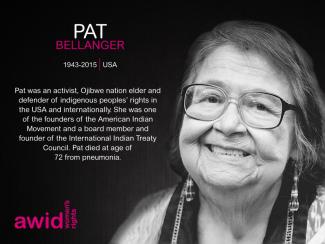
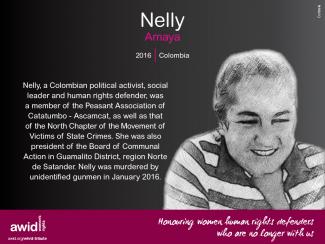
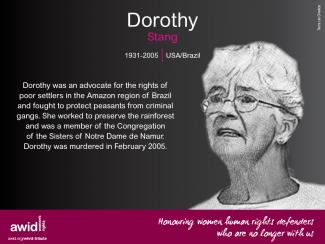
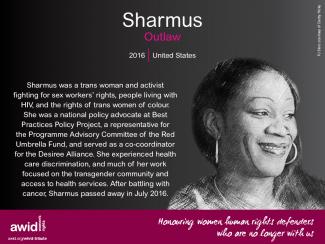
The 3 Women Human Rights Defenders (WHRDs) from the Pacific we are featuring in this year's Online Tribute have worked in the media, campaigned for disability rights and advocated for women’s rights. Their contributions are missed and we honor them in this Tribute. Please join AWID in commemorating these WHRDs, their work and legacy by sharing the memes below with your colleagues, networks and friends and by using the hashtags #WHRDTribute.
Please click on each image below to see a larger version and download as a file
Your comprehensive research product is now all organized and edited. You now want to ensure your findings are visually accessible and appealing to facilitate the dissemination.
Consider developing smaller products along with your long report.
As mentioned in the “Synthesize your research findings,” AWID often pulls smaller products from the lengthy research report. This allows for wider and easier distribution specialized for key audiences.
Always keep your targeted population in mind: who will read your report?
Examples of smaller products distilled from a larger report:
Infographics
Online gallery
An animation presenting your arguments
1. Think as your audience thinks
People are bombarded with information constantly. Your product will have to be visually compelling to maintain the interest of your audience. Again, having an idea of what you hope to accomplish and who you hope to reach, will allow the designer to create targeted products.
A lengthy written PDF report may seem the only way to present your research, but it could appear overwhelming to most people – especially online.
If you want to share your product with an online community, think about creating memes and infographics to use on social media, blogs and web platforms.
When deciding whether to create smaller products, consider dividing your results into several smaller products that you could share with targeted populations or at different times of the year to reactivate the interest on your product.
2. Work with a professional designer
If you have limited time and a little bit of budget, we recommend hiring a design firm.
It can be tempting for economic reasons to use in-house staff to package your report. However, a professional graphic designer can make a huge difference on how your final product looks and thus on how much impact it will have!
The designer (in-house or hired) must be able to:
Show you samples of their previous work that is similar to what you seek.
Provide you clear advice on how to present your research based on the content you provide and the audience you are targeting.
Suggest additional or different pieces to package your product.
What the designer will need from you:
A general idea on what you would like the lengthy report to highlight through visuals and graphics (what are the most important pieces of information, the key findings, for example) and some ideas on the types of smaller products you want to create (brochure, an infographic, a series of viral memes, for example). If possible, show the designer examples of similar documents developed by other organizations.
Your budget and time frame.
Your organization’s visual guidelines if you have any (logo, official colours, fonts, etc...).
A few photos copyright free or access to your photo bank if you have one.
Key visuals that need to be included – graphs, tables and other visual graphics drawn from your research.
The designer is a graphic expert. S/he is not necessarily familiar with women’s issues and does not know the results of your research, especially if you hire an external firm.
Communicate what elements of this report is important to you and who is your target. The designer will propose a way to highlight these elements and make the whole piece appealing to your users.
3. Make sure it's consistent
While creating a set of smaller information products, do not forget to link them all together:
A shorter version of the report that focuses only on your final results and recommendations should present a link to the final, full report
A visually compelling infographic that sends a message on the state of funding for your particular research can link to your website and the related section of the full report. It should be associated with a call to share on social media.
A short animation video that uses the data, findings and recommendations from your report should link back to your organization website and social media
A series of viral memes that can be distributed online should link back to your report, infographic, shorter report, etc.
It is also important to keep the research staff involved, so they can ensure any offshoot products stay true to the actual findings of the research.
After the design and packaging of the final research report is complete, if any of the wording of content was changed, be sure to re-send to translators.
If you create smaller products, once designed and packaged, you will also need to get the copy translated for those pieces. The translations should be clear enough so the designer can apply to the design, even if she/he does not speak the language.
Once translated, make sure to have your design proofread by a native speaker before sharing it!
Member states and women's rights advocates and organisations are gathering at the United Nations Headquarters in New York from 13 - 24 March for the 61st Commission on the Status of Women to address ‘women’s economic empowerment’ in the context of Sustainable Development Goal 5.
Whilst AWID is looking forward to physically meeting those of you who will be in New York, we want to engage with all those who cannot attend CSW, and as much as possible, amplify your voices in relevant spaces.
Continue reading to find out how to engage with AWID around CSW, whether you are attending physically or not.
Participate in an artistic takeover!
We are thrilled that AWID member Nayani Thiyagarajah is attending CSW this year and will take over the AWID Instagram. She will be available onsite to connect with other members for a possible feature on our Instagram. She will also explore possibilities of including some AWID members in a short film on the theme, ‘The personal is political’, a story of Nayani’s participation in this year’s CSW.
Nayani Thiyagarajah
Who is Nayani?
Nayani Thiyagarajah is a director, producer, and writer, dedicated to stories for the screen. A daughter of the Tamil diaspora, she calls Toronto home. For over 10 years, Nayani has worked in the arts and cultural industries. Her first independent feature documentary Shadeism: Digging Deeper (2015) had its World Premiere at the 2015 Zanzibar International Film Festival, where it won a Special Jury Prize. Nayani recently launched [RE]FRAME, with her producing partner Camaro West, a production company based out of Atlanta and Toronto, focused on re-framing the narratives around Black, Indigenous, and other people of colour through storytelling on screen.
On a more serious note, it should be noted that Nayani has a strange laugh, she's quite awkward, and her head is always in the clouds. She feels blessed beyond belief to create stories for the screen and play make believe for a living. Above all else, she believes in love.
Interested in meeting Nayani and being considered for inclusion in the film?
Send an email to membership@awid.org with the subject line “CSW Artistic Takeover”
By 13 March 2017
Please include your full name and country information.
Can't attend? Voice it!
If you are not able to attend CSW61 because of a travel ban, either due to the one imposed by the Trump administration or one you are facing from your own government, please share your story with us.
Send us messages you want heard in the United Nations spaces concerning funding, the impact of the reinstatement of the Global Gag Rule, and the need to push back against all types of religious fundamentalisms. You can send these in the following formats:
Video: no longer than two minutes and sent through a file sharing folder (for example dropbox, google drive)
Audio: no longer than two minutes and sent through a file sharing folder (for example dropbox, google drive)
Image: you can share a photo or a poster of your message
Text: no longer than 200 words and sent in the body of an email or in a word document
AWID members tell us that connecting with other members at CSW is valuable. In such a huge advocacy space, it is useful to connect with others including activists working on similar issues, or originating from the same country or region. Recognising the importance of connecting for movement building, we invite you to:
Interested in connecting with other members @CSW61?
If you are attending the CSW, we’d love to see what’s going on through your eyes!
Show us by capturing a moment you find speaks to the energy in the CSW space, be it on or off site. We hope to publish some of your ‘images’ on our social media channels and share on awid.org.
You can send us:
colour and/ or black and white photographs with a title (if you wish) and
a caption (no longer than 100 words) about the story your image tells.
Please also include:
your full name and country of origin and
let us know if we can publish the information you shared (in part or in full).
During the whole CSW or shortly after until Tuesday 28 March 2017.
Snippet FEA Sopo Japaridze (EN)
Meet Sopo Japaridze, fierce feminist, union leader and chair of the independent service trade union at the Solidarity Network.
She left the country when she was very young to go to the United States where she first became very politically active as a labor organizer. She kept Georgia in the back of her mind all that time, until one day, two decades later, she decided to return.
The existing Georgian union confederation back then was less than ideal. So, equipped with her skills, knowledge and labor organizing experience, Sopo went back to Georgia and built her own union.
Sopo is a passionate researcher and writer. She studies labor and social relations, writes for various publications and is the contributing editor of LeftEast, an Eastern European analytical platform. She also co-founded the political history initiative and podcast, Reimagining Soviet Georgia, where she explores the complexities and nuances of the country's experiences under the Soviet Union, to better understand its past in order to shed light on how to build a better future.
Keeping an eye on anti-rights actor at the Human Rights Council
Anti-rights mobilization at the United Nations constitutes a response to the significant feminist and progressive organizing. It involves a constant threat for women's rights, especially when it comes to sexual and reproductive rights and an open door to racism, xenophobia and all kinds of discrimination.
Get to know all their tactics and discourses worldwide.
Main resolutions and organizations to follow on the 38th session
We’re looking at an attack on the human rights system, and all of these fundamentalisms are coming together to try to weaken the fabric of multilateralism, and that’s happening in large part at the expense of marginalized groups of people. It’s happening at the expense of women, and it’s happening through tactics that are often about gender and sexuality.
Cynthia Rothschild
Independent human rights expert, OURs member
We’ve experienced a lot of pushback from different states, from different civil society actors, from private corporations and large donors who are funding the activities of these anti-rights actors.
Meghan Doherty
Director of Global Policy and Advocacy with Action Canada
When you do a search for “Female Genital Mutilation” or “FGM” online, an image of four line-drawings of the female anatomy pop up next to its Wikipedia entry. It illustrates four types of violence. The first being a partial cut to the clitoris. The second, a more invasive cut with the entire clitoris removed. The third is progressively worse with the removal of the clitoris, labia majora and minora. And the fourth box illustrates a series of hash marks to symbolize stitches over the vaginal opening to allow only for urination and menstruation.
As a survivor of FGM, most questions about my story fixate on the physical. The first question I usually get asked is what type of FGM I underwent. When I told a journalist once that I went through Type 1, she said “oh, that’s not so bad. It’s not like type three which is far worse.” She was technically right. I had the least invasive form. And for many years, I gaslighted myself into feeling a sense of relief that I was one of the lucky ones. I comforted myself noting that I could have been less fortunate with all of my genitalia gouged out, not just the clitoral tip. Or worse I could have been one of the ones who didn’t survive at all. Like Nada Hassan Abdel-Maqsoud, a twelve year old, who bled to death on a doctor’s operating table earlier this year in Upper Egypt. Nada is a reminder to me that for every data point -- 200 million women and girls who live with the consequences of FGM globally -- there is a story. Nada will never be able to tell hers.
As much as I find the label “survivor” suffocating at times -- I also realize there is privilege embedded in the word. By surviving, you are alive. You have the ability to tell your story, process the trauma, activate others in your community and gain insights and a new language and lens to see yourself through.
The act of storytelling can be cathartic and liberating, but it can also shatter the storyteller in the process.
Without integrating the psychosocial support of trained clinicians into storytelling and healing retreats, well-intentioned interventions can result in more trauma. This is all the more important as FGM survivors navigate the double pandemic of their own PTSD from childhood trauma, and the indefinite COVID-19 global shutdown.
In many anti-FGM advocacy spaces, I have seen this insatiable hunger to unearth stories -- whatever the cost to the storyteller. The stories help activate funding and serve as a data point
for measuring impact.
Survivor stories then become commodities fueling a storytelling industrial complex. Storytellers, if not provided proper mental health support in the process, can become collateral damage.
My motivation in writing this piece is to flip the script on how we view FGM survivors, prioritizing the storyteller over the story itself.
FGM survivors are more than the four boxes describing how the pieces of our anatomy were cut, pricked, carved, or gouged out. In this essay, I’ll break down the anatomy of an FGM survivor’s story into four parts: stories that break, stories that remake, stories that heal, and stories that reveal.
Type 1: Stories that break
I was sitting in the heart of Appalachia with a group of FGM survivors, meeting many for the first time. As they shared their traumas, I realized we all belonged in some way or another to the same unenviable club. A white Christian survivor from Kentucky - who I don’t think I would have ever met if we didn’t have FGM survivorship connecting us - told the contours of her story.
There were so many parallels. We were both cut at seven. She was bribed with cake after her cut. I was bribed with a jumbo-sized Toblerone chocolate bar when mine was over. Absorbing her trauma overwhelmed me. And I imagine when I shared my story, others in the circle may also have been silently unraveling. We didn’t have a clinician or mental health professional in a facilitation role and that absence was felt. The first night, I was sharing a room with six other survivors and tried hard to keep the sounds of my own tears muffled. By the last day, I reached breaking point. Before leaving for the airport, my stomach contracted and I convulsively vomited. I felt like I was purging not only my pain, but the pain of the others I’d absorbed that week. We all dutifully produced our stories into 90 second social media friendly soundbites with narration and photos. But at what cost?
Type 2: Stories that remake
On February 6, 2016, the Guardian published my story as a survivor. The second it was released, I was remade. My identity transformed from nondescript, relatively invisible mid-level Foreign Service Officer to FGM survivor under a public microscope. That same day, then-U.S. Ambassador to the United Nations Samantha Power tweeted my story with the introduction: “I was seven years old” before linking to the article. The tweet symbolized a moment for me where my personal and professional worlds collided. Since then, they have been forever intertwined.
Even though I spent ten years of my career as a diplomat focused on other issues -- I lived in Cairo during the early days of the Arab Spring in 2011 and served in Baghdad and Erbil when the Syrian revolution turned from an uprising to civil war -- all of those past experiences that began to make mefeel erased. When I spoke on panels, my identity would be reduced to “survivor.” Like other survivors, I have worked hard to rewrite the script on how others see me.
I reinsert pieces of my other identities when speaking to underscore to the broader public that while yes, I am a survivor of childhood trauma and while my FGM story may have remade a part of my identity, it doesn’t define me.
Type 3: Stories that heal
With the guidance of a mental health expert, I have spent the last few months doing a deep dive into my FGM survivor story. I have told and retold my story over dozens of times in public venues. My goal is to break the culture of silence and inspire action. At this point, the telling of my story has almost become mechanized, as though I am reciting a verse from the Quran I memorized as a kid. I would always start with: “I was sitting an anthropology class when a fellow student described her research project on Female Genital Mutilation. And that’s when I had the memory jolt. A memory I had suppressed since childhood came flooding to the foreground.” I go into the details of what happened in granular detail -- the color of the floor, the feelings of confusion and betrayal in the hazy aftermath. And then I go on to talk about the afternoon I confronted my mother about the summer she and my father shipped my brother and off to India to stay with my aunt. The summer it happened. I later found out my aunt cut me without my parents’ consent. In my years of telling and retelling this story, I would have moments I felt nothing, moments I would break down, and moments of relief. It was a mixed bag, often contradictory emotions happening all at once.
When I began to take apart the story, I discovered the core moment where I felt most gutted. It wasn’t the cut itself. It was the aftermath. I remember sitting in a corner alone, feeling confused and ashamed. When I looked at my aunt on the other side of the room, she was whispering to my cousin and they both pointed and laughed at me. Unearthing the moment of shame - the laughter - has haunted me since childhood. The piece that was carved out of me is called “haram ki boti” which translates into sinful flesh. Over time, the physical scar healed. But for many FGM survivors, the psychological wounds remain
Type 4: Stories that reveal
Last year, I decided to take a sabbatical from the Foreign Service. I was burning out on both ends -- I had just completed a really tough assignment in Pakistan and was also doing anti-FGM
advocacy in my personal capacity. When I came home, an acquaintance from graduate school approached me to capture my story on film. As part of the process, she would send a camera
crew to shadow me. Sometimes while giving speeches, other times filming mundane interactions with friends and family. On a visit to my home in Texas, I’ll never forget the moment where my mom told me her story of survival. As part of the film, we went on a roadtrip to Austin to visit the university where I first had the memory jolt. My mom is patiently waiting for the cameraman to set up his tripod. My father is standing next to her.
In the end, we eventually had the conversation I never had the courage to have with either of my parents face to face. Looking them both in the eye, retelling my story with a camera as witness, we discussed how FGM ripped our family apart (specifically my dad’s relationship with his sister). For the first time, I heard my mom talking about her own experience and the feeling of betrayal when she discovered my aunt cut me without her consent. When I later told her that FGM was actually indigenous to the U.S. and Europe and that it was a cure for hysteria (prescribed by doctors) up until the 19th century, my mother exclaimed “that’s crazy to me, this was a cure for hysteria. I’m going to educate other doctors to speak out.” And in that moment, my mother, a survivor who had never shared her story before, became an activist.
My story, intertwined with her story, revealed a tightly woven fabric of resistance. With our voices, we were able to break the cycle of intergenerational structural violence. We were able to rewrite the stories of future generations of girls in our own family and hopefully one day, the world.
This is a woman breaking free from her mundane reality, devoid of color. She dreams in a colorful, "nonsensical" way that people in her life would not understand. She could be considered insane, yet her dreams are more vivid and imaginative than actual life. This is frequently how schizophrenia occurs to me, more engaging and exciting than real life.