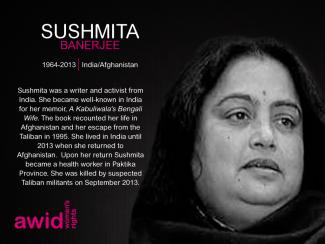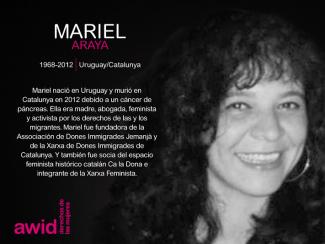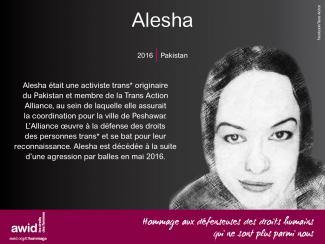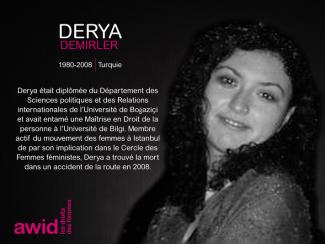

Philippe Leroyer | Flickr (CC BY-NC-ND 2.0)

Special Focus

AWID is an international, feminist, membership organisation committed to achieving gender equality, sustainable development and women’s human rights

Women Human Rights Defenders

WHRDs are self-identified women and lesbian, bisexual, transgender, queer and intersex (LBTQI) people and others who defend rights and are subject to gender-specific risks and threats due to their human rights work and/or as a direct consequence of their gender identity or sexual orientation.

WHRDs are subject to systematic violence and discrimination due to their identities and unyielding struggles for rights, equality and justice.

The WHRD Program collaborates with international and regional partners as well as the AWID membership to raise awareness about these risks and threats, advocate for feminist and holistic measures of protection and safety, and actively promote a culture of self-care and collective well being in our movements.


Risks and threats targeting WHRDs  

WHRDs are exposed to the same types of risks that all other defenders who defend human rights, communities, and the environment face. However, they are also exposed to gender-based violence and gender-specific risks because they challenge existing gender norms within their communities and societies.

By defending rights, WHRDs are at risk of:

  • Physical assault and death
  • Intimidation and harassment, including in online spaces
  • Judicial harassment and criminalization
  • Burnout

A collaborative, holistic approach to safety

We work collaboratively with international and regional networks and our membership

  • to raise awareness about human rights abuses and violations against WHRDs and the systemic violence and discrimination they experience
  • to strengthen protection mechanisms and ensure more effective and timely responses to WHRDs at risk

We work to promote a holistic approach to protection which includes:

  • emphasizing the importance of self-care and collective well being, and recognizing that what care and wellbeing mean may differ across cultures
  • documenting the violations targeting WHRDs using a feminist intersectional perspective;
  • promoting the social recognition and celebration of the work and resilience of WHRDs ; and
  • building civic spaces that are conducive to dismantling structural inequalities without restrictions or obstacles

Our Actions

We aim to contribute to a safer world for WHRDs, their families and communities. We believe that action for rights and justice should not put WHRDs at risk; it should be appreciated and celebrated.

  • Promoting collaboration and coordination among human rights and women’s rights organizations at the international level to  strengthen  responses concerning safety and wellbeing of WHRDs.

  • Supporting regional networks of WHRDs and their organizations, such as the Mesoamerican Initiative for WHRDs and the WHRD Middle East and North Africa  Coalition, in promoting and strengthening collective action for protection - emphasizing the establishment of solidarity and protection networks, the promotion of self-care, and advocacy and mobilization for the safety of WHRDs;

  • Increasing the visibility and recognition of  WHRDs and their struggles, as well as the risks that they encounter by documenting the attacks that they face, and researching, producing, and disseminating information on their struggles, strategies, and challenges:

  • Mobilizing urgent responses of international solidarity for WHRDs at risk through our international and regional networks, and our active membership.

Related Content

註冊費包括什麼?

所有參與者的AWID論壇註冊費包括:

  • 可自由參加所有四天的論壇
  • 論壇期間的午餐和咖啡/茶歇
  • 材料資源
  • 全體會議期間和部分選定的分組討論/活動(英語、法語、西班牙語和當地語言)的同聲傳譯
  • 參加慶祝晚宴/派對
  • 具有最終程序和聊天功能的移動應用
  • 論壇場所提供免費Wi-Fi服務
  • 機場接送和酒店與會場之間的交通

Janette Sunita

From India, Janette was feisty, formidable, compassionate and loving.

Janette’s intolerance of injustice and fierce commitment to standing up for all people’s rights led her to work at TARSHI (an NGO that works on sexuality and sexual and reproductive health and rights) for more than 15 years. Janette ably managed and led the finance, human resources and operations aspects of TARSHI’s work, adeptly navigating the labyrinthine bureaucracy to which Indian NGOs are subjected.

Her team remembers that  “She stood watch so we could steer well in open waters. A woman of many talents, Janette not only helped us procure our own office space but also designed it for optimal usage.She loved travel and animals and was interested in animal assisted therapy."


Janette Sunita, India

Snippet FEA Financial Precarities (ES)

This image represents a faceless person with dark hair, yellow glasses, and V-neck navy blue colored shirt that is writing on a burgundy piece of paper with a yellow pencil
LA PRECARIEDAD FINANCIERA
es constante

1. Gather your resources

This section highlights key resources recommended by AWID so you can conduct your own WITM research.

In this section

People needed

  • 1 or more person(s) to lead overall implementation of research methodology and ensure all key pieces are on track (Sections 2-11)
  • 1 or more person(s) to conceptualize the key research objectives and guiding questions
  • 1 or more person(s) to refine and conduct the research methodology, including collecting data
  • 1 or more person(s) to conduct relevant qualitative and quantitative analysis of collected data
  • 1 or more person(s) to document and package research findings for desired audience(s)
  • 1 or more person(s) to serve as an editor to your final products
  • 1 or more person(s) to conduct outreach to spread the word about your survey and advocacy using your research results

Back to top


Potential expenses

  1. Staff and/or consultant salaries
  2. Data analysis software if conducting analysis of large dataset in-house. Options:
    - SPSS
    - Stata
    - R (this is free)
  3. Cost of producing publications and research products
  4. If desired, incentive prize that survey participants can win if they complete the survey
  5. If desired, incentives to offer your advisors

Back to top


Estimated time

  • For research process: 6 to 18 months, depending on size of dataset(s) and staff capacity
  • For advocacy: 1-2 years, as determined by your organizational goals

Back to top


Resources needed

  • List of advisor organizations, donors and activists
  • List of online spaces and events/networks to distribute your survey and present your survey results
  • List of donors, activists, and women’s rights organizations to interview
  • Prepared interview questions
  • List of publication sources to use for desk research

Back to top


Resources available

Online tools

Once you gather these resources, you can estimate the costs for your research using our “Ready to Go? Worksheet”

Back to top


Previous step

Before you begin

Next step

2. Frame your research


Previous step

Before you begin

Next step

2. Frame your research


The Ready to Go? Worksheet helps you estimate resources, staff and budget needed for your research

Download the toolkit in PDF

I don't feel comfortable sharing the name of my group and our contact information with AWID, should I still fill out the survey?

Absolutely. These questions are optional, we value your right to remain anonymous. Please fill the survey regardless of your decision to share the name and contact information of your group, organization and/or movement.

我無法親自參加論壇,我還可以以何種方式參加?

AWID論壇不僅是一個活動,更是我們女權主義現實實踐之旅的一部分。有許多空間可以供參會者在線和離線地聚集在一起,用於共享、討論、制定戰略和共同創建女權主義現實實踐。

在論壇之前瞭解有關女權主義現實實踐之旅的更多信息。(In English) 加入我們的郵件列表,可隨時關注論壇結束後的公告!

我們正在探索以虛擬的方式參與論壇,而且會即時地分享信息一旦我們確定可以提供任何信息。

Juana Raymundo

Juana fue una indígena maya ixil, enfermera profesional y coordinadora del Comité de Desarrollo Campesino – CODECA de la microrregión de Nebaj Quiché.

El comité es una organización de derechos humanos formada por granjerxs indígenas dedicada a promover los derechos sobre la tierra y el desarrollo rural para las familias indígenas. Inicialmente, Juana se unió a CODECA como integrante de su rama juvenil, la Juventud de CODECA. Al momento de su muerte, había sido elegida para ser parte del Comité Ejecutivo del Movimiento de Liberación de los Pueblos (MLP).

Su cuerpo fue encontrado por lxs vecinxs, junto a un pequeño río en el camino cerca de Nebaj y Villa Acambalam, en Guatemala. Según CODECA, el cuerpo de Juana mostraba signos de tortura. 


Juana Raymundo, Guatemala

Snippet FEA Get Involved Story 3 (FR)

ENGAGEZ-VOUS!

Suivez le travail de la coopérative sur Facebook ou Instagram, partagez leurs campagnes et gardez un oeil sur leurs actions et événements de collecte de fonds!

5. Conduct interviews

Interviews produce in-depth information that you cannot easily obtain from surveys. While surveys focuses mainly on quantifiable data and closed questions, interviews allow for expert opinions from activists and donors, and open-ended questions which can provide context to survey data results.

In this section

General tips

1. Before conducting your interviews

Send the interviewees a concept note with your objectives for the interview and for your overall research, as well as a list of questions.

This allows them to prepare answers for more complicated questions and look up information that they may not have immediately on hand.

2. During the interviews

  • You can conduct interviews while your survey is running, in order to save time.
  • Try to keep your interviews as consistent as possible in order to facilitate systematic analysis of results. This means asking the same questions. Coding identical responses to each question will allow you to uncover hidden trends.
  • The interviews can also be used to flesh out some of the survey findings

Do not base your questions on assumptions about your interviewees’ knowledge.
Instead, first clarify what they know – this will reveal information as well.

  • DON’T: “Given the current funding trends in Switzerland, do you know of any opportunities for collaboration? This question assumes that the interviewee knows current funding trends and that their understanding of funding trends matches yours.
  • DO: First ask “What is your understanding of current funding trends in Switzerland?”, followed by “Do you know of any opportunities for collaboration?” This will reveal what their understanding is, giving you even more information than the first question.

Back to top


Specialized interviews

1. Donor interviews

Interviews with donors will allow you to build deeper relationships with them, which will be useful when you conduct post-research advocacy. They will also provide you with deeper insight into funders’ decision-making processes.

Suggested topics of focus for donor interviews:

  • What are their funding priorities? Why and how did they select those priorities? For example, why do they choose project-funding over core support or vice versa?
  • What are annual amounts allocated to the advancement of women’s human rights? This will strengthen overall reliability of data collected.
  • Have they noticed any funding trends, and what do they believe are the origins and politics behind these trends?
  • What is their theory of social change and how does that impact their relationships with women’s rights organizations?
View samples of donor interviews

2. Women’s rights organizations and activists interviews

Interviews with women’s rights organizations and activists will provide you with insight into their on-the-ground realities. Again, these interviews will allow you to build deeper relationships that can be incorporated into your advocacy, particularly to encourage collaboration between donors and activists.

Suggested topics of focus for women’s rights organizations and activist interviews:

  • Long-term funding priority trends noted by women’s organizations and their impact.
  • Successful examples of feminist and collaborative resource mobilization strategies that build strong and complementary movements.
  • “Making the case” for why it is important to support women’s organizations and organizing.
  • How different actors understand the social change process and their role in advancing/achieving gender equality and women’s rights.
View samples of women’s organizations and activists interviews

Back to top


Preliminary findings

Through the course of your WITM research, we recommend analyzing your preliminary findings. Presenting your preliminary findings opens up opportunities to conduct more interviews and get feedback on your research process and initial results. This feedback can be incorporated into your final research.

AWID conducts “WITM convenings” to share preliminary results of survey data and interviews. These gatherings allow participants (activists, women’s rights organizations, and donors) to debate and discuss the results, clarifying the context, creating more ownership amongst members of the movement, and providing more input for final research.

For example, the Resource Mobilization Hub for Indigenous Women’s Rights at the World Summit on Indigenous Philanthropy was used as a space to debut preliminary results.

See the presentation given at the RMH

Back to top


Previous step

4. Collect and analyze your data

Next step

6. Conduct desk research


Estimated time:

• 1.5 - 3 months

People needed:

• 1 or more research person(s)

Resources needed:

• List of donors and women’s rights organizations and activists to interview
• Prepared interview questions
• Concept Note (You can use the research framing you created in the “Frame your research” section)

Resources available:

AWID Sample Interview Questions: Donors
AWID Sample Interview Questions: Activists & Women’s Rights Organizations


Previous step

4. Collect and analyze your data

Next step

6. Conduct desk research


Ready to Go? Worksheet

Download the toolkit in PDF

¿Cuándo estarán disponibles los resultados de la encuesta?

Analizaremos las respuestas a la encuesta para extraer conclusiones y tendencias, y presentaremos los resultados durante el 15º Foro Internacional de AWID en Bangkok y en línea, en diciembre de 2024. Para asistir al Foro, puedes inscribirte aquí.

鑒於新冠肺炎疫情,AWID國際論壇還會在台北舉行嗎?

AWID正密切關注全球新冠肺炎疫情,目前會按原訂計畫推動論壇事宜。

若屆時情況有變,我們會立即通知您。

第十四屆AWID國際論壇將於西元2021年9月20日至23日在台北举行。

更多資訊 (in English)

Kagendo Murungi

Sa famille et ses ami-e-s se souviennent de Kagendo comme d'une activiste, féministe, artiste et cinéaste africaine acharnée

Elle a consacré plus de 20 ans à défendre les droits et la dignité des personnes LGBTIQ d'Afrique et des personnes non conformes du genre. Les collègues de Kagendo se souviennent d'elle comme une personne à la personnalité joviale, à la conviction sans faille et qui aimait la vie. Kagendo est décédée de cause naturelle chez elle à Harlem le 27 décembre 2017.

L'écrivaine et activiste kényane, Shailja Patel, a commenté son décès en ces termes « Tout au long de sa vie, l'engagement de Kagendo à établir des liens entre toutes les formes d’oppressions et à montrer comment le colonialisme a favorisé l'homophobie sur le continent africain, a contribué à rapprocher le Kenya d’un pays où les personnes queer et les femmes indépendantes pourraient vivre et prospérer. »


Kagendo Murungi, Kenya

Snippet FEA how important essential workers are (EN)

The COVID-19 pandemic showed the world how important essential workers are. We’re talking about cleaners, nurses, paramedics, domestic workers, transport workers, grocery shop workers, among others. Their work is to tend to and guarantee the wellbeing of others, and they make our economies function.

But while they take care of us…

Gracias por participar en la creación de nuestros Futuros Feministas

¡Gracias por haber sido parte del Foro AWID 2016!

AWID agradece enormemente a todxs ustedes que han compartido con nosotrxs estos últimos cuatro días de aprendizaje, celebraciones, ideaciones, sueños y la construcción conjunta de nuestros futuros feministas en el Foro AWID 2016.

Nos sentimos muy inspiradxs, maravilladxs y llenxs de energía con todo el trabajo colectivo que hemos hecho para crear nuestros diversos futuros feministas.

Para más imagen, blogues y recursos:

Visite el sitio del Foro


Conéctate con #AWIDForum

Snippet - WITM why - RU

Почему Мне Следовало Бы Пройти Этот Опрос?

AWID為何決定將論壇舉辦地點從峇里島移師到台北呢?

自2019年年末在印尼發生的一連串事件中,我們觀察到了當地軍事緊張與對同志權益的反彈跡象,AWID希望多元的與會者能在論壇齊聚一堂,但這讓我們自問是否能為與會者維持合理安全和讓人感到被歡迎的環境。

經過仔細商討後,AWID董事會在2019年11月決定將第十四屆AWID國際論壇的舉辦地點由峇里島改至台北。

台北擁有穩健的勤務服務能力,對旅客友善(針對國際論壇參與者提供便利的電子簽證流程)。

更多資訊請見以下 :

Teresia Teaiwa

Described by the Guardian as one of Kiribati’s national icons, Teresia was a fearless advocate who worked closely with feminist groups in Fiji.

She used her research to address the issues of feminism and gender in the Pacific, as well as being co-editor of the International feminist Journal of Politics. Her influence spanned the academic frontier as well as social justice movements in the Oceania region.


Teresia Teaiwa, Fiji