Human Rights Council (HRC)
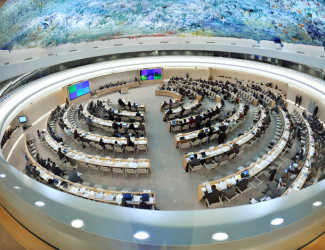
The Human Rights Council (HRC) is the key intergovernmental body within the United Nations system responsible for the promotion and protection of all human rights around the globe. It holds three regular sessions a year: in March, June and September. The Office of the UN High Commissioner for Human Rights (OHCHR) is the secretariat for the HRC.
The HRC works by:
-
Debating and passing resolutions on global human rights issues and human rights situations in particular countries
-
Examining complaints from victims of human rights violations or activist organizations on behalf of victims of human rights violations
-
Appointing independent experts (known as “Special Procedures”) to review human rights violations in specific countries and examine and further global human rights issues
-
Engaging in discussions with experts and governments on human rights issues
-
Assessing the human rights records of all UN Member States every four and a half years through the Universal Periodic Review
AWID works with feminist, progressive and human rights partners to share key knowledge, convene civil society dialogues and events, and influence negotiations and outcomes of the session.
With our partners, our work will:
◾️ Raise awareness of the findings of the 2017 and 2021 OURs Trends Reports.
◾️Support the work of feminist UN experts in the face of backlash and pressure
◾️Advocate for state accountability
◾️ Work with feminist movements and civil society organizations to advance rights related to gender and sexuality.
Related Content
Nuestra agrupación, organización o movimiento no ha tomado ni movilizado financiamiento de donantes externos, ¿deberíamos responder la encuesta?
¡Sí! Reconocemos y valoramos las distintas razones por las que los feminismos en sus contextos respectivos no cuentan con financiamiento externo, ya sea por no reunir los requisitos para solicitar donaciones o para recibir dinero del exterior, o bien porque se financian con recursos generados de manera autónoma como estrategia política en sí misma. Deseamos saber de ustedes con independencia de su experiencia de financiamiento externo.
Snippet FEA Audio A Caring Economy (ES)
Escucha esta historia aquí:
L’activisme au Moyen-Orient et en Afrique du Nord
Notre hommage en ligne met à l’honneur cinq défenseuses des droits humains assassinées au Moyen-Orient ou en Afrique du Nord. Ces défenseuses étaient avocates ou militantes et ont œuvré pour les droits des femmes ou pour les droits civils. Leur mort met en évidence les conditions de travail souvent difficiles et dangereuses dans leurs pays respectifs. Nous vous invitons à vous joindre à nous pour commémorer la vie, le travail et l’activisme de ces femmes. Faites circuler ces mèmes auprès de vos collègues et amis ainsi que dans vos réseaux et twittez en utilisant les hashtags #WHRDTribute et #16Jours.
S'il vous plaît cliquez sur chaque image ci-dessous pour voir une version plus grande et pour télécharger comme un fichier


Patrona Benita Sandoval
Luz Yeni Montaño
Quelles sont les langues officielles de l’enquête WITM?
À l’heure actuelle, l’enquête est disponible sur KOBO en français, anglais, arabe, espagnol, portugais et russe. Vous pouvez choisir votre langue au début du questionnaire.
Snippet FEA Travesti (FR)
TRAVESTI :
une identité de genre latino-américaine
Le terme travesti désigne une identité de genre latino-américaine sans équivalent dans d'autres langues, et exclusivement féminine. C'est une personne désignée de genre masculin à la naissance qui s'identifie comme une femme.
Elles doivent toujours être adressées avec le pronom “elle”. Travesti n'est pas seulement une identité de genre située en dehors de la binarité de genre, c'est aussi une identité culturelle enracinée dans les mouvements latino-américains.
Le terme était initialement péjoratif, mais a ensuite été réapproprié comme symbole de résistance et de dignité. Chaque travesti est trans parce qu'elle ne s'identifie pas au genre désigné à la naissance, mais toutes les travesti ne se considèrent pas comme femmes trans, car travesti est déjà une identité de genre en soi.
Référence: Berkins, Lohana. (2006). Travestis: una Identidad Política . Trabajo presentado en el Panel Sexualidades contemporáneas en las VIII Jornadas Nacionales de Historia de las Mujeres/ III Congreso Iberoamericano de Estudios de Género Diferencia Desigualdad. Construirnos en la diversidad, Villa Giardino, Córdoba, 25 al 28 de octubre de 2006.
WHRDs from Sub-Saharan Africa
In our 2015 Online Tribute to Women Human Rights Defenders No Longer With Us we are commemorating four women from Sub-Saharan Africa, three of whom were murdered due to their work and/or who they were in their gender identity and sexual orientation. Their deaths highlight the violence LGBT persons often face in the region and across the globe. Please join AWID in honoring these women, their activism and legacy by sharing the memes below with your colleagues, networks and friends and by using the hashtags #WHRDTribute and #16Days.
Please click on each image below to see a larger version and download as a file


Paula Ettelbrick
María Verónica Reina
María was recognized globally for her extraordinary leadership in the disability community.
She represented the International Disability and Development Consortium during the negotiation of the United Nations Convention on the Rights of Persons with Disabilities (2001-2006).
Her work was devoted to the implementation of the goal of the Convention - realization of universal human rights by, for and with persons with disabilities for an inclusive, accessible and sustainable world.
In her words, her leadership was about “...serving the disability community, starting with small tasks that others may not wish to do”.
She passed away on October 27, 2017 in her hometown of Rosario, Argentina.
Read more about María Verónica Reina in her own words