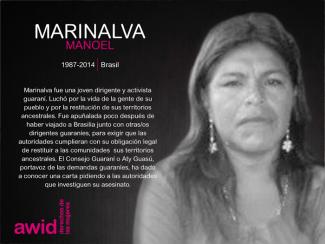
Marinalva Manoel
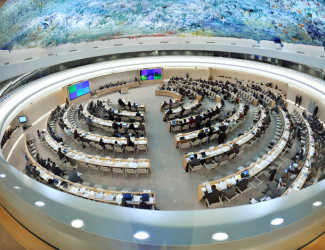
The Human Rights Council (HRC) is the key intergovernmental body within the United Nations system responsible for the promotion and protection of all human rights around the globe. It holds three regular sessions a year: in March, June and September. The Office of the UN High Commissioner for Human Rights (OHCHR) is the secretariat for the HRC.
Debating and passing resolutions on global human rights issues and human rights situations in particular countries
Examining complaints from victims of human rights violations or activist organizations on behalf of victims of human rights violations
Appointing independent experts (known as “Special Procedures”) to review human rights violations in specific countries and examine and further global human rights issues
Engaging in discussions with experts and governments on human rights issues
Assessing the human rights records of all UN Member States every four and a half years through the Universal Periodic Review
AWID works with feminist, progressive and human rights partners to share key knowledge, convene civil society dialogues and events, and influence negotiations and outcomes of the session.
Enciende tu fuego feminista leyendo nuestras investigaciones y publicaciones varias sobre financiamiento, defensoras de derechos humanos, construcción de movimientos, fundamentalismos, justicia económica, seguimiento y evaluación feminista y más
Building on our 20-year history of mobilizing more and better funding for feminist-led social change, AWID invites you to complete the new iteration of our flagship survey, WITM.
Affectueusement connue sous le nom de « Mama Efua », Efua a lutté contre les mutilations génitales féminines (MGF) pendant trois décennies et a contribué à attirer l'attention et l'action de la communauté internationale pour mettre fin à cette pratique néfaste.
En 1983, Efua a cofondé FORWARD (fondation pour la santé, la recherche et le développement des femmes), qui est devenue une organisation de premier plan dans la lutte contre les MGF. Son livre intitulé « Cutting the Rose: Female Genital Mutilation » (couper la rose), publié en 1994, est considéré comme le premier ouvrage sur les mutilations génitales féminines. Il figure parmi « Les 100 meilleurs livres africains du XXe siècle » de l’Université de Columbia.
Originaire du Ghana et infirmière de formation, Efua a rejoint l'OMS en 1995 et a réussi à faire en sorte que les mutilations génitales féminines fassent partie des agendas politiques des États membres de l'OMS. Elle a également travaillé en étroite collaboration avec le gouvernement nigérian pour élaborer une politique nationale globale qui servirait de base légale aux lois nigérianes contre les mutilations et qui est toujours en vigueur à ce jour.
Son travail de pionnière a abouti à une campagne menée par l'Afrique intitulée « The Girl Generation », qui s'est engagée à mettre fin aux MGF en une génération. Efua a montré comment une seule personne peut devenir la voix unificatrice d'un mouvement : « Une identité partagée peut aider à rassembler des activistes d'horizons différents dans un but commun ». Ces mots, emplis de sagesse, sont plus pertinents que jamais.

La financiación para el desarrollo encierra amenazas y oportunidades concretas para los derechos de las mujeres y los derechos humanos de todas las personas. Una financiación y políticas para el desarrollo que sean transformadoras pueden constituir un aporte importante para los cambios sistémicos que se necesitan a fin de garantizar el respeto, la protección y la realización de los derechos humanos de las mujeres.
El año 2015 es importante en el proceso de la FpD. La tercera Conferencia Internacional sobre la FpD tuvo lugar del 13 al 16 de julio de 2015 en Adís Abeba, Etiopía, y los gobiernos están finalizando la Agenda de Desarrollo Post-2015 que incluye acuerdos acerca de cómo se van a financiar los Objetivos de Desarrollo Sostenible.
En su actual etapa, el proceso de la FpD ofrece una oportunidad importante para fijar un marco de financiación que garantice un apoyo financiero efectivo para la implementación de la Agenda Post-2015 y de los Objetivos de Desarrollo Sostenible (ODS). También constituye una oportunidad para abordar las condiciones estructurales y los cambios sistémicos necesarios para la plena implementación de otras agendas y compromisos como los tratados internacionales de derechos humanos y la Plataforma de Acción de Beijing.
En estos últimos trece años, organizaciones por los derechos de las mujeres y feministas han participado activamente en el proceso de la FpD.
Écoutez cette histoire ici :
par Maryum Saifee
Lorsqu’on effectue une recherche en ligne sur les « Mutilations génitales féminines » ou « MGF », un schéma en quatre parties sur l’anatomie des femmes apparaît à côté d’une page Wikipédia dédiée. (...)
Illustration : « Rêves », par Neesa Sunar >
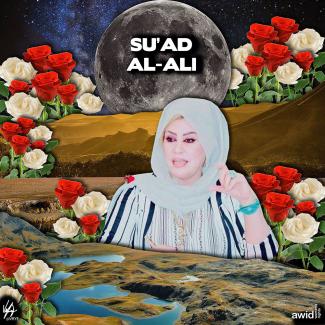
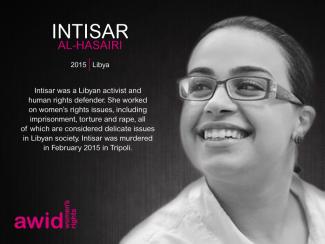
Su’ad was a strong advocate of women’s and children’s rights, and was the head of Al-Weed Al-Alaiami - an Iraqi human rights organisation.
She participated in the July 2018 demonstrations that took place in Basra and several other Iraqi cities protesting unemployment and demanding jobs and proper public services for citizens, as well as calling for the elimination of rampant corruption.
On 25 September 2018, Su’ad was assassinated in the Al-Abbasiyah district in downtown Basra. A video of the incident showed a person approaching her as she was getting into her car, firing a bullet at the back of her head and pointing another bullet at her driver Hussain Hassan, who was injured in the shoulder. Al-Ali was 46 and the mother of four children.
For any questions related to the Call for Forum Activities please contact us, selecting Forum Call for Activities as the subject of your email.
We are thrilled to announce the launch of AWID’s new podcast THAT FEMINIST FIRE. Our narrative series unravels over 40 years of feminist movements—and reimagines a way forward.
In our pilot season, you’ll hear five compelling stories that are part of a constellation of feminist activism today. Hosted by our very own Gopika Bashi, Deputy Director of Programmes at AWID, each episode explores unique but interconnected feminist realities that are achieving greater gender justice and human rights.
Produced by our Webby-winning podcast partner Hueman Group Media, you can subscribe to THAT FEMINIST FIRE and listen to our first episode here.
Find us on Apple Podcasts, Spotify, or wherever you get your podcasts. Share with your network! Help us spread stories that ignite our feminist fire and move us to action.
The AWID International Forum is both a global community event and a space of radical personal transformation. A one-of-a-kind convening, the Forum brings together feminist, women’s rights, gender justice, LBTQI+ and allied movements, in all our diversity and humanity, to connect, heal and thrive.
The Forum theme – Rising Together – is an invitation to engage with our whole selves, to connect with each other in focused, caring and brave ways, so that we can feel the heartbeat of global movements and rise together to meet the challenges of these times.
For the first time, the AWID Forum offered three modes of participation:
 |
 |
 |
|
In Person at the Queen Sirikit National Convention Centre in Bangkok, Thailand. |
Online in Virtual Space (Capacity: 3000 participants). |
Hubs Connected in Cross Border Space. |
With over 4,000 participants, 15th AWID International Forum in 2024 created a sweeping force to resist oppression towards collective healing and liberation. Keep watching this space for more forum stories and future forums updates!
The past Forums
In December 2020, the AWID board took the difficult decision to cancel the 14th AWID International Forum which had been scheduled to take place from September 20-23, 2021, in the City of Taipei.
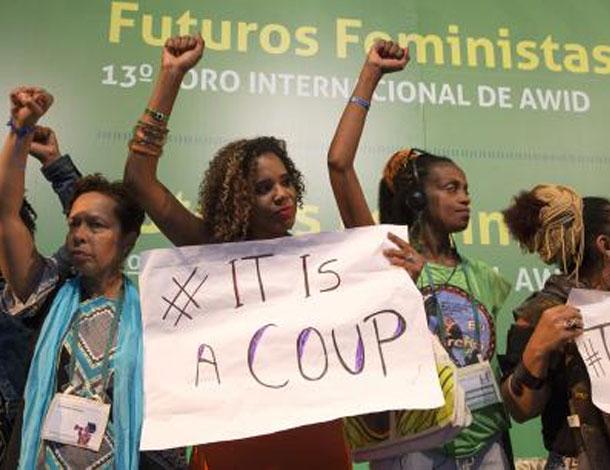
Given the complex world that we face today, the 2016 AWID Forum did not focus on a particular “issue”, but rather on creating more effective ways of working together!
Despite the challenging contexts in which the 2016 Forum took place (the Zika epidemic, a strike by Brazilian foreign-service workers, the impeachment of President Dilma Rousseff and subsequent turmoil), it succeeded in bringing together over 1800 participants from 120 countries and territories across all regions of the world.
For 96% of participants who responded to the post Forum evaluation survey, the Forum was a major source of inspiration and energy.
98% of participants considered it an important convening space for feminist movements and expressed hope that AWID continues to organize forums.
59% of Forum evaluation survey respondents declared to be very satisfied with the Forum and 34% somewhat satisfied.
Over 150 sessions were delivered in different formats on a variety of topics ranging from bodily integrity and freedoms, to gender-based violence in the workplace, to strategies for building collective power.
The first-time Black Feminisms Forum (BFF), held just before the main AWID Forum, brought together 250 Black feminists from all over the world to co-create a powerful space to build and strengthen ongoing, intergenerational, transnational connections
Download the Forum evaluation report
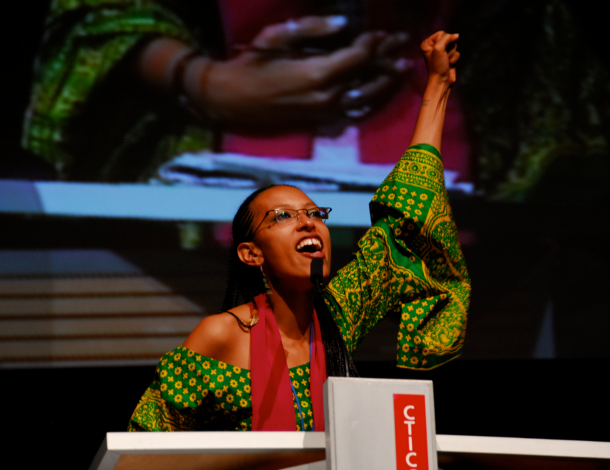
The 12th AWID Forum was the largest and most diverse AWID Forum to date, bringing together 2239 women’s rights activists from 141 countries. Of these participants, around 65% were from the Global South and close to 15% were young women under 30, and 75% attended an AWID Forum for their first time.
The Forum program focused on transforming economic power to advance women’s rights and justice and featured over 170 different kinds of sessions including feminist economics toolbox skills-building sessions, breakout sessions representing all 10 Forum themes, in-depth sessions, and solidarity roundtables.
Building on the momentum of the 2012 Forum, we transformed the website into a resource and learning Hub, which builds on the content generated by participants by featuring multi-media resources on all Forum components.
Visit the 2012 Forum web archive
Every three to four years, AWID hosts its flagship international event. It is the world’s largest event that wholeheartedly centers feminist and gender justice movements in all their diversity. It is a global gathering of feminist activists, allied movements, scholars, funders and policymakers. The Forums rotate between different regions and countries in the global South.
by Marta Plaza Fernández
The feminist reality that I want to share is about weaving networks in which we uphold one another. (...)
artwork: “Entretejidas” [Interwoven women] by Surmercé >
Learn more about upcoming CSW69 events that AWID is co-organizing
“Afterwards
After love the first time,
Our naked bodies and minds
A hall of mirrors,
Wholly unarmed, utterly fragile,
We lie in one another's arms
Breathing with care,
Afraid to break
These crystal figurines.” - Fahmida Riaz
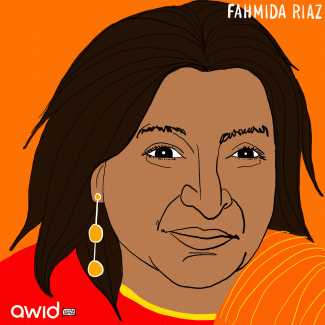
Her work faced harsh criticism from conservatives, who accused her of using erotic and “pornographic” expressions in her poetic language.
Fahimida was eventually blacklisted and charged with sedition under Section 124A of the Pakistan Penal Code) during the dictatorship of Zia Ul Haq. Forced into exile in 1981, she spent almost seven years in India before returning to Pakistan.
As part of the preface to “Badan Dareeda” ('The Torn-Bodied'), a collection of poetry published in 1974, she wrote:
The brilliance of Fahmida was in defying any singular logic or categories of gender, nation, religion or culture. She refused to be put in the role of a ‘woman poet’, breaking with traditional definitions of feminine poetry and concepts and themes (ranging from political consciousness, body, culture, desire, religion, home) and knocking down inhibitions put on her gender.
“You have to understand that culture can have no essence. Cultures move, flowing into one another, forming new cultures. Culture is born this way. There is no clash of cultures.”
Fahmida authored more than 15 books on poetry and fiction including her poem ‘Taaziyati Qaraardaaden’ (‘Condolence Resolutions’) that might serve as an appropriate tribute to her life and legacy and a collection of poems (Apna Jurm To Saabit He ‘My Crime Stands Proven’) published in 1988 during her time in exile.
Fahmida Riaz was born in Meerut, India on 28 July 1946 and passed away on 21 November 2018 in Lahore, Pakistan.
This information will only be available when registration opens.