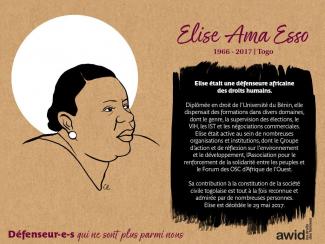
Elise Ama Esso
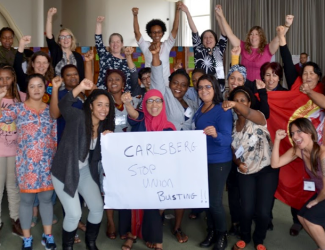
Women human rights defenders (WHRDs) worldwide defend their lands, livelihoods and communities from extractive industries and corporate power. They stand against powerful economic and political interests driving land theft, displacement of communities, loss of livelihoods, and environmental degradation.
Extractivism is an economic and political model of development that commodifies nature and prioritizes profit over human rights and the environment. Rooted in colonial history, it reinforces social and economic inequalities locally and globally. Often, Black, rural and Indigenous women are the most affected by extractivism, and are largely excluded from decision-making. Defying these patriarchal and neo-colonial forces, women rise in defense of rights, lands, people and nature.
WHRDs confronting extractive industries experience a range of risks, threats and violations, including criminalization, stigmatization, violence and intimidation. Their stories reveal a strong aspect of gendered and sexualized violence. Perpetrators include state and local authorities, corporations, police, military, paramilitary and private security forces, and at times their own communities.
AWID and the Women Human Rights Defenders International Coalition (WHRD-IC) are pleased to announce “Women Human Rights Defenders Confronting Extractivism and Corporate Power”; a cross-regional research project documenting the lived experiences of WHRDs from Asia, Africa and Latin America.
"Women Human Rights Defenders confronting extractive industries: an overview of critical risks and Human Rights obligations" is a policy report with a gender perspective. It analyses forms of violations and types of perpetrators, quotes relevant human rights obligations and includes policy recommendations to states, corporations, civil society and donors.
"Weaving resistance through action: Strategies of Women Human Rights Defenders confronting extractive industries" is a practical guide outlining creative and deliberate forms of action, successful tactics and inspiring stories of resistance.
The video “Defending people and planet: Women confronting extractive industries” puts courageous WHRDs from Africa, Asia, and Latin America in the spotlight. They share their struggles for land and life, and speak to the risks and challenges they face in their activism.
Challenging corporate power: Struggles for women’s rights, economic and gender justice is a research paper outlining the impacts of corporate power and offering insights into strategies of resistance.
AWID acknowledges with gratitude the invaluable input of every Woman Human Rights Defender who participated in this project. This project was made possible thanks to your willingness to generously and openly share your experiences and learnings. Your courage, creativity and resilience is an inspiration for us all. Thank you!
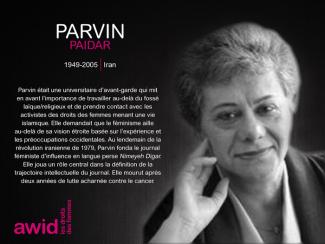
En Europe de l’Ouest et du Sud-Est ces défenseuses des droits humains ont voué leur vie à mener des campagnes ou des recherches. Elles ont été membres de différents mouvements pour la paix ou pour les droits des femmes et ont contribué à les faire évoluer par le biais de l'action politique, de l’activisme social ou à travers la danse. Nous les remercions infiniment pour l'héritage qu'elles nous ont laissé. Nous vous invitons à vous joindre à l’AWID pour rendre hommage à ces femmes, à leur activisme et à l’héritage qu’elles nous ont laissé. Faites ces mèmes auprès de vos collègues et amis ainsi que dans vos réseaux et en twittez en utilisant les hashtags #WHRDTribute et #16Jours.
S'il vous plaît cliquez sur chaque image ci-dessous pour voir une version plus grande et pour télécharger comme un fichier


La durée est estimée à 30 minutes.
Le cadre de référence de votre recherche vous guidera tout au long du processus de recherche. Le document de référence que vous élaborez peut aussi servir de note de synthèse destinée aux personnes qui vous conseillent et à vos partenaires, ainsi qu’à une demande de financement aux éventuels donateurs.
Dans cette section
Avant de mener toute recherche :
- Fixez les objectifs de votre recherche.
- Dressez la liste des questions principales auxquelles vous souhaitez que votre recherche réponde.
- Écrivez les types de données que vous devrez recueillir et examinez-les pour répondre à vos questions principales.
- Définissez les produits finaux que vous élaborerez à l’aide de votre recherche.
Le cadre de votre recherche pourra évoluer avec le temps, alors que vous peaufinez vos questions et recueillez de nouvelles informations. Cependant, le fait de créer un cadre de recherche dès le départ vous permettra de travailler à partir d’une base solide.
Afin que votre recherche WITM ait une base solide, il est important de définir clairement ce que vous souhaitez accomplir.
Par exemple, l’un des objectifs de la recherche mondiale WITM de l’AWID consistait à fournir des données rigoureuses afin de prouver ce que nous savions déjà par ouï-dire : que les organisations de droits des femmes sont sous-financées, et de surcroît de façon marquée. Ces données nous permettraient selon nous d’être en meilleure position pour influencer les prises de décisions des bailleurs de fonds.
Vos objectifs pourraient être les suivants :
Structurez votre processus de recherche à l’aide de questions clés auxquelles seule votre recherche puisse répondre et limitez ces questions à un laps de temps spécifique (p. ex. la dernière année, les derniers cinq ans, etc.).
Tenez compte des aspects suivants :
Le fait de choisir une période spécifique pour votre recherche peut mener à des résultats plus précis qu’ils ne le seraient si vous travailliez avec un calendrier ouvert. De plus, la décision de répéter ou non votre recherche à intervalles réguliers vous permettra de fixer des repères de collecte de données, facilitant la reproduction et la comparaison au fil du temps.
Principales questions qui ont guidé le processus de recherche WITM de l’AWID :
- Quelle est la situation actuelle quant à la durabilité financière des organisations de droits des femmes à travers le monde ?
- Quelles sont les tendances externes et internes qui influent sur les décisions de financement des donateurs à l’appui des organisations et des mouvements de femmes ?
Maintenant que vous avez défini vos questions principales, vous pouvez déterminer les types de données qui vous aideront à répondre à ces questions. Ainsi, vous serez en mesure de planifier le reste du calendrier de votre recherche WITM.
Par exemple, est-ce que vous mènerez une enquête qui couvre une vaste proportion de votre population prioritaire ? Est-ce que vous analyserez les demandes de financement que les bailleurs de fonds reçoivent dans une région particulière ? Est-ce que vous procéderez à des interviews (recommandé) ? En déterminant quelles sont les données dont vous avez besoin, vous pourrez entrer en contact avec des parties externes qui vous fourniront ces données dès le départ, et serez à même de planifier en conséquence l’ensemble de votre calendrier. Nous vous suggérons les sources de données suivantes :
La diversité des ensembles de données constitue un excellent moyen de créer une analyse robuste et riche.
Par exemple, les données de l’Enquête mondiale de l’AWID en 2011 sont les piliers de nos récentes analyses. Cependant, nous avons également recueilli des données d’interviews sur le terrain, avec des donateurs, des activistes ou des organisations de droits des femmes.
L’élaboration d’un plan initial sur les produits que vous créerez vous permettra non seulement de fixer votre calendrier, mais vous donnera également une idée des ressources dont vous aurez besoin.
Par exemple, produirez-vous uniquement un rapport de recherche ou créerez-vous également des infographies, des dépliants et des présentations ? Selon les produits que vous choisirez, vous aurez peut-être à recourir à des sociétés de conception graphique, à prévoir des manifestations, etc.
Ces produits seront également les outils que vous utiliserez pour atteindre vos objectifs. Ainsi, il est important de garder ces objectifs à l’esprit. Par exemple, votre recherche WITM a-t-elle pour unique objectif de servir d’outil de plaidoyer visant à influencer les bailleurs de fonds ? Si tel est le cas, vos produits devraient vous permettre de mobiliser les bailleurs de fonds de manière significative.
Exemples de produits :
Le fait d’établir un cadre de recherche portant sur les objectifs, les questions principales, les types de données et les produits finaux vous permettra de créer un calendrier bien planifié, de préparer vos ressources à l’avance et de fixer un budget réaliste.
Cette démarche facilitera les interactions avec les partenaires externes, tout en vous permettant de gérer plus aisément les contretemps inattendus.

• 1 mois
• 1 personne (ou plus) chargée de la recherche
• Exemple 1 : Cadre de référence d’une recherche
• Exemple 2 : Cadre de référence d’une recherche
If, for any reason, you want your response to be withdrawn and deleted, you have the right to do so. Please contact us via the form here, indicating “WITM Survey” as the title of your message, and we will withdraw and delete your response.
“It’s the indigenous knowledge and the practices that have always supported food sovereignty and this knowhow is in the hands of the women … Ecofeminism for me is the respect for all that we have around us.”
Mariama Sonko
Interview to The Guardian
La recherche documentaire peut se dérouler tout au long de votre initiative. Elle peut vous aider à encadrer vos travaux, à choisir des questions de sondage et à comprendre vos résultats.
Dans cette section
- Préciser le contexte
- S’appuyer sur les connaissances existantes
- Sources éventuelles d’information pour la recherche documentaire
1. Sites Web et rapports annuels des donateurs
2. Sources d’information en ligne
La réalisation de recherches documentaires tout au long de votre initiative peut vous aider à encadrer vos travaux, à choisir les questions de sondage et à vous fournir une clarté contextuelle, tout en rehaussant votre compréhension des résultats de votre sondage. Vous pourriez notamment comparer les similarités et les différences entre les résultats de votre sondage et l’information diffusée par la société civile et les donateurs.
Il se peut que vous déceliez des tendances dans les résultats de votre sondage et que vous souhaitiez mieux les comprendre.
Par exemple, vos données de sondage pourraient révéler que les budgets des organisations diminuent, mais cela ne vous dit pas pour quelle raison cette situation se produit. L’analyse des publications vous donne un contexte et vous révèle certaines des raisons pour lesquelles ces tendances surviennent.
La recherche documentaire garantit également que vous appuyez votre recherche sur les connaissances existantes touchant à votre sujet d’intérêt, confirmant ainsi la validité et la pertinence de vos résultats.
Vos résultats pourraient être complémentaires ou contradictoires par rapport aux connaissances actuelles, mais ils doivent faire référence aux données existantes sur le sujet.
Pour que votre recherche soit complète et englobe tout le panorama du financement qui entoure votre sujet, examinez une gamme de secteurs de financement.
Vous pouvez notamment considérer :
- Les fonds pour les femmes
- Les fondations privées et publiques
- Les organisations non gouvernementales internationales (ONGI)
- Les agences bilatérales et multilatérales
- Les acteurs et actrices du secteur privé
- Les philanthropes
- Les groupes de financement participatif
Inclure tout secteur pertinent dans le cadre de référence de votre recherche.
Par exemple, vous pourriez décider qu’il est important d’effectuer des recherches sur les organisations non gouvernementales (ONG) locales.
Voici des sources directes d’information sur les actions des bailleurs de fonds qui contiennent habituellement des renseignements sur les politiques et les budgets. Si vous réalisez vos recherches avant d’interviewer les donateurs, vos questions seront mieux ciblées et vos interviews plus solides.

• 1-2 mois
• 1 personne (ou plus) chargée de la recherche
7. Synthétisez les résultats de votre recherche
¡Sí, por favor! Te alentamos a compartir el enlace a la encuesta con tus redes. Cuanto más diversas sean las opiniones que recolectemos, más completa será nuestra comprensión del panorama financiero para las organizaciones feministas.
Un lugar de trabajo no tiene que operar sobre la base de la competencia y las ganancias. No tiene que explotar a la gente en beneficio de unx dueñx o pequeña élite.
Las comunidades vulnerabilizadas al margen de las economías formales han ido construyendo modelos cooperativos alternativos basados en la autonomía, la cooperación, la corresponsabilidad, la autogestión y la solidaridad.
Las cooperativas y lugares de trabajo autogestionados por lxs trabajadorxs siempre han ofrecido formas alternativas de generar oportunidades de empleo, ingresos, seguridad social y ahorros y, al mismo tiempo, distribuir los ingresos de formas más comunitarias, sostenibles y seguras.
Pero es más que una oportunidad de empleo: es hacer realidad los sueños y construir economías feministas basadas en la solidaridad y el cuidado mutuo. Es crear un mundo donde nuestras vidas, nuestro trabajo y nuestras comunidades importen.
Esta es la historia de la Cooperativa Textil Nadia Echazú, la primera cooperativa creada y dirigida por y para personas travesti y trans en Argentina.
Avant de prendre sa retraite, elle a occupé de nombreux postes de haut niveau, notamment celui de membre de la cour d’appel et juge en chef adjointe de l’Ouganda. Elle a été la première femme ougandaise à occuper le poste de magistrat en chef entre 1973 et 1986 et la première femme à être nommée juge à la Haute Cour de justice en 1986.
Elle fut l'une des premières femmes à recevoir le titre de chevalier pontifical de l'histoire de l'Église catholique en Afrique. Elle est morte d'une crise cardiaque.