Sabriya Simon
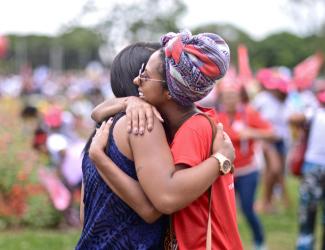
Marcha da Mulheres Negras 2016

Priority Areas

Supporting feminist, women’s rights and gender justice movements to thrive, to be a driving force in challenging systems of oppression, and to co-create feminist realities.

Co-Creating Feminist Realities

While we dream of a feminist world, there are those who are already building and living it. These are our Feminist Realities!

What are Feminist Realities?

Feminist Realities are the living, breathing examples of the just world we are co-creating. They exist now, in the many ways we live, struggle and build our lives.

Feminist Realities go beyond resisting oppressive systems to show us what a world without domination, exploitation and supremacy look like.

These are the narratives we want to unearth, share and amplify throughout this Feminist Realities journey.

Transforming Visions into Lived Experiences

Through this initiative, we:

  • Create and amplify alternatives: We co-create art and creative expressions that center and celebrate the hope, optimism, healing and radical imagination that feminist realities inspire.

  • Build knowledge: We document, demonstrate & disseminate methodologies that will help identify the feminist realities in our diverse communities.

  • Advance feminist agendas: We expand and deepen our collective thinking and organizing to advance just solutions and systems that embody feminist values and visions.

  • Mobilize solidarity actions: We engage feminist, women’s rights and gender justice movements and allies in sharing, exchanging and jointly creating feminist realities, narratives and proposals at the 14th AWID International Forum.


The AWID International Forum

As much as we emphasize the process leading up to, and beyond, the four-day Forum, the event itself is an important part of where the magic happens, thanks to the unique energy and opportunity that comes with bringing people together.

We expect the next Forum to:

  • Build the power of Feminist Realities, by naming, celebrating, amplifying and contributing to build momentum around experiences and propositions that shine light on what is possible and feed our collective imaginations

  • Replenish wells of hope and energy as much needed fuel for rights and justice activism and resilience

  • Strengthen connectivity, reciprocity and solidarity across the diversity of feminist movements and with other rights and justice-oriented movements

Learn more about the Forum process

We are sorry to announce that the 14th AWID International Forum is cancelled

Given the current world situation, our Board of Directors has taken the difficult decision to cancel Forum scheduled in 2021 in Taipei. 

Read the full announcement

Find out more!

Related Content

Yelena Grigoriyeva

Yelena Grigoriyeva, often called Lena by friends, was a prominent LGBT rights campaigner in Russia.

She was part of democratic, anti-war and LGBT movements. In her activism, Yelena was a fierce critic of President Vladimir Putin and his administration, expressing her opposition against Russia’s annexation of Ukraine’s Crimea peninsula and the ill-treatment of prisoners. 

Yelena came out as bisexual earlier in 2019.

"Her coming out was a surprise to me, and I didn't approve of it. I told her 'Listen, Lena, you already have a target painted on you because of your political activity. You've just pinned another to your chest."
- Olga Smirnova

Yelena did receive multiple death threats and according to some of her acquaintances, was listed on a homophobic website that called on its visitors to hunt down LGBT persons. She reported the threats to the police, however the Russian state failed to provide protection. 

But even in a society where political opposition, as well as members of the LGBT community and advocates for their rights, face continuous and increasing violence, Yelena kept campaigning for social justice and equality.

“She did not miss a single action. And they detained her so often that I already lost count,”
- Olga Smirnova (fellow opposition activist and friend).

Yelena was murdered on 21 July 2019, not far from home. A suspect was arrested but according to some sources, many friends and fellow activists believe that the suspect is a scapegoat and that this was a targeted political killing. 

For Yelena’s relatives and friends, her case remains unsolved even though the suspect confessed. 

In 2013, Russia passed legislation banning the spreading of what it described as ‘gay propaganda’. In 2014, Human Rights Watch published a report relating to this. 

لقد تقدمت بطلب للمشاركة في المنتدى السابق، هل أحتاج إلى إعادة التقديم؟

نعم من فضلك. لقد تغير العالم منذ عام 2021 ونحن ندعوك لتقديم مقترح يعكس واقعك وأولوياتك الحالية.

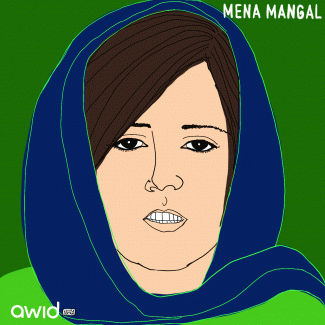
Mena Mangal

Mena Mangal was a prominent TV journalist, women’s rights advocate and cultural adviser to Wolesi Jirga, the lower house of Afghanistan's national parliament. 

For more than a decade, she worked for Ariana TV, Tolo TV's Pashto-language channel Lamar, and the private Afghan national television broadcaster Shamshad TV. As a presenter, Mena focused on women’s rights and cultural talk shows. 

"Women's rights activist Wazhma Frogh said Mangal "had a loud voice" and actively spoke out as an advocate for her people."

Off-screen, she also ran popular social media pages that advocated for the rights of Afghan girls and women to education and work. In terms of her private life, Mena wrote extensively about being forced into an arranged marriage in 2017 and the process she had to go through to finally obtain a divorce. 

In a Facebook post, Mena wrote she was receiving death threats from unknown sources but would continue to carry out her work.

On 11 May 2019, she was attacked by unknown gunmen and shot dead in broad daylight in a public space in Southeast Kabul. 

"We are concerned about the situation because it has a direct impact on women who work outside their homes...Female journalists are changing their professions due to the increasing risks they are facing." - Robina Hamdard, Kabul-based women’s rights activist.

มีมาตราการอย่างไรในการปกป้องด้านสาธารณสุขและควบคุมการระบาดของโรคโควิด19

เราจับตาดูเรื่องนี้และความเสี่ยงอื่นๆอย่างระมัดระวัง และจะนำเสนอข้อมูลด้านสุขภาพและความปลอดภัยที่คลอบคลุมเมื่อมีการเปิดให้ลงทะเบียน เพื่อให้คุณสามารถตัดสินใจได้อย่างมีข้อมูล มากกว่านั้นการจัดประชุมแบบสองรูปแบบ(ออนไลน์และกายภาพ)ถูกออกแบบให้ให้เกิดการมีส่วนร่วมอย่างมีความหมายสำหรับผู้เข้าร่วมที่เลือกจะไม่เดินทาง หรือผู้เข้าร่วมที่ไม่สามารถเดินทางได้

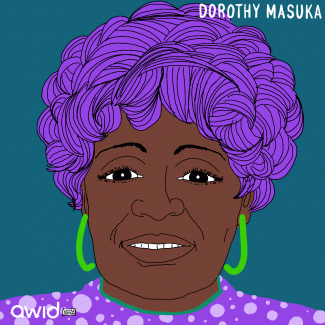
Dorothy Masuka

“I didn’t plan to be a singer, singing planned to be in me.” - Dorothy Masuka (interview with Mail & Guardian)

Dorothy Masuka, born 1935 in Bulawayo (then Southern Rhodesia, now Zimbabwe), grew up in South Africa to become a well-known songwriter, composer, jazz singer and activist, a fervent advocate of the struggle against apartheid. Called “an architect of the discourse of popular African liberation music”, Dorothy often sang about politics in indigenous African languages and throughout her work she confronted the racist policies of the South African government.

One such song titled “Dr. Malan” (named after the pro-apartheid politician D.F. Malan) was banned. She went on to record “Lumumba” (1961), a song about the assassination of the anti-colonial leader Patrice Lumumba. Dorothy’s work and activism attracted the attention of the Special Branch of the South African police and she was forced into a political exile that would span over three decades. Throughout this time, she worked with pro-independence groups including the African National Congress. In 1992, as apartheid started to crumble and Nelson Mandela was released from prison, she returned to South Africa. 

Some of her other work includes the first song she recorded in 1953 entitled “Hamba Notsokolo”, a hit in the 1950s and a valued classic. She also wrote “El Yow Phata Phata”, a song that was adapted by Miriam Makeba, making “Pata, Pata” popular internationally.

Rooted in resistance, Dorothy’s music and activism were intertwined, leaving a magnificent and inspiring legacy. She was also widely known as “Auntie Dot”. 

On 23 February 2019 at the age of 83, Dorothy passed away in Johannesburg due to ill health. 


Watch Dorothy Masuka in an interview with Mail & Guardian

Listen to some of her music:

Hamba Nontsokolo
El Yow Phata Phata
 

CFA 2023 - breadcrumbs Menu _ FAQ-ar

Snippet - WITM survey is focused on - EN

The WITM survey is focused on the feminist resourcing realities of the last 3 years (2021 to 2023), and has five key sections:

  1. Group information
  2. Financial status
  3. Shifting power
  4. Sustainability
  5. Key aspirations

It consists of mandatory* and optional questions, most of which are multiple-choice. You will have a chance to share more on issues that are important to you by responding to the open question(s) at the end of the survey.

Hand holding magnifying glass

To respond to the questions quickly and easily, we advise that you have your key financial information at hand (e.g., your annual budgets from 2021 to 2023). However, if you wish to save your responses and come back to the survey later, you are able to do this whenever needed.

Snippet - WITM about research - EN

About Where is the Money? research

The global survey is a key pillar of the third iteration of our action-oriented research: “Where is the Money for Feminist Organizing?” (in short, Where is the Money or WITM). The results of the survey will be further elaborated and explored through in-depth conversations with activists and funders and cross-referenced with other existing analysis and research on the state of funding for feminists and gender equality globally. 

The full “Where is the Money for Feminist Organizing” report will be published in 2026.

To learn more how AWID has been shining a light on money for and against feminist movements check out the work of our Resourcing Feminist Movements Initiative here.

Our group, organization and/or movement has not taken or mobilized funding from external funders, should we take the survey?

Yes! We recognize and appreciate different reasons why feminists, in their respective contexts, don’t have external funding: from being ineligible to apply for grants and/or receive money from abroad, to relying on resources generated autonomously as a political strategy in its own right. We want to hear from you regardless of your experience with external funding.

Why are you asking for the name of the group, organization and/or movement completing the survey and our contact information?

We are asking for this data to facilitate the review of responses, avoid duplication and be able to contact your group in case you have been unable to complete the questionnaire and/or you have doubts or further questions. You can learn more about how we use the personal information we collect through our work here.

Snippet - WITM why - AR

لماذا عليّ تعبئة الاستطلاع؟

Snippet - WITM To Strengthen - AR

لتقوية صوتنا وقوتنا الجماعية لنصل لتمويل أكبر وأفضل للتنظيمات النسائية والنسوية وحركات الميم - عين وحلفائها/يفاتها عالمياً

Snippet - WITM about research - PT

Sobre o inquérito WITM

O inquérito global do WITM é um pilar fundamental da terceira edição da nossa investigação orientada para a ação: "Onde está o dinheiro para a organização feminista" (abreviado, "Onde está o dinheiro" ou WITM). Os resultados do inquérito serão aprofundados e explorados através de conversas profundas com ativistas e financiadores, e comparados com outras análises e investigações existentes sobre o estado do financiamento para feministas e para a igualdade de género globalmente

O relatório completo "Onde está o dinheiro para a organização feminista" será publicado em 2026.

Para mais informações sobre como a AWID tem chamado a atenção para o dinheiro a favor de e contra os movimentos feministas, consulte a nossa história do WITM e os nossos relatórios anteriores aqui.

ما هو الهدف من استطلاع "أين المال"؟

الهدف الأساسي من وراء استطلاع "أين المال" هو تسليط الضوء على على وقائع التمويل المتنوّعة والمركّبة للحركات النسوية، حركات النساء، حركات العدالة الجندرية وحركات مجتمع الميم - عين والحركات الحليفة لها على المستوى العالمي. بناءاً على هذا، وبناءً على ذلك - تعزيز قضية تحويل أموال أكثر وأفضل وتحويل السلطة باتجاه الحركات النسوية.

Values - intersectionality

Intersectionality

We believe that for feminist movements to be transformative and strong we must continue to work across our similarities and differences. We also must interrogate power and privilege both within and outside our movements.

Мы распределяем деньги среди наших грантополучающих партнерок(-ров) и являемся феминистским и/или женским фондом – можем ли мы участвовать в опросе?

Нет, мы высоко ценим вашу работу, но в данный момент мы не просим откликов от женских и феминистских фондов. Мы будем рады, если вы поделитесь информацией об опросе со своими партнерками(-рами) и контактами внутри феминистской сети.

Posso aceder a e realizar o inquérito no meu telemóvel?

Sim, o inquérito pode ser acedido através de um smartphone.

FRMag - The Story of An Unhappy Tale

The Story of An Unhappy Tale

by Gabriela Estefanía Riera Robles

Juliana. How I would love to be called Juliana! The name is full of power and presence, full of force and vehemence. (...)

Read

< artwork by Borislava Madeit and Stalker Since 1993

هل ستكون لي الفرصة بمشاركة افكاري بأمور لا تغطيها أسئلة الاستطلاع؟

نعم. ندعوكم/ن لمشاركتنا بالأمور التي تجدونها مهمة بالنسبة لكم/ن عن طريق الإجابة على الأسئلة المفتوحة في نهاية الاستطلاع.