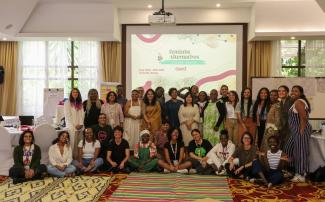
In July 2026 AWID convened 30 feminists from across the Global Majority who are imagining, building and nurturing feminist solutions to learn from each other about how to build and sustain economic alternatives. Our group was made up of farmers, researchers, community organizers, healers and educators from 17 countries working towards building feminist economies that sustain life. After two virtual learning sessions bringing together participants for the first time, we met in Nairobi, Kenya and over a five day period we learned, strategized, questioned and ultimately began the slow, intentional yet essential task of building community. Here are five takeaways for activists exploring how to build alternatives grounded in feminist principles and praxis.
1. Build safeguards against the risks of States mainstreaming feminist alternatives
Feminist community-led economic models existed long before the colonial, capitalist system that dominates our global political economy today. From solidarity-based banking models to communal farming, to bartering of goods and services, among others, community-led economies have stood the test of time and crises. Feminist alternatives have persisted over time partly because they tend to be localized, trust-based, agile, responsive to and in service to community needs. However, they are constantly facing pressure from funders, States and government institutions to formalize their operations. This includes forcing them to register as formal entities, such as an NGO or business enterprise, in order to regulate them, monitor their work, grant them access to funding opportunities they need, allow them to be seen as “legitimate” and in many cases co-opt their work. Yet registration comes with multiple risks. Firstly, the risk of increased State scrutiny and intervention in the day-to-day activities and finances of these feminist initiatives. Secondly, the risk of increased de-politicization and loss of autonomy to comply with the demands of funders and who provide restricted, short-term, project-based funding with tight controls (as the next section explores). Thirdly, in political contexts that are increasingly authoritarian, far-right and fascist, the visibility of feminist collectives comes with greater security risks.
In Kenya for example the government has introduced a bill to attempt to further control Savings and Credit Cooperative Organizations (SACCOs) by putting their money into a centralized fund controlled and regulated by the government. Additionally the government is trying to place limits on the amount of money members can withdraw from the SACCO while proposing to use the reserves to invest in infrastructure. In a country with high interest rates, where only about 30,016 mortgages have been issued by banks and about 8 million people are part of SACCOs, this move risks dispossessing primarily women of the only safety they’ve managed to build through years of saving.
For African diaspora communities in Canada on the other hand, who set up their own community based banking models after being excluded from formal banking systems, the pressure to formalize usually comes from financial institutions. Along with pressure, these communities face stigmatization due to a lack of public knowledge about their alternative banking models. In her book The Banker Ladies: Vanguards of Solidarity Economics and Community Based Banks Professor Caroline Shehnaz Hossein found that women who are part of informal community-based banking systems, referred to collectively as Rotating Savings and Credit Associations (ROSCAs), face greater scrutiny from regular banks and some even fear reprisal from police because of the perception that ROSCAs facilitate money laundering and other harmful activities. However, rather than regulate ROSCAs, Professor Hossein advocates for their recognition as legitimate trust-based models led by African women whose knowledge should be valued and affirmed particularly for the lessons they can offer about solidarity economics. She adds
“I think what they teach the solidarity economy is that democracy matters, consultation matters, collectivity and reciprocity… these are the sort of the cornerstone of what a rescue system is. They have these clear cooperative values based on membership, where people themselves, who are often rejected in society, dehumanized, made to feel like they don't fit into the corporate capitalist system, feel valued and feel belonged in”
The informal nature of these economic alternative models allows them to support their communities while maintaining their autonomy. While some feminist initiatives may opt to formalize by registering, others will likely remain independent. For those that remain informal it is essential that they are neither penalized nor unnecessarily scrutinized for doing so. By remaining informal, feminist alternatives are able to remain subversive while minimizing the risk of State and anti-rights actors’ surveillance, criminalization, and repression. Formalization can also open these models up to taxation even while States fail to provide quality public services in return. As such, rather than pushing for formalization, States should prioritize developing public services that will in turn strengthen these community-led models so that formal systems become less relevant. As Valiana Aguilar from the Suumil Móokt’áan Collective put it:
“We must constantly affirm that communities are not waiting to be organised as they are already organising themselves. These alternative economies are often built around relationships, solidarity and redistribution through networks. They contain organic elements of collective care, resource sharing and mutual support that can offer alternative ways of organising beyond formal economic systems.”
2. Intentionally integrate ethics, politics and practices of care into groups and collectives
One of the most fundamental contributions feminist movements have made to mainstream economics and to social justice organizing is putting care on the agenda both as an organizing principle and as the invisible labour that sustains our societies. By advancing concepts like the social organization of care, which examines how households, the State, markets and community organizations interact to meet the care needs in a society, feminist movements illuminated the unequal distribution of care labour which is disproportionately carried by women. In doing so, feminist labour movements also emphasize that building sustainable and equitable economies requires recognizing care as a human right and a public good that should be provided by the State and is available to all who need it regardless of their ability to pay for it or their employment status. Furthermore that care should not be a private responsibility carried mostly by women but rather it should be a collective social responsibility.
Along with highlighting the role of care as life-sustaining labour, feminist movements center care as a foundational organizing principle in the journey of building feminist economies. In fact, care is as much about the journey as it is about the vision of the feminist worlds that movements are building. This means that community mobilizing work itself must center collective care as both a daily practice and as a framework to sustain activists and movements. As Sapphire Alexander from Caribbean Feminist put it:
“Our work is grounded in collective care… Care is not something separate from the work; it is part of how we organise and sustain ourselves.”
Acknowledging care as infrastructure also means integrating care policies and practices into our organizations and collectives. For Crystal Simeoni who leads the Nawi Afrifem Collective, this means intentionally seeking out health insurance coverage for staff that offers coverage for more than just immediate family members, recognizing that feminist care networks are more expansive. For Gizem Kendik, co-founder of Ihtimam, this involves doing a regular care mapping exercise with her fellow organizers to create more understanding and more intimacy and to make networks of invisible care labour that make civil society organizing possible. This practice was born out of Gizem’s realization that as much as she wanted to, she couldn’t organize in civil society with her grandmother because civil society organizing is not designed for caregivers. Yet her own work would not be possible without the care from her grandmother.
“When care networks are acknowledged, the aspect around the collective creates the possibility and fluidity in movements to do things.” Gizem Kendik
For Mehrub Awan from the Gender Interactive Alliance (GIA), an organization working for the equality and civil rights of transgender people in Pakistan, integrating care is about ensuring flexible leave policies for folks receiving gender affirming care. Care is also embedded into the GIA’s Sarfarosh Camp which creates a space for trans and queer folks to meaningfully connect and share knowledge while prioritizing their care and wellbeing.
It is therefore crucial that we build feminist solutions grounded in care by integrating care into our daily lives, organizing and movement-building work.
3. Funding should enable autonomy, not foster dependency.
Funders should prioritize the needs of movements and communities building and sustaining alternatives over their own pre-determined agendas. Funding should also be directed in the form of flexible and core grants rather than project-based funding which limits feminist organizing by requiring movements shift their work to adapt to existing funding opportunities rather than their own needs. AWID’s Where is The Money research found that “63% of feminist and women’s rights organizations reported having changed their priorities to be eligible for or to increase their chances of receiving funding”1.
In addition to flexible grants, funders should resource movements regardless of whether they are registered or not. For movements, registration often comes with additional burdens including reporting and compliance requirements to States alongside existing administrative demands from funders2. In fact authoritarian governments use burdensome reporting requirements to restrict movements and end up draining the time and resources that could have been used for organizing.3 AWID’s report on a feminist funding ecosystem finds:
“a healthier, more robust funding ecosystem must include movements and funders alike opening space for the full range and diversity within our movements, including frontline activists, communities, and informal collectives, and not just established NGOs.…” (p.11)
Enabling movement autonomy requires that resources be directed to funding feminist alternatives. Funders should support communities to enable them to cultivate strategies that allow them to flourish and trust that communities know what they need.
4. Start planning how to transition away from Big Tech
Building and sustaining feminist economies requires reckoning with the fact that the digital technologies we use on a day to day basis for feminist organizing are not simply neutral tools. In fact, much of the technology we rely on, such as social media platforms like Instagram and messaging tools like WhatsApp, are part of a digital infrastructure owned by a handful of corporations commonly referred to as Big Tech. This means that these tools exist within a global political economy dominated by capitalism and their proliferation perpetuates social, economic and ecological harm. On the economic front, Big Tech is driven by privatization and corporate control that is enriching a handful of billionaires while dispossessing and exploiting the labour of the masses. For example, the rapid growth of AI requires building more data centres which are draining already limited resources including water and energy while dispossessing communities of their land.
“Corporations redefining the service economy take a cut of people's paid work without providing benefits like health insurance or pension or sick leave. Data-driven corporations morph us into "produsers" of social media.” Feminist Principles of the Internet: Economy
The good news is that we can disrupt these models and there are alternatives to Big tech that we can start engaging with today. One way to disrupt is to resist the data driven culture by limiting the information and permissions we share with the apps and platforms we are using, particularly when it is not necessary for the service being provided. Disrupting also means engaging with and promoting the use of free and open source technologies which offer greater transparency about the code as well as the function of the tool/service. Open source platforms like Signal, for example, don’t collect our data and are therefore more secure.
However, it is worth remembering that migrating from Big Tech tools and platforms towards more secure and open source alternatives is a gradual process. As hvale vale notes:
“As we transition from a practice where hardware is privately owned, deployed with little or no respect for the planet, and data is mined, collated, analyzed and algorithmized solely for profit, to a practice of infrastructures-done-differently, we can easily forget that humans need time.”
Along with time movements also need resources to support and enable these shifts. This requires a concerted effort from funders to support movements by providing resources to facilitate the shift to open source and by investing in these alternative technologies directly.
This cannot be a one year fund from a donor project or the three-to-five year cycle of some institution’s strategic planning. This must be a sustained, hopeful, and long-term commitment. hvale vale
The overall challenge for movements is to work towards developing alternative practices and infrastructures that are more aligned with care, privacy, collective security and community needs. Additionally, it is important to keep asking “what is the purpose” when determining what technologies, tools and practices to adopt and, where possible, invest in approaches that can be reused, adapted and shared, rather than creating isolated solutions.
5. Resistance and regeneration are essential for the alternative worlds we are building.
A large part of imagining, building and sustaining feminist economic alternatives comes from shared understandings that many of the challenges movements in the Global Majority are navigating including climate disasters, inequality, inadequate public services and debt are rooted in our shared histories of colonization, capitalist extraction and from the models of development imposed on us. Along with shared histories of oppression, we also have shared histories of resistance to mining and extraction, land dispossession, industrial food systems and the erasure of indigenous knowledge and culture practices. From the Comité Ambiental en Defensa de la Vida (CADV) who organized and successfully resisted a mining project in Cajamarca, Colombia to the Rural Women’s Assembly South Africa resisting the marginalisation of rural women farmers through campaigns like One Woman One Hectare to support their access to land, create space for indigenous knowledge sharing and advance food sovereignty, communities are mobilizing, challenging and rebuilding.
For Serapeng Se Ditlhare and Environment, a women-led community organization in Waterdal South Africa, a feminist solution to energy poverty is about exploring what a low carbon economy could look like in their community. This involves experimenting and creating alternative technologies using recycled materials while ensuring that women lead the design, development and implementation. Through this initiative they have developed low-carbon technologies such as biogas digesters and parabolic stoves using stainless steel from scrapyards, bricks from abandoned brick mines and discarded polystyrene to name a few. As Mamosweu Tsoabi put it:
“The principle is to work with resources that are already available and avoid creating additional demand for extraction and production.”
For Wangũi wa Kamonji, building feminist economies requires unlearning the ways capitalist systems have disconnected us from land and from ancestral knowledge about how to steward it. Through From The Roots Wangũi seeks to create spaces for transformation, like the Serian Sanctuary, to enable community members to learn about ancestral practices, restore their relationship with the land and to heal the land itself.
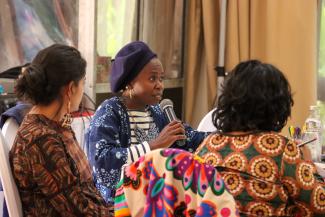
“At its core, regeneration is about community collaboration and embodying sovereignty. If we are not sovereign beings, we cannot be fully at will or connected to our true selves. We need to move towards greater connection with the land: learning how to grow our own food, work with water and listen to the land.”
- Wangũi wa Kamonji
These feminist initiatives are an important reminder that reconnecting and listening to land, understanding our food systems and preserving indigenous and ancestral knowledge is crucial to building just, regenerative and thriving economies that sustain life.
What became abundantly clear over our five days in person together is that while feminists continue to organize in their communities, spaces like our Feminist School are needed now more than ever. With the corporate capture of multilateral policy making spaces like COP, funding cuts severely impacting the United Nations and the growing presence of of anti-rights agendas at women’s rights policy spaces like the Commission on the Status of Women, it is evident that spaces for civil society engagement are shrinking at an alarming rate. Yet, it is in times like these where we need to continue to mobilize in communities and build networks that transcend borders. We need to return to the basics of organizing by building meaningful connections, learning from one another and sharing strategies to build and strengthen the power, solutions and alternatives emerging out of shared struggles.
Learning spaces like feminist schools offer movements an escape from the isolation that often comes with activism in a neoliberal world that is destroying our social fabric. These are also spaces to brainstorm, to experiment and to build cross-regional and cross-movement solidarity. Building communities of practice, networks and confluences of feminist alternatives is the infrastructure we need to build caring, life-affirming, sustainable feminist worlds.
With gratitude to Zinzi Mutiso for the crucial work of being our documentor for this convening
- AWID Where is The Money: An Evidence Driven Call to Resource Feminist Organizing https://www.awid.org/witm, p.66
- AWID WITM, https://www.awid.org/witm, p.67
- Ibid