Protection of the Family
The Issue
Over the past few years, a troubling new trend at the international human rights level is being observed, where discourses on ‘protecting the family’ are being employed to defend violations committed against family members, to bolster and justify impunity, and to restrict equal rights within and to family life.
The campaign to "Protect the Family" is driven by ultra-conservative efforts to impose "traditional" and patriarchal interpretations of the family, and to move rights out of the hands of family members and into the institution of ‘the family’.
“Protection of the Family” efforts stem from:
- rising traditionalism,
- rising cultural, social and religious conservatism and
- sentiment hostile to women’s human rights, sexual rights, child rights and the rights of persons with non-normative gender identities and sexual orientations.
Since 2014, a group of states have been operating as a bloc in human rights spaces under the name “Group of Friends of the Family”, and resolutions on “Protection of the Family” have been successfully passed every year since 2014.
This agenda has spread beyond the Human Rights Council. We have seen regressive language on “the family” being introduced at the Commission on the Status of Women, and attempts made to introduce it in negotiations on the Sustainable Development Goals.
Our Approach
AWID works with partners and allies to jointly resist “Protection of the Family” and other regressive agendas, and to uphold the universality of human rights.
In response to the increased influence of regressive actors in human rights spaces, AWID joined allies to form the Observatory on the Universality of Rights (OURs). OURs is a collaborative project that monitors, analyzes, and shares information on anti-rights initiatives like “Protection of the Family”.
Rights at Risk, the first OURs report, charts a map of the actors making up the global anti-rights lobby, identifies their key discourses and strategies, and the effect they are having on our human rights.
The report outlines “Protection of the Family” as an agenda that has fostered collaboration across a broad range of regressive actors at the UN. It describes it as: “a strategic framework that houses “multiple patriarchal and anti-rights positions, where the framework, in turn, aims to justify and institutionalize these positions.”
Related Content
Construction d’économies féministes
La construction d’économies féministes a pour objet de créer un monde où l’air est respirable et l’eau buvable, où le travail est significatif et où nous bénéficions de soins pour nos communautés et nous-mêmes, où chacun-e peut jouir de son autonomie économique, sexuelle et politique.
Dans ce monde où nous vivons aujourd’hui, l’économie continue de s’appuyer sur le travail de soins non rémunéré et sous-évalué des femmes au service des autres. La poursuite de la “croissance” ne fait que développer l’extractivisme--un modèle de développement fondé sur l’extraction et l’exploitation massives des ressources naturelles, qui continue de détruire les populations et la planète tandis qu’elle concentre les richesses entre les mains des élites mondiales. Parallèlement, l’accès aux soins de santé, l’éducation, les salaires décents et la sécurité sociale sont réservés à une poignée de privilégiés. Ce modèle économique repose sur la suprématie blanche, le colonialisme et le patriarcat.
En adoptant la seule « approche pour l’autonomisation économiques des femmes», on ne fait guère qu’intégrer davantage les femmes dans ce système. Cela peut constituer un moyen temporaire de survie. Nous devons semer les graines d’un nouveau monde possible pendant que nous abattons les murs du monde existant.
Nous croyons en la capacité des mouvements féministes à créer de vastes alliances entre mouvements qui leur permettent d’oeuvrer pour le changement. En multipliant les propositions et visions féministes, nous cherchons à construire les nouveaux paradigmes d’économies plus justes.
Notre approche doit être interconnectée et intersectionnelle, car nous ne pourrons jouir d’aucune autonomie sexuelle et corporelle tant que chacun·e d’entre nous ne jouira pas de ses droits économique ni d’une autonomie financière. Nous voulons travailler avec celles et ceux qui s’opposent à la montée mondiale de la droite conservatrice et des fondamentalismes religieux et la contrent, car tant que nous n’aurons pas ébranlé les fondements même du système actuel, aucune économie ne saura être juste.
Nos Actions
Notre travail conteste le système de l’intérieur et met en évidence ses injustices fondamentales.
-
Promouvoir des programmes féministes : Nous nous opposons au pouvoir des entreprises et à l’impunité concernant les violations des droits humains en travaillant avec des allié-e-s afin de nous assurer que les perspectives féministes, relatives aux droit des femmes et à la justice de genre sont intégrées dans les espaces politiques. A titre d’exemple, vous pouvez vous informer sur le futur instrument juridiquement contraignant concernant “les sociétés transnationales et autres entreprises en matière de droits humains” au Conseil des droits humains des Nations Unies.
-
Mobiliser des actions solidaires : Nous oeuvrons à renforcer les liens qui existent entre les mouvements féministes et les mouvements en faveur de la justice fiscale, y compris à réclamer les ressources publiques perdues à cause de flux financiers illicites afin de garantir une justice de genre et sociale.
-
Enrichir nos connaissances : Nous fournissons aux Défenseuses des droits humains (WHRD) des informations stratégiques qui s’avèrent vitales dans la lutte contre le pouvoir des entreprises et l’extractivisme. Nous contribuerons à développer une base de connaissances autour du financement local et mondial et les mécanismes d’investissements qui alimentent l’extractivisme.
-
Créer et élargir les alternatives : Nous participons et mobilisons nos membres et nos mouvements à envisager des économies féministes et à partager nos savoirs, nos pratiques et nos programmes féministes en faveur d’une justice économique.
« La révolution corporative s’effondrera si nous refusons d’acheter ce qu’ils nous vendent: leurs idées, leurs versions de l’histoire, leurs guerres, leurs armes, leur notion d’inéluctabilité. Un autre monde est non seulement possible, mais il est aussi déjà en bonne voie. Quand tout est tranquille, je peux l’entendre respirer. » Arundhati Roy, War Talk.
Related Content
Snippet - COP30 - Actions - ES
Eventos y acciones en la COP30
8-16 de noviembre de 2025
Clone of Clone of CFA 2023 - Hybrid like never before: in person - ES
Híbrido como nunca antes
Por primera vez, el Foro de AWID ofrece tres modos de participación:
Participación presencial
Lxs participantes se reunirán en Bangkok, Tailandia. ¡No podemos esperar!
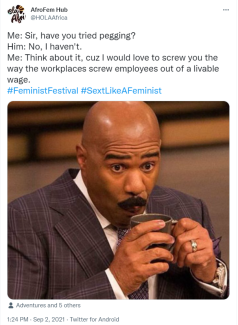
#6 - Sexting like a feminist Tweets Snippet FR
Snippet - COP30 - Our Tools title - EN
Herramientas de organización para la COP30
CFA 2023 - Submit application card - thai
เรายินดีรับข้อเสนอกิจกรรมจากหลากหลายสาขาที่เชื่อมโยงกับแนวคิดสตรีนิยมและความยุติธรรมทางเพศ ในแบบฟอร์มใบสมัครนั้น ท่านจะสามารถทำเครื่องหมายเลือกประเด็นหลักที่เหมาะกับกิจกรรมของท่านได้ มากกว่าหนึ่งหัวข้อ
Zuhour Mahmoud | Snippet EN

Zuhour Mahmoud is the Communication Strategist at Kohl. She is a writer and an editor, and an occasional DJ based in Berlin. Her work focuses on critical approaches to music, technology and politics and their life cycles within the digital sphere.
Rubylita Garcia
Rapport Annuel 2011

Chaque programme comporte plusieurs volets, y compris le développement et la diffusion de connaissances, la recherche-action, les plaidoyers, l’établissement d’alliances et l’organisation de dialogues stratégiques.
Notre Rapport Annuel 2011 vous proposent un sommaire des principales réalisations pendant l'année, dans le cadre de chacune des programmes de l’AWID.
Snippet - COP30 - Partner intro - FR
Cette campagne est menée par 8 organisations partenaires sur différents continents, et construit des alternatives féministes à la crise climatique, aux écocides et aux génocides.
Forum 2024 - FAQ - General Information ES
Información general
La comunicación del deseo | Small Snippet ES
La comunicación del deseo
y otras praxis políticas del cuerpo
Tendemos a pensar en la comunicación del deseo como algo circunscrito a la intimidad de la alcoba y nuestras relaciones personales. Sin embargo, ¿podemos también pensar este tipo de comunicación como una estructura, una práctica que nutre nuestro trabajo, y cómo somos, y cómo actuamos en el mundo?
Ruqia Hassan
AWID in 2016: Co-Creating Feminist Futures
AWID is pleased to share our 2016 Annual Report.

2016 was an incredible year for AWID, we convened the 13th International AWID Forum in Bahia, Brazil, a space for strategizing and alliance building with feminists and other justice movements, which was attended by over 1800 participants from 120 countries and territories across the globe.
We know that women’s rights and feminist movements are key actors in creating sustainable transformative change. Within our movements, organizing, resisting and responding to the challenging context is sharpening, and in our increasingly connected world, the potential for collective action across diverse movements has dramatically grown.
This is the crucial work that AWID seeks to amplify and support every day.
What we achieved in 2016
We expanded solidarity and joint action across diverse movements
A highlight of 2016 was our ground-breaking 13th International Forum with the theme: “Feminist Futures: Building Collective Power for Rights and Justice”, where we harnessed the thinking and energy of nearly 500 partners, presenters, panelists, moderators, artivists, writers, facilitators, IT innovators, and performers, many of them leaders in their movements. We also supported the convening of the first and historical Black Feminisms Forum (BFF) organised by a working group of Black Feminists from across the world.
We strengthened knowledge of issues and strategies
- On challenging corporate power - we produced ‘Challenging corporate power: Struggles for women’s rights, economic and gender justice’ with the Solidarity Center, revealing the scale and scope of corporate power and outlining how corporations in collusion with elites and other powerful actors, are impacting the lives of women and oppressed peoples.
- On feminist economies - we released ‘Feminist Propositions for a Just Economy’ with the Center for Women’s Global Leadership (CWGL) and the African Women’s Development and Communication Network FEMNET.
- On Young Feminist Activism - we published ‘Brave, Creative, Resilient: The Global State of Young Feminist Organizing’, a young feminist mapping project.
We contributed to collective advocacy
AWID, in partnership with other feminist and women’s rights organisations, engaged in advocacy and dialogue to explore better solutions for women’s rights agendas including our work with the Count Me In! consortium .
We increased the visibility of movements
The experiences of women with disabilities, Black and Afro-descendant women, sex workers, Indigenous women, trans and intersex people, domestic workers and how their lives are impacted by multiple oppressions and violence were placed front and center of the Forum process.
We also launched the 2016 WHRD Tribute to commemorate defenders who are no longer with us, during the 16 Days of activism, and thanks to the contributions from our members,
We drove attention to groups and issues that do not usually receive adequate mainstream media coverage through our partnership with The Guardian and Mama Cash.
Our members

Snippet - COP30 Key Messages - ES
Nuestros mensajes clave para les activistas por la justicia climática en la COP30
Te animamos a usar este material para fortalecer tu labor de incidencia.
Forum 2024 - FAQ - Call for Activities ES
Convocatoria para Actividades
Illumination by the Light of the Full Moon | Snippet Small ES
Luz de Plenilunio: Una experiencia BDSM africana
Más que una divertida excentricidad para explorar las sensaciones, el BDSM puede ser una forma de abordar el dolor y el trauma emocionales. Ha sido un medio de sanación sexual para mí, pues me ha permitido una forma radical de liberación.
Macarena Valdés Muñoz
2021: Feminist Power in Action
In 2021, AWID, along with many other organizations, was coming to grips with the implications of the on-going global pandemic for how we work and our role in this particular time. The year taught us three critical lessons about navigating this moment as a global feminist movement-support organization.
Download the full 2021 Annual review

Through dialogue and exchanges critical to their work, AWID connected thousands to feminists from around the world.
Our experience in 2021 reaffirmed the importance of building and sustaining a global feminist community, and AWID’s core mission to support feminist movements as a whole. We believe that at this moment, a strong community bound by a shared vision and collective care is the foundation of all social change and transformation.