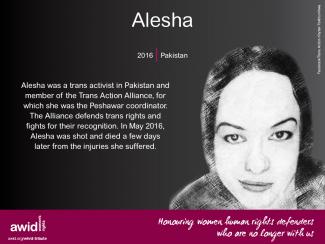
Alesha
Over the past few years, a troubling new trend at the international human rights level is being observed, where discourses on ‘protecting the family’ are being employed to defend violations committed against family members, to bolster and justify impunity, and to restrict equal rights within and to family life.
The campaign to "Protect the Family" is driven by ultra-conservative efforts to impose "traditional" and patriarchal interpretations of the family, and to move rights out of the hands of family members and into the institution of ‘the family’.
Since 2014, a group of states have been operating as a bloc in human rights spaces under the name “Group of Friends of the Family”, and resolutions on “Protection of the Family” have been successfully passed every year since 2014.
This agenda has spread beyond the Human Rights Council. We have seen regressive language on “the family” being introduced at the Commission on the Status of Women, and attempts made to introduce it in negotiations on the Sustainable Development Goals.
AWID works with partners and allies to jointly resist “Protection of the Family” and other regressive agendas, and to uphold the universality of human rights.
In response to the increased influence of regressive actors in human rights spaces, AWID joined allies to form the Observatory on the Universality of Rights (OURs). OURs is a collaborative project that monitors, analyzes, and shares information on anti-rights initiatives like “Protection of the Family”.
Rights at Risk, the first OURs report, charts a map of the actors making up the global anti-rights lobby, identifies their key discourses and strategies, and the effect they are having on our human rights.
The report outlines “Protection of the Family” as an agenda that has fostered collaboration across a broad range of regressive actors at the UN. It describes it as: “a strategic framework that houses “multiple patriarchal and anti-rights positions, where the framework, in turn, aims to justify and institutionalize these positions.”
Trabajamos para fortalecer las voces y el impacto de lxs activistas, organizaciones y movimientos por los derechos de las mujeres.
Las áreas prioritarias de AWID se relacionan con temas estrechamente vinculados con tendencias globales dominantes. Estos temas reflejan los crecientes desafíos que afectan negativamente a los derechos de las mujeres en todo el mundo.
La conspiration du cercle des écrivain·e·s | Wazina Zondon
 |
 |
 |
| Également connue sous le nom de Réseau de recherche Teta, la conspiration des écrivain·e·s a été fondée en 2021 dans le cadre des cercles d’écriture hebdomadaires de Kohl. Le Réseau est un groupe transnational d’écrivain·e·s queer et féministes qui se consacrent à l’écriture, à la réflexion et à la création de monde collectifs. | Wazina Zondon est une Afghane élevée à New York. Elle centre son travail de recueil d’histoires et de narration sur les souvenirs collectifs et les rites de passage dans la diaspora. Elle travaille actuellement sur Faith : in Love/faith in love (Foi : en amour / Foi en l’amour), travail qui (re)retrace l’histoire d’amour de ses parents et l’empreinte d’amour héritée de sa famille. |
L’amour est sur le marché noir en enfer
car l’amour est un acide
qui ronge nos barres de fer.
Mais toi, moi et demain,
on jure en se tenant la main
que les luttes se multiplieront.
La scie à métaux a deux lames.
Le fusil a deux canons.
Nous portons la liberté en notre sein.
Nous sommes un complot.
Il est de notre devoir de lutter pour la liberté.
Il est de notre devoir de vaincre.
Nous devons nous aimer et nous soutenir mutuellement.
Nous n’avons rien d’autre à perdre que nos chaînes.
« Love » d’Assata Shakur

Voilà la question que pose Wazina Zondon dans son récit de souvenir collectif Loveprint. Loveprint est une déambulation, un chevauchement, un détour qui (re)crée, là où se rejoignent les entrevues et les essais personnels, nos histoires de famille et nos connaissances sur l’amour, les relations de couple et les aventures amoureuses. Sur les conseils de Wazina, la conspiration du cercle des écrivain·e·s s’est retrouvée autour d’une tentative de reproduction de cette épreuve littérale, sous la forme d’une écriture collective dans laquelle nos différentes histoires, nos genres et nos identités sexuelles se complètent et se contredisent. Nos voix empiètent les unes sur les autres, les unes complètent les phrases des autres et nous créons une conversation, un mémorial, des morceaux de nous qui parlent à un « nous ».
Je suis ce que l’on appelle un « joyeux accident ». Il y aurait beaucoup à dire à ce propos – une vie accidentelle, mais dans le même temps totalement voulue. Je sens que cela a façonné ma manière d’aimer. Je ne tombe pas simplement amoureuse, je prends le risque de la glissade qui me fera tomber. Ça a peut-être fait de moi une amor fati.
On m’a dit que je n’étais pas une enfant voulue. Donc, j’ai grandi et je suis devenue une adulte non voulue. Les origines de mon impression d’amour viennent d’avoir été éternellement non bienvenue. Je ne suis pas le fruit d’un amour ou d’une quelconque émotion joyeuse, mais bien plutôt de douleur et de fardeau. Je n’ai pas d’impression d’amour – du moins pas dans ce sens-là.
Je sais avec certitude que mes parents se sont aimés à un moment, mais la santé mentale est un tel démon – si personne ne lui tient tête, il n’y a pas de gagnant.
Je n’associerai jamais « l’amour » à mes parents ou à la famille normative. En grandissant, l’amour était accompagné de tant de violence et de responsabilités que je n’avais pas demandées, et pour lesquelles je n’étais pas prête. Alors que mes parents « s’aimaient », c’était un éthos toxique de violence, de jalousie et d’insécurité dans lequel grandir. J’ai grandi avec une immense faim de stabilité, et c’est ce que je suis aujourd’hui. Je prends des risques, mais jamais dans mon « espace d’amour ».
Je ne sais pas pourquoi ma mère a choisi d’accueillir une enfant
(moi) en son sein. Elle ne m’aime pas sous cette forme.
Ma mère me dit que si je dois penser à « trouver » l’amour, je ne devrais jamais prendre son mariage en exemple. Mon impression d’amour vient au contraire des chiens que j’élève depuis deux décennies (18 ans précisément). Le contraire est également vrai – ils m’ont élevée. Je comprends de mieux en mieux cet amour et ses différents niveaux, en leur compagnie.
Je n’ai pas découvert l’amour avec une « impression ». Dans notre maison, nous ne parlons pas d’amour. J’ai dû m’enseigner à aimer. J’ai dû y travailler dur. Malgré cela, j’échoue et malgré cela, je continue d’essayer et d’échouer tous les jours. L’échec est peut-être mon impression d’amour.
Mon impression d’amour est l’attention, la chaleur et la compréhension
que je donne aux personnes qui m’entourent, qu’il s’agisse d’un inconnu,
d’une amie, d’une proche ou d’une amante.
Mon impression d’amour est politique – sans calcul et sans réflexion.
Je suis né·e sous une pluie de bombes.
Mon impression d’amour est le négatif
de ce moment-là.
J’en sais plus sur ce que l’amour n’est pas que je n’en sais sur ce qu’est l’amour.
L’amour, ce n’est ni l’anxiété ni la panique.
L’amour, ce n’est pas de demander la permission de vivre ou de respirer. C’est toujours à propos de l’amour et il n’y a pas d’amour sans liberté.
Tout ce que l’on fait, on le fait avec le cœur, sauf l’amour. L’amour, c’est se servir de son esprit.
Je crains parfois que le langage de mon amour ne se perde dans la traduction.
--- Il y a de nombreuses manières
de cartographier les origines
de
la manière de ne pas
aimer
aimer juste assez
aimer beaucoup trop
aimer un peu
perdre un peu
à l’amour
à l’amour perdu ---
Je ne supporte pas l’idée du couple. Je ne supporte pas l’idée de vivre seule en vieillissant non plus. Je suis fatiguée de tout faire toute seule, de déménager seule, de payer le loyer et les factures toute seule… Je m’imagine avoir un arrêt cardiaque toute seule, et ça m’effraie. Je n’ai absolument pas envie de « me mettre en couple ». Je veux un monde où je peux épouser une amie, acheter une maison avec une amie, ne pas avoir de rapports sexuels.
Aimer plusieurs personnes ne corrompt
absolument pas l’amour partagé à deux, et que l’amour
soit romantique ou non n’est vraiment pas si
important que cela.
Lorsque je réfléchis à l’état déplorable de mes relations, je me rends compte que je suis dans le type de relation auquel on m’a formée. Malgré toute ma « radicalité », je n’ai toujours pas désappris les foutues normes de genre.
Mon besoin de stabilité ne me semble pas « assez radical ». Je veux sortir de cette catégorisation. Je veux quelque chose que je n’ai jamais eu. Je veux le rendre beau. Je veux me sentir belle et en sécurité – et seule la stabilité me procure ces sensations. Sûre, hors de danger, savoir que le foyer n’a rien à voir avec la violence ni les tensions.
--- Impression d’amour – j’aime sentir les livres pour voir où ils
ont été imprimés
Je tente de réfléchir à l’origine de ma compréhension et de ma
pratique de l’amour
A-t-on besoin d’origine, n’est-ce pas pareil à la pureté? Pas de
pureté ni d’origine de l’amour.
Pourquoi est-ce la compréhension et la pratique, et non
« l’émotion » qui vient à l’esprit? ---
Lorsque j’appelle mes parents, je ne raccroche pas après que l’on se soit dit au revoir, pour pouvoir entendre les bruits de la maison.
Lors de mon enterrement sunni, je veux que toutes les femmes et tous les hommes se rassemblent pour mon enterrement. Qu’est-ce que c’est que cette histoire de ne pas pouvoir dire au revoir à des morts d’un autre sexe? Il sera sunni parce que ma mère voudrait qu’il le soit. Il sera écologique – pas besoin de pierre tombale. J’adore tous les rituels funéraires. Le Coran c’est bien, mais je veux aussi de la musique. J’aime vraiment Asmahan, Oum Koulthoum et The Stones Roses.
J’ai une liste de musiques pour la semaine, du lundi au vendredi. Et deux autres pour la fin de semaine : une pour les samedis et une pour les dimanches. Je voudrais que celles et ceux qui m’ont aimée mettent la musique que j’écoutais, en respectant les jours – avec une légère tolérance tant que l’on respecte les listes de musiques.
Je veux être entourée par la ou les personnes qui m’auront aimée, même pour un bref instant. En musique et entourée de bouquets de fleurs coupées. Je ne veux pas qu’on me trouve morte; je veux mourir en riant avec des êtres aimés.
Je veux que l’on se rappelle de moi comme de quelqu’un qui aimait.
I don’t need to feel loved in death. I need the people around me to feel I loved them, even after I die. Being loved in death is about those who are alive. So I think more about how we come together as a living and loving community in the death of those we love and live with. How we take their memories with us. How we become archives of their lives.
--- Parfois, on ne peut aimer les gens que dans leur mort ---
Je dois revenir en arrière à l’idée du corps connecté à un espace. Ma famille est très réduite et, bien que ne venions pas de différents endroits, c’est comme si chaque génération était partie dans un nouveau lieu. C’est peut-être la raison pour laquelle la mort n’est pas reliée à un endroit spécial, à un cimetière. Il est courant dans notre famille d’enterrer les morts sans nom ou pierre tombale, ou de disperser les cendres dans le vent. Je me sens apaisée par ce genre de commémoration sans lieu fixe. L’idée que mes cendres puissent fertiliser une nouvelle vie me donne le sentiment d’être aimée, d’être remémorée par la re-création. Ma grand-mère est décédée en début d’année du fait de complications suite à la vaccination. Deux heures après son décès, ma famille riait aux larmes en repensant aux blagues qu’elle faisait, à sa manière hilarante de raconter des histoires. Nous avons ri et l’avons aimée, et c’était comme si elle était à nouveau assise avec nous. Voilà ce qui me ferait me sentir bien – pouvoir fertiliser les sols, fertiliser les conversations et une commémoration collective.
--- Il y avait
Deux rues dans lesquelles
Je marchais
Je courais
Je jouais
Je demeurais
Il y avait
Cinq heures pendant lesquelles
Le soleil était chaud
Le ciel était bleu
La terre était verte
Il y avait
Une fleur que je pouvais
Sentir
Toucher
Pincer
Écraser
Il y avait
Les amies que je pouvais
Caresser
La nourriture
Que je pouvais
inhaler
La langue
Qui me glissait des
lèvres
Il pourrait toujours y avoir
Tous ces nombreux lieux
Et des choses
Et des gens
Après moi ---
Peut-être qu’une promesse que je serai « spatialement commémorée » en tant que plante et soignée à tour de rôle, jusqu’à ce qu’elle devienne un arbre, serait suffisante. Pas de nom, pas de plaque – juste la plante/l’arbre, et savoir qu’on en prendra soin. Quant à mon corps, je veux qu’il soit incinéré sans aucune forme de rituel et que les cendres de mes os soient libérées dans la mer d’Arabie.
J’ai besoin que l’on traite mon corps aussi subversivement qu’il a vécu.
Je ne veux pas être enterrée à côté de ma famille. Dans ce petit tiroir à côté de toutes les personnes qui ne m’ont jamais connue. Coincée dans la mort comme je l’ai été dans la vie. Je veux être incinérée, et que mes cendres soient finalement libres.
Je veux être autorisé·e à passer, pas pendre dans l’entre-deux, pour être une présence, un processus actif, un trépas.
Je vous demanderai de :
Je veux que l’on se souvienne de moi pour l’amour que j’ai mis dans ce monde. Je veux que
mon corps soit donné, et que mes organes continuent d’alimenter
l’amour d’une ou d’autres vies.
--- L’odeur du jasmin ---

Cette édition du journal, en partenariat avec Kohl : a Journal for Body and Gender Research (Kohl : une revue pour la recherche sur le corps et le genre) explorera les solutions, propositions et réalités féministes afin de transformer notre monde actuel, nos corps et nos sexualités.

نصدر النسخة هذه من المجلة بالشراكة مع «كحل: مجلة لأبحاث الجسد والجندر»، وسنستكشف عبرها الحلول والاقتراحات وأنواع الواقع النسوية لتغيير عالمنا الحالي وكذلك أجسادنا وجنسانياتنا.

The artwork is a photography and illustration collaboration between Siphumeze and Katia during lockdown. The work looks at black queer sex and plesure narratives, bondage, safe sex, toys, mental health and sex and many more. It was created to accompany the Anthology Touch.
Não, apreciamos muito o vosso trabalho, mas atualmente não solicitamos respostas de fundos feministas e de mulheres. Encorajamos-vos a partilhar o inquérito com os vossos parceires beneficiários e as vossas redes feministas.
Tous nos rapports annuels sont accessibles sur notre site web.
Por María Bonita - Venezuela
Las ancestras hacen un círculo
Sagrado, vivo, poderoso
Estamos en el medio
Sintiendo su fuerza.
Suena el tambor de la tierra
Nuestra piel se viste de colores
Somos verdes, rojas, naranja, azules, violetas, negras
Suena el tambor de la tierra
La voz vibra, el grito ocupa, el canto se presenta, arrulla el sueño, despierta conciencia.
Suena el tambor de la tierra
Y la mirada se hace cómplice, amiga, profunda.
Suena el tambor de la tierra
El corazón es uno solo, percuta el alma, nos invita a movernos, nos vuelve deseo, nos indica un camino.
El de la juntanza comunera, el del poder popular, el del autogobierno, el de la revolución de las mujeres, el del cuidado subversivo.
Suena el tambor de la tierra
Y yo les invito a entrar, a ser voz, piel, mirada, semilla, fuego, canción, comunión.
Suena el tambor de la tierra
Y yo les invito a descubrirla, a amarla, a conocerla, a defenderla, desde el corazón de la comuna
Hace 25 años que habitan las mismas calles polvorientas, en lo más alto de una loma con nombre de león, vienen de diferentes lugares, muchas con tradición campesina, tienen la piel color rebeldía, color cardón, porque en ellas habita el semiárido larense, de allí su amor por la vida, su aprecio, el cuidado y resguardo por el agua y el territorio, es que son herederas de la estirpe Gayón, Ayaman, comunidades indígenas que habitaron y habitan el norte del estado Lara.
Desde muy jóvenes aprendieron que la maternidad es un signo del que no se escapa con facilidad, cuidar a los hijos, la casa, el marido, lavar, planchar, cocinar, fregar, todo tenía que estar impecable, insisten.
Y la vida era eso, eso y la violencia, el insulto, el maltrato, el golpe, el reclamo, la queja era algo de esperar, algo que parecía natural, así se vivían los días, la cotidianidad, en aquellas calles de tierra viviendo en pequeñas casitas de chapa, de zinc, sin servicios básicos, esa era pobreza, la precariedad cuando llego un hombre, si, un hombre, un proyecto, una revolución inusual porque se hizo sin la guerra.
Entonces las invitaron a salir, las invitaron a tomar la calle, el espacio público y ellas en ese proceso derribaron puertas y ventanas, rompieron cadenas, se soltaron el cabello, se sintieron libres, libres cimarronas, rebeldes caribes, guerreras libertadoras.
Y es que eso de independencia y soberanía es algo que las que pudieron estudiar lo habían leído, pero sentirse, sentirse protagonistas de un proceso de cambio de transformación social, eso es una importante conquista que tenemos que mencionar, que no podemos olvidar.
En lo alto de esa loma se siente la complicidad, el fuego compartido, los años de lucha, cuentan que una de ellas se iba con su paragua por las tardes y de casa en casa tomando un cafecito, conversando con la gente iba convocando, convenciendo
¡Vamos a hacer el consejo comunal!
¡Avancemos hacia la comuna!
Hagamos planes de trabajo para la educación, el deporte, la salud, la alimentación, el comité de mujer e igualdad de género, la economía.
¡Vamos a ser Gobierno Popular para que el Barrio se Ponga Bonito!
Y así llegaron las casas, el consultorio popular, el simoncito, el proyecto de electrificación, el de agua potable son algunos de los logros comunales, de los sueños comunales hechos realidad.
Y ustedes se preguntaran como llego una cuentera, una cuenta cuentos a esa loma con nombre de león
Y yo les digo: es que nací bochinchera, dando pelea, nací callejera diría mi abuela, disposicioner agregaría el Comandante Chávez, de tanto andar, renegar, pelear y dudar de aquel militar, me termino convenciendo con el proyecto comunal, con eso de ser autogobierno, de que el pueblo administre sus recursos, con eso de todo el poder para las comunas, con eso me convenció.
Pero yo sabía que algo faltaba porque las mujeres, las mujeres comuneras seguimos construyendo poder popular y nuestro corazón se viste de lucha antiimperialista y anticapitalista pero hay algo que nos duele, que nos sigue afectando, hay heridas del patriarcado que están presente.
Entonces un día, me descubro llorando y sonó el tambor de la tierra y las ancestras hablaron.
Me vi rodeada de un grupo de mujeres que me sostuvo, me contuvo mientras me derramaba frente a ellas, mientras dolía y me liberaba al mismo tiempo, así que descubrí que el amor entre mujeres te sana, te salva, que nuestra amistad en profundamente política y que la sororidad es una manera de andar, de vivir la vida, a partir de ese momento no me volví a sentir sola, no me sentí más nunca una isla, porque sé que hay un grupo de mujeres que me llevan, me traen, me aman, me cuidan y viceversa, sé que esta forma de hacerme feminista con la mística de mujeres por la vida es una experiencia de sentirse conectada, amada por mujeres aunque no las vuelvas a ver, entonces como no querer que esto que me ocurrió, le pase a otras, este amanecer, este parirme un nuevo corazón es un regalo de las diosas que tiene que ser compartido.
Por eso decidí unirme a ellas y echar a andar por las comunas, comencé a caminar, a conocer otras experiencias, comenzamos a debatir sobre salud, educación, alimentación, nos fuimos predicando el verbo antipatriacal y las comunas libres de machismo, insistimos en recuperar la sabiduría ancestral, la intuición, decidimos defender la vida hablando de aborto y nos vemos riendo, llorando, debatiendo, reflexionando, me encuentro con macu, con la china, yenni, carolina, maria, ramona, irma y hasta con nuestra hermana yenifer que se nos fue hace poco.
Este es mi homenaje a ellas, a las mujeres loma a las mujeres leonas, ellas sin duda se sembraron en mí con tanta fuerza que son parte de mis latidos.
Ellas sin duda marca un camino, ellas son las que hacen posible el cuidado familiar, el cuidado colectivo, ellas son también una fuerza, una fuerza en el territorio para superar el bloqueo, la violencia patriarcal, la traición política, para superar la burocracia la corrupción.
Ellas sin duda marcan un camino
Ellas sin duda son una brújula
Ellas sin duda son el corazón de la comuna
Gracias.
Nicole Barakat es una artista femme queer de SWANA, que nació y vive en las tierras de Gadigal (llamadas Sydney) en Australia. Trabaja con procesos intuitivos y de escucha profunda, con la intención de transformar las condiciones de la vida cotidiana. Su obra se desarrolla a través de métodos artísticos no convencionales, creando objetos intrincados que plasman el amor y la paciencia característicos de las prácticas textiles tradicionales.
نعم، يمكن تعبئة الاستطلاع من خلال الهاتف الذكي.
We invite you to explore the Priority Areas and Stay Informed sections of our website, or use the search function to find information about the specific topics you are researching.
We particularly recommend that you explore our toolkit “Where is the Money for Women’s Rights” (WITM Toolkit). This is a Do-it-Yourself Research methodology to support individuals and organizations who want to conduct their own research on funding trends for a particular region, issue or population by adapting AWID’s research methodology.
par Marianne Mesfin Asfaw
J’ai de nombreux souvenirs émotifs de mon aventure vers le féminisme, mais un en particulier me vient à l’esprit. Je suis alors en études supérieures, à une conférence dans le cadre d’un cours sur la théorie féministe. La conférence porte sur le féminisme africain et la professeure nous parle de l’histoire du panafricanisme et explique en quoi ce mouvement est patriarcal, centré sur les hommes, et comment les universitaires panafricanistes perpétuent l’effacement des femmes africaines. Elle commente la manière dont les contributions des Africaines aux luttes anticoloniales et décoloniales sur le continent ne sont que rarement, voire jamais l’objet de discussions et que l’on ne crédite que rarement les autrices. Nous lisons alors des textes sur des universitaires africaines féministes qui remettent en question cet effacement et mettent en lumière les récits de mouvements et efforts de résistance menés par des Africaines. Cela semble naïf, mais ce qui me paraissait le plus frappant était que l’on puisse juxtaposer les termes « africaine » et « féministe ». Et également que nous étions très nombreuses dans les différents coins du continent à nous débattre avec une histoire, des politiques et des normes sociétales compliquées, que nous envisagions cependant toutes selon le prisme du féminisme. Je suis sortie de cette conférence à la fois émue et complètement chamboulée. Trois de mes amies (toutes féministes africaines) et moi-même sommes sorties discuter du contenu de ce que nous venions d’entendre. Nous étions ébahies par l’excellence de la conférence et du contenu mais, plus que tout encore, nous nous sentions véritablement vues. Et c’est cette sensation qui m’est restée.
Tomber en amour avec le féminisme était époustouflant. C’était comme de finalement pouvoir parler à un coup de cœur de longue date, et de se rendre compte qu’on lui plaît aussi. Je parle de coup de cœur parce qu’au lycée je me disais féministe, tout en sentant que je n’en savais pas assez. Y avait-il une bonne manière d’être féministe? Et si je ne m’y prenais pas bien? Ma première conférence en Études féministes a répondu à toutes ces questions. C’était génial d’apprendre toutes ces histoires de résistance féministe et de démantèlement du patriarcat. Je sentais que je m’affirmais et que j’étais validée, mais je sentais également qu’il manquait quelque chose.
Approfondir ma relation avec le féminisme dans une institution universitaire où la majorité des élèves et du corps enseignant étaient blancs signifiait que pendant ces premières années, nous ne discutions que rarement de la place de la race ou du dénigrement des Noir·es dans les mouvements féministes traditionnels. Dans la plupart des cours, il y avait peut-être une semaine, ou pire une seule séance qui portait sur la race et nous lisions alors généralement un texte de bell hooks ou de Kimberly Crenshaw sur l’intersectionnalité, et peut-être un autre de Patricia Hill Collins. Et la semaine suivante, nous continuions à botter le sujet en touche. Je gérais cette situation en incluant la race et le féminisme noir dans presque tous mes travaux, en écrivant sur les cheveux des Noir·es et la politique de respectabilité, sur l’hypersexualisation du corps des femmes noires, et bien plus encore. Avec le temps, j’ai pris conscience que je tentais de combler une lacune, sans toutefois saisir laquelle.
Découvrir le féminisme africain et en apprendre davantage me permettait de boucler la boucle. Je comprenais que j’avais encore tant de choses à apprendre. Et principalement, que mon africanité et mon féminisme politique n’avaient pas à être écartés. Ils avaient en réalité tant à apprendre l’un de l’autre, et des féministes africaines faisaient déjà ce travail. C’était la pièce manquante et insaisissable lors de mon exploration du féminisme pendant mes années universitaires.
Pour moi, le féminisme est l’antithèse de l’apathie sociale et politique. Il signifie également que dès lors que l’on adopte une optique féministe, plus rien ne peut être pareil. Mes amies et moi parlions de ce que ça fait de mettre des lunettes qu’on ne peut plus jamais enlever, parce que l’on voit le monde pour ce qu’il est, avec tout son désordre. Un désordre qu’on ne peut pas simplement ignorer ou laisser tomber. J’ai donc fait la promesse aux mouvements féministes de ne jamais arrêter d’apprendre, de continuer à étirer les limites de mon empathie et de ne jamais vivre passivement. De dédier davantage de temps et d’espace dans ma vie aux mouvements féministes et de continuer à amplifier, célébrer, documenter et citer les travaux de féministes africaines. Je m’engage également à placer l’attention et le soin au centre de tout et à donner la priorité au plaisir dans cette aventure féministe, parce que nos mouvements en ont besoin pour durer.
Contenu lié
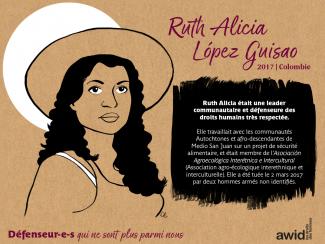
Front Line Defenders: Assassinat de Ruth Alicia Lopez Guisao
Ce projet est le fruit d’une collaboration avec :


Поскольку опрос посвящен исследованию реалий обеспечения феминистских организаций ресурсами, большинство вопросов касаются финансирования вашей организации в период с 2021 по 2023 год. Вам необходимо будет иметь при себе данную информацию для заполнения анкеты (например, годовые бюджеты и информацию об основных источниках финансирования).
Segundo Diálogo de Alto Nivel sobre la Financiación para el Desarrollo
Las naciones ‘en desarrollo’ exhortaron a que se tuvieran en cuenta los desafíos globales así como las necesidades y posibilidades locales en la interacción con diferentes grupos (mujeres, jóvenes, personas con discapacidad, etc.) para abordar las temáticas identificadas en el Consenso de Monterrey.
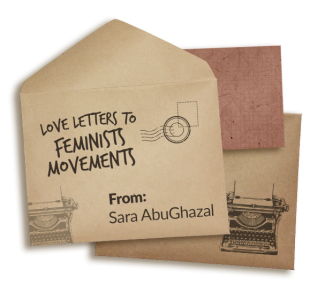
How does a movement start?
we get expelled by ghosts from a house, a family, and a nation
we arrive fatigued to a space (sometimes an actual address) but mainly to a state of being
preceded by a fallen star
perhaps our arrival isn’t accompanied by fatigue,
maybe accompanied by fear
perhaps our arrival isn’t accompanied by fear
maybe accompanied by anger
from issues that keep on repeating themselves:
a stab in the heart (read heartache)
a bullet in the back (read betrayal)
forced disappearances
bodies sentenced by marriage, disfiguration, and chronic fatigue
yet when we arrive, we gather, whisper, speak and weep.
This is how our movements begin when we arrive at each other
We become seeds,
This is how our movements start when we plant each other
Becoming flowers, sometimes just thorns, sometimes fruits,
we are each other’s oasis
to sing for the battles
to make remedies
to place the faces of our lovers, the shape of their smiles, the sound of their laughter
the secret of turning silences into language
the detailed instructions of witches
our movement is: for all of us
when we arrive as seeds with the purpose of flowering.
Sara AbuGhazal
www.badiya.blog