Left
Half
Left

Special Focus

AWID is an international, feminist, membership organisation committed to achieving gender equality, sustainable development and women’s human rights

Memory as Resistance: A Tribute to WHRDs no longer with us

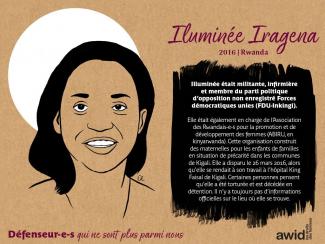
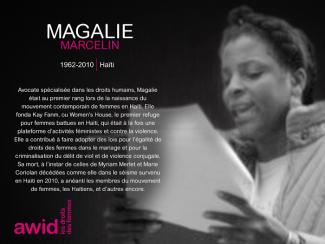
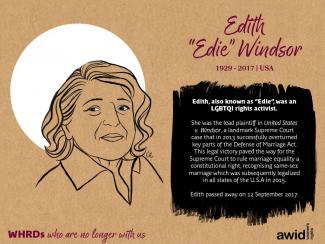
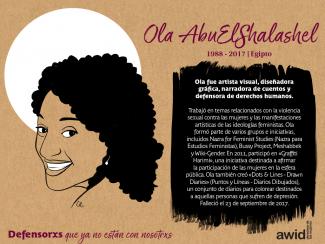
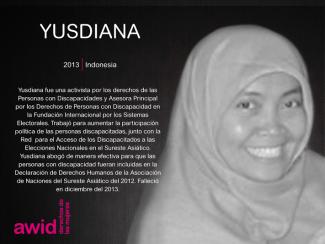
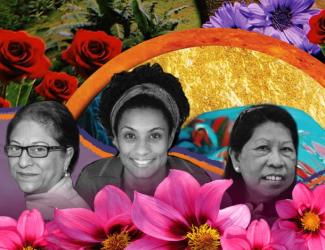
AWID’s Tribute is an art exhibition honouring feminists, women’s rights and social justice activists from around the world who are no longer with us. 


In 2020, we are taking a turn

This year’s tribute tells stories and shares narratives about those who co-created feminist realities, have offered visions of alternatives to systems and actors that oppress us, and have proposed new ways of organising, mobilising, fighting, working, living, and learning.

49 new portraits of feminists and Women Human Rights Defenders (WHRDs) are added to the gallery. While many of those we honour have passed away due to old age or illness, too many have been killed as a result of their work and who they are.

This increasing violence (by states, corporations, organized crime, unknown gunmen...) is not only aimed at individual activists but at our joint work and feminist realities.

The stories of activists we honour keep their legacy alive and carry their inspiration forward into our movements’ future work.

Visit the online exhibit

The portraits of the 2020 edition are designed by award winning illustrator and animator, Louisa Bertman

AWID would like to thank the families and organizations who shared their personal stories and contributed to this memorial. We join them in continuing the remarkable work of these activists and WHRDs and forging efforts to ensure justice is achieved in cases that remain in impunity.

“They tried to bury us. They didn’t know we were seeds.” - Mexican Proverb 


The Tribute was first launched in 2012

It took shape with a physical exhibit of portraits and biographies of feminists and activists who passed away at AWID’s 12th International Forum, in Turkey. It now lives as an online gallery, updated every year.

To date, 467 feminists and WHRDs are featured.

Visit the online exhibit

Related Content

Snippet Festival Days 8-13_Fest (FR)

Day, jour, día 8 festival - Sept. 16, 2021
Panneau
Plaisir corporel pour les grosses 

Amy Lin

regardez la vidéo


Atelier
Élargir le plaisir

Hedone

regardez l'atelier


Atelier
La campagne #emptychairs (chaises vides)

Caroline Tagny, Coalition of African Lesbians
Carrie Shelver, Sexual Rights Initiative
Emeline Dupuis, Sexual Rights Initiative
Pooja Badarinath, Sexual Rights Initiative
Pooja Patel, International Service for Human Rights
Antje Schupp


Atelier
Réalités féministes:
Maisons de repos et de soin pour les défenseures

Ana María Hernández Cárdenas, Consorcio Oaxaca
Nallely Tello Méndez, Red Nacional de Defensoras de Derechos Humanos en México
Jelena Dordevic Liana Funes, National Network of Women Human Rights Defenders in Honduras
Rebeca Girón
Tania Lopes Muri, Movimento de Mulheres da Região dos Lagos
Rogéria Peixinho


Fem Movement:
Soirée dansante Extravaganza pour les membres

DJ Cozmic Cat


Day, jour, día 9 festival - Sept. 17, 2021
Conte
Conte- Education sans entraves:
L’histoire de Fatoumata

Lina Baaziz

regardez la vidéo


Instagram Live:

L’éducation sexuelle

Oloricoitus

apprendre encore plus


Atelier
Les voix du premier rang:
Renforcer le pouvoir collectif pour en finir avec l’incarcération des femmes à travers le monde


Claudia A. Cardona, Mujeres Libres Colombia
Phyllis Hardy, National Council for Incarcerated and Formerly Incarcerated Women and Girls
Grace Natalia, Womxn’s Voice and Women and Harm Reduction International Network
Mónica Marginet Flinch, Metzineres
Kenya Cuevas, Casa de las Muñecas Tiresias A.C.
Dawn Harrington, Free Hearts

regardez l'atelier


Atelier
Le mouvement comme guérison
Guérison pour les mouvements


Kimalee Phillip
Luz Stella Uspina Murillo, Fondo Acción Urgente para América Latina y el Caribe
Sara Munarriz-Awad, Fondo Acción Urgente para América Latina y el Caribe
Tai Pelli
Everdith (Evie) Landrau


Atelier
Leadership féministe émergent :
la réussite solidaire

Deborah A, Black LGBTQ Migrant Project (BLMP)
Anima Adjepong, Silent Majority
Maame Adwoa Marfo, FRIDA
Debbie Owusu-Akyeeah, Canadian Centre for Gender and Sexual Diversity


Day, jour, día 10 festival
Panneau
Le plaisir au-delà des frontières

Lindiwe Rasekoala
Lizzie Kiama
Jovana Drodevic
Malaka Grant

regardez la vidéo


Panneau
Réalités de l’avortement :
Stratégies pour combattre l’injustice reproductive

Lindiwe Rasekoala
Lizzie Kiama
Jovana Drodevic
Malaka Grant


Day, jour, día 11, festival
Atelier
Construction de réseaux et de solidarité parmi les jeunes organisatrices féministes

Nino Ugrekhelidze, AWID
Anwulika Ngozi
Okonjo Pooja Singh


Panneau
Survivre à la guerre contre la drogue

Ganna Dovbakh, Eurasian Harm Reduction Association (EHRA)
Priscila Gadelha, Rede Nacional de Feministas Antiproibicionistas (RENFA)
Veronica Russo, Red Latinoamericana y del Caribe de Personas que Usan Drogas (LANPUD)
Diana Edem, Heartland Alliance International
Judy Chang, International Network of People who Use Drugs (INPUD)
Louise Vincent, NC Urban Survivors Union
Aura Roig, Metzineres
Malicia, Live Artist

regardez la vidéo


Panneau
Les jeunes féministes pour le climat créant des avenirs radicaux: Lancement vidéo et conversation

Sanam Amin, Asia Pacific Forum on Women, Law and Development
Maggie Mapondera, Womin African Alliance
Maria Alejandra Escalente, FRIDA
Patricia Miranda Wattimena, Asia Indigenous Peoples Pact
Mara Dolan, WEDO
Andrea Vega Troncoso, WEDO

regardez la vidéo


Atelier
Antal: univers non binaire

Malicia Sabina, Resistencia No Binarix
Andras Yareth Hernández, Resistencia No Binarix

regardez la vidéo


Day, jour, día 12, festival
Panneau
Merci, je peux prendre mes propres décisions

Grace Chang, Taiwan Association for Disability Rights
Angel Hsu, Taiwan Association for Disability Rights
Joyann Peng, Taiwan Association for Disability Rights
Amy Wu, Taiwan Association for Disability Rights

regardez la vidéo


Panneau
Apprentissages féministes sur la sécurité numérique en temps de crise sociopolitique et sanitaire

Paul Nail Ojeda
Paola Moss


Atelier
L’état actuel des forêts:
quel est le problème et pourquoi est-ce si important?

Camila Romero, VientoSur
Kanta Marathe, Navrachna Samaj Sevi Sansthan
Jeanette Sequeira, Global Forest Coalition

Download Resources  Descargar Recursos  Télécharger les Ressourceses

Visite du salon des membres de l’AWID

Jessica Whitbread, AWID


Day, jour, día 13 festival
Atelier
Soutenir l’autogestion: 
doulas, accompagnantes, assistance téléphonique et réseaux radicaux de soutien à l’avortement

Aditi Pinto, Inroads
Daniela Tellez Del Valle, Di RAMONA
Sandra Cardona, Necesito Abortar México
Mickreen Adhiambo, Aunty Jane Hotline and MAMA Network
Zachi Brewster, Dopo Abortion Support
Ika Ayi, Samsara

regardez la vidéo


Atelier
Partage de compétences de jeunes féministes: 
comment financer vos idées

Nino Ugrekhelidze, AWID
Cassie Denbow
Nida Mushtaq


"Yo Imposible"
Projection & Discussion avec des cinéastes d'Amérique latine et d'Amérique centrale du Club de cinéma féministe de l'AWID

Alejandra Laprea
Patricia Ortega
Alejandra Henriquez
Maria Torrellas
Carolina Reynoso
Camila Rodó
Micol Mtzener
Giovana Garcia

Can organizations be members of AWID?

Yes, we encourage institutional membership.

AWID currently has hundreds of prominent, innovative organizations working on issues related to women’s rights and development as members. Criteria for membership are the same as for individuals, although membership fees and membership benefits are different, and are geared to address the needs of our member organizations.

Find out more about our membership

Como é que os dados recolhidos através do questionário serão divulgados e processados?

Os dados serão processados para fins estatísticos para esclarecer o estado de financiamento dos movimentos feministas globalmente e serão divulgados apenas em forma agregada. A AWID não divulgará informações sobre uma organização específica ou informações que permitam identificar uma organização através da respetiva localização ou características sem o respetivo consentimento comprovado.

Su’ad Al-Ali

Ardente défenseure des droits des femmes et des enfants, Su’ad dirigeait Al-Weed Al-Alaiami, une organisation irakienne de défense des droits humains.

Elle a participé aux manifestations de juillet 2018 qui ont eu lieu à Bassorah et dans plusieurs autres villes irakiennes pour protester contre le chômage, réclamer des emplois et des services publics appropriés pour les citoyen-ne-s, ainsi que pour exiger l'élimination de la corruption endémique. Le 25 septembre 2018, Su’ad a été assassinée dans le quartier d’Al-Abbasiyah, dans le centre-ville de Bassorah.

Une vidéo de l’incident a montré une personne qui s'est approchée d'elle alors qu'elle montait dans sa voiture, et lui a tiré une balle dans la tête avant de pointer son arme sur son chauffeur, Hussain Hassan, qui a été blessé à l'épaule. Su’ad Al-Ali avait 46 ans et était mère de quatre enfants.


Su'ad Al Ali, Iraq

Snippet title Festival Articles (EN)

Festival Articles

Estoy interesada en trabajar en favor de los derechos de las mujeres, ¿cómo empiezo?

حالة التمويل للحركات النسوية ووقائعها تتغير بسرعة. هل هذا الاستطلاع لمرة واحدة؟

كلا. يبني هذا الاستطلاع على المعلومات التي حشدتها جمعية حقوق المرأة في التنمية حول كيفية الحصول على تمويل أكبر وأفضل للحركات النسوية وحركات التغيير الاجتماعي وهذه الدورة الثالثة لاستطلاع "أين التمويل للتنظيمات النسوية". نهدف للقيام بالاستطلاع مرة كل ثلاثة أعوام.

Fahmida Riaz

« Après
Après l’amour la première fois,
Nos corps et nos esprits nus
Une galerie des glaces,
Complètement désarmés, absolument fragiles,
Nous nous couchons dans les bras de l’autre
Respirant attentivement,
Avec la crainte de briser
Ces figurines en cristal. » - Fahmida Riaz

Fahmida Riaz a brisé les tabous sociaux en écrivant sur le désir des femmes dans ses poèmes, créant des récits alternatifs à propos du corps des femmes et de leur sexualité, et établissant de nouveaux standards dans la littérature urdu.

Son travail s’est confronté à de sévères critiques de la part des conservateurs, qui l’ont accusée d’utiliser des expressions érotiques et « pornographiques » dans son langage poétique.  

Fahmida a finalement été mise sur liste noire et accusée de sédition en vertu de l’article 124A du Code pénal pakistanais sous la dictature de Zia-ul-Haq. Forcée à l’exil en 1981, elle a passé presque sept ans en Inde avant de retourner au Pakistan. 

Dans la préface de « Badan Dareeda » (Un corps ravagé), un recueil de poèmes publié en 1974, elle écrit :

Si, en effet, je suis forcée à me tenir aujourd’hui devant ce maqtal et me confronte à la potence, je dois y faire face, la tête haute. Mes poèmes sont la trace d’une tête mutilée : des sons émanant même lorsque suspendue par des cordes… Un corps ravagé a pris la forme de razmia, ou  d’un son de rupture. Et si cette rupture est effectivement choquante pour les gens, c’est que la poète a atteint son intention : elle a réussi à la perturber. (traduction de l’urdu vers l’anglais par Asad Alvi) 

La splendeur de Fahmida résidait dans sa défiance de toute logique ou toute catégorie particulière de genre, nation, religion ou culture. Elle refusait d’être mise dans le rôle d’une « femme poète », brisant les définitions traditionnelles de la poésie féminine, des concepts et des thématiques (variant entre conscience politique, corps, culture, désir, religion, foyer), et renversant les inhibitions assignées à son genre.   

« Il faut que vous compreniez que la culture ne peut avoir d’essence. Les cultures changent, circulent entre elles, formant de nouvelles cultures. La culture est née de cette façon. Il n’y a pas de conflits de cultures. »

Fahmida a écrit plus de 15 livres de poésie et de fiction, dont son poème ‘Taaziyati Qaraardaaden’ («Résolutions de condoléances» en anglais) qui pourrait servir d'hommage approprié à sa vie et à son héritage et de collection de poèmes (Apna Jurm To Saabit He «Mon crime est prouvé») publié en 1988 durant son exil.

Fahmida Riaz est née à Meerut, en Inde, le 28 juillet 1946 et est décédée le 21 novembre 2018 à Lahore, au Pakistan. 

Snippet “Gender Ideology” Narratives (EN)

“Gender Ideology” Narratives

For decades, feminist scholars and advocates have articulated important concepts related to gender to understand and challenge oppression and discrimination. Those concepts have now become the target of anti-rights actors who claim that oppressive patriarchal gender roles are “common sense”, strategically painting all other ideas, cultural norms, and forms of social life as a dangerous, conspirative ideology.

Read our Brief  on “Gender Ideology” Narratives: A Threat To Human Rights

Download here 

Je suis une défenseuse des droits humains et je me sens en danger. À qui puis-je m’adresser pour obtenir du soutien ?

Snippet - WITM Who should - PT

Quem deve realizar este inquérito?

O inquérito destina-se a grupos, organizações e movimentos que trabalham especificamente ou principalmente pelos direitos das mulheres, pessoas LBTQI+ e pela justiça de género, em todos os contextos, em todos os níveis e em todas as regiões. Se este for um dos pilares principais do seu grupo, da sua comunidade, da sua rede ou de qualquer outro tipo de organização, quer esteja registada ou não, seja nova ou já estabelecida, convidamo-lo a participar neste inquérito.

* De momento, não solicitamos respostas de indivídues ou de fundos feministas e de mulheres.

Perguntas Frequentes

Sylvia Rivera

Sylvia Rivera was a civil rights activist, a transvestite and sex worker.

Known as the New York Drag queen of color, Silvia was fierce and tireless in her advocacy, in defense of those who  were marginalized and excluded as the “gay rights” movement mainstreamed in the United States in the early 1970’s.

In a well-known speech on Christopher Street Day in 1973, Sylvia, shouted through a crowd of LGBT community members: 

“You all tell me, go and hide my tail between my legs.
I will no longer put up with this shit.
I have been beaten.
I have had my nose broken.
I have been thrown in jail.
I have lost my job.
I have lost my apartment.
For gay liberation, and you all treat me this way?
What the fuck’s wrong with you all?
Think about that!” 

In 1969, at age 17, Silvia took part in the iconic Stonewall Riots by allegedly throwing the second Molotov cocktail to protest the police raid of the gay bar in Manhattan. She continued to be a central figure in the uprisings that followed, organizing rallies and fighting back police brutality.

In 1970, Sylvia worked together with Marsha P. Johnson to establish Street Transvestite Action Revolutionaries (S.T.A.R.), a political collective and organisation that would set up projects of mutual support for trans people living on the streets, those struggling with drug addiction and in prisons and in particular for trans people of color and those living in poverty. 

Defiant of labels, Silvia lived life in a way that challenged people in the gay liberation movement to think differently. She said: 

“I left home at age 10 in 1961. I hustled on 42nd Street. The early 60s was not a good time for drag queens, effeminate boys or boys that wore makeup like we did. Back then we were beat up by the police, by everybody. I didn't really come out as a drag queen until the late 60s. when drag queens were arrested, what degradation there was. I remember the first time I got arrested, I wasn't even in full drag. I was walking down the street and the cops just snatched me. People now want to call me a lesbian because I'm with Julia, and I say, "No. I'm just me. I'm not a lesbian." I'm tired of being labeled. I don't even like the label transgender. I'm tired of living with labels. I just want to be who I am. I am Sylvia Rivera. 

Through her activism and courage, Sylvia offered a mirror that reflected all that was wrong within society, but also the possibility of transformation. Sylvia was born in 1951 and passed away in 2002. 

Snippet FEA Title Menu (ES)

Las Economías Feministas

QUE AMAMOS

ECONOMIAS DE CUIDADOSAGROECOLOGÍA Y SOBERANÍA ALIMENTARIACOOPERATIVISMO FEMINISTASINDICALISMO FEMINISTA

2009: The UN holds Conference on the impact of the economic crisis

2009 UN Conference on the World Financial and Economic Crisis and its Impacts on Development

  • The 2009 conference was an outcome of the 2008 Doha conference. The Doha Declaration had mandated that the United Nations hold a conference, to be organized by the President of the General Assembly, on the world financial and economic crisis and its impact on development.
  • During the conference women’s groups, through the WWG, highlighted the impact of the global financial crisis on vulnerable groups. In their statement to the members, the WWG proposed necessary actions to be taken by member states to redress the effects of the crisis to women. They stated that other social groups affected by the crisis are key to a response that is harmonized with international standards and commitments to gender equality, women’s rights and human rights and empowerment. 

AWID Community Jobs board - ES

Bolsa de Empleos Comunitaria

¿Estás buscando trabajo? Una de las ventajas de unirse a la Comunidad AWID es tener acceso a nuestra bolsa de empleos co-creada por la comunidad. Podrás explorar nuevas oportunidades y también tendrás la oportunidad de compartir vacantes y convocatorias de propuestas con todos los miembros.

Cynthia Cockburn

Cynthia Cockburn fue una socióloga feminista, escritora, académica, fotógrafa y activista por la paz.

Estudió los aspectos relacionados con el género en la violencia y el conflicto e hizo importantes contribuciones al movimiento por la paz gracias a sus investigaciones sobre masculinidad y violencia, así como gracias a su activismo local e internacional.

Cynthia aportó un análisis feminista potente sobre la militarización y la guerra, y fue una de las académicas cuyos escritos y estudios demostraron claramente cómo la violencia de género desempeñaba un papel clave en la perpetuación de la guerra. Al trabajar en estrecha colaboración con activistas por la paz en distintos países en conflicto, sus conclusiones abarcaron diversos contextos, entre ellos: Irlanda del Norte, Bosnia y Herzegovina, Israel/Palestina, Corea del Sur, Japón, España y el Reino Unido. También logró incluir en sus investigaciones y escritos académicos una interpretación sobre cómo la violencia se experimenta como un continuo de tiempo y escala y cómo se percibe de forma muy diferente cuando se analiza desde la perspectiva de género.

En sus propias palabras: "El género nos ayuda a ver la continuidad, la conexión entre los casos de violencia".

Cynthia conectó su trabajo de investigación con el activismo que sostuvo a nivel local e internacional con los movimientos por la desmilitarización, el desarme y la paz. Ayudó a iniciar el campamento de paz de las mujeres de Greenham Common, que defendía el desarme nuclear universal en Gran Bretaña, y formó parte también de la creación del capítulo londinense de Women in Black [Mujeres de Negro]. A lo largo de las décadas, Cynthia organizó y participó en vigilias semanales locales y en el coro político Raised Voices [Elevar las Voces], para el que, además de cantar, escribió varias letras de canciones que forman parte de su repertorio.

Su activismo la llevó a apoyar también el trabajo de la Women’s International League for Peace and Freedom [Liga Internacional de Mujeres por la Paz y la Libertad] (WILPF, por su siglas en inglés), el European Forum of Socialist Feminists [Foro Europeo de Feministas Socialistas] y Women Against Fundamentalism [Mujeres contra el Fundamentalismo].

"Cynthia arrojó claridad feminista, tejió comunidades feministas, cantó canciones de paz, escuchó, escuchó, escuchó, observó los pájaros - y detuvo el tráfico. Siempre estaré agradecida y en deuda con ella, la otra 'Cynthia'" - Cynthia Enloe.

Cynthia nació en julio de 1934 y falleció en septiembre de 2019, a la edad de 85 años.