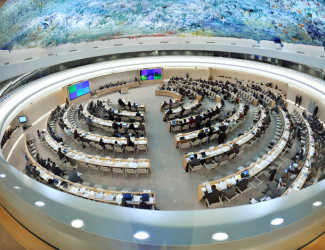
Jean-Marc Ferré | Flickr (CC BY-NC-ND 2.0)
A general view of participants at the 16th session of the Human Rights Council in Geneva, Switzerland.

Special Focus

AWID is an international, feminist, membership organisation committed to achieving gender equality, sustainable development and women’s human rights

Human Rights Council (HRC)

The Human Rights Council (HRC) is the key intergovernmental body within the United Nations system responsible for the promotion and protection of all human rights around the globe. It holds three regular sessions a year: in March, June and September. The Office of the UN High Commissioner for Human Rights (OHCHR) is the secretariat for the HRC.

The HRC works by:

  • Debating and passing resolutions on global human rights issues and human rights situations in particular countries

  • Examining complaints from victims of human rights violations or activist organizations on behalf of victims of human rights violations

  • Appointing independent experts (known as “Special Procedures”) to review human rights violations in specific countries and examine and further global human rights issues

  • Engaging in discussions with experts and governments on human rights issues

  • Assessing the human rights records of all UN Member States every four and a half years through the Universal Periodic Review

Learn more about the HRC


AWID works with feminist, progressive and human rights partners to share key knowledge, convene civil society dialogues and events, and influence negotiations and outcomes of the session.

With our partners, our work will:

◾️ Monitor, track and analyze anti-rights actors, discourses and strategies and their impact on resolutions

◾️ Raise awareness of the findings of the 2017 and 2021 OURs Trends Reports.

◾️Support the work of feminist UN experts in the face of backlash and pressure

◾️Advocate for state accountability
 
◾️ Work with feminist movements and civil society organizations to advance rights related to gender and sexuality.
 

Related Content

Snippet - WITM To Strengthen - ES

Para fortalecer nuestra voz y poder colectivos para obtener más y mejor financiamiento para las organizaciones feministas, por los derechos de las mujeres y de las personas LBTQI+ y demás organizaciones aliadas de todo el mundo.

2024: Renforcement des mouvements, soutenir le changement

La montée de la droite dans nombre de pays et le déluge de coupes dans les financements frappent durement la société civile de la Majorité mondiale ; le génocide en cours à Gaza, l’intensification des conflits violents au Soudan, la crise climatique à de nombreux endroits de notre planète : nous faisons face à des fascismes qui reviennent en force et un ordre mondial de l’impunité.

Téléchargez le rapport annuel 2024


Renforcement des mouvements, soutenir le changement RAPPORT ANNUEL

Ensemble, nous pouvons construire un monde où la justice, la libération et la bienveillance ne sont pas des aspirations, mais des réalités.

Téléchargez le rapport annuel 2024

Riham Al-Bader

Riham was a lawyer and activist committed to monitoring rights violations in Yemen.

She worked with other activists to supply civilians trapped by Houthi militias in the outskirts of the city of Taiz with food and water.

Riham was killed in February 2018 and it is unconfirmed whether she was killed by a sniper or hit by an aircraft. Nobody has been held accountable for her murder. 


Riham Al Bader, Yemen

Snippet FEA Get Involved 1 (ES)

¡INVOLÚCRATE!

Siga el trabajo de estos colectivos en sus cuentas de redes sociales y sitios internet:

Snippet - WITM Survey will remain open - FR

Regardez le webinaire « Où est l'argent?» maintenant !

Le 11 juillet 2024, nous avons eu une conversation étonnante avec de grandes féministes sur l'état de l'écosystème du financement et le pouvoir du recherche « Où est l'argent ? ».

Un merci spécial à Cindy Clark (Thousand Currents), Sachini Perera (RESURJ), Vanessa Thomas (Black Feminist Fund), Lisa Mossberg (SIDA) et Althea Anderson (Fondation Hewlett).

N'oubliez pas que l'enquête restera ouverte jusqu'au 31 août 2024 !

Regardez le webinaire

Inna Michaeli

Biography

Inna es una activista y socióloga feminista queer. Posee muchos años de profundo compromiso con las luchas feministas y LGBTQI+, la educación en política y en procesos de organización de y para las mujeres migrantes, así como por la liberación de y la solidaridad con Palestina. Se incorporó a AWID en 2016 y cumplió diferentes funciones, la más reciente como Directora de Programas. Reside en Berlín (Alemania), creció en Haifa (Palestina/Israel), nació en San Petersburgo (Rusia), y ha puesto todo ese recorrido geográfico político y de resistencia a los colonialismos pasados y presentes al servicio del activismo feminista y la solidaridad transnacional.

Inna es autora de Women's Economic Empowerment: Feminism, Neoliberalism, and the State (Empoderamiento económico de las mujeres: Feminismo, neoliberalismo y Estado. Palgrave Macmillan, 2022), basado en la tesis que le valió un doctorado de la Universidad Humboldt de Berlín. Como académica, impartió cursos sobre globalización, producción de conocimientos, identidad y pertenencia. Inna posee una maestría en Estudios Culturales de la Universidad Hebrea de Jerusalén. Integra la Junta de Jewish Voice for a Just Peace in the Middle East (Voces Judías por una Paz Justa en Medio Oriente, Alemania) y, con anterioridad, fue miembro de la Junta de +972 Advancement of Citizen Journalism (+972 Avance del Periodismo Ciudadano). Antes, Inna trabajó con la Coalición de Mujeres por la Paz y es una apasionada de la movilización de recursos para el activismo de base.

Position
Codirectora Ejecutiva
Add to stories
Off

So'oalo Roger

So'oalo fue una ferviente defensora de los derechos humanos, especialmente de los derechos de la comunidad LGBTQI en el Pacífico.

Fue integrante de la Asociación Fa’afafine de Samoa (SFA) y una apasionada activista por el reconocimiento de un tercer género en el país insular. Bajo su liderazgo, la SFA luchó por el reconocimiento de la validez y los derechos de la comunidad fa’afafine.

También fue pionera en articular los vínculos entre derechos humanos, explotación de lxs fa’afafines en Samoa y el Pacífico y la salud, el bienestar y la seguridad de la comunidad LGBTQI.

Fue fuente de inspiración, visionaria y su dedicación a la lucha por los derechos de su comunidad es admirable y será recordada  por siempre.


So'oalo Roger, Samoa

Snippet FEA EoS The Cover (ES)

Illustration of a pink human in white underwear doing a power pose

La Poderosa
Autoprotección y fortalecimiento

Snippet - WITM RESOURCES - ES

Recursos

Margo Okazawa-Rey

Biography

Dre. Margo Okazawa-Rey est titulaire de la Chaire Barbara Lee pour le leadership des femmes et professeure invitée en études sur les femmes, le genre et la sexualité et en politique publique au Mills College à Oakland, en Californie. Elle est également professeure émérite à la San Francisco State University.

Ses principaux domaines de recherche et d’activisme au cours des 25 dernières années sont le militarisme, les conflits armés et la violence à l’égard des femmes, analysés de manière intersectionelle. Professeure Okazawa-Rey siège au conseil consultatif international de Du Re Bang à Uijongbu en Corée du Sud, au Conseil international de PeaceWomen Across the Globe à Berne, en Suisse, et est co-présidente du conseil du Highlander Research and Education Centre à New Market, Tennessee aux États-Unis.

Ses publications récentes incluent « Nation-izing » Coalition and Solidarity Politics for US Anti-militarist Feminists (en presse) ; « No Freedom without Connections: Envisioning Sustainable Feminist Solidarities » (2018) dans Feminist Freedom Warriors : Genealogies, Justice, Politics, and Hope, Chandra Talpade Mohanty et Linda Carty (ed.) ; Between a Rock and Hard Place: Southeast Asian Women Confront Extractivism, Militarism, and Religious Fundamentalisms (2018) ; à « Liberal Arts Colleges Partnering with Highlander Research and Education Center : Intergenerational Learning for Student Campus Activism and Personal Transformation, » numéro spéciale de Feminist Formations (Feminist Social Justice Pedagogy, (2018).

Position
Présidente
Add to stories
Off

About the AWID International Forum

More than an event!

The AWID International Forum is a truly global space that gives participants an opportunity to network, build alliances, celebrate, and learn in a stimulating, emotive and safe atmosphere. 

AWID International Forum in Costa de Sauipe, Brazil, 2016

More and more, we are trying to bring the Forum process outside of the convening’s borders. Engaging with partners and deepening relationships all year round, connecting with local movements to better understand problems and co-create solutions. The Forum event itself, held every three to four years in a different region of the world, is just a crystallization of all these alliances that we are building as part of our work.

The AWID Forum dissolves our inner and external boundaries, fosters deep discussion, personal and professional growth, and strengthens our movements for gender justice and women’s rights.

As a convening, it is a response to the urgency to promote stronger and more coordinated engagement and action by feminists, women’s rights and other social justice advocates, organizations and movements. We also believe that the Forum is more than just an event – it can facilitate a process to influence thinking and set agendas for feminist movements and other related actors.

Evolving from a national conference of around 800 people, the event now brings together around 2000 feminists, community leaders, social justice activists, and donor agencies from around the world. 

The 14th AWID International Forum will take place 11-14 January 2021 in Taipei, Taiwan.

Find out more!


The past Forums

2016 - Feminist Futures: Building Collective Power for Rights and Justice (Costa de Sauipe, Brazil)

Participants at the Black Feminisms Forum in Brazil, 2016

Given the complex world that we face today, the 2016 AWID Forum did not focus on a particular “issue”, but rather on creating more effective ways of working together!

Despite the challenging contexts in which the 2016 Forum took place (the Zika epidemic, a strike by Brazilian foreign-service workers, the impeachment of President Dilma Rousseff and subsequent turmoil), it succeeded in bringing together over 1800 participants from 120 countries and territories across all regions of the world.

What happened at the 13th AWID international Forum:

  • For 96% of participants who responded to the post Forum evaluation survey, the Forum was a major source of inspiration and energy.

  • 98% of participants considered it an important convening space for feminist movements and expressed hope that AWID continues to organize forums.

  • 59% of Forum evaluation survey respondents declared to be very satisfied with the Forum and 34% somewhat satisfied.

  • Over 150 sessions were delivered in different formats on a variety of topics ranging from bodily integrity and freedoms, to gender-based violence in the workplace, to strategies for building collective power.

  • The first-time Black Feminisms Forum (BFF), held just before the main AWID Forum, brought together 250 Black feminists from all over the world to co-create a powerful space to build and strengthen ongoing, intergenerational, transnational connections

Read more about what the 2016 AWID Forum achieved:

Download the Forum evaluation report


2012 - Transforming Economic Power to Advance Women's Rights and Justice (Istambul, Turkey)

AWID International Forum, in Cape Town, South Africa, 2008

The 12th AWID Forum was the largest and most diverse AWID Forum to date, bringing together 2239 women’s rights activists from 141 countries. Of these participants, around 65% were from the Global South and close to 15% were young women under 30, and 75% attended an AWID Forum for their first time.

The Forum program focused on transforming economic power to advance women’s rights and justice and featured over 170 different kinds of sessions including feminist economics toolbox skills-building sessions, breakout sessions representing all 10 Forum themes, in-depth sessions, and solidarity roundtables. 

Building on the momentum of the 2012 Forum, we transformed the website into a resource and learning Hub, which builds on the content generated by participants by featuring multi-media resources on all Forum components. 

Visit the 2012 Forum web archive


All AWID Forums

  • 2016: Feminist Futures: Building Collective Power for Rights and Justice (Costa de Sauipe, Brazil). Read the 2016 Forum Evaluation report
  • 2012: Transforming Economic Power to Advance Women's Rights and Justice (Istanbul, Turkey)
  • 2008: The Power of Movements (Cape Town, South Africa). Read our 2008 Forum Report
  • 2005: How does change happen? (Bangkok, Thailand)
  • 2002: Reinventing Globalization (Guadalajara, Mexico)
  • 1999: Leading Solutions for Equality and Justice (US)
  • 1996: Beyond Beijing From Words to Action (US)
  • 1993: Joining Forces to Further Shared Visions (US)
  • 1991: Working Together/Learning Together: A South North Dialogue (US)
  • 1989/1990: Global Em-Powerment for Women (US)
  • 1987: Moving Forward: Innovations in Development Policy, Action and Research (US)
  • 1985: Women Creating Wealth; Transforming Economic Development (US)
  • 1983: ‘Women in Development’ (Washington D.C, US)

Samira Khalil

Samira était une activiste syrienne sous le régime de Bachar al-Asad.

Dès son plus jeune âge, Samira s'est opposée à toutes les formes de despotisme et en particulier au régime autoritaire dans lequel elle vivait. Samira a été kidnappée en 2013 avec trois autres activistes de premier plan. Elle aurait été enlevée au Centre de documentation sur les violations à Douma, une ville située en périphérie rurale de Damas.

Le principal suspect associé à sa disparition est le groupe rebelle syrien Jaych al-Islam (l'armée de l'islam), qui nie son implication. Aucune enquête officielle n’a été ouverte sur la disparition de Samira et elle n’a plus donné de nouvelles depuis lors. Samira était attachée à son pays et refusait de quitter la Syrie tant qu'elle estimait que son rôle en faveur de l'émancipation des femmes et la documentation des crimes était utile et nécessaire.


Samira Khalil, Syria

Snippet FEA Land and Agroecology (FR)

AGROÉCOLOGIE ET

SOUVERAINETÉ ALIMENTAIRE

Comment les femmes rurales s’occupent de la Nature et des communautés

Je suis activiste à titre individuel, je ne travaille avec aucun groupe, organisation et/ou mouvement à l’heure actuelle, est-ce que je devrais participer à cette enquête?

Non, nous reconnaissons l’importance de votre travail, mais nous ne collectons pas les réponses fournies à titre individuel à l’heure actuelle.

Salome Chagelishvili

Biography

Salome is a feminist activist from Tbilisi, Georgia, devoted to social and gender justice. She holds a Master's degree in gender studies, and has been engaged in feminist, queer and green movements for over twelve years, working amongst others on issues of gender based violence, domestic violence, sexual and reproductive health and rights, LGBTIQ rights, [women’s] Labor Rights, Healing Justice and holistic and digital security and rights.

Since 2014 she has been actively working on safety and security issues of activists and Women Human Rights Defenders, providing integrated security and digital security workshops specifically for activists from under-privileged groups (queer persons, ethnic and religious minorities, rural women and girls, etc) as well as bigger feminist organisations. Salome is a member of the Independent Group of Feminists - a non-formal, non-hierarchical and non-registered initiative that unites feminists with diverse backgrounds in Georgia. Currently, she is the Executive Director of the Women's Fund in Georgia, fully engaged in women's/feminist movement building, providing feminist funding, and encouraging local feminist philanthropy.

Add to stories
Off

Test Page

This is body text

After the gallery

Some English aside content