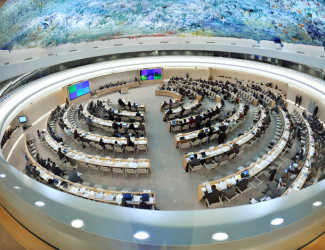
Jean-Marc Ferré | Flickr (CC BY-NC-ND 2.0)
A general view of participants at the 16th session of the Human Rights Council in Geneva, Switzerland.

Analyses Spéciales

L´AWID est une organisation féministe mondiale qui consacre ses efforts à la justice de genre, au développement durable et aux droits humains des femmes

Conseil des Droits de l'Homme (CDH)

​​​​​​Le Conseil des droits de l'homme (CDH) est un organe intergouvernemental clé du système des Nations Unies, responsable de la promotion et la protection des droits humains autour du globe. Il se réunit  trois fois par an en session ordinaire, en Mars, Juin et Septembre. Le Bureau du Haut-Commissariat des Nations Unies aux Droits de l’Homme (HCDH) constitue le secrétariat pour le CDH.

Le CDH :

  • Débat et adopte des résolutions sur les questions globales des droits humains ainsi que sur la situation des droits humains dans des pays particuliers

  • Examine les plaintes des victimes de violations des droits humains et des organisations activistes, au nom des victimes de violations des droits humains

  • Nomme des experts indépendants (que l'on connaît sous le nom de « Procédures Spéciales ») pour réviser les cas de violation des droits humains dans des pays spécifiques, ainsi que pour examiner et suivre des questions globales relatives aux droits humains

  • Prend part à des discussions avec les experts et les gouvernements sur les questions de droits humains

  • Évalue les bilans des États membres de l'ONU en matière de droits humains tous les quatre ans et demi, dans le cadre de l'examen périodique universel.

En savoir plus sur le CDH


Session actuelle: CDH 44

La prochaine session du CDH a lieu à Genève, en Suisse, du 30 juin au 17 juillet 2020.

AWID travaille avec des partenaires féministes, progressistes et du domaine des droits humains pour partager nos connaissances clé, convoquer dialogues et évènements avec la société civile, et influencer les négociations et les résultats de la session.

Avec nos partenaires, notre travail consiste à :


◾️ Suivre, surveiller et analyser les acteurs, discours et stratégies anti-droits et leur impact sur les résolutions du CDH.

◾️ Co-développer un plaidoyer collectif pour contrer les acteurs anti-droits et discuter plus en détails les résultats du Rapport de tendances 2017 du OURs

◾️ Soutenir, coordoner et développer de manière collaborative le Caucus féministe qui émerge au CDH.


Contenu lié

My Queer Ramadan 

by Amal Amer, California, US

I pray with my family for the first time in six years while wrapped in a keffiyah I scavenged from a dumpster.

Since coming into myself, I have refused to pray in jamaat with my family. Joining in the ranks of hierarchy, “women” behind “men” irks me. It grates my skin and teeth to the degree where I can’t focus, and the standing, bowing, and kneeling feels like a battle against my true being. Each second listening, a betrayal of my nature. Instead, I pray by myself in my own way. 

Yet this Ramadan, I feel different. Back in my childhood home after many years, I am choosing to fast. I choose suhoor with my family, and praying together feels like a natural extension of eating together. After eating, my mother, father, brother and I line up for fajr. 

I pray behind Baba, but my prayer is my own. I close my eyes, staying with my breath and my body. 

My eyes closed, I open my inner sight to a wide open window on a vista of mountains, bright sun spreading over a light mist of clouds. This was the view I had while praying in jamaat at a queer Muslim wedding I attended in the mountains of the South of France last September. 

I lined up with the wedding guests, queer and trans folks of North and West African, Arab, and European descent. Folks of all faiths joined while some chose to stand in respect at the sides or behind. The groups did not fall along fault lines of “Muslim” or “non-Muslim,”  “religious” or “non religious.” The two lovers marrying each led us in prayer, and so did the Muslim woman officiating the nikkah. Each of the three led us in two rounds of prayers, two raqat.

I showed up as I was, my body uncovered. I had not washed. I only passed my camera to a friend who chose to stand at the side. 

In the first sujood, I broke down crying. I wore a jean dress that loves my body, one found at a thrift store my ex-girlfriend pointed me to.

The sobs come through my whole body during the prayer, and I put my head to the earth with my community like a homecoming. A return to the embrace of love both intensely personal and communal, and I am held.

It feels like swimming in the sea with multiple people:  joyful togetherness. But when you go beneath the water, it’s just you and the current. 

Like a dozen people buried in the same graveyard. Separate, but sharing the same soil. Becoming one with the growing earth. 

That was how it felt to pray in communion at a queer Muslim wedding.

I welcomed the light of acceptance while showing up as myself that day, with a group of people who had also chosen to claim all the parts of themselves in love. That light made a home in me, and it illuminates my heart in the dark living room at fajr this Ramadan morning. Though I pray with my birth family who do not accept all of me, I see myself praying in jamaat at that glorious wedding with all of my queer Muslim ancestors, my queer angels, my lineage, my soul family, my queer Muslim family, all standing in prayer. Bowing as one. 

My family’s home does not always feel like my own, though I am here now. I take the bukhoor from room to room, barefoot. Smolder from the censer, an incense that says, “Here I am.” Baraka, blessings from the source of all, Allah and the Goddess to each room in the house, bidding good and dispersing the unbidden. 

As I write this the sky turns the same royal blue I am familiar with from exiting the club and pulling all-nighters. It is the gradient of morning I step into as I go to sleep. 

Word meanings:

  • Ramadan: the Muslim holy month, traditionally observed with 29 days of fasting without food or water during daylight hours

  • Keffiyah: a patterned scarf common in the SWANA region. The black and white version referred to here is associated with the Palestinian liberation movement 

  • Pray in jamaat: Islamic ritual prayer in a group. Participants follow one person, traditionally male, who calls the prayer aloud.

  • Suhoor: the meal before the fast starts at dawn

  • Fajr: the dawn prayer

  • Baba: father

  • Raqat: one round of prayer consisting of standing, bowing, kneeling, and pressing the head to the ground

  • Sujood:the prayer position when one presses one’s head to the earth

  • Nikkah: the religious marriage ceremony 

  • Bukhoor: an Arabic incense, woodchips soaked in resin

  • Baraka: blessing


“Angels go out at night too”

by Chloé Luu (@Electrichildren), France

Pictures of angels in my life, just some women and non-binary people of color hanging out, taking care of themselves and expressing love to each other. It's these simplest moments that are the most empowering.

Chloé Luu (@Electrichildren)


< Freeing the Church, Decolonizing the Bible for West Papuan Women

Kunyit Asam: The Roots of Love and Resilience >

Body

Snippet FEA WE ARE LEGAL AND ALWAYS WERE (FR)

Espagne

Syndicat OTRAS


NOUS SOMMES LÉGAL·ES

ET L’AVONS TOUJOURS ÉTÉ

هل استطلاع "أين المال" متاح للأشخاص ذوي/ات الإعاقات؟

نعم، انه متاح للأشخاص أصحاب/ صاحبات الإعاقات السمعية، البصرية، النظرية والفكرية المختلفة.

Zita Kavungirwa Kayange

Zita was a women’s rights activist who defended the rights of rural women in Greater Kivu.

She was the first Executive Director of UWAKI - a well known women’s organisation. Through her work with Women's Network for Rights and Peace (RFDP), and the Women's Caucus of South Kivu for Peace, she committed her life to helping to restore peace in the Eastern DRC. She spoke out strongly against the use of sexual violence as a weapon of war.

In 2006, she put herself forward as a candidate in the first democratic elections in the DRC. Although she did not win, she continued to advocate for women’s rights and the South Kivu community remembers her fondly. 


Zita Kavungirwa Kayange, Republic Democratic of Congo

Values - intersectionality

Intersectionnalité

nous estimons que pour être transformateurs et forts, les mouvements féministes doivent continuer à travailler au-delà de leurs similitudes et de leurs différences. Nous devons également interroger le pouvoir et les privilèges, tant au sein qu'à l'extérieur de nos mouvements.

Principes d'engagement

Bienvenue à Crear | Résister | Transform : un festival dédié aux mouvements féministes !

Principes d'engagement

L'AWID s'engage à créer un espace en ligne qui nous invite et nous pousse tou·te·s à faire preuve de courage, de curiosité, de générosité et de responsabilité partagée. 

Nous vous invitons à créer à nos côtés des espaces sans harcèlement ni violence, où chacun·e est respecté·e dans son identité et son expression de genre, sa race, ses capacités, sa classe, sa religion, sa langue, son ethnicité, son âge, sa profession, son type d'éducation, sa sexualité, sa taille et son apparence physique. Des espaces où nous reconnaissons les inégalités de notre monde et où nous nous efforçons de les transformer au gré de nos propres interactions avec les autres.


Nous voulons créer un espace qui permette à tout·te·s :

  • d’être présent·e·s:

Soyez là les un·e·s pour les autres en étant activement à l’écoute. Essayons de nous sentir proches, même si tout est virtuel. Pour cela, vous aurez accès à l’interprétation de la discussion et à des moyens de communications ouverts (comme la boîte de dialogue et autres outils) pour réagir et échanger. Nous vous recommandons de porter des écouteurs ou un casque pendant la séance pour mieux entendre les autres et vous faire entendre. Dans la mesure du possible, essayez de fermer votre messagerie électronique ou toute autre distraction pendant que vous prenez part à la discussion.

  • de valoriser toutes les formes de savoirs:

Célébrons les multiples façons dont le savoir se manifeste dans nos vies. Nous vous invitons à aborder la conversation avec curiosité et ouverture d’esprit pour apprendre des autres, en se permettant de désapprendre et de réapprendre à travers ces  échanges, comme une manièrede commencer à construire collectivement des connaissances.

  • de se sentir accueillie·s: 

Nous nous engageons à adopter une approche holistique de l'accessibilité en tenant compte des différents besoins physiques, linguistiques, mentaux et de sécurité. Nous voulons un espace qui accueille des personnes d'origines, de croyances, de capacités et d'expériences différentes. Nous anticiperons au mieux mais vous demanderons également de nous communiquer vos besoins, et nous ferons de notre mieux pour y répondre.

  • de se sentir en sécurité et respecté·e·s :

Nous nous engageons tou·te·s individuellement et collectivement à respecter la vie privée de chacun·e· et à demander le consentement des autres avant de partager des images ou du contenu qui les concerne,  générés au cours de la conversation.


Créer un environnement sécurisé, respectueux et agréable durant ces conversations est la responsabilité de  tou·te·s .


Signalement

Si vous remarquez qu'une personne a un comportement discriminatoire ou offensant, veuillez contacter la personne de référence qui vous sera indiquée en début de session. 

Tout·e participant·e qui utilisera un langage ou des images abusives sera exclu·e de la conversation et ne sera pas réadmis·e. Nous n’aurons plus de relations avec cette personne de quelque manière que ce soit. 

Snippet FEA Unio Otras Photo 3 (EN)

Photo of Sabrina Sanchez speaking next to a screen on Ilga World meeting

Должен ли я отвечать на все вопросы сразу или я могу делать это с перерывами?

При необходимости, вы можете сохранить свои ответы и вернуться к опросу позже. Eсли Вы хотите сохранить ответы и вернуться к опросу позже, это можно сделать при условии, что Вы продолжите работу на том же устройстве. KOBO сохранит Ваши ответы в левом верхнем углу страницы опросника и подгрузит Ваш черновик, когда Вы вернетесь к опросу.

Bessy Ferrera

Bessy Ferrera was a lifelong defender of the human rights of trans people, sex workers and HIV positive people in Honduras.

Bessy was also a member of Arcoíris, an organisation which supports the LGBTI+ community. She was also a focal point person for the Right Here, Right Now (Derechos aquí y Ahora) Platform of Honduras, and advocated strongly for full citizenship of trans people, and the passing of a gender identity law that would allow trans people to change their gender identity legally.

"Since the beginning of the year [2019] the trans community has been suffering a series of attacks, for defending, for demanding rights." - Rihanna Ferrera (Bessy’s sister)

Bessy was a sex worker, and in early July 2019, was shot to death by two men while working in the streets of Comayagüela. Her assailants were subsequently arrested. 

Bessy is one of many LGBTI+ rights defenders in Honduras, who were murdered because of their identities and work. Other companeras include: Cynthia Nicole, Angy Ferreira, Estefania "Nia" Zuniga, Gloria Carolina Hernandez Vasquez, Paola Barraza, Violeta Rivas, and Sherly Montoya.

Bessy’s case is emblematic of injustice and a much larger problem of the systematic violence the LGBTI+ community faces in Honduras as the state fails to guarantee rights offer and fails to offer protection. This has created a culture of impunity.

Despite the risks LGBTI+ defenders in Honduras face, they continue their work to challenge and resist violence, and fight stigma and discrimination on a daily basis. 

“If I die, let it be for something good not for something futile. I don’t want to die running away, being a coward. If I die, I want people to say that I died fighting for what is mine.” - member of Arcoíris 

Membership why page - Kirthi Jayakumar quote

"I participated in a member-only activity and I was particularly moved to see how there was space for everyone to share and that there was no judgment whatsoever. The entire session was energetic and vibrant."

- Kirthi Jayakumar, Founder, The Gender Security Project, India 

Colectivo Morivivi

Colectivo Moriviví is an all women artistic collective. Our artistic production consists of muralism, community-led muralism, and protest performance/actions. Our work is about democratizing art and bringing the narratives of Puerto Rican communities to the public sphere to create spaces in which they are validated. We believe that through artivism we can promote consciousness on social issues and strengthen our collective memory.  

“Cacibajagua” 2017, Mural Project. Jiangxi, China
“Paz para la Mujer” 2015, collaboration with Coordinadora Paz para la Mujer Organization. Santurce,
“Paz para la Mujer” 2015, collaboration with Coordinadora Paz para la Mujer Organization. Santurce, Puerto Rico


“Paz para la Mujer” 2015, collaboration with Coordinadora Paz para la Mujer Organization. Santurce, Puerto Rico
“Paz para la Mujer” 2015, collaboration with Coordinadora Paz para la Mujer Organization. Santurce, Puerto Rico
Collectivo Moriri Artwork


As part of their participation in AWID’s Artist Working Group, Colectivo Morivivi gathered a diverse group of members, partners and staff to facilitate a collaborative process of dreaming into, informing, and deciding on the content for a community mural through a multi-stage co-creation process. The project began with a remote conceptualization with feminists from different parts of the planet brought together by AWID, and then it evolved to its re-contextualization and realization in Puerto Rico. We were honored to have the input of local artists Las Nietas de Nonó(@lasnietasdenono), the participation of local women in the Community Painting Session, the logistics support from the Municipality of Caguas, and FRIDA Young Feminist Fund’s additional support to the collective.
 
The mural explores the transcendence of borders by presenting bodies like a map, in an embrace that highlights the intersection of the different feminist manifestations, practices and realities. 
 
We also thank Kelvin Rodríguez, who documented and captured the different stages of this project in Puerto Rico:

Collectivo Moriri Artwork

About Colectivo Morivivi 

Colectivo Morivivi portrait

Moriviví is a collective of young female artists, working on public art since April 2013. Based in Puerto Rico, we’ve gained recognition for the creation of murals and community led arts.

The group started out in local Urban Art Festivals. As our work became more popular, organizations and community leadership started to reach out to us. We began as eight high schoolers who wanted to paint a mural together. However, in eight years of hard work, we’ve faced many challenges.  Now we are in a period of transition. During this following year, we aim to restructure the collective internally. Our goal is to open new opportunities for collaborators and back-up our decision making process with a new evaluation system.  In the long run, we aspire to become an alternative school of art practice for those interested in immersing themselves in community art production.
Body

Snippet FEA Linda Porn Bio (ES)

Linda Porn es una otra heroína de la organización sindical feminista y del activismo de las trabajadoras sexuales a nivel nacional (en España) y transnacional.

Originaria de México, vive en España desde los años 2000. Es trabajadora sexual, activista, madre soltera y artista multidisciplinar.

Partiendo de estas diferentes identidades, utiliza la performance, el videoarte y el teatro para visibilizar las luchas en las intersecciones del transfeminismo, el trabajo sexual, la migración, el colonialismo y la maternidad. Combina el arte y el trabajo sexual mientras cuida a su hija como madre soltera.

Linda también pertenece a colectivos de trabajadoras sexuales que luchan por sus derechos, como el sindicato OTRAS y CATS Murcia. También cofundó el grupo 'Madrecitas' - que visibiliza y denuncia la violencia institucional racista contra las familias migrantes. Violencia de la que ella y su hija fueron objeto por ser trabajadora sexual y madre soltera migrante.

¡No te pierdas su trabajo artístico aquí!

Respondi ao inquérito, mas mudei de ideias e quero que a nossa resposta seja eliminada. Como devo proceder?

Tem o direito de eliminar a sua resposta, por qualquer motivo e se assim o desejar. Queira entrar em contacto connosco através deste formulário, ao indicar "WITM Survey" ("Inquérito WITM") no título da sua mensagem, e iremos proceder à eliminação da sua resposta.

Yelena Grigoriyeva

Yelena Grigoriyeva, a menudo conocida entre sus amigxs como Lena, fue una destacada defensora de los derechos LGBT en Rusia.

Formó parte de movimientos democráticos, anti-guerra y LGBT. En su activismo, fue una crítica feroz del Presidente Vladimir Putin y su administración, y expresó su oposición a la anexión por parte de Rusia de la península de Crimea de Ucrania y al maltrato de prisionerxs.

Yelena se declaró bisexual a principios de 2019. "Su salida del armario fue una sorpresa para mí, y no la aprobé. Le dije: ‘Escucha, Lena, ya estás en la mira por tu actividad política. Te acabas de clavar otro blanco en el pecho’". - Olga Smirnova

Yelena, de hecho, recibió múltiples amenazas de muerte y, según algunxs de sus conocidxs, figuraba en un sitio web homofóbico que instaba a sus visitantes a que persiguieran a las personas LGBT. Yelena denunció las amenazas a la policía, pero el Estado ruso no le proporcionó ningún tipo de protección.

Sin embargo, Yelena, a pesar de vivir en una sociedad en la que la oposición política, así como lxs integrantes de la comunidad LGBT y lxs defensores de sus derechos, se enfrentan a una violencia continua y creciente, siguió haciendo campaña por la justicia social y la igualdad.

"No se perdió ni una sola acción. Y la detuvieron tantas veces que hasta perdí la cuenta", Olga Smirnova (compañera activista de la oposición y amiga).

Yelena fue asesinada el 21 de julio de 2019, cerca de su casa. Las autoridades detuvieron a una persona sospechosa pero, según algunas fuentes, muchxs amigxs y compañerxs activistas creen que es un chivo expiatorio y que, en realidad, se trata de un asesinato político deliberado.

Para los familiares y amigxs de Yelena, su caso sigue sin resolverse aunque la persona sospechosa haya confesado.

En 2013, Rusia aprobó una ley que prohíbe la difusión de lo que describió como "propaganda gay". En 2014, Human Rights Watch publicó un informe al respecto.