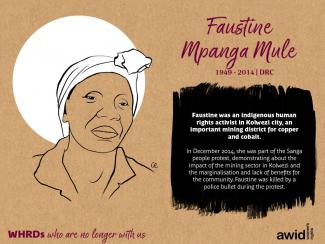
Faustine Mpanga Mule

Building Feminist Economies is about creating a world with clean air to breath and water to drink, with meaningful labour and care for ourselves and our communities, where we can all enjoy our economic, sexual and political autonomy.
In the world we live in today, the economy continues to rely on women’s unpaid and undervalued care work for the profit of others. The pursuit of “growth” only expands extractivism - a model of development based on massive extraction and exploitation of natural resources that keeps destroying people and planet while concentrating wealth in the hands of global elites. Meanwhile, access to healthcare, education, a decent wage and social security is becoming a privilege to few. This economic model sits upon white supremacy, colonialism and patriarchy.
Adopting solely a “women’s economic empowerment approach” is merely to integrate women deeper into this system. It may be a temporary means of survival. We need to plant the seeds to make another world possible while we tear down the walls of the existing one.
We believe in the ability of feminist movements to work for change with broad alliances across social movements. By amplifying feminist proposals and visions, we aim to build new paradigms of just economies.
Our approach must be interconnected and intersectional, because sexual and bodily autonomy will not be possible until each and every one of us enjoys economic rights and independence. We aim to work with those who resist and counter the global rise of the conservative right and religious fundamentalisms as no just economy is possible until we shake the foundations of the current system.
Advance feminist agendas: We counter corporate power and impunity for human rights abuses by working with allies to ensure that we put forward feminist, women’s rights and gender justice perspectives in policy spaces. For example, learn more about our work on the future international legally binding instrument on “transnational corporations and other business enterprises with respect to human rights” at the United Nations Human Rights Council.
Mobilize solidarity actions: We work to strengthen the links between feminist and tax justice movements, including reclaiming the public resources lost through illicit financial flows (IFFs) to ensure social and gender justice.
Build knowledge: We provide women human rights defenders (WHRDs) with strategic information vital to challenge corporate power and extractivism. We will contribute to build the knowledge about local and global financing and investment mechanisms fuelling extractivism.
Create and amplify alternatives: We engage and mobilize our members and movements in visioning feminist economies and sharing feminist knowledges, practices and agendas for economic justice.
“The corporate revolution will collapse if we refuse to buy what they are selling – their ideas, their version of history, their wars, their weapons, their notion of inevitability. Another world is not only possible, she is on her way. On a quiet day, I can hear her breathing”.
Arundhati Roy, War Talk

نرحب بالطلبات عبر مجموعة كاملة من المواضيع والتقاطعات المهمة للحركات النسوية وحركات العدالة الجندرية. في نموذج الطلب، ستتمكن/ين من تحديد أكثر من موضوع يناسب نشاطك.
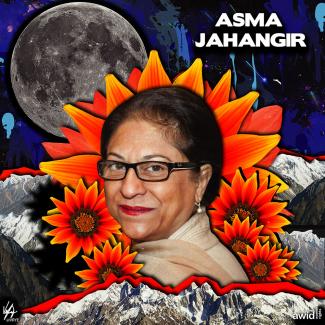
Asma was a leading Pakistani rights activist, fearless critic of the military’s interference in politics and a staunch defender of the rule of law.
She was the founding chairwoman of the Human Rights Commission of Pakistan, an independent group, and was a trustee of the International Crisis Group. She won international awards and served as the United Nations rapporteur on human rights and extrajudicial killings.
She is remembered fondly by colleagues and friends at AWID
“With her life, Asma rewrote the history that many of us were told as women. Asma changed the world. She changed it in Pakistan, and she changed it in our imaginations."
From the rising right in many countries and the flurry of funding cuts hitting hard civil society of the Global Majority, to the ongoing genocide in Gaza, the intensification of violent conflicts in Sudan, and climate crisis in many parts of our planet, we are facing real forces of fascism and a world order of impunity. This makes our opportunities to come together and build solidarity particularly valuable and imperative for our survival as a global feminist community. Of course, in 2024, the 15th AWID International Forum finally happened, and what a powerful space it was.
Download the full 2024 Annual Report
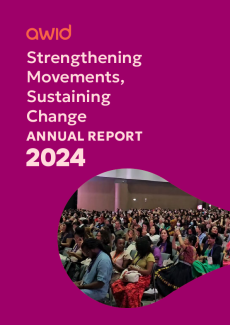
As we look ahead, we build on the powerful calls to action made by feminists at the AWID Forum; Together we can build a world where justice, liberation and care are not aspirations but realities.
From Peacebuild to the Canadian Feminist Alliance for International Action, Amnesty International, and the Canadian Centre for Policy Alternatives (CCPA), Kate had a lifelong passion for women’s rights and gender equality and dedicated her career to fighting inequality and making the world a more compassionate place.
Kate was a member of the Coordinating Committee of Social Watch and a contributor to the Canadian National Social Watch reports. As a Senior Researcher at the CCPA, Kate received national acclaim for researching, writing, and producing the annual “The Best and Worst Places to be a Woman in Canada” report.
Kate died peacefully surrounded by her family, following a three-year battle with colon cancer. She is described by loved ones as a “Funny, Fearless, Unapologetically Feminist.”

ทุกสามถึงสี่ปี AWID จะเป็นเจ้าภาพงานประชุมนานาชาติที่สำคัญ โดยจะเป็นการประชุมขนาดใหญ่ระดับโลกที่หัวใจหลักอยู่ที่ขบวนการเฟมินิสต์และความเป็นธรรมทางเพศที่หลากหลาย เป็นการรวมตัวกันระดับโลกของนักกิจกรรมเฟมินิสต์ เครือข่ายพันธมิตร นักวิชาการ แหล่งทุน และผู้กำหนดนโยบาย โดยฟอรัมเปลี่ยนสถานที่จัดหมุนเวียนไปในต่างภูมิภาคและในประเทศต่างๆทั่วซีกโลกใต้
Umyra Ahmad is a Malaysian feminist with a background in international and regional advocacy, and human rights education. In AWID, she works on advancing rights related to gender and sexuality at the UN. Prior to joining, she was a programme officer at IWRAW Asia Pacific, where she supported regional, national and grassroots organizations in using UN treaty body mechanisms as a tool for state accountability and access to justice. In Malaysia, she works with queer and refugee collectives and supports coordination of various mutual aid initiatives.
Amal was a prominent politician and parliamentarian in Libya. She was a faculty member at Benghazi University from 1995 until her death in 2017.
Amal was a civil society activist and a member of various social and political initiatives. She assisted the families of martyrs and the disappeared, and was a founding member of a youth initiative called ‘’Youth of Benghazi Libya”. In the 2014 parliamentary elections, Amal was elected to the House of Representatives with more than 14,000 votes (the highest number of votes anyone received in the 2014 elections).
Amal will remain in the memories of many as a woman politician working to ensure a better future in one the most difficult and conflict-ridden contexts in the region.

ไม่ คุณไม่จะเป็นต้องเป็นสมาชิก AWID เพื่อที่จะเข้าร่วมฟอรัม แต่สมาชิก AWID จะได้รับส่วนลดค่าลงทะเบียนรวมถึงสิทธิประโยชน์อื่นๆ เรียนรู้เพิ่มเติมเกี่ยวกับการเป็นสมาชิก AWID
Jemimah Naburri-Kaheru is an accomplished international HR strategist with a profound impact within the Horn of Africa Region. Jemimah previously served as the Regional Human Resource and Office Manager at the Strategic Initiative for Women in the Horn of Africa (SIHA). Her influence extends to HR leadership for over 70 regional staff, as the organization experienced rapid growth with a 40% increase in annual revenues. Throughout her career, Jemimah has orchestrated successful recruitment efforts, introduced merit-based performance systems, and overseen employee relations and HR policies.. She played a pivotal role in supporting global workforce strategies. With an academic background in Development Studies from Makerere University (Uganda) and an ongoing MBA in Human Resource Management, Jemimah's commitment to professional development is evident. Her contribution to high-performance workforces and international HR leadership positions her as an invaluable asset to any global enterprise.
Andaiye was seen as a transformative figure on the frontlines of the struggles for liberation and freedom. She was an early member and active in the leadership of the Working People’s Alliance (WPA), a socialist party in Guyana which fought against authoritarian rule and continued throughout her life to focus on justice for the working-class and rural women’s rights and on bridging ethnic barriers between Indo and Afro-Guyanese women.
Andaiye was a founding member of Red Thread Women, an organization that advocated for women’s care work to be fairly remunerated, worked at the University of the West Indies and with CARICOM. Never afraid to challenge governments, she pointed out gender imbalances in state boards, laws that discriminated against sex workers, called for abortion rights in Jamaica and spoke out against trade agreements such as the Caribbean Single Market and Economy (CSME) that allowed for the free movement of women domestic migrant workers but did not give their children the same rights.
Andaiye published several scholarly essays, wrote newspaper columns and also edited the last books of Walter Rodney, the Guyanese political activist and fellow WPA leader, who was assassinated in 1980. A cancer survivor, Andaiye was one of the founders of the Guyana Cancer Society and the Cancer Survivors’ Action Group. She also served on the executive of the Caribbean Association for Feminist Research and Action (CAFRA), as a Director of Help and Shelter and as Board Member of the Guyana National Commission on Women. She received a number of awards, including the Golden Arrow of Achievement in Guyana (the fourth highest national award).
Andaiye passed away on 31 May 2019 at the age of 77. The subsequent tributes that flowed in from activists, friends and those inspired by her life spoke eloquently to her amazing legacy and her beautiful humanity.
Here are but a few:
“Andaiye had a profound effect on me...she was so many things, an educator, fighter, she taught me to be self-critical, to think more clearly, she taught me about survival, about incredible courage, about compassion, about going beyond external appearances and treating people as people and not being distracted by status, class, race...anything.”
- Peggy Antrobus, Feminist Activist, Author, Scholar, Barbados
“The kind of confident idealism Andaiye expressed, this willingness to confront the world and a stubborn belief that you could actually change it... That politics of hope...How else to honour her life, legacy and memory but to keep doing the work ethically and with ongoing self-critique? And to put women’s caring work at the center of it.”
- Tonya Haynes, Barbados
“I can hear her quip at our collective keening. So through the tears I can laugh. Deep bows to you beloved Andaiye, thank you for everything. Love and light for your spirit’s journey. Tell Walter and all the ancestors howdy.” - Carol Narcisse, Jamaica

คุณสามารถส่งกิจกรรมได้มากถึง 2 กิจกรรมในฐานะผู้จัดกิจกรรม และคุณยังสามารถเป็นผู้ร่วมจัดในการส่งกิจกรรมของผู้อื่นได้
AWID’s work is made possible through the financial support of a wide range of donors including multilateral and bilateral agencies, private foundations and women’s funds.
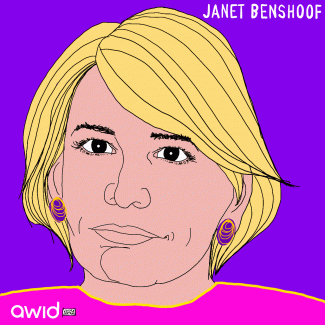
Janet Benshoof was a human rights lawyer from the United States and an advocate for women’s equality, sexual and reproductive rights.
She campaigned to broaden access to contraceptives and abortions across the world, and battled anti-abortion rulings and in the American territory of Guam. She was arrested in 1990 for opposing her country’s most restrictive abortion law, but won an injunction at the local court in Guam that blocked the law and eventually won at the Ninth Circuit Court of Appeals, striking down the law for good.
“The women in Guam are in a very tragic situation. I never intend to be quiet about that.” - Janet Benshoof for People Magazine
Janet established landmark legal precedents including the US Food and Drug Administrations’ approval of emergency contraception, as well as the application of international law to ensure the rights of rape victims in the Iraqi High Tribunal’s prosecution of Saddam-era war crimes.
Janet was President and founder of the Global Justice Center, as well as founder of the Center for Reproductive Rights, the world’s first international human rights organization focused on reproductive choice and equality. She served 15 years as Director of the American Civil Liberties Union’s Reproductive Rights Project, where she spearheaded litigation shaping US constitutional law on gender equality, free speech, and reproductive rights.
“Janet was known for her brilliant legal mind, her sharp sense of humor, and for her courage in the face of injustice.” - Anthony D. Romero
Named one of the “100 Most Influential Lawyers in America” by the National Law Journal, Janet was the recipient of numerous awards and honors.
She was born in May 1947 and passed away in December 2017.
ได้หรือไม่ เพราะได้มีการเสนอกิจกรรมเป็นเวลาเกือบ 1 ปีก่อนกิจกรรมจริง
แน่นอน! ในตอนนี้แบบฟอร์มสำหรับเสนอกิจกรรมได้ให้ระบุชื่อวิทยากร แม้วิทยากรเหล่านั้นอาจยังไม่ได้ยืนยันเข้าร่วมเราเข้าใจว่าการเปลี่ยนแปลงอาจเกิดขึ้นได้ภายในระยะเวลา 1 ปี
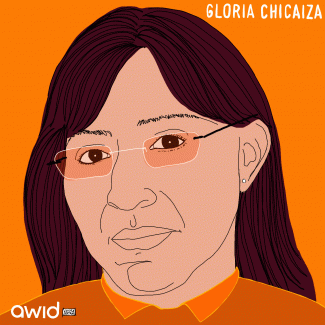
Gloria Chicaiza, an Ecuadorian social and environmental activist, was a fervent defender of land and water. She defied the status quo, fighting against a model of development based on extraction and worked tirelessly for ecological justice and the rights of communities affected by mining.
In diverse areas of Ecuador, Gloria was part of resistance actions in favour of protecting the ecosystem. With passion and dedication, Gloria supported the indigenous and environmental movement, its communities and organizations who oppose mining projects and protect their territories and collective life projects. She spoke out, in local and international foras, against the criminalization of dissent and resistance, the pressure and violence being enacted against community activists, in particular, women human rights defenders and in support of community led efforts for food sovereignty and sustainability.
She was the Mining Justice Coordinator at Acción Ecológica, member of the Latin American Network of Women Defenders of the Social and Environmental Rights and a Board member at the Observatory of Mining Conflicts of Latin America.
In October 2010, Gloria was accused by the mining company Curimining / Salazar Resources S.A. (with Headquarters in Vancouver, Canada) of sponsoring an act of terrorism, sabotage and illegal association to commit a crime. Acción Ecológica believed this to be “in retaliation for her work of denouncing the impacts of mining activities in the country.”
In 2014, Gloria supported the coordination of a delegation to the UN COP 20 Dialogue on Climate Change. The group consisted of 25 Indigenous women from Latin America.
Gloria passed away due to complications from a lung transplant on December 28, 2019. She is remembered for her resistance and tireless work.
"The fastest way to achieve sustainability is still resistance." - Gloria Chicaiza (2010 interview)
“Para GLORIA. GLORIA Agua. GLORIA Tierra. GLORIA Madre. GLORIA Revolución. GLORIA Hermana. GLORIA Cielo. GLORIAmiga. GLORIAstral. Thank you for weaving us together.” -Liliana Gutierrez
“Thank you Glorita, for sustaining hope, for keeping the fabric strong, for connecting the community, for the united hands, for solidarity, thank you Glorita for standing with us in the most difficult moments. Thank you for teaching us that throughout life, nobody gets tired.” (Chakana News)
“Gloria Chicaiza cherished and flourished in being one of many. And as humble as she was, she had an uncanny ability to lead and maintain a steady and thunderous beat, a life-affirming pulse that guided, mobilized, and inspired communities and networks in the protection of Mother Earth. She denounced all forms of violence against cuerpos-territorios. She endorsed el buen vivir.” - Gabriela Jiménez, Latin America Partnerships Coordinator, KAIROS
“Thank you Gloria Chicaiza from infinity we are sure that you will continue to support our struggle. You who continued to struggle with us despite your failing health. You will live on in the forests and the water that you defended with such courage. You will live on in our hearts.”- The community of Intag in Ecuador
Women's Forum on Financing for Gender Equality
The Third UN International Conference on Financing for Development