
Adolfo Lujan | Flickr (CC BY-NC-ND 2.0)
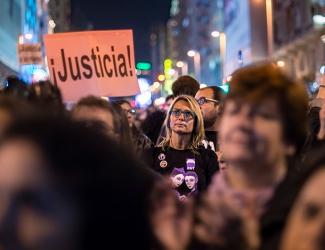
Mass demonstration in Madrid on International Women's Day
Multitudinaria manifestación en Madrid en el día internacional de la mujer

Priority Areas

Supporting feminist, women’s rights and gender justice movements to thrive, to be a driving force in challenging systems of oppression, and to co-create feminist realities.

Advancing Universal Rights and Justice

Uprooting Fascisms and Fundamentalisms

Across the globe, feminist, women’s rights and gender justice defenders are challenging the agendas of fascist and fundamentalist actors. These oppressive forces target women, persons who are non-conforming in their gender identity, expression and/or sexual orientation, and other oppressed communities.


Discriminatory ideologies are undermining and co-opting our human rights systems and standards,  with the aim of making rights the preserve of only certain groups. In the face of this, the Advancing Universal Rights and Justice (AURJ) initiative promotes the universality of rights - the foundational principle that human rights belong to everyone, no matter who they are, without exception.

We create space for feminist, women’s rights and gender justice movements and allies to recognize, strategize and take collective action to counter the influence and impact of anti-rights actors. We also seek to advance women’s rights and feminist frameworks, norms and proposals, and to protect and promote the universality of rights.


Our actions

Through this initiative, we:

  • Build knowledge: We support feminist, women’s rights and gender justice movements by disseminating and popularizing knowledge and key messages about anti-rights actors, their strategies, and impact in the international human rights systems through AWID’s leadership role in the collaborative platform, the Observatory on the Universality of Rights (OURs)*.
  • Advance feminist agendas: We ally ourselves with partners in international human rights spaces including, the Human Rights Council, the Commission on Population and Development, the Commission on the Status of Women and the UN General Assembly.
  • Create and amplify alternatives: We engage with our members to ensure that international commitments, resolutions and norms reflect and are fed back into organizing in other spaces locally, nationally and regionally.
  • Mobilize solidarity action: We take action alongside women human rights defenders (WHRDs) including trans and intersex defenders and young feminists, working to challenge fundamentalisms and fascisms and call attention to situations of risk.  


Related Content

CFA 2023 - Call for Activities is live- EN

The Call for Activities is Live!

The Deadline to submit activities has been extended to February 1st, 2024


In the spirit of the Forum’s theme, we invite a diversity of activity topics and formats that:

  • Facilitate genuine connection and interaction among participants
  • Foster healing and regeneration in various forms, as individuals, as communities and as movements
  • Inspire and challenge us to thrive together as communities and movements

Guadalupe Campanur Tapia

Guadalupe was an environmental activist involved in the fight against crime in Cherán, Mexico.

Guadalupe helped to overthrow the local government in April 2011 and participated in local security patrols including those in municipal forests.  She was among the Indigenous leaders of Cherán, who called on people to defend their forests against illegal and merciless logging. Her work for seniors, children, and workers made her an icon in her community.

She was killed in Chilchota, Mexico about 30 kilometers north of her hometown of Cherá.


Guadalupe Campanur Tapia, Mexico

CFA 2023 - Online and Hybrid - ar

 جديد

عبر الإنترنت وهجين

كمشارك/ة عبر الإنترنت، يمكنك توجيه النشاطات والتواصل والتحدث مع الآخرين/ الأخريات وتجربة الإبداع والفن والاحتفال بمنتدى جمعية حقوق المرأة في التنمية بشكل مباشر. سيستمتع المشاركون/ات المتصلون/ات عبر الإنترنت ببرنامج غني ومتنوع، بدءًا من ورشات العمل والنقاشات وحتى نشاطات الاستشفاء والعروض الموسيقية. ستركز بعض الأنشطة على التواصل بين المشاركين/ات عبر الإنترنت، وسيكون البعض الآخر هجينًا بالفعل، يركز على الاتصال والتفاعل بين المشاركين/ات عبر الإنترنت وأولئك الموجودين/ات في بانكوك.

Anna Campbell (şehid Hêlîn Qerecox)

Anna grew up in Lewes, Sussex (UK) and, after deciding not to pursue her English degree at Sheffield University, she moved to Bristol and became a plumber.

She spent much of her time defending the marginalised and under-privileged, attending anti-fascist rallies, and offering support to the women of Dale Farm when they were threatened with eviction. A vegan and animal lover, she attended hunt sabotages and her name is honoured on PETA's 'Tree of Life' Memorial. Anna went to Rojava in May 2017 with a strong commitment to women's empowerment, full representation of all ethnicities and protection of the environment.

Anna died on March 15, 2018 when she was hit by a Turkish airstrike in the town of Afrin, northern Syria. Anna was fighting with the Women's Protection Forces (YPJ), when she was killed.


Anna Campbell (şehid Hêlîn Qerecox), UK
Body

Mridula Prasad

Mridula was a strong advocate for the advancement for women’s health at a time when the topic of women’s sexual and reproductive health were considered taboo in Fiji.

The initial works of the Fiji Women’s Rights Movement about sexual and reproductive rights were under her guidance, and in September 1999, the United Nations Population Fund presented her with a regional award for Reproductive Health and Rights. Mridula was a strong, dedicated and tireless campaigner who was passionate about women’s health and empowerment.

She was a valued member of the women’s and feminist movement in Fiji and her contributions will always be remembered. Mridula passed away due to natural causes in 2017.

Mridula Prasad, Fiji

What criteria are you using to select the activities?

Please refer to the Call for Activities for this information, including the section “What you need to know”.

Body

Zita Kavungirwa Kayange

Zita was a women’s rights activist who defended the rights of rural women in Greater Kivu.

She was the first Executive Director of UWAKI - a well known women’s organisation. Through her work with Women's Network for Rights and Peace (RFDP), and the Women's Caucus of South Kivu for Peace, she committed her life to helping to restore peace in the Eastern DRC. She spoke out strongly against the use of sexual violence as a weapon of war.

In 2006, she put herself forward as a candidate in the first democratic elections in the DRC. Although she did not win, she continued to advocate for women’s rights and the South Kivu community remembers her fondly. 


Zita Kavungirwa Kayange, Republic Democratic of Congo

متى وأين سيكون المنتدى؟

2-5 ديسمبر 2024، بانكوك، تايلاند! سنجتمع في مركز الملكة سيريكيت الوطني للمؤتمرات (QSNCC) وكذلك افتراضيا عبر

Struggling for Human Rights, Facing Injustice across LAC

This year we are honoring 19 Women Human Rights Defenders from the Latin America and the Caribbean region. 16 defenders were murdered, including 6 journalists and 4 LGBTQI rights defenders. Please join us in commemorating the life and work of these women by sharing the memes below with your colleagues, friends and networks and by tweeting using the hashtags #WHRDTribute and #16Days.


Please click on each image below to see a larger version and download as a file


Magaly Quintana

Magaly Quintana was known by many in Nicaragua as ‘La Maga’ (meaning wizard). She was a feminist historian, activist, and an unyielding defender of women’s rights demanding justice for the victims of femicide.

Magaly was committed to documenting and building statistics on women and girls who were killed as a result of sexual violence in the country. 

“She rebuilt the life of each one, of their families, to show those lives that had been torn away.” - Dora María Téllez

Magaly also criticized the government for reforming Law 779 addressing violence against women. A product of the hard work of Nicaraguan women’s movements, this law included important provisions to criminalize femicide before its reform. She argued that legislative reforms weakened the law and limited the definition of femicides to homicides, as a result invisibilizing violent crimes against women.

Magaly’s feminist organizing began in the early 1980s. She was the director of Catholic Women for the Right to Choose, advocating for the right to therapeutic abortion after it was banned in 2006. In 2018, she supported the protests against Daniel Ortega’s government.

Magaly was born in May 1952 and passed away in May 2019.

“See you later, my dearest Magaly Quintana. Thanks so much, thanks for your legacy. We’ll see you again, as strong and powerful as ever.”- Erika Guevara Rosas (American Director of Amnesty International)

ويخطط عدد من الأشخاص من منظمتي لحضور المنتدى. هل يوجد خصم جماعي للمنتدى؟

لا تقدم جمعية حقوق المرأة في التنمية خصومات جماعية، ولكننا نقدم خصومات التسجيل للأعضاء/ العضوات. (انقر هنا لمعرفة المزيد عن كيفية الانضمام)

3. Design your survey

After assessing your organization’s capacity and research goals, you may choose to conduct a survey as one of the methods of data collection for your research analysis.

In this section:

Why conduct a survey?

A survey is an excellent way to gather information on individual organizations to capture trends at a collective level.

For example, one organization’s budget size does not tell you much about a trend in women’s rights funding, but if you know the budgets of 1,000 women’s rights organizations or even 100, you can start to form a picture of the collective state of women’s rights funding.

As you develop your survey questions, keep in mind the research framing that you developed in the previous section.

Remember: Your framing helps you determine what information you are trying to procure through your survey. The data collected from this survey should allow you to accomplish your goals, answer your key questions, and create your final products.

See examples of survey questions in AWID’s Sample WITM Global Survey

Back to top


Identify your survey population

This is an important step – the clearer you are about which populations you want to survey, the more refined your questions will be. 

Depending on your research goals, you may want to create separate surveys for women’s rights organizations, women’s funds and donors. Or you may want to focus your survey on women’s groups and collect interviews for women’s funds and donors, as a survey for each population can be resource-intensive.

The questions you ask women’s groups may be different than ones you would ask women’s funds. If you plan on surveying more than one population, we encourage you to tailor your data collection to each population.

At the same time, some key questions for each population can and should overlap in order to draw comparative analysis from the answers.

Online survey

If you can reach your survey population online, it is useful and efficient to create an online survey.

We recommend two online tools, both which offer free versions:

Survey Gizmo allows you to convert your data for SPSS, a statistical software useful for advanced data analysis

Your data analyst person(s) will be the best person(s) to determine which tool is best for your survey based on staff capacity and analysis plans.

For accessibility, consider making a PDF form version of your survey that you can attach via email. This ensures organizations that have sporadic internet connections or those that pay for it by the minute can download the survey and complete it without requiring a constant online connection.

Paper survey

You may decide that an online approach is not sufficiently accessible or inclusive enough for your popuation.

In this case, you will need to create a paper survey and methods to reach offline populations (through popular events or through post, with pre-stamped envelopes for returning).

Back to top


Create your questions

Make it easy for participants to complete your survey.

1. Short and clear questions

If the questions are confusing or require complex answers, you risk having participants leave the survey unfinished or providing answers that are unusable for your analysis.

Ensure your questions only ask for one item of information at a time.

For example:

  • What is your organization’s budget this year?
    Easy to answer: participant can easily locate this information for their organization, and it is only asking for one item of information.
  • What percentage of your budget have you identified as likely sources for funding for your organization, but are still unconfirmed? 
    Confusing and difficult to answer: are you asking for a list of unconfirmed funding sources or percentage of funding that is likely but unconfirmed?
    This information is difficult to obtain: the respondent will have to calculate percentages, which they may not have on hand. This increases the risk that they will not complete the survey.

2. Simple and universal language

Many words and acronyms that are familiar to you may be unknown to survey participants, such as “resource mobilization”, “WHRD”, and “M&E”, so be sure to choose more universal language to express your questions.

If you must use industry lingo – phrases and words common to your colleagues but not widely known – then providing a definition will make your survey questions easier to understand.

Be sure to spell out any acronyms you use. For example, if you use WHRD, spell it out as “Women’s Human Rights Defenders".

3. "Closed” and "Open" questions

Closed questions:

Only one response is possible (such as “yes,” “no” or a number). Survey participants cannot answer in their own words and they typically have to choose from predetermined categories that you created or enter in a specific number. Responses to closed questions are easier to measure collectively and are often quantitative.

Example of a closed question: What is your organization’s budget?

Open-ended questions:

These are qualitative questions that are often descriptive. Respondents answer these questions entirely in their own words. These are more suitable for interviews than surveys.

They are harder to analyze at a collective level as compared to closed-end questions, especially if your survey sample is large. However, by making open-ended questions very specific, you will make it easier to analyze the responses.

Whenever possible, design your survey questions so that participants must select from a list of options instead of offering open-ended questions. This will save a lot of data cleaning and analysis time.

Example of open-ended question: What specific challenges did you face in fundraising this year?

Familiarize yourself with different types of questions

There are several ways to ask closed-ended questions. Here are some examples you can review and determine what fits best for the type of data you want to collect:

  • Multiple choice questions: the participant can select one or several options you pre-entered
  • Rating scales: the participant gives a note on a scale you pre-determine.
    For this type of questions, make sure to clearly state what the bottom and the top of your scale mean
  • Ranking: the participant will choose and organize a certain number of answers you pre-determine.

View more question types

4. Logical organization

If you plan to conduct this research at regular intervals (such as every two years), we recommend developing a baseline survey that you can repeat in order to track trends over time.

Set 1: Screening questions

Screening questions will determine the participant’s eligibility for the survey.

The online survey options we provided allow you to end the survey if respondents do not meet your eligibility criteria. Instead of completing the survey, they will be directed to a page that thanks them for their interest but explains that this survey is intended for a different type of respondent.

For example, you only want women’s rights groups in a given location to take this survey. The screening questions can determine the location of the participant and prevent respondents from other locations from continuing the survey.

Set 2: Standardized, basic demographic questions

These questions would collect data specific to the respondent, such as name and location of organization. These may overlap with your screening questions.

If resources permit, you can store these answers on a database and only ask these questions the first year an organization participates in your survey.

This way when the survey is repeated in future years, it is faster for organizations to complete the entire survey, increasing chances of completion.

Set 3: Standardized and mandatory funding questions

These questions will allow you to track income and funding sustainability. Conducted every year or every other year, this allows you to capture trends across time.

Set 4: Special issues questions

These questions account for current context. They can refer to a changing political or economic climate. They can be non-mandatory funding questions, such as attitudes towards fundraising.

For example, AWID’s 2011 WITM Global Survey asked questions on the new “women & girls” investment trend from the private sector.

5. Less than 20 mins

The shorter, the better: your survey shouldn’t exceed 20 minutes to ensure completion and respect respondents’ time.

It is natural to get excited and carried away by all the types of questions that could be asked and all the information that could be obtained. However, long surveys will lead to fatigue and abandonment from participants or loss of connection between participants and your organization.

Every additional question in your survey will add to your analytical burden once the survey is complete.

6. Simple and exciting

  • Let participants know the estimated time to complete the survey before they begin
  • Specify what information they will need to complete it so they have it on hand (for example, if you are asking for financial data, say it at the outset so they can prepare)
  • Request information that organizations can easily access and provide – for example, requesting financial information from 20 years ago may be difficult (or impossible) for organizations to provide.
  • Create an incentive to convince your survey population to complete the survey, such as a prize raffle. For example, AWID held a raffle draw for a round-trip flight to the AWID Forum as a prize for completing our 2011 WITM Global Survey.

General tips

  • Ask for exact budgets instead of offering a range (in our experience, specific amounts are more useful in analysis).
  • Specify currency! If necessary, ask everyone to convert their answers to the same currency or ask survey takers to clearly state the currency they are using in their financial answers.
  • Ensure you collect enough demographic information on each organization to contextualize results and draw out nuanced trends.
    For example, if you are analyzing WITM for a particular country, it will be useful to know what region each organization is from or at what level (rural, urban, national, local) they work in order to capture important trends such as the availability of greater funding for urban groups or specific issues.

Back to top


Test and translate

1. Your advisors

Involving your partners from the start will allow you to build deeper relationships and ensure more inclusive, higher quality research.

They will provide feedback on your draft survey, pilot test the survey, and review your draft research analysis drawn from your survey results and other data collection.

These advisors will also publicize the survey to their audiences once it is ready for release. If you plan on having the survey in multiple languages, ensure you have partners who use those languages.

If you decide to do both survey and interviews for your data collection, your advisor-partners on your survey design can also double as interviewees for your interview data collection process.

2. Draft and test

After your survey draft is complete, test it with your partners before opening it up to your respondents. This will allow you to catch and adjust any technical glitches or confusing questions in the survey.

It will also give you a realistic idea of the time it takes to take the survey.

3. Translation

Once the survey is finalized and tested in your native language, it can be translated.

Be sure to test the translated versions of your survey as well. At least some of your pilot testers should be native speakers of the translated languages to ensure clarity.

Back to top


Target the right population

1. Sample size

Your survey sample size is the number of participants that complete your survey.

Your survey sample should reflect the qualities of the larger population you intend to analyze.

For example: you would like to analyze the millions of women’s rights groups in Valyria but you lack the time and resources to survey every single one.
Instead, you can survey only 500 of the Valyrian women’s rights groups – a sample size - to represent the qualities of all the women’s groups in the region.

Recommended sample size

  • 100 survey participants or less tend to be unreliable
  • 250 to 400 will yield results of reasonable accuracy
  • over 400 are fully adequate and will also allow accurate analysis of subgroups (for example, age groups).

Although it is not necessary to determine your exact sample size before you launch your survey, having a size in mind will allow you to determine when you have reached enough participants or whether you should extend the dates that the survey is available, in case you feel that you have not reached enough people.

2. Degree of participation

Even more important than size of a sample is the degree to which all members of the target population are able to participate in a survey.

If large or important segments of the population are systematically excluded (whether due to language, accessibility, timing, database problems, internet access or another factor) it becomes impossible to accurately assess the statistical reliability of the survey data.

In our example: you need to ensure all women’s groups in Valyria had the opportunity to participate in the survey.

If a segment of women’s groups in Valyria do not use internet, and you only pull participants for your sample through online methods, then you are missing an important segment when you have your final sample, thus it is not representative of all women’s groups in Valyria.

You cannot accurately draw conclusions on your data if segments of the population are missing in your sample size; and ensuring a representative sample allows you to avoid this mistake.

3. Database and contact list

To gain an idea of what the makeup of women’s groups for your area of research (region, population, issue, etc) looks like, it may be useful to look at databases.

  • Some countries may have databases of all registered nonprofits, which will allow you to know your full population.
  • If databases are not available or useful, you can generate your own list of groups in your area of research. Start with networks and coalitions, ask them to refer you to additional groups not in the membership lists.

By understanding the overall makeup of women’s groups that you plan to target, you can have an idea of what you want your sample to look like - it should be like a mini-version of the larger population.

After participants have taken your survey, you can then gauge if the resulting population you reached (your sample size) matches the makeup of the larger population. If it doesn’t match, you may then decide to do outreach to segments you believe are missing or extend the window period that your survey is open.

Do not be paralyzed if you are unsure of how representative your sample size is – do your best to spread your survey as far and wide as possible.

Back to top


Previous step

2. Frame your research

Next step

4. Collect and analyze your data


Estimated time:
• 2 - 3 months
People needed:
• 1 or more Research person(s)
• Translator(s), if offering survey in multiple languages
• 1 or more Person(s) to assist with publicizing survey to target population
• 1 or more Data analysis person(s)
Resources needed:
• List of desired advisors: organizations, donors and activists
• Optional: an incentive prize to persuade people to complete your survey
• Optional: an incentive for your advisors
Resources available:
Survey Monkey or Survey Gizmo
Sample of WITM Global Survey

Previous step

2. Frame your research

Next step

4. Collect and analyze your data


Ready to Go? Worksheet

Download the toolkit in PDF