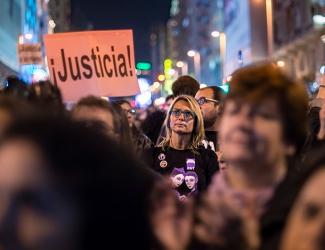
Adolfo Lujan | Flickr (CC BY-NC-ND 2.0)
Mass demonstration in Madrid on International Women's Day
Multitudinaria manifestación en Madrid en el día internacional de la mujer

Priority Areas

Supporting feminist, women’s rights and gender justice movements to thrive, to be a driving force in challenging systems of oppression, and to co-create feminist realities.

Advancing Universal Rights and Justice

Uprooting Fascisms and Fundamentalisms

Across the globe, feminist, women’s rights and gender justice defenders are challenging the agendas of fascist and fundamentalist actors. These oppressive forces target women, persons who are non-conforming in their gender identity, expression and/or sexual orientation, and other oppressed communities.


Discriminatory ideologies are undermining and co-opting our human rights systems and standards,  with the aim of making rights the preserve of only certain groups. In the face of this, the Advancing Universal Rights and Justice (AURJ) initiative promotes the universality of rights - the foundational principle that human rights belong to everyone, no matter who they are, without exception.

We create space for feminist, women’s rights and gender justice movements and allies to recognize, strategize and take collective action to counter the influence and impact of anti-rights actors. We also seek to advance women’s rights and feminist frameworks, norms and proposals, and to protect and promote the universality of rights.


Our actions

Through this initiative, we:

  • Build knowledge: We support feminist, women’s rights and gender justice movements by disseminating and popularizing knowledge and key messages about anti-rights actors, their strategies, and impact in the international human rights systems through AWID’s leadership role in the collaborative platform, the Observatory on the Universality of Rights (OURs)*.
  • Advance feminist agendas: We ally ourselves with partners in international human rights spaces including, the Human Rights Council, the Commission on Population and Development, the Commission on the Status of Women and the UN General Assembly.
  • Create and amplify alternatives: We engage with our members to ensure that international commitments, resolutions and norms reflect and are fed back into organizing in other spaces locally, nationally and regionally.
  • Mobilize solidarity action: We take action alongside women human rights defenders (WHRDs) including trans and intersex defenders and young feminists, working to challenge fundamentalisms and fascisms and call attention to situations of risk.  


Related Content

Snippet - Section Two Funding Resources in One Place - EN

A Universe of Funders & Funding Commitments

Snippet Festival Artwork_fest (EN)

Festival Art!

Featuring artwork by Upasana Agarwal, Ika Vantiani, & Naadira Patel.

Click on the images to enlarge

By artist Upasana Agarwal

WebsiteInstagram

Illustrated portrait of Anima Adjepong saying I learn queer as practice, as in the service of freedom… Queer disrupts the normative order we live in, in order to create something else, it is about leadership beyond the individual
Illustrated portrait of Anwulika Okonjo that says: Feminists are World Builders
Portrait of Dilar Dirik saying: “We need to make sure that feminism is a threat to the system”  "We no longer need to just be in solidarity with each other, we need new platforms of common struggles"
Illustrated portrait of Makgosi Letimile saying: Sex toys should not be a luxury. They should be accessible and affordable
Illustrated portrait of Manal Tamimi that says: “You are the fire that keeps everyone warm"
Illustrated portrait of Nana Akosua Hanson that says: "Art allows us to create an alternate reality"
Illustrated portrait of Nomsa Sizani, over a white and turquise background, that says: “When we occupy this land, it is another way of condemning this capitalist system”  “If we don’t so, nobody will liberate ourselves”
Illustrated portrait of Sandie Hanna that says: “Solidarity is a mechanism of survival”  “We need to keep going because continuity is vital in our causes for liberation”
Illustrated portrait of Doctor Vandana Shiva that says: “The panel today is a beautiful awakening of the world that is possible”
Illustrated portrait of Yannia S. Garzón that says: “Recovering the dignity of being a black woman is what keeps me alive”
Illustrated portrait of Dr. Angelique V. Nixon that says: “Listen to your body. It’s smarter than you are.”
 Patricia Wattimena : I want a future where economies work for the women and not women working the economy

By artist Ika Vantiani

Facebook | TwitterInstagram

 
Collage of Mariama Sonko
Collage of Nomsa Sizani
Artistic collage featuring Yania Sofia

By artist Naadira Patel 

Website | Facebook | Instagram

Illustration of several women of color with text that says: Moving from Transactional to Transformative
Illustration of three hand outstretched. Two are spilling seeds into the other. In the center there is planet Earth and a woman walking over plants. The text reads "To defy capitalism we occupy land acting as custodians of diversity"

Snippet2 - WCFM Regional focus: - EN

globe icon

Regional focus:

Filter for funders that support initiatives in your geographical area.

WITM - Refreshed INFOGRAPHIC 3 EN

How feminists resource themselves

Feminist and women’s rights organizations don’t just rely on institutional funding, we resource ourselves. Our organizing is powered by passion, political commitment, solidarity and collective care.
These resources are self- generated and autonomous, and often invisible in our budgets, but they are the backbone of our organizing.

 Explore the data on autonomous resourcing

Snippet - COP30 - Feminist Demands for COP30 Col 1

What We Reject:

  • Market-based false solutions
  • Ecosystem service trading
  • Green neoliberal economies mining
  • Geo-engineering
  • Fossil fuels
  • Military spending over climate funds
  • Climate finance as loans

Protection of the Family

The Issue

Over the past few years, a troubling new trend at the international human rights level is being observed, where discourses on ‘protecting the family’ are being employed to defend violations committed against family members, to bolster and justify impunity, and to restrict equal rights within and to family life.

The campaign to "Protect the Family" is driven by ultra-conservative efforts to impose "traditional" and patriarchal interpretations of the family, and to move rights out of the hands of family members and into the institution of ‘the family’.

“Protection of the Family” efforts stem from:

  • rising traditionalism,
  • rising cultural, social and religious conservatism and
  • sentiment hostile to women’s human rights, sexual rights, child rights and the rights of persons with non-normative gender identities and sexual orientations.

Since 2014, a group of states have been operating as a bloc in human rights spaces under the name “Group of Friends of the Family”, and resolutions on “Protection of the Family” have been successfully passed every year since 2014.

This agenda has spread beyond the Human Rights Council. We have seen regressive language on “the family” being introduced at the Commission on the Status of Women, and attempts made to introduce it in negotiations on the Sustainable Development Goals.


Our Approach

AWID works with partners and allies to jointly resist “Protection of the Family” and other regressive agendas, and to uphold the universality of human rights.

In response to the increased influence of regressive actors in human rights spaces, AWID joined allies to form the Observatory on the Universality of Rights (OURs).  OURs is a collaborative project that monitors, analyzes, and shares information on anti-rights initiatives like  “Protection of the Family”.

Rights at Risk, the first OURs report, charts a map of the actors making up the global anti-rights lobby, identifies their key discourses and strategies, and the effect they are having on our human rights.   

The report outlines “Protection of the Family” as an agenda that has fostered collaboration across a broad range of regressive actors at the UN.  It describes it as: “a strategic framework that houses “multiple patriarchal and anti-rights positions, where the framework, in turn, aims to justify and institutionalize these positions.”


Related Content

2021: Feminist Power in Action

In 2021, AWID, along with many other organizations, was coming to grips with the implications of the on-going global pandemic for how we work and our role in this particular time. The year taught us three critical lessons about navigating this moment as a global feminist movement-support organization.

Download the full 2021 Annual review


English language cover for the 2021 AWID Annual Report. It shows a collage of protests fists raised, along with flowers and a silhouette of a person with short hair in the back.

Through dialogue and exchanges critical to their work, AWID connected thousands to feminists from around the world.

Our experience in 2021 reaffirmed the importance of building and sustaining a global feminist community, and AWID’s core mission to support feminist movements as a whole. We believe that at this moment, a strong community bound by a shared vision and collective care is the foundation of all social change and transformation.

Download the full 2021 Annual review

Marta Musić

Biography

Marta is a queer, transfeminist non-binary activist-researcher from ex-Yugoslavia, currently based in Barcelona. They work as a transnational movement organizer, a feminist economist and a weaver of systemic alternatives. They are the co-founder and one of the coordinators of the Global Tapestry of Alternatives, a global process that seeks to identify, document and connect alternatives on local, regional and global levels. Locally, they are engaged in anti-racist, transfeminist, queer, migrant organizing. They also hold a doctoral degree in Environmental Science and Technology from the Autonomous University of Barcelona, dedicated to decolonial feminist perspectives of a pluriverse of systemic alternatives and the creation of feminist alternative systems based on care and the sustainability of life. During their free time, they enjoy boxing, playing the guitar and the drums as part of a samba band, photography, hiking, cooking for loved ones and spoiling their two cats.

Position
Building Feminist Economies Lead
Add to stories
Off

Leila Hessini

Biography

Leila is a transnational feminist leader, strategist, and advisor with over 25 years of organizing, advocacy and philanthropic experience advancing human rights, gender equality, and sexual and reproductive rights and justice.  She was born in Algeria and educated in the U.S., France, and Morocco; over her professional career, she has lived and worked in forty countries across Africa, Europe, Latin America and Asia.  Leila currently serves as a Senior International Fellow at the Asfari Institute for Civil Society and Citizenship at the American University of Beirut in Lebanon and as Senior Strategist for various feminist movements and organizations as well as the the Urgent Action Fund-Africa and Trust Africa on an initiative on Reimagining Feminist and Pan-African Philanthropies.
 
From 2017-2023, Leila held the position as Vice-President of Programs at Global Fund for Women where she oversaw its strategic grantmaking, movement-strengthening, global advocacy and philanthropic collaborations. At GFW, she doubled its grantmaking to over $17 million, launched its feminist and gender-based movements and crises work, created an adolescent girls program led by a girls’ advisory council and led its philanthropic advocacy work.  Prior to that she served on the senior leadership team of Ipas from 2002 to 2016 where she published extensively on abortion rights and justice, lead global advocacy efforts and partnered with feminist groups working on self-management, community strategies and stigma reduction around bodily integrity and sexual and reproductive rights.
 
Leila is currently researching shifts in the philanthropic sector including recognizing non-institutional practices of giving resources in the Global South and efforts to decolonize practices in the Global North.  She has written extensively on the political nature of veiling across North Africa and the Middle East, abortion practices in majority Muslim contexts and feminist approaches to sexual and reproductive health, rights and justice.
 
Leila holds an MPH in public health and a MA in Middle Eastern and North African Studies, studied Islamic law in Morocco and pursued doctoral studies in sociology in France. She studied Arabic and speaks French and English fluently.  She is a mother of two feminist young women, an avid scuba diver, mountain bike rider, skier, and outdoor enthusiast.

Position
Co-Treasurer
Add to stories
Off

Who are AWID's members?

A dynamic network of people around the world, AWID members are researchers, academics, students, educators, activists, business people, policy-makers, development practitioners, funders, and more. Our members - of every age - are those who make AWID a unique global feminist association.

Membership with AWID is open to anyone who shares our values

We offer different types of memberships geared to income level and whether you are an individual or an organization. Currently we have over 5000 members, individual and institutional, from 164 countries.

Our members are an important part of our work

We collaborate for advocacy on specific issues, members vote in elections for our Board, and can also participate in and contribute to our Priority Areas through webinars, surveys, or urgent actions, for example.

Our institutional membership draws from a broad range of organizations interested in advancing gender justice and women’s human rights, including women’s rights organizations, from the local to the global levels, grassroots networks, major international institutions, government departments, university programs and more. 63% of our members are from the global South and 38% are under the age of 30.

Learn more about our membership

March 2015: The Zero-Draft Outcome Document is released

Release of the Zero-Draft Outcome Document, March 2015

  • The zero-draft outcome document (dated 16 March), prepared by the Co-facilitators, was released for discussion at the 2nd drafting session from 13-17 April 2015
  • During the opening session, the WWG on FfD called for dedicated resources for gender equality and women’s empowerment as stated in both the Monterrey Consensus and Doha Declaration,to be added into the Zero draft. 

What is included in registration fees?

The AWID Forum registration fees for all forum participants cover:

  • Full access to all four days of the Forum
  • Lunches and coffee/tea breaks during forum days
  • Resource materials
  • Simultaneous interpretation during plenaries and some selected breakout sessions/activities (English, French, Spanish, and local language)
  • Participation in the celebration dinner/party
  • Mobile app with final program and chat function
  • Free Wi-Fi service in the forum premises
  • Airport pick ups and hotel-venue-hotel transportation