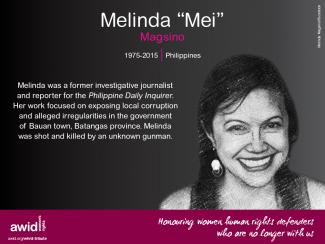
Melinda "Mei" Magsino
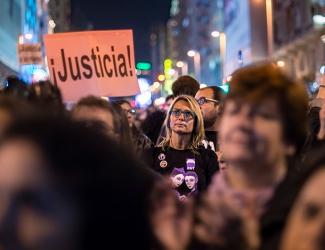
Across the globe, feminist, women’s rights and gender justice defenders are challenging the agendas of fascist and fundamentalist actors. These oppressive forces target women, persons who are non-conforming in their gender identity, expression and/or sexual orientation, and other oppressed communities.
Discriminatory ideologies are undermining and co-opting our human rights systems and standards, with the aim of making rights the preserve of only certain groups. In the face of this, the Advancing Universal Rights and Justice (AURJ) initiative promotes the universality of rights - the foundational principle that human rights belong to everyone, no matter who they are, without exception.
We create space for feminist, women’s rights and gender justice movements and allies to recognize, strategize and take collective action to counter the influence and impact of anti-rights actors. We also seek to advance women’s rights and feminist frameworks, norms and proposals, and to protect and promote the universality of rights.
What does an AWID Forum mean to those who have been there? What is this magic that happens when feminists from around the world gather to celebrate, strategize, learn and share joy?
AWID spoke to over forty Forum participants to hear their stories of the transformations that happened to them as activists, to their organizations and to the movements they are part of. We also learned about what we should keep and build on that makes an AWID Forum different and how we can improve.
This report holds lessons and advice invaluable to anyone planning in-person regional and thematic convenings and for us as we plan for the 15th AWID International Forum.
Related Content
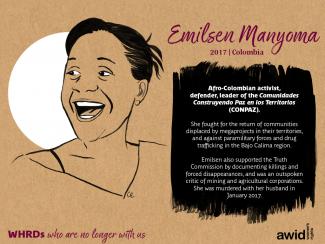
Front Line Defenders: Emilsen Manyoma Killed
ReliefWeb: A human rights defender killed every other day in 2017 in Colombia (between 1 and 23 January 2017)
Global Witness: Defenders of the Earth (2016 Report)
okayafrica.: Who is Killing Colombia's Black Human Rights Activists?
PBI Colombia: We will always accompany your work
Bitch Media: Don’t Touch My Crown: The failure of decapitation and the power of black women’s resistance
Each Forum takes place in a different region, and it is time for the AWID Forum to come back to Asia! We visited many countries in the region, consulted feminist movements, and conducted detailed assessments of logistics, accessibility, safety, visas and more. Eventually, the AWID Board enthusiastically approved Bangkok, Thailand, as the best option. We are excited to come back to Bangkok, where we held the AWID Forum in 2005.
Related content
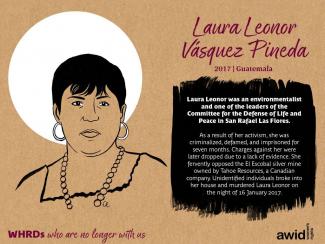
Telesur: Another Activist Murder Linked to Canadian Mining in Guatemala
Guatemala Human Rights Commission: Two Defenders Killed in January
IM Defensoras: Assailants kill territorial defender, Laura Leonor Vásquez
AWID’s working languages are English, French and Spanish. Thai will be added as the local language, as well as sign language & other accessibility measures. Other languages may be added if funding permits, so check back regularly for updates. We care about language justice and will try to include as many languages as we can and as our resources allow. We hope to create multiple opportunities for many of us to be present in our languages and to communicate with each other.
The Deadline to submit activities has been extended to February 1st, 2024
In the spirit of the Forum’s theme, we invite a diversity of activity topics and formats that:
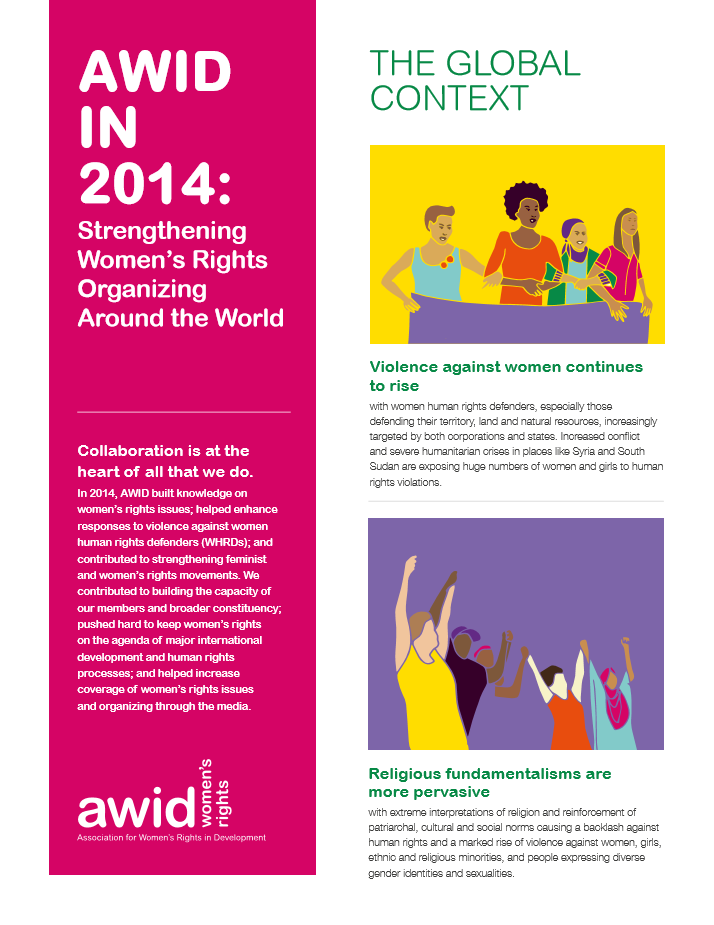
AWID is very pleased to share our 2014 Annual Report.
From building knowledge on women’s rights issues to amplifying responses to violence against women human rights defenders (WHRDs), our work last year continued to strengthen feminist and women’s rights movements across the world.
Get learn how we built the capacity of our members and broader constituency, pushed hard to keep women’s rights on the agenda of major international development and human rights processes, and helped increase coverage of women’s rights issues and organizing through the media. You'll find a panoramic sampling of our projects and some concrete numbers demonstrating our impact.
Collaboration is at the heart of all that we do, and we look forward to another year of working together to take our movements to the next level.
Despite an increasingly challenging panorama, there are important signs of hope for advancing women’s rights agendas. Women’s rights activists remain crucial in creating openings to demand structural change, sustaining their communities, opposing violence and holding the line on key achievements. And there are important opportunities to influence new actors and to mobilize greater resources to support women’s rights organizations.
In this context, strong collective action and organizing among women’s rights activists remains essential.
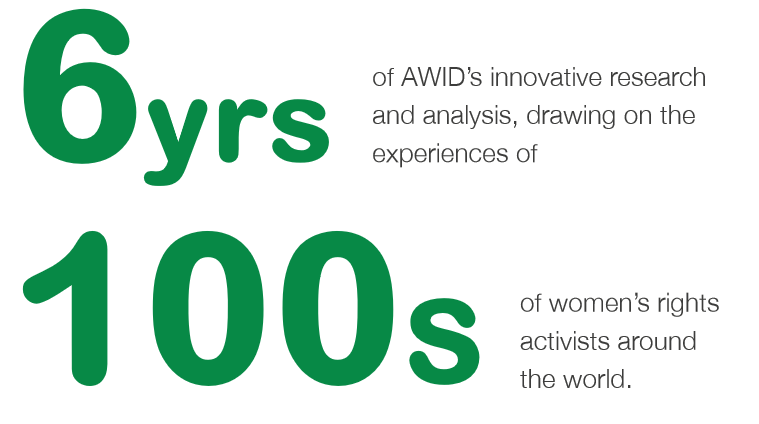
I am sincerely thrilled by AWID’s accomplishments since 1982 and hope to be able to pay at least a modest contribution to its hard work for the benefit of women and situation of gender equality.” — Aleksandra Miletic-Santic, Bosnia Herzegovina
Related content
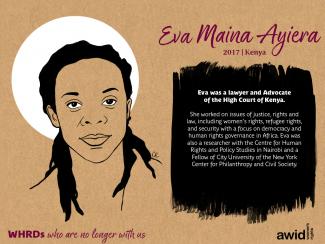
AfriCOG's security forum: Eva Ayiera on key drivers of Kenya's security threats (Video)
جديد
كمشارك/ة عبر الإنترنت، يمكنك توجيه النشاطات والتواصل والتحدث مع الآخرين/ الأخريات وتجربة الإبداع والفن والاحتفال بمنتدى جمعية حقوق المرأة في التنمية بشكل مباشر. سيستمتع المشاركون/ات المتصلون/ات عبر الإنترنت ببرنامج غني ومتنوع، بدءًا من ورشات العمل والنقاشات وحتى نشاطات الاستشفاء والعروض الموسيقية. ستركز بعض الأنشطة على التواصل بين المشاركين/ات عبر الإنترنت، وسيكون البعض الآخر هجينًا بالفعل، يركز على الاتصال والتفاعل بين المشاركين/ات عبر الإنترنت وأولئك الموجودين/ات في بانكوك.
With over ten years of finance experience, Lucy has devoted her career to for profit and furthering nonprofit missions. She also worked and volunteered at non-for-profit organizations. From the fast-paced world of Finance, Lucy has passion for staying tuned with tech skills in the finance field. Lucy joined AWID in 2014. During her spare time she enjoys music, traveling, and variety sports.
We all can dance
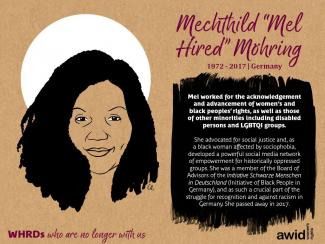
by Mechthild Möhring (aka serialmel)
How I punt myself at the narrow hard knitting I once retrieved. I'm dancing in the kitchen when I'm alone. Gracile and powerful. When I'm in company I'm clumsy. My body scandalizes, scandalizes the laws of look I feel, scandalizes the words which banished me. "Of course she can dance, it's in her blood as a Black person." "If she is able to dance nicely she is good in bed" they whisper, they murmur, no - they say it openly into my face. They smirk and rub themselves against me and let me move back. I stumble and fall. My feet reject their duty. Bearish I get out of breath. Smiling I place myself out of events and notice how my face freezes into a mask.
Translated into English by Tsepo Bollwinkel
Original in German
Tanzen können wir alle
Von Mechthild Möhring (aka serialmel)
Wie ich mich stosse an den engen, harten Maschen, in die ich mich einst zurückgezogen habe. Ich tanze in der Küche, wenn ich allein bin. Grazil und kraftvoll. Wenn ich in Gesellschaft bin, bin ich unbeholfen. Mein Körper eckt an, an die Gesetze des Blicks, den ich spüre, an die Worte, die mich bannten. „Natürlich kann sie tanzen, als Schwarze hat sie das im Blut.“ „Wenn sie gut tanzen kann, dann ist sie auch gut im Bett“ flüstern sie, raunen sie, nein, sie sagen es mir laut ins Gesicht. Sie grinsen und reiben sich an mir und lassen mich zurückweichen. Ich stolpere und falle. Meine Füsse verweigern ihren Dienst. Tollpatschig gerate ich ausser Atem. Lächelnd setze ich mich an den Rand des Geschehens und bemerke, wie mein Gesicht zur Maske erstarrt.
Elina is a young afro-Dominican intersectional feminist and human rights lawyer, committed to use her voice and skills to build a more just, empathic and inclusive world. She started Law school at 16, convinced it would give her the tools to understand and promote social justice. After a J.D. in the Dominican Republic, she pursued an LL.M. in Public International Law and Human Rights in the UK as a Chevening Scholar. She was the only Latinx-Caribbean woman in her class, graduating with honours.
Elina has worked at the intersection of human rights, gender, migration and policy, from government, grassroots collectives and international organizations. She helped litigate cases on gender-based violence before the Inter-American Court of Human Rights. As a member of the Youth Advisory Panel of UNFPA, she contributed to strengthening sexual and reproductive rights in the Dominican Republic. She co-led Amnesty International’s first campaign on sex workers’ rights in the Americas, developing strong partnerships with sex-worker led organizations and using Amnesty’s position to amplify women human rights defenders and sex workers’ voices.
Elina is part of Foro Feminista Magaly Pineda and the Global Shapers Community. She speaks Spanish, French and English. Thanks to her diverse background, Elina brings strong governance and strategic planning skills, substantive expertise on the United Nations and regional human rights mechanisms and her bold determination to keep AWID as an inclusive organization for all women, especially young and Caribbean feminists. With these offerings, joins a global sisterhood of feminist badasses, where she can keep nurturing her feminist leadership and never again feel alone in her path.
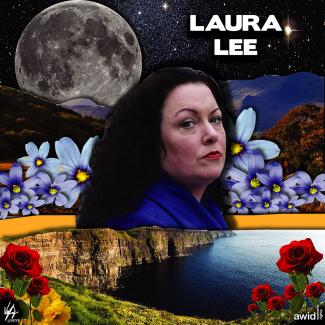
Laura was a leading activist and lawyer who campaigned fearlessly for the decriminalisation of sex work in Ireland.
She is remembered as “a freedom fighter for sex workers, a feminist, a mother to a daughter and a needed friend to many.”
Laura advocated for individuals in the sex industry to be recognised as workers deserving of rights. She advanced demands for decriminalisation, including initiating a judicial review at Belfast’s high court in respect of the provisions criminalising the purchase of sex. Laura stated that her intention was to bring the case to the European Court of Human Rights.
It is exactly the same process and same deadline. Please use the same form to submit your activity, whether it is in-person, online, or both (hybrid).
Ekaete Judith Umoh is an international disability rights advocate and inclusive development expert with astute analysis of issues regarding gender, disability and inclusive development. Her dream is to see increased visibility of women and girls with disabilities in the global feminist movement, as well as in all development efforts around the world.
Ekaete enjoys activism and politics, and went on to become the first elected female President of the Joint National Association of Persons with Disabilities (JONAPWD) in Nigeria, where she led Organizations of Persons with disabilities in the struggle to sign the Nigerian Disability Bill into Law in 2019, after over 17 years of consistent advocacy. Thereafter, she joined CBM Global as a pioneer Country Director and led her team for about 3 years, contributing towards ending the circle of poverty and disability in Nigeria. Aside from disability activism, Ekaete has served as consultant to several development agencies, providing technical assistance on disability inclusion in program and project design.
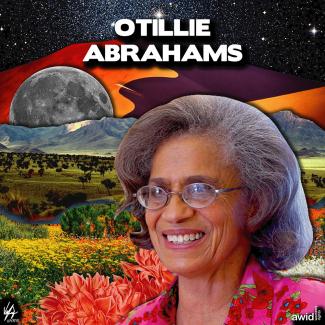
Ottilie was a Namibian feminist activist, educator and politician.
Ottilie was one of the founders of the South West African People's Organisation (SWAPO), the Yu Chi Chan Club (an armed revolutionary group); and the South West African National Liberation Front (SWANLIF). She was also a founder of the Namibian Women’s Association and Girl Child Project.
Throughout her life, Ottilie argued for the right to argue, think, contest, and demand. She mobilized women, organized students and teachers and criticized other comrades for their elitism and their corruption.
Ottilie worked ferociously to dismantle patriarchy, and to create a concrete transformative, liberatory, feminist participatory democracy.
Ottilie often said: “I will rest the day I die.”
ภาษาที่ AWID ใช้งานคือ ภาษาอังกฤษ ภาษาฝรั่งเศส และภาษาสเปน โดยภาษาไทยจะถูกเพิ่มเข้ามาในฐานะภาษาท้องถิ่น รวมถึงภาษามือและมาตราการในการช่วยให้เข้าถึงอื่นๆ โดยภาษาอื่นๆอาจถูกเพิ่มเข้ามาหากมีงบประมาณเพียงพอ สามารถเข้ามาดูการอัปเดทว่ามีการเพิ่มภาษาอื่นใดบางได้เรื่อยๆ เราใส่ใจในความยุติธรรมด้านภาษาและจะพยายามให้มีภาษามากที่ที่สุดเท่าที่งบประมาณจะสามารถครอบคลุมได้ เราหวังว่าเราจะสามารถสร้างโอกาสมากมายให้พวกเราสามารถสื่อสารกันหรือนำเสนอในภาษาของตัวเองได้