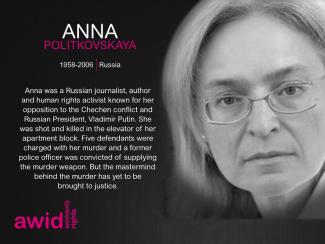
Anna Politkovskaya
Across the globe, feminist, women’s rights and gender justice defenders are challenging the agendas of fascist and fundamentalist actors. These oppressive forces target women, persons who are non-conforming in their gender identity, expression and/or sexual orientation, and other oppressed communities.
Discriminatory ideologies are undermining and co-opting our human rights systems and standards, with the aim of making rights the preserve of only certain groups. In the face of this, the Advancing Universal Rights and Justice (AURJ) initiative promotes the universality of rights - the foundational principle that human rights belong to everyone, no matter who they are, without exception.
We create space for feminist, women’s rights and gender justice movements and allies to recognize, strategize and take collective action to counter the influence and impact of anti-rights actors. We also seek to advance women’s rights and feminist frameworks, norms and proposals, and to protect and promote the universality of rights.
Trauma is not the event; it is how our bodies respond to events that feel dangerous to us. It is often left stuck in the body, until we address it. There’s no talking our body out of this response – it just is.
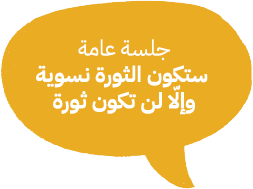
جلسة عامة | ستكون الثورة نسوية وإلّا لن تكون ثورة
مع منال التميمي وبوبولينا مورينو وكارولينا فيكيفيتش وأنووليكا نوجوزي أوكونجو
Don't know where to start? Let's try understanding the filters.

منجزاتك الأكاديمية جسر عبور نحو شهوتك الجنسيّة (جدّيًا، سلِّم الأوراق المطلوبة، الكترونية كانت أم ورقيّة)
If your funding institution is already a part of the Database and you would like to contact us to update your record, or if you would like to leave some feedback for us, please use the form above.
In partnership with young feminist activists and youth-led organizations, AWID co-organized Beijing Unfettered in parallel to and independently from Beijing+25.
Thanks to our global feminist community! From May to August 2024, nearly 1,200 organizations working for Women's rights, gender justice, and LBTQI+ equality shared their experiences in the WITM survey. The results offer a unique picture of how feminist movements are resourced and where gaps remain.
As world leaders gather in Brazil, it’s vital that feminist movements especially from the Global Majority have autonomous spaces to gather, strategize, and disrupt.
These Hubs challenge the elitism of climate talks, center lived experiences, and aim to build collective power across borders. They offer a critical counterbalance to top-down, often exclusionary international negotiations. The Hubs aim to foster community-driven solutions, amplify feminist demands, and ensure that feminist principles of care and solidarity shape the climate agenda. It’s not just about being present at COP30, it’s about reshaping the conversation on climate justice on feminist terms.
For feminist and social justice movements working in authoritarian contexts, this report can be read as a source of analytical and political strength to help connect our feminist, anti-racist, migrant, environmental, disabled, queer and trans struggles that are usually kept apart.
From the rising right in many countries and the flurry of funding cuts hitting hard civil society of the Global Majority, to the ongoing genocide in Gaza, the intensification of violent conflicts in Sudan, and climate crisis in many parts of our planet, we are facing real forces of fascism and a world order of impunity. This makes our opportunities to come together and build solidarity particularly valuable and imperative for our survival as a global feminist community. Of course, in 2024, the 15th AWID International Forum finally happened, and what a powerful space it was.
Download the full 2024 Annual Report
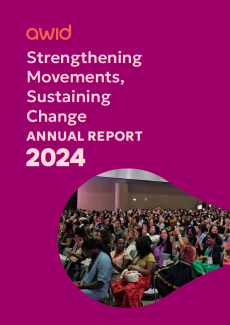
As we look ahead, we build on the powerful calls to action made by feminists at the AWID Forum; Together we can build a world where justice, liberation and care are not aspirations but realities.
Marta is a queer, transfeminist non-binary activist-researcher from ex-Yugoslavia, currently based in Barcelona. They work as a transnational movement organizer, a feminist economist and a weaver of systemic alternatives. They are the co-founder and one of the coordinators of the Global Tapestry of Alternatives, a global process that seeks to identify, document and connect alternatives on local, regional and global levels. Locally, they are engaged in anti-racist, transfeminist, queer, migrant organizing. They also hold a doctoral degree in Environmental Science and Technology from the Autonomous University of Barcelona, dedicated to decolonial feminist perspectives of a pluriverse of systemic alternatives and the creation of feminist alternative systems based on care and the sustainability of life. During their free time, they enjoy boxing, playing the guitar and the drums as part of a samba band, photography, hiking, cooking for loved ones and spoiling their two cats.
With over 30 years of finance experience, Christine has devoted her career to furthering nonprofit missions on a global scale. Her contributions extend to serving as Treasurer on the Board of an NGO. Christine joined AWID in 2007 as Controller and in 2023 took on the role as Director of Finance. During her spare time she enjoys traveling, gardening and hiking.
A dynamic network of people around the world, AWID members are researchers, academics, students, educators, activists, business people, policy-makers, development practitioners, funders, and more. Our members - of every age - are those who make AWID a unique global feminist association.
We offer different types of memberships geared to income level and whether you are an individual or an organization. Currently we have over 5000 members, individual and institutional, from 164 countries.
We collaborate for advocacy on specific issues, members vote in elections for our Board, and can also participate in and contribute to our Priority Areas through webinars, surveys, or urgent actions, for example.
Our institutional membership draws from a broad range of organizations interested in advancing gender justice and women’s human rights, including women’s rights organizations, from the local to the global levels, grassroots networks, major international institutions, government departments, university programs and more. 63% of our members are from the global South and 38% are under the age of 30.