WHRDs are self-identified women and lesbian, bisexual, transgender, queer and intersex (LBTQI) people and others who defend rights and are subject to gender-specific risks and threats due to their human rights work and/or as a direct consequence of their gender identity or sexual orientation.
WHRDs are subject to systematic violence and discrimination due to their identities and unyielding struggles for rights, equality and justice.
The WHRD Program collaborates with international and regional partners as well as the AWID membership to raise awareness about these risks and threats, advocate for feminist and holistic measures of protection and safety, and actively promote a culture of self-care and collective well being in our movements.
Risks and threats targeting WHRDs
WHRDs are exposed to the same types of risks that all other defenders who defend human rights, communities, and the environment face. However, they are also exposed to gender-based violence and gender-specific risks because they challenge existing gender norms within their communities and societies.
By defending rights, WHRDs are at risk of:
Physical assault and death
Intimidation and harassment, including in online spaces
Judicial harassment and criminalization
Burnout
A collaborative, holistic approach to safety
We work collaboratively with international and regional networks and our membership
to raise awareness about human rights abuses and violations against WHRDs and the systemic violence and discrimination they experience
to strengthen protection mechanisms and ensure more effective and timely responses to WHRDs at risk
We work to promote a holistic approach to protection which includes:
emphasizing the importance of self-care and collective well being, and recognizing that what care and wellbeing mean may differ across cultures
documenting the violations targeting WHRDs using a feminist intersectional perspective;
promoting the social recognition and celebration of the work and resilience of WHRDs ; and
building civic spaces that are conducive to dismantling structural inequalities without restrictions or obstacles
Our Actions
We aim to contribute to a safer world for WHRDs, their families and communities. We believe that action for rights and justice should not put WHRDs at risk; it should be appreciated and celebrated.
Promoting collaboration and coordination among human rights and women’s rights organizations at the international level to strengthen responses concerning safety and wellbeing of WHRDs.
Supporting regional networks of WHRDs and their organizations, such as the Mesoamerican Initiative for WHRDs and the WHRD Middle East and North Africa Coalition, in promoting and strengthening collective action for protection - emphasizing the establishment of solidarity and protection networks, the promotion of self-care, and advocacy and mobilization for the safety of WHRDs;
Increasing the visibility and recognition of WHRDs and their struggles, as well as the risks that they encounter by documenting the attacks that they face, and researching, producing, and disseminating information on their struggles, strategies, and challenges:
Mobilizing urgent responses of international solidarity for WHRDs at risk through our international and regional networks, and our active membership.
Isabel Cabanillas de la Torre était une jeune artiste et activiste féministe très appréciée de Ciudad Juárez, au Mexique. Elle était connue pour ses belles peintures textiles, très expressives. Les yeux faisaient partie des représentations emblématiques de son travail. Ses peintures murales ont métamorphosé les immeubles décrépis et laissés à l’abandon du centre-ville de Ciudad Juárez, ornant leurs façades de messages de vie et de commentaires politiques.
Isabel voulait, à travers son art et son activisme politique, attirer l’attention sur les violences basées sur le genre omniprésentes dans sa ville natale. Elle était bénévole dans le réseau Mesa de Mujeres pour l’Observatoire citoyen sur le genre, qui supervise le travail des juges, procureurs et avocats de la défense dans les affaires de féminicides et autres violations basées sur le genre. Elle était également membre de Hijas de su Maquilera Madre, un collectif féministe dont le nom fait référence aux filles de mères qui travaillent dans les maquiladoras, ou zones de traitement pour l’exportation. Certaines de ces mères ont figuré parmi les premières victimes de féminicide dans la ville.
Le dernier projet d’Isabel, toujours en cours, était une installation artistique pour protester contre une entreprise canadienne qui cherchait à extraire du cuivre dans le désert de Samalayuca.
Le 18 janvier 2020, Isabel a été tuée par balle alors qu’elle rentrait chez elle à vélo dans le centre de Juárez, dansce qui semble avoir été un acte ciblé, son corps ayant été retrouvé à côté de son vélo.
Le meurtre d’Isabel a déclenché une nouvelle vague d’indignation contre les féminicides dans la région, des centaines de personnes ont manifesté jusqu’au pont frontalier entre le Mexique et les États-Unis, le bloquant pendant des heures et scandant « Ni Una Menos » (pas une de plus) alors que des collectifs féministes continuaient de manifester contre les meurtres de femmes dans tout le pays. Au cours de la seule année 2019, 3 142 femmes et filles ont été tuées au Mexique. Un grand nombre ont été spécifiquement ciblées du fait de leur genre.
Elle adorait faire du vélo.
« Le vélo était son symbole de liberté. Il symbolisait le fait d’être libre dans les rues. » - Marisol (une amie d’Isabel)
Leila es una líder, defensora y consultora feminista transnacional, con más de veinticinco años de experiencia en la promoción de los derechos humanos, la igualdad de género y la justicia sexual y reproductiva en salud, derechos y justicia a nivel local y global. Leila nació en Argelia y se educó en Estados Unidos, Francia y Marruecos; a lo largo de su carrera profesional, ha vivido y trabajado en África, Europa y Estados Unidos.
Durante más de cinco años fue Vicepresidenta de Programas en el Fondo Global de Mujeres (GFW), supervisando el otorgamiento estratégico de subvenciones, el fortalecimiento de los movimientos, la incidencia global y las colaboraciones filantrópicas. En GFW duplicó las subvenciones otorgadas a más de 17 millones USD, inauguró el trabajo sobre movimientos feministas y de género en las crisis, creó un programa para niñas adolescentes liderado por un consejo asesor de niñas, y dirigió su trabajo de incidencia filantrópica. Antes de eso, entre 2002 y 2016 se desempeñó en el equipo de dirección de Ipas, donde publicó extensamente sobre derecho al aborto y justicia, lideró tareas de incidencia globales, y se asoció con grupos feministas que trabajan sobre gestión autónoma, movilización comunitaria y reducción de estigmas respecto de la integridad corporal y de los derechos sexuales y reproductivos. Mientras vivió en África del Norte, cofundó una empresa consultora feminista interseccional, Strategic Analysis for Gender Equality (SAGE), que trabajaba en las intersecciones de los derechos económicos, de género y sexuales y reproductivos, y dirigió el trabajo nacional, regional y mundial sobre género de la oficina de El Cairo de la Fundación Ford durante cinco años.
Leila tiene una vasta experiencia en educación popular, incidencia, organizaciones sin fines de lucro, juntas de desarrollo, filantropía, y monitoreo y evaluación. Es una hábil comunicadora comprometida con la utilización del enfoque interseccional para priorizar y difundir las voces y las experiencias de las personas más marginadas. Ha recibido la beca «Op-ed Public Voices» de la Fundación Ford, y fue becaria Fulbright en Marruecos. Sus publicaciones cubren una amplia gama de tópicos, incluyendo enfoques feministas y decoloniales a la filantropía, la promoción de los derechos humanos de las mujeres en contextos mayoritariamente musulmanes, estrategias feministas para impulsar la justicia reproductiva, el fomento de los abortos autogestionados, y la lucha contra los estigmas y la discriminación.
Actualmente Leila se desempeña como Copresidenta de la Junta Directiva del Centro por los Derechos Constitucionales (CCR), e integra la Junta Directiva del Highlander Research and Education Center. Es también funcionaria del consejo de rendición de cuentas del Numun Feminist Technology Fund y del comité asesor de la African Women’s Human Rights Defenders Platform. Anteriormente ha integrado las Juntas de la SisterSong Women of Color Reproductive Justice Collective, de la Red Mundial de Mujeres por los Derechos Reproductivos (WGNRR), del Fondo Global de Mujeres (GFW), del Fondo de Acción para el Aborto Seguro (SAAF), y del Proyecto de Tecnologías para la Salud Reproductiva (RHTP). Fue elegida Tesorera e integrante del Comité Ejecutivo de la Junta Directiva de Prospera, y del Comité de Dirección de Fenomenal Funds por cuatro años. Leila tiene una Maestría en Salud Pública, y una Maestría en Estudios de Medio Oriente y Norte de África; ha estudiado derecho islámico en Marruecos, y cursó estudios doctorales en sociología en Francia. Ha estudiado árabe y alemán, habla francés e inglés en forma fluida.
Position
Tesorera
Add to stories
Off
Clone of Snippet - WITM About the survey - FR
In 2023, feminist and
women's rights organizations
had a median annual budget of $22,000
In contrast, over $1 billion went to three anti-rights groups 2021-2022, with funding for anti-gender networks still rising.1
1 Global Philanthropy Project, 2024
¿Qué hará diferente a este Foro?
Con una asistencia de hasta 2500 participantes presenciales y 3,000 conectadxs de manera virtual, este será el Foro de AWID más grande hasta ahora. Vislumbramos múltiples espacios para establecer conexiones significativas, aprender, intercambiar ideas, tener conversaciones estratégicas, sanar y celebrar. Es la primera vez que nos reunimos en este espacio desde la pandemia, y estamos muy deseosxs de hacerlo.
Cartas de amor a los movimientos feministas: una carta de Inna y Faye
Queridos movimientos feministas,
El amor es lo que mantiene encendido nuestro fuego feminista. Junto con el cuidado de nuestras comunidades, la ira y la rabia ante la injusticia, y el coraje para actuar.
En septiembre de 2022, asumimos con gran entusiasmo nuestros roles de liderazgo en AWID, como Co-Directoras Ejecutivas. Sentimos el calor y el abrazo de la sororidad feminista cuando ustedes nos recibieron.
Reflexionando sobre nuestras memorias más preciadas como feministas, recordamos momentos poderosos de unión en protestas callejeras, análisis agudos y voces valientes que sacuden el status quo en las reuniones. Mantuvimos esas conversaciones íntimas hasta bien entrada la noche, nos reímos durante horas y bailamos juntes en fiestas.
Es necesario alimentar los fuegos feministas, especialmente en tiempos difíciles cuando no faltan los desafíos externos, desde la crisis climática y el ascenso de las fuerzas de derecha, hasta las economías explotadoras y los patrones persistentes de opresión dentro de nuestros propios movimientos sociales. Son estos fuegos, que arden por todas partes, los que iluminan nuestros caminos y nos mantienen calientes, pero no podemos ignorar los efectos agotadores de la violencia política y la represión dirigida contra muchas de nuestras luchas, movimientos y comunidades
Entendemos el deseo de cambiar el mundo como un ingrediente esencial de la organización feminista. Nunca podemos olvidar que somos quienes hemos estado esperando, en la construcción de alternativas y la configuración de nuestro futuro. Sin embargo, la vibrante energía feminista no puede darse por sentada y debe salvaguardarse de muchas maneras. En este sentido, seguiremos vigilantes. Mejor y más equitativo acceso a la atención y el bienestar, a la sanación y al placer, no son solo instrumentales para prevenir el agotamiento y sostener nuestros movimientos, aunque esa es una función importante; ante todo, son la forma en que esperamos vivir nuestras vidas.
Estamos encantades de arremangarnos y trabajar con ustedes. El nuevo plan estratégico de AWID "Fierce Feminisms: Together We Rise" (“Feminismos Osados: Juntos Nos Levantamos”) refleja nuestra convicción de que ahora es el momento de ser desenfadades y sin temores en nuestras agendas mientras hacemos un esfuerzo por conectar a través de los movimientos y llegar a conocer verdaderamente las realidades individuales, para que podamos ponernos en pie juntes, porque, para nosotres, este es el único camino.
¡Nuestros planes incluyen el tan esperado Foro de AWID! Esperamos conocerles a todes en persona y en línea en 2024. Escuchamos de ustedes la necesidad de conectarse y recargar energías, descansar y sanar, ser desafiados e inspirados, compartir buena comida y reír y bailar juntes. Pocas cosas en este mundo son tan poderosas y transformadoras, como la unión de feministas de todas partes del mundo, y realmente esperamos con ansias por este momento, porque sabemos la magia que podemos crear juntes.
Nuestra conexión con la membresía ha cobrado vida propia a través de la Comunidad AWID (nuestra plataforma en línea), y nuestro enfoque en construir conexión y solidaridad resuena con muches de ustedes. Únase y conéctese con nosotres y otras personas en los movimientos feministas de todo el mundo. Conocemos la importancia de la conexión en un tiempo y espacio donde las reglas no están hechas para nosotres, y mantenemos cerca nuestra comunidad, donde cada uno de nosotres importa.
Junto con nuestres fantásticas colegas de AWID, prometemos hacer todo lo posible para apoyar los movimientos feministas, como es la misión y el propósito de AWID. Por favor, observen y exijan lo mejor de nosotres.
Durante los últimos 40 años, ustedes, los movimientos feministas, han dado forma a la historia de AWID y nos han impulsado a ser más valientes, creatives y radicales. 40 es una edad fabulosa, y esperamos cumplir otros 40 años más junto a ustedes. Esperamos con ansias las asociaciones, los llamados a la justicia, la colaboración, la influencia política y el poder feminista genial que todes traen para navegar la resistencia cada vez mayor a la justicia de género, racial y ambiental. Tenemos mucho que aprender de ustedes y unes de otres, mientras construimos colectivamente los mundos en los que creemos.
Cindy Clark y Hakima Abbas, gracias por abrirnos el camino y prepararnos para llenar sus enormes zapatos. Siempre apreciamos a todes sobre cuyos hombros nos apoyamos y continuamos de pie. Nos entendemos como parte de un panorama de movimiento más amplio, historias feministas, presentes y futuros valientes.
A la Junta Directiva de AWID, les agradecemos el apoyo y el amor feminista que nos muestran, y su compromiso con el liderazgo del Sur Global y el modelo de co-liderazgo. Enviamos nuestro amor y respeto a todes y cada une de les compañeres de AWID, nos sentimos honradas de trabajar con un equipo feminista tan excepcional de profesionales dedicadas.
Esta es la primera vez que escribimos una carta de amor juntes, ¿cómo podríamos concluir sin expresar amor, cuidado y respeto mutuo? ¡Es una relación bastante intensa en la que hemos entrado! Ambas aportamos nuestras diferentes y diversas perspectivas y habilidades a nuestro trabajo y, de manera individual, también aportamos nuestras experiencias vividas y nuestras “yo” auténticas.
Junto con todes ustedes, somos una historia en desarrollo, una parte de un bello tejido, y a menudo hermosamente desafiante, un tapiz que continuará en el futuro. Nos divertimos al comenzar este viaje juntes y con ustedes, y tenemos muchas esperanzas de mantener vivo el romance.
En solidaridad, con amor y cuidado.
Inna y Faye
¡Reserva la fecha!
21 de febrero de 2023, Fiesta Feminista #5, sobre Políticas Feministas con Faye e Inna.
Anti-rights discourses continue to evolve. As well as using arguments related to religion, culture, and tradition, anti-rights actors co-opt the language of social justice and human rights to conceal their true agendas and gain legitimacy.
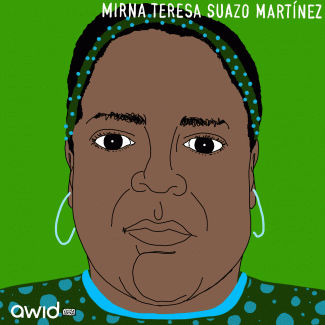
Mirna Teresa Suazo Martínez was part of the Garifuna (Afro-descendent and Indigenous) Masca community, living on the North Caribbean coast of Honduras. She was a community leader and a fervent defender of the Indigenous territory, a land that was violated when the National Agrarian Institute of Honduras gave territorial licenses to people outside of the community.
This deplorable deed resulted in repeated harassment, abuse and violence against the Masca, where economic interests of different groups met those of Honduran armed forces and authorities. According to the Black Fraternal Organization of Honduras (OFRANEH), the strategy of these groups is to evict and exterminate the Indigenous population.
“Masca, the Garifuna community located next to the Cuyamel Valley, is part of the area of influence of one of the supposed model cities, a situation that has triggered territorial pressures along the Garifuna coast.” - OFRANEH, 8 September 2019
Mirna Teresa, president of the Board of Trustees of the Masca Community in Omoa, was also firmly rejecting the construction of two hydroelectric plants on the river that carries the same name as her community, Masca.
“The Garífuna community attributes the worsening of the situation in their region to their opposition to tourist exploitation, the monoculture of African palm and drug trafficking, at the same time that it seeks to build an alternative life through the cultivation of coconut and other products for self-consumption.” - Voces Feministas, 10 September 2019
Mirna Teresa was murdered on 8 September 2019 in her Restaurant “Champa los Gemelos”.
She was one of six Garifuna women defenders murdered between September and October 2019 alone. According to OFRANEH, there was no investigation by the authorities into these crimes.
“In the case of the Garífuna communities, a large part of the homicides are related to land tenure and land management. However, squabbles between organized crime have resulted in murders, such as the recent ones in Santa Rosa de Aguán.” - OFRANEH, 8 September 2019
Alexandra is an anglo-colombian feminist with over 20 years of experience in local, national and international HIV and sexual and reproductive health and rights programming. She has extensive experience in resource mobilization and donor relations with private philanthropic foundations and multilateral agencies on behalf of international, national and local NGOs, predominantly in Latin America and the Caribbean. Prior to AWID, Alexandra worked at Fundación Si Mujer, a feminist abortion provider and educator in Colombia, RedTraSex and the International HIV/AIDS Alliance.
Alexandra has a BA in International Relations and Development Studies from Sussex University and a MSc in Public Health from the London School of Hygiene and Tropical Medicine. In rare moments when she is not working or parenting, she loves to swim, eat and has recently begun to play Zelda: Breath of the Wild with her son.
Position
Resource Mobilization Manager
Add to stories
Off
WITM - Refreshed INFOGRAPHIC 3 ES
¿Cómo se autofinancian las organizaciones feministas?
Las organizaciones feministas y por los derechos de las mujeres no solo dependemos del financiamiento institucional, también nos autofinanciamos. Son la pasión, el compromiso político, la solidaridad y el cuidado colectivo lo que empuja a nuestras organizaciones.
Estos recursos se autogeneran y son autónomos y, aunque a menudo no se reflejan en nuestros presupuestos, son la columna vertebral de las organizaciones.
Comment puis-je financer ma participation au Forum de l'AWID ?
Si votre groupe ou votre organisation est récipiendaire de fonds, vous feriez bien de vous entretenir dès maintenant avec votre organisme de financement pour savoir si ce dernier est en mesure de prendre en charge votre voyage et votre participation au Forum. De nombreuses institutions planifient leur budget pour l'année prochaine dès le début de l'année 2023, aussi vaudrait-il mieux ne pas reporter cette discussion à l'année prochaine.
Lettre d’amour aux mouvements féministes #10
Je n'ai jamais su que j'avais une famille proche qui m'aime et qui veut que je m'épanouisse, Ma mère a toujours été là pour moi, mais je n'aurais jamais imaginé que j'aurais des milliers de familles qui ne sont pas liées à moi par le sang.
J'ai découvert que les familles ne sont pas seulement des personnes liées par le sang, mais des personnes qui vous aiment inconditionnellement, sans se soucier de votre orientation sexuelle, de votre état de santé, de votre statut social ou de votre race.
Je pense aux moments précieux où j'ai écouté toutes mes sœurs du monde entier qui sont des féministes fortes, des personnes que je n'ai pas rencontré.e.s physiquement, mais qui me soutiennent, m'enseignent, se battent pour moi : je suis à court de mots, les mots ne peuvent pas exprimer à quel point je vous aime, vous les mentor.esse.s et les autres féministes, vous êtes une mère, une sœur, une amie pour des millions de filles.
Vous êtes incroyables, vous vous êtes battu.e.s pour des personnes que vous ne connaissez pas - et c'est ce qui vous rend si spéciales.aux.
Cela me fait plaisir de l'exprimer par écrit.
Je vous aime tou.te.s et je continuerai à vous aimer. Je n'ai vu aucun.e d'entre vous physiquement, mais il me semble que nous nous connaissons depuis des décennies.
Nous sommes féministes et nous sommes fières d'être des femmes.
Nous continuerons à faire savoir au monde que notre courage est notre couronne.
Une lettre d'amour de FAITH ONUH, une jeune féministe du Nigeria.
Primer: Spot key groups and debunk their narratives
Cartilla:
Cómo identificar a los principales grupos y refutar sus narrativas
¿Es usted una persona que diseña políticas en la ONU y quiere saber quiénes son los principales grupos anti-derechos y frente a qué discursos mantenerse alerta? ¿O unx feminista que busca argumentos para refutar esos discursos rápidamente? Esta cartilla de 8 páginas le ofrece información importante de un vistazo.
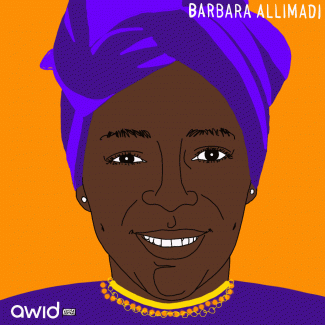
Barbara Allimadi fue una activista política y defensora de los derechos humanos de Uganda. En 2012, co-organizó una protesta contra la agresión policial a Ingrid Turinawe, una figura política de la oposición, que fue televisada y muestra cómo un policía le aprieta el pecho. Durante la protesta, Barbara, junto con otras compañeras activistas, se quitaron la ropa hasta quedarse en sujetador frente a la Estación Central de Policía de Kampala. Este hecho pasó a conocerse en Uganda como la infame "protesta de los sujetadores".
"Nos decidimos por la protesta de los sujetadores. Pensamos que sería lo más apropiado para lo que había sucedido. Con esta acción, no es que estuviésemos diciendo que no nos respetásemos a nosotras mismas. Estábamos indignadas con lo que había sucedido." - Barbara Allimadi, 2013 (Daily Monitor, en inglés)
Barbara se licenció en Ingeniería Electrónica y de Comunicaciones en la Universidad Metropolitana de Londres, y ejerció como ingeniera de redes en el Reino Unido. Era,además, una fan entusiasta de la música reggae. Regresó a Uganda en 2007, cuando su madre falleció.
En 2019, fue nombrada Coordinadora de Asuntos Internacionales y de la Diáspora de la Alianza para la Transformación Nacional (ANT, por sus siglas en inglés), un partido político lanzado ese año por un líder de la oposición.
"Queremos garantizar la seguridad de la vida y la propiedad, no el dolor, las lesiones o incluso la muerte a manos de unas fuerzas de seguridad que se supone deberían protegernos. Y lo más importante, queremos un entorno estable y propicio donde podamos realizar nuestros sueños y aspiraciones". - Barbara Allimadi, video de ANT (en inglés)
Barbara falleció el 27 de abril de 2020.
Tributos:
"Estaba muy orgullosa de mi hermana por muchas razones, pero, en particular, por su intrépida búsqueda de la paz, la democracia, la justicia y la igualdad en Uganda. En los momentos más álgidos de su activismo, Barbara lideró muchas marchas por las calles de Kampala, hacia las comisarías de policía y el Parlamento". - Doris Allimadi, hermana de Barbara
"Nos enteramos con profunda tristeza del prematuro fallecimiento de Barbara Allimadi. Ella ha sido una fuerza valiente, implacable y valerosa para el movimiento de liberación de Uganda. Queremos dar nuestro más sentido pésame a su familia. La echaremos mucho de menos". - Akina Mama wa Afrika (tweet, 28 April 2020)
"El fallecimiento de Barbara es una noticia muy triste para nosotrxs y para toda su familia. Barbara dedicó su vida a luchar por la justicia, la libertad y los derechos de las personas desde la sociedad civil, hasta que se unió, recientemente, al partido." Maj Gen Mugisha Muntu, coordinador nacional de la ANT (por sus siglas en inglés)
"Una hermana hermosa, encantadora, divertida, carismática e inspiradora. Mis hijxs han perdido a su tía. Uganda ha perdido a una audaz y valiente defensora de la libertad. Barbara dijo una vez: "Mientras siga habiendo aliento en ti, sigue trabajando por conseguir tus sueños". - Doris Allimadi, hermana de Barbara.
Jemutai is a passionate plant lover who finds inspiration in the natural world and its intricate web of interconnections. This fascination with the universe's interrelatedness is mirrored in their approach to work, community building, care and support.
She believes in the vibrant presence of their ancestors within them and lives to experience, remember, uphold, appreciate and celebrate their struggles, triumphs and values.
As an intersectional queer feminist and human rights activist, Jemutai has dedicated their career to advocating for equity and inclusivity. They are passionate about Organizational Development, with a background in Grants Making and Administration, and now pursuing a path in creating impactful experiences for convenings and providing operational leadership and support, ensuring that spaces are inclusive, safe and curated with precision and care.
Jemutai is also a strong believer in the philosophy of Ubuntu – the idea that "I am because we are." This belief in our shared humanity and mutual interdependence informs their collaborative approach and commitment to fostering a supportive, inclusive environment for all, especially structurally silenced and marginalized people.
Position
Operations Lead
Add to stories
Off
Snippet - COP30 - Radical Democracy - ES
Democracia radical y justicia climática: el debate ausente en la COP30
Modelos de gobernanza alternativos como vías para salir de la crisis climática.
📅 Miércoles 12 de noviembre de 2025
📍 Seminario Mar Nossa Sra Da Assunção, Pará, Brasil
Will there be pre-Forum regional, thematic or other convenings?
We believe so! It is still very early in the planning process, so please stay tuned as plans are forming.
Coming Out at the Highest Point in My Life: The Black Feminisms Forum
Many participants experience the AWID Forums as a unique space of freedom where they are embraced and celebrated as they are. In a world where even the most privileged feminists often find themselves not fully fitting in, for those whose identities are criminalized or otherwise condemned in their everyday contexts this experience of freedom and celebration can be deeply transformative (and restorative). The story of how OluTimehin Kukoyi – a first time participant – experienced the Black Feminist Forum (BFF) and the AWID Forum in Bahia (2016) powerfully illustrates this.
Nos droits en danger – Rapport sur les tendances 2017 de l'OURs
Rapport
Nos droits en danger – Rapport sur les tendances 2017 de l’OURs
Le premier rapport de l’Observatoire sur l’universalité des droits (OURs) - disponible en anglais et en espagnol - compile les informations disponibles sur les tendances antidroits dans les sphères internationales. Découvrez les principaux groupes religieux, les discours et les tactiques antidroits à l’œuvre au sein de l’ONU.