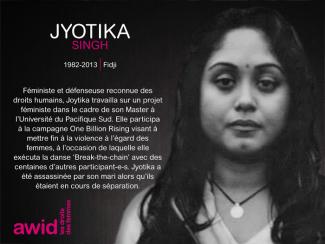
Jyotika Singh

WHRDs are self-identified women and lesbian, bisexual, transgender, queer and intersex (LBTQI) people and others who defend rights and are subject to gender-specific risks and threats due to their human rights work and/or as a direct consequence of their gender identity or sexual orientation.
WHRDs are subject to systematic violence and discrimination due to their identities and unyielding struggles for rights, equality and justice.
The WHRD Program collaborates with international and regional partners as well as the AWID membership to raise awareness about these risks and threats, advocate for feminist and holistic measures of protection and safety, and actively promote a culture of self-care and collective well being in our movements.
WHRDs are exposed to the same types of risks that all other defenders who defend human rights, communities, and the environment face. However, they are also exposed to gender-based violence and gender-specific risks because they challenge existing gender norms within their communities and societies.
We work collaboratively with international and regional networks and our membership
We aim to contribute to a safer world for WHRDs, their families and communities. We believe that action for rights and justice should not put WHRDs at risk; it should be appreciated and celebrated.
Promoting collaboration and coordination among human rights and women’s rights organizations at the international level to strengthen responses concerning safety and wellbeing of WHRDs.
Supporting regional networks of WHRDs and their organizations, such as the Mesoamerican Initiative for WHRDs and the WHRD Middle East and North Africa Coalition, in promoting and strengthening collective action for protection - emphasizing the establishment of solidarity and protection networks, the promotion of self-care, and advocacy and mobilization for the safety of WHRDs;
Increasing the visibility and recognition of WHRDs and their struggles, as well as the risks that they encounter by documenting the attacks that they face, and researching, producing, and disseminating information on their struggles, strategies, and challenges:
Mobilizing urgent responses of international solidarity for WHRDs at risk through our international and regional networks, and our active membership.
Ritu is a feminist technologist who brings her experience in the non-profit sector, driven by a passion for utilizing innovative approaches to finding feminist technological solutions. Holding a Master's in Technology in Computer Applications from the Indian Institute of Technology, her role at AWID encompasses a diverse range of responsibilities. From overseeing digital security and server management to database administration, capacity building, technology evaluation, software implementation and cloud solutions, Ritu ensures that AWID's IT infrastructure is resilient and effective. Prior to joining AWID, she played a pivotal role in advancing technological initiatives in the Health Promotion and Environment sectors, fueled by her dedication to leveraging technology for social good.
Tout à fait, nous souhaitons connaître votre opinion et votre expérience du financement.
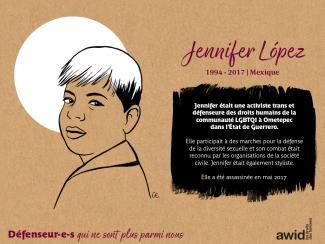
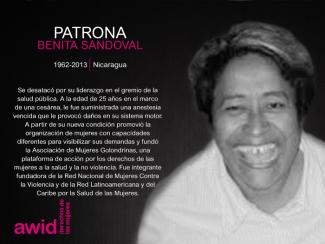
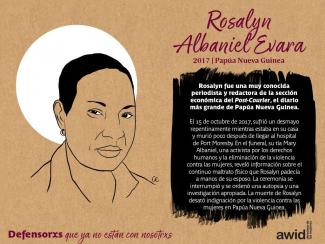
Estas 20 Defensoras de derechos humanos (WHRDs, por las siglas en inglés) trabajaron como periodistas, y de manera más amplia, en los medios comunicación de México, Colombia, Fiji, Libia, Nepal, Estados Unidos de Norteamérica, Nicaragua, Filipinas, Rusia, Alemania, Francia, Afganistán, y el Reino Unido. De ellas, 16 han sido asesinadas, y la causa de muerte en uno de los casos sigue sin ser esclarecida. Por esto, en este Día Mundial de la Libertad de Prensa, por favor únete a nosotrxs para conmemorar la vida y el trabajo de estas mujeres, compartiendo las memes aquí incluidas con tus colegas, amistades y redes, utilizando los hashtags #LibertadDePrensa y #WHRDs.
Los aportes del trabajo realizado por estas mujeres fueron celebrados y honrados en nuestro Tributo virtual para defensoras que ya no están con nosotrxs.
Por favor, haz click en cada imagen de abajo para ver una versión más grande y para descargar como un archivo.



Priscilla posee prácticamente dos décadas de experiencia de trabajo en el sector sin fines de lucro con organizaciones por la justicia social abocadas a los derechos de las mujeres y las juventudes, la conservación, la consolidación de la paz y el desarrollo. Sus intereses se centran en establecer procesos y sistemas progresistas que ayuden a una organización a operar de acuerdo a sus valores y principios y a prosperar, así como en encontrar formas de ayudar a las organizaciones y los donantes a identificar y garantizar los recursos que necesitan para una buena labor. Priscilla se unió a AWID en 2018, como Gerente de Movilización de Recursos y, en julio de 2023, asumió el cargo de Directora de Operaciones y Alianzas para el Financiamiento.
Posee una Maestría en Política Internacional de la Escuela de Estudios Orientales y Africanos (SOAS), una pila cada vez más alta de libros para los que todavía intenta encontrar tiempo para leer e integra la Junta de Hodan Somali Community, una entidad benéfica radicada en Londres.
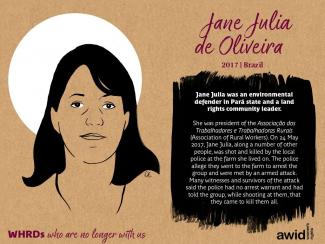
Les données que nous avons recueillies pour élaborer notre hommage montrent à quel point le Mexique est un pays dangereux pour les défenseuses. Sur les 12 femmes mexicaines défenseuses des droits humains que nous commémorons cette année, 11 ont été assassinées. Elles étaient des journalistes ou des activistes, des défenseuses des droits des femmes ou de ceux des personnes trans*. Nous vous invitons à vous joindre à nous pour rendre hommage à ces défenseuses, à leur travail et à l’héritage qu’elles nous ont laissé. Faites circuler ces mèmes auprès de vos collègues et amis ainsi que dans vos réseaux et twittez en utilisant les hashtags #WHRDTribute et #16Jours.
S'il vous plaît cliquez sur chaque image ci-dessous pour voir une version plus grande et pour télécharger comme un fichier


Marta est chercheur·se et activiste queer, transféministe et non binaire, originaire de l'ex-Yougoslavie, actuellement basé·e à Barcelone. Iel facilite des mouvements transnationaux, tisse des alternatives systémiques et est économiste féministe. Iel a cofondé et coordonné avec d’autres la Tapisserie mondiale des alternatives, un processus mondial qui cherche à identifier, documenter et relier les alternatives aux niveaux local, régional et mondial. À l’échelle locale, Marta est engagé·e au sein d’organisations antiracistes, transféministes, queer et migrantes. Iel détient également un doctorat en sciences et technologies environnementales de l'Université autonome de Barcelone, consacré aux perspectives féministes décoloniales d'une pluralité d'alternatives systémiques et à la création de systèmes alternatifs féministes basés sur les soins et la pérennité de la vie. Pendant son temps libre, iel aime boxer, jouer de la guitare et de la batterie dans un groupe de samba, faire de la photographie, de la randonnée, cuisiner pour ses proches et gâter ses deux chats.
Sí, es accesible para personas con diverso grado de discapacidades auditivas, visuales, cognitivas y de movilidad.
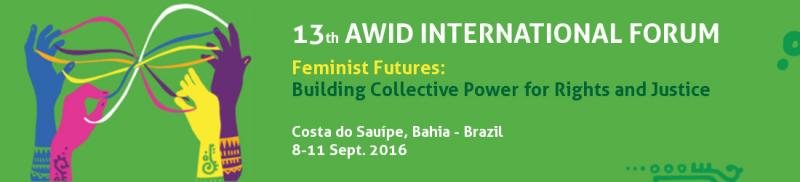
This kit includes sample messages fit for Twitter, Facebook, LinkedIn and Instagram, plus images that can be used to accompany these messages.
Using this kit is simple. Just follow these steps:
Match up your favourite messages and images any way you like.
Share them on your personal and/or professional social media accounts.
Match up your favourite tweets below with these images for Twitter
I'm going to the #AWIDForum. It's THE place to connect with women's rights & social justice movements. Join me!: http://forum.awid.org/forum16/
Can't wait to re-imagine #FeministFutures connect with other women's rights & social justice activists @ the #AWIDForum Join me!: http://forum.awid.org/forum16/
I’m so excited to attend the #AWIDForum next September, and now we can register! Join me! http://forum.awid.org/forum16/
Registration is now open for the #AWIDForum! Costa do Sauípe, Brazil, 8-11 Sept. 2016: http://forum.awid.org/forum16/
Join #AWIDForum, a historic global gathering of women's rights & social justice activists: http://forum.awid.org/forum16/
Join #AWIDForum to celebrate the gains of our movements & analyze lessons to move forward: http://forum.awid.org/forum16/
#AWIDForum – not just an event, a chance to disrupt oppression & advance justice: http://forum.awid.org/forum16/
Join the #AWIDForum to celebrate, strategize and renew ourselves and our movements: http://forum.awid.org/forum16/
Let's build #FeministFutures together. Register for 2016 #AWIDForum. Costa do Sauípe, Brazil http://forum.awid.org/forum16/
Join us to re-imagine & co-create #FeministFutures at the 2016 #AWIDForum. Register: http://forum.awid.org/forum16/
#FeministFutures: seize the moment @ #AWIDForum to advance shared visions for a just world: http://forum.awid.org/forum16/
We’ll be 2,000 social movement activists @ the #AWIDForum, strategizing our #FeministFutures http://forum.awid.org/forum16/
We’re more than a one-issue struggle. Join us at the #AWIDForum: http://forum.awid.org/forum16/
Join #AWIDForum, a space to strategize across movements & leverage our collective power: http://forum.awid.org/forum16/
Mobilize solidarity & collective power across social movements at the #AWIDForum: http://forum.awid.org/forum16/
Break the silos b/w our movements. Re-imagine & co-create our futures. All at the #AWIDForum: http://forum.awid.org/forum16/
Solidarity is a verb. Let’s put it into action at the #AWIDForum: http://forum.awid.org/forum16/
Donors engaging with women’s rights and social movements at the #AWIDForum: http://forum.awid.org/forum16/
Media and movements: amplifying #FeministFutures at the #AWIDForum: http://forum.awid.org/forum16/
Match up your favourite messages below with these images for Facebook.
These messages may also be used on Twitter via private Direct Messages, which don’t have character limits.
“Nous Sommes la Solution a une vision d'une Afrique où, solidairement, les femmes rurales impliquées dans la prise de décision peuvent cultiver, transformer, vendre et consommer les produits de l'agriculture familiale tout en préservant l'environnement, pour un développement harmonieux et durable”
Sanyu is a Pan-African feminist based in Nairobi, Kenya. She has spent the last decade supporting labour, feminist and human rights movements advocating for corporate accountability, economic justice and gender justice. She has worked with the Business & Human Rights Resource Centre, IWRAW Asia Pacific and the Commonwealth Human Rights Initiative. She has a Master’s of Laws in Human Rights Law and a Bachelor’s of Laws from the University of Nottingham. Her writing has been published in the Business and Human Rights Journal, Human Rights Law Review, Open Global Rights, Open Democracy and more. In her free time, she loves walking in the forest and chasing butterflies.