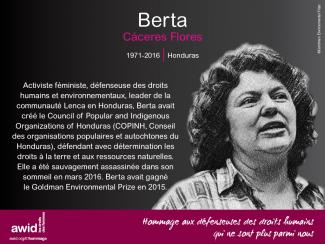
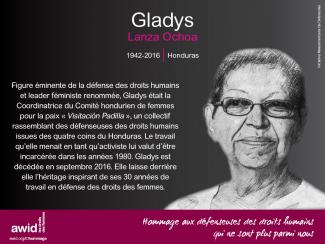
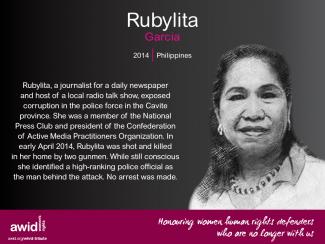
Berta Cáceres Flores
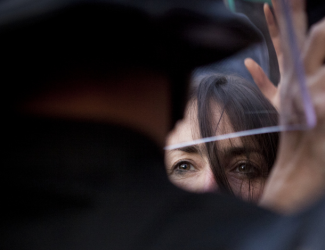
WHRDs are self-identified women and lesbian, bisexual, transgender, queer and intersex (LBTQI) people and others who defend rights and are subject to gender-specific risks and threats due to their human rights work and/or as a direct consequence of their gender identity or sexual orientation.
WHRDs are subject to systematic violence and discrimination due to their identities and unyielding struggles for rights, equality and justice.
The WHRD Program collaborates with international and regional partners as well as the AWID membership to raise awareness about these risks and threats, advocate for feminist and holistic measures of protection and safety, and actively promote a culture of self-care and collective well being in our movements.
WHRDs are exposed to the same types of risks that all other defenders who defend human rights, communities, and the environment face. However, they are also exposed to gender-based violence and gender-specific risks because they challenge existing gender norms within their communities and societies.
We work collaboratively with international and regional networks and our membership
We aim to contribute to a safer world for WHRDs, their families and communities. We believe that action for rights and justice should not put WHRDs at risk; it should be appreciated and celebrated.
Promoting collaboration and coordination among human rights and women’s rights organizations at the international level to strengthen responses concerning safety and wellbeing of WHRDs.
Supporting regional networks of WHRDs and their organizations, such as the Mesoamerican Initiative for WHRDs and the WHRD Middle East and North Africa Coalition, in promoting and strengthening collective action for protection - emphasizing the establishment of solidarity and protection networks, the promotion of self-care, and advocacy and mobilization for the safety of WHRDs;
Increasing the visibility and recognition of WHRDs and their struggles, as well as the risks that they encounter by documenting the attacks that they face, and researching, producing, and disseminating information on their struggles, strategies, and challenges:
Mobilizing urgent responses of international solidarity for WHRDs at risk through our international and regional networks, and our active membership.
Movements marching globally for climate justice.
📅 Saturday, November 15, 2025
📍 Multiple Locations
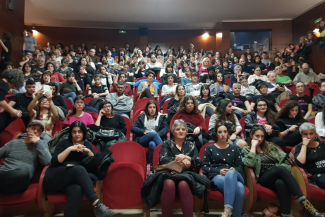

As feminist and labour movements, together in solidarity, we articulate the following points as a collective vision for care economies with domestic workers rights at the centre. We call on feminist and social movements to join the call to rethink the economy with care at its centre recognising the rights, agency and leadership of domestic worker movements.
Domestic and care work is in the limelight after the COVID-19 global pandemic as it provided the means to carry the world through multiple intersecting crises at the global scale. The World Bank, the International Monetary Fund, and other multilateral institutions also acknowledge the importance of care and domestic work in sustaining the world’s economy. However, it is our analysis that this recognition most often takes an instrumentalist approach (i.e. care work sustains the ‘productive’ economy) focused on profiteering from care work without recognizing care as a human right and public good, or providing recognition and rights to the workers undertaking the bulk of this labour.
Given the current world situation, our Board of Directors has taken the difficult decision to cancel Forum scheduled in 2021 in Taipei.
La Construcción de Economías Feministas se trata de crear un mundo con aire limpio para respirar y agua limpia para beber, con trabajo significativo y cuidado para nosotrxs y nuestras comunidades, donde todxs podamos disfrutar de nuestra autonomía económica, sexual y política.
En el mundo en que vivimos hoy, la economía sigue dependiendo del trabajo de cuidado no remunerado o subvalorado que realizan las mujeres para ganancia de otrxs. La búsqueda del «crecimiento» solo expande el extractivismo, un modelo de desarrollo basado en la extracción y explotación masiva de los recursos naturales que sigue destruyendo a las personas y al planeta mientras concentra la riqueza en manos de las elites globales. Mientras tanto, el acceso a la salud, a la educación, a un salario digno y a la seguridad social se están convirtiendo en el privilegio de pocxs. Este modelo económico se asienta sobre la supremacía blanca, el colonialismo y el patriarcado.
Adoptar solamente un «enfoque de empoderamiento económico de las mujeres» es solo integrar aún más a las mujeres a este sistema. Ese ‘empoderamiento’ puede ser un medio temporal de supervivencia, pero debemos plantar las semillas que hagan que otro mundo sea posible mientras derribamos los muros del que ya existe.
Creemos en la capacidad de los movimientos feministas de trabajar para el cambio con alianzas amplias que atraviesen distintos movimientos sociales. Al amplificar las propuestas y visiones feministas, nuestro objetivo es construir nuevos paradigmas para economías justas.
Nuestro enfoque debe ser interconectado e interseccional, porque la autonomía sexual y corporal no será posible hasta que todxs y cada unx de nosotrxs disfrute de sus derechos e independencia económicos. Queremos trabajar con quienes resisten y enfrentan el auge mundial de la derecha conservadora y de los fundamentalismos religiosos, porque no es posible ninguna economía justa hasta que no hagamos crujir las bases del actual sistema.
Promovemos agendas feministas: Enfrentamos al poder corporativo y su impunidad por los abusos de derechos humanos trabajando con aliadxs. Así nos asegurarnos de llevar a los espacios de decisión política las perspectivas feministas, de derechos de las mujeres y de justicia de género. Un ejemplo sobre el que puedes leer más es nuestro trabajo sobre el futuro instrumento legalmente vinculante sobre las «corporaciones transnacionales y otras empresas comerciales con respecto a los derechos humanos», en el Consejo de Derechos Humanos de las Naciones Unidas.
Movilizamos acciones solidarias: Trabajamos para fortalecer los vínculos entre los movimientos feministas y por la justicia impositiva, incluyendo el reclamo de que los recursos públicos perdidos a través de los flujos financieros ilícitos (IFFs, por sus siglas en inglés) sean usados para asegurar la justicia social y de género.
Construimos conocimiento: Brindamos a las defensoras de derechos humanos información estratégica que es vital para enfrentar el poder corporativo y el extractivismo. Contribuiremos a construir conocimiento acerca del financiamiento local y global para el extractivismo,y los mecanismos de inversión que lo sostienen.
Creamos y difundimos alternativas: Movilizamos a nuestra membresía y a los movimientos imaginando de manera colectiva economías feministas, y compartiendo conocimientos, prácticas y agendas feministas por la justicia económica.
«La revolución corporativa va a colapsar si nos rehusamos a comprar lo que están vendiendo: sus ideas, su versión de la historia, sus guerras, sus armas, su idea de inevitabilidad. Otro mundo no solo es posible, sino que está en camino. En los días tranquilos, puedo oírlo respirar».
Arundhati Roy, War Talk.
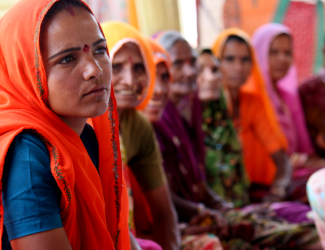
AWID presenta este Manual WITM para apoyar a personas y organizaciones que quieran investigar por su cuenta las tendencias en el financiamiento para una región, temática o población en particular, adaptando las metodologías de investigación de AWID.
El Manual WITM de AWID es producto de diez años de experiencia. Las investigaciones de WITM y este Manual son una demostración política y práctica de los recursos y pasos necesarios para realizar investigaciones en acción de buena calidad.
Más información sobre el contexto de la metodología de la investigación WITM
El equipo WITM también ofrece apoyo técnico y político antes y durante el proceso de investigación. Te invitamos a leer el Manual y a ponerte en contacto con nosotras en fundher@awid.org si necesitas más información.

Esta publicación (zine) colaborativa surgió de una serie de círculos de intercambio que reunieron a feministas de todo el mundo durante 2022. El propósito fue intercambiar ideas y aprender mutuamente de qué manera las comunidades responden a la crisis climática en diversos contextos locales.
Par le biais de l'organisation syndicale, Sopo, Sabrina et Linda se battent non seulement pour les droits des femmes, des travailleur·euses essentiel·les, des travailleur·euses migrant·e·s et des travailleur·euses du sexe, mais pour les droits de tous·tes les travailleur·euses .
La lutte pour mettre fin à l'exploitation des travailleur·euses est une lutte féministe. C’est pourquoi il n’y a pas d’économies féministes sans syndicats féministes.
par Nandini Tanya Lallmon
Olajumoke « Jay » Abdullahi et Kym Oliver sont des féministes révolutionnaires à plus d'un titre. (...)
illustration : « Éclose » de Titash Sen >
As world leaders gather in Brazil, feminist movements are advocating, gathering and disrupting the status quo- at COP30 and beyond! We're heading alongside other feminists to Belém, Brazil for COP30, from 10 November – 21 November 2025, where we will continue to denounce false solutions.
Even in times of climate crisis, governments continue to encourage large-scale agriculture industries to expand. These activities poison the land, threaten biodiversity, and destroy local food production and livelihoods. Meanwhile, while women produce the majority of our food in the world, they own almost none of the land.
What if we perceived land and Nature not as private property to exploit, but as a whole to live in, learn from, and harmoniously coexist with? What if we repaired our relationships with the land and embraced more sustainable alternatives that nurture both the planet and its communities?
Nous Sommes la Solution (We Are the Solution, NSS) is one of many women-led movements striving to do this. This is their story.
by Alejandra Laprea
I live in a country of the impossible, where there are no bombs yet we are living in a war. (...)
artwork: “Entretejidas” [Interwoven women] by Surmercé >
Enciende tu fuego feminista leyendo nuestras investigaciones y publicaciones varias sobre financiamiento, defensoras de derechos humanos, construcción de movimientos, fundamentalismos, justicia económica, seguimiento y evaluación feminista y más