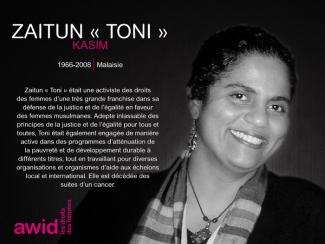
Zaitun Kasim

WHRDs are self-identified women and lesbian, bisexual, transgender, queer and intersex (LBTQI) people and others who defend rights and are subject to gender-specific risks and threats due to their human rights work and/or as a direct consequence of their gender identity or sexual orientation.
WHRDs are subject to systematic violence and discrimination due to their identities and unyielding struggles for rights, equality and justice.
The WHRD Program collaborates with international and regional partners as well as the AWID membership to raise awareness about these risks and threats, advocate for feminist and holistic measures of protection and safety, and actively promote a culture of self-care and collective well being in our movements.
WHRDs are exposed to the same types of risks that all other defenders who defend human rights, communities, and the environment face. However, they are also exposed to gender-based violence and gender-specific risks because they challenge existing gender norms within their communities and societies.
We work collaboratively with international and regional networks and our membership
We aim to contribute to a safer world for WHRDs, their families and communities. We believe that action for rights and justice should not put WHRDs at risk; it should be appreciated and celebrated.
Promoting collaboration and coordination among human rights and women’s rights organizations at the international level to strengthen responses concerning safety and wellbeing of WHRDs.
Supporting regional networks of WHRDs and their organizations, such as the Mesoamerican Initiative for WHRDs and the WHRD Middle East and North Africa Coalition, in promoting and strengthening collective action for protection - emphasizing the establishment of solidarity and protection networks, the promotion of self-care, and advocacy and mobilization for the safety of WHRDs;
Increasing the visibility and recognition of WHRDs and their struggles, as well as the risks that they encounter by documenting the attacks that they face, and researching, producing, and disseminating information on their struggles, strategies, and challenges:
Mobilizing urgent responses of international solidarity for WHRDs at risk through our international and regional networks, and our active membership.
Solicitamos estos datos para facilitar el análisis de las respuestas, para evitar duplicaciones y para contactar a su organización en caso de que no hayan podido completar el cuestionario o de que tengan dudas u otras preguntas. Puedes consultar más detalles acerca de cómo utilizamos la información personal que recolectamos a través de nuestro trabajo aquí.
Nous Sommes la Solution élève et développe le leadership des femmes rurales travaillant à des solutions africaines pour la souveraineté alimentaire.
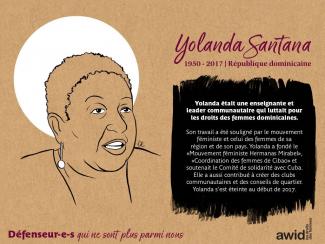
As feminists struggling for gender, peace, economic, social and environmental justice, we know there is no single recipe for success but an array of possibilities that can and are making change happen. The menu of options is as diverse as our movements and the communities in which we live and struggle.
Before we dare to present some of the feminist imaginations for another world, here are the principles around which we base our propositions:
We believe there is no one model for all and that everyone has a right to claim and contribute to building another world that is possible, as the World Social Forum motto puts it.
This includes the right to participate in democratic governance and to influence one’s future – politically, economically, socially and culturally.
Economic self-determination gives peoples the ability to take control over their natural resources and use those resources for their own ends or collective use. Furthermore, women’s economic agency is fundamental to mitigating the often cyclical nature of poverty, denial of education, safety, and security.
The principle of substantive equality is laid out in the Convention on the Elimination of All Forms of Discrimination against Women (CEDAW) and other international human rights instruments. This principle is fundamental for development and achieving a just economy as it affirms that all human beings are born free and equal.
Non-discrimination is an integral part of the principle of equality that ensures that no one is denied their rights because of factors such as race, gender, language, religion, sexual orientation, gender identity, political or other opinion, national or social origin, property or birth.
The inherent dignity of all persons without distinction must be upheld and respected. While States are responsible for ensuring the use of maximum available resources for the fulfilment of human rights, reclaiming rights and dignity is fundamentally a key space for civil society struggle and popular mobilization.
This principle, exercised through organized efforts to transform unjust institutions, guides the restoration of balance between "participation" (input) and "distribution" (output) when either principle is violated.
It puts limits on monopolistic accumulations of capital and other abuses of property. This concept is founded on an economy model that is based on fairness, and justice.
In order to make change happen, we need strong and diverse feminist networks. We need movements building solidarity from the personal to the political, from the local to the global and back.
Building collective power through movements helps convert the struggle for human rights, equality and justice into a political force for change that cannot be ignored.
“Only movements can create sustained change at the levels that policy and legislation alone cannot achieve.”
See more on this at Batliwala, S: 2012 “Changing Their World. Concepts and Practices of Women’s Movements” 2nd Edition. AWID
Elle est ouverte jusqu’à la fin août 2024. Merci d’y répondre avant cette date butoir, afin que vos réponses soient incluses dans l’analyse.
A workplace does not have to operate on competition and profit. It does not have to exploit people for the benefit of the owner and a small elite either.
Instead, communities on the margins of formal economies are building cooperative models based on autonomy, cooperation, shared responsibility, self-management and solidarity.
Worker-controlled cooperatives and workplaces have always offered alternative ways of generating employment opportunities, income, social security and savings - while distributing revenues in more communal, sustainable and safer ways.
But it is more than an employment opportunity: it is the making of dreams into a reality, and the building of feminist economies based on solidarity and care for each other. It is about creating a world where our lives, our labor and our communities matter.
This is the story of the Nadia Echazú Textile Cooperative, the first social enterprise managed by and for travesti and trans people in Argentina.

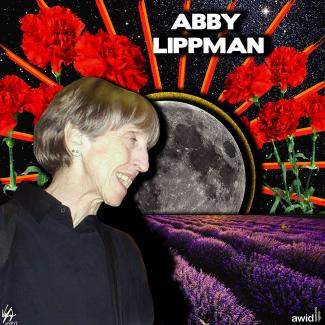
Abby was a pioneering feminist, human-rights activist and former McGill University epidemiologist.
Abby was renowned for championing social causes and for her insightful critiques of reproductive technologies and other medical topics. Specifically, she campaigned against what she called the "geneticization" of reproductive technologies, against hormone replacement therapy and for better, longer research before the approval of discoveries such as the vaccines against the human papillomavirus.
On the news of her passing, friends and colleagues described her fondly as an “ardent advocate” for women’s health.
Las propuestas de decrecimiento cuestionan la premisa de que la economía de los países debe ‘crecer o perecer’ y muestran la falsedad del lugar central que se le otorga al crecimiento medido por un aumento del Producto Bruto Interno (PIB).
Un modelo de decrecimiento propone un cambio hacia niveles de producción y consumo más bajos y sostenibles. En esencia postula una reducción del sistema económico para dejarle más espacio a la cooperación entre personas y a los ecosistemas humanos.
Esta propuesta incluye:
Las perspectivas feministas dentro de la teoría y práctica del decrecimiento sostienen que también es necesario redefinir y revalidar el trabajo no remunerado y remunerado, de cuidados y en el mercado, para superar los estereotipos tradicionales de género así como las brechas laborales y las desigualdades en el ingreso prevalecientes que devalúan el trabajo de cuidado.

Опрос предназначен для групп, организаций и движений, работающих исключительно или главным образом по вопросам защиты прав женщин, ЛГБТКИ+, гендерной справедливости во всех контекстах, на всех уровнях и во всех регионах. Если одно из этих направлений является основным видом деятельности вашей группы, коллектива, сети или любого другого типа организации – независимо от того, зарегистрирована она или нет, недавно создана или существует уже давно, мы приглашаем вас принять участие в этом опросе.

* На данном этапе мы не ожидаем ответов от частных лиц или женских и феминистских фондов.
Узнайте больше об опросе:
загляните в часто задаваемые вопросы

1 de cada 3 personas trans y travesti en Argentina vive en un hogar de bajos ingresos.
Marielle fue una política brasileña feminista lesbiana y activista por los derechos humanos.
Criticó abiertamente la brutalidad policial y las ejecuciones extrajudiciales. Su política declaradamente feminista, negra, centrada en las favelas, fue una fuente de esperanza para los grupos marginados de Río de Janeiro, gobernados actualmente por un gobierno municipal conservador y un intendente evangélico.
El 14 de marzo de 2018, después de dar un discurso en Río de Janeiro, Franco y su chofer fueron asesinados a balazos. A partir de la noticia de su muerte, multitudes se volcaron a las calles al grito de «¡Marielle presente!», en demanda de justicia.
En esta nota se puede leer más sobre Marielle y la situación en Brasil

Lxs actores ultra conservadores han desarrollado una serie de discursos en la esfera internacional de los derechos humanos. Utilizan argumentos que manipulan la religión, la cultura, la tradición y la soberanía nacional para minar los derechos relacionados con el género y la sexualidad.
Lxs actores anti-derechos se han alejado cada vez más del lenguaje explícitamente religioso. Vemos que actores regresivxs —que antes tal vez ridiculizaban los conceptos de derechos humanos — ahora los manipulan y cooptan para promover sus propios objetivos.
Este discurso emergente y exitoso parece inocuo, pero resulta útil como un tema ‘sombrilla’ bajo el que se cobijan múltiples posiciones patriarcales y anti-derechos. Por eso el tema de la «protección de la familia» resulta un ejemplo clave que muestra la tendencia de lxs actores regresivxs a llevar adelante una incidencia integral e integrada.
El lenguaje de la «protección de la familia» opera desplazando al sujeto de los derechos humanos, reemplazando al individuo por instituciones ya poderosas. También afirma una concepción unitaria, jerárquica y patriarcal de la familia que discrimina a todo formato familiar que esté fuera de estos límites rígidos.
Por último, intenta cambiar el enfoque del reconocimiento y la protección de los derechos de integrantes vulnerables de la familia a la no discriminación, la autonomía y la ausencia de violencia en el contexto de las relaciones familiares.
La Santa Sede y varios grupos de la derecha cristiana buscan apropiarse del derecho a la vida para ponerlo al servicio de su misión contra el aborto. Mezclando el lenguaje de los derechos humanos con la doctrina religiosa conservadora, argumentan que el derecho a la vida, tal como se lo establece en la Declaración Universal de Derechos Humanos y en el Pacto Internacional de Derechos Civiles y Políticos, se aplica a partir del momento de la concepción.
Ningún instrumento universal de derechos humanos apoya ese argumento. Sin embargo, esta es una táctica atractiva para lxs actores anti-derechos, porque el derecho a la vida no puede ser violado bajo ninguna circunstancia y es un estándar legal vinculante.

Lxs actores anti-derechos humanos utilizan una serie de dispositivos retóricos en su campaña para minar los derechos sexuales: sostienen que estos derechos no existen o que son «nuevos derechos»; que causan daño a las niñas, los niños y la sociedad; y/o que se oponen a la cultura, la tradición o las leyes nacionales.
Lxs actores conservadores dedicados a hacer incidencia en la ONU atacan el derecho a una educación sexual integral (ESI) desde varios frentes. Afirman que viola los «derechos parentales»; que perjudica a las niñas y los niños; y que no es educación sino adoctrinamiento ideológico.
También alegan que poderosos grupos de presión les imponen la Educación Sexual Integral a las niñas y los niños, los padres y las Naciones Unidas para beneficiarse de los servicios que estos mismos grupos proporcionan a niñas, niños y jóvenes.
Los intentos de invalidar los derechos relacionados con la orientación sexual y la identidad de género se han multiplicado. Lxs actores ultra conservadores argumentan que aplicar los principios y leyes históricos de derechos humanos a esta temática equivale a crear «nuevos derechos», y proponen un cambio radical en el significado actual de los derechos que resultaría de interpretarlos a la luz de la "cultura" o de las «particularidades nacionales».
Desde hace muchos años, las organizaciones de la derecha cristiana se movilizan en contra de los derechos reproductivos junto con la Santa Sede y otrxs aliadxs anti-derechos. A menudo argumentan que los derechos reproductivos no son más que una forma de control poblacional impuesto por Occidente sobre los países del Sur Global. Irónicamente, esta afirmación proviene a menudo de actores con sede en Estados Unidos y Europa Occidental, que en su mayoría trabajan activamente para exportar sus discursos y políticas fundamentalistas.
Lxs actores regresivxs también citan argumentos «científicos» de grupos de expertxs ultra conservadores y de fuentes que emplean metodologías de investigación poco sólidas, para sugerir que el aborto causa una serie de efectos secundarios psicológicos, sexuales, físicos y relacionales.
Así como lxs actores anti-derechos buscan construir una nueva categoría de «protección de la familia», también proponen otra: los «derechos parentales», que tampoco encuentra respaldo en las normas de derechos humanos vigentes. Este discurso paradójicamente intenta utilizar las protecciones de derechos que les corresponden a los niños y las niñas, tal como las expresa la Convención sobre los Derechos del Niño, para fundamentar el derecho de padres y madres a controlar a sus hijas e hijos y limitar sus derechos.
Cada vez más, lxs actores anti-derechos, están intentando infiltrar y subvertir los estándares y discursos desarrollados por defensoras de derechos humanos, como la violencia contra las mujeres.
En la Comisión de la Condición Jurídica y Social de las Mujeres y en otros escenarios, estos actores insisten en tratar esta forma de violencia como un concepto al que le adosan argumentos anti-derechos reproductivos y otros de cariz patriarcal. Lxs actores ultra conservadores, por ejemplo, han argumentado que las relaciones de pareja no tradicionales ni heteronormativas son un factor de riesgo para la violencia, y enfatizan que los padres son necesarios para proteger a las familias de la violencia.
La Santa Sede ha elaborado y sostenido una crítica al género, a la «ideología de género», lxs «radicales del género» y la teoría de género. Lxs actores anti-derechos a menudo leen el término ‘género’ como un código equivalente a ‘derechos LGBTQ’. La derecha religiosa utiliza el género como un concepto transversal que une muchos de sus discursos. Cada vez más, el pánico que generan en torno a este tema se concentra en la identidad de género y en los derechos de las personas trans.
Varios actores ultra-conservadores emplean el discurso de la complementariedad de los sexos. Estructuran su retórica en torno a una presunción de diferencia: se supone que los hombres y las mujeres tienen roles diferentes pero complementarios en el matrimonio, la vida familiar, y también en su participación en la vida comunitaria, política y económica.
La referencia a los roles «naturales» tiene por objeto rechazar los derechos humanos universales a la igualdad y la no discriminación. También se utiliza para justificar las violaciones de estos derechos por parte de actores estatales y no estatales, y el incumplimiento de las obligaciones del Estado en cuanto a eliminar los prejuicios y las prácticas basadas en roles estereotipados para hombres o mujeres.
Este discurso sugiere que organismos de la ONU o Estados que actúan a través de la ONU atacan injustamente a los gobiernos nacionales. Lo que se intenta aquí es desplazar el sujeto de los derechos humanos de la persona o sector marginado que sufre una violación de sus derechos a una institución poderosa y/o regresiva, el Estado, para justificar excepciones nacionales a los derechos universales o para apoyar la impunidad estatal.
Lxs actores anti-derechos han adoptado el discurso de la libertad religiosa para justificar violaciones a los derechos humanos. Se refieren a la libertad religiosa de una manera que contradice directamente el propósito de este derecho humano y entra seriamente en conflicto con el principio de la universalidad de los derechos.
Su argumento es que la libertad religiosa se ve amenazada y debilitada por la protección a los derechos humanos, particularmente aquellos relacionados con el género y la sexualidad.
Lo que se proponen instalar es que el derecho a la libertad religiosa tiene por objeto proteger a las propias religiones y no a las personas, que son quienes en verdad tienen la libertad de profesar o no distintas creencias. Sin embargo, el derecho internacional de los derechos humanos protege a lxs creyentes y no a las creencias, y el derecho a la libertad de religión, pensamiento y conciencia incluye el derecho a no profesar ninguna religión ni creencia así como a cambiar de religión o de creencias.
El despliegue de referencias a la cultura y la tradición para debilitar los derechos humanos, incluido el derecho a la igualdad, es una táctica común entre lxs actores anti- derechos. Presentan la cultura como algo monolítico, estático e inmutable, y a menudo la oponen a las «normas occidentales».
Las alusiones a la cultura por parte de lxs actores anti-derechos en los debates de política internacional tienen como objetivo debilitar la universalidad de los derechos, defendiendo un relativismo cultural que prevalece sobre las reivindicaciones de derechos o las limita. El uso de los derechos culturales por parte de actores regresivxs se basa en una tergiversación deliberada de la cultura como derecho humano. Los Estados deben velar por que no se utilicen actitudes tradicionales o culturales para justificar violaciones a la igualdad. Las normas de derechos humanos exigen acceso, participación y contribución igualitaria en todos los aspectos de la vida cultural para todas las personas, incluidas las mujeres, las minorías religiosas y raciales y las personas cuya identidad o expresión de género difieren de las normativas.
En espacios políticos internacionales, lxs actores anti-derechos manipulan cada vez más las referencias a los derechos humanos universales o fundamentales para revertir el significado de la universalidad de los derechos.
En lugar de utilizar el término ‘universal’ para describir todo el conjunto de derechos humanos indivisibles e interrelacionados, lxs actores ultra conservadores lo emplean para delimitar y describir un subconjunto de derechos humanos que ellxs consideran «verdaderamente fundamentales». Todos los otros derechos estarían sujetos a la discreción del Estado, serían derechos 'nuevos' u opcionales. Este discurso resulta especialmente poderoso ya que instala una categoría indefinida - lo «verdaderamente universal» - que queda abierta a interpretaciones cambiantes.

Para dar ênfase à complexidade do financiamento de várias formas de organização feminista;

LE QUOTA D'EMPLOI TRANS
n'est pas respecté par les entreprises