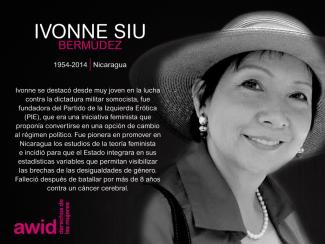
Ivonne Siu Bermudez
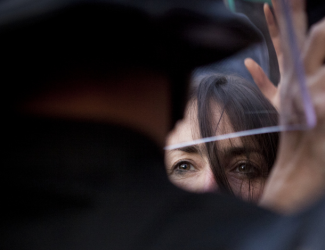
WHRDs are self-identified women and lesbian, bisexual, transgender, queer and intersex (LBTQI) people and others who defend rights and are subject to gender-specific risks and threats due to their human rights work and/or as a direct consequence of their gender identity or sexual orientation.
WHRDs are subject to systematic violence and discrimination due to their identities and unyielding struggles for rights, equality and justice.
The WHRD Program collaborates with international and regional partners as well as the AWID membership to raise awareness about these risks and threats, advocate for feminist and holistic measures of protection and safety, and actively promote a culture of self-care and collective well being in our movements.
WHRDs are exposed to the same types of risks that all other defenders who defend human rights, communities, and the environment face. However, they are also exposed to gender-based violence and gender-specific risks because they challenge existing gender norms within their communities and societies.
We work collaboratively with international and regional networks and our membership
We aim to contribute to a safer world for WHRDs, their families and communities. We believe that action for rights and justice should not put WHRDs at risk; it should be appreciated and celebrated.
Promoting collaboration and coordination among human rights and women’s rights organizations at the international level to strengthen responses concerning safety and wellbeing of WHRDs.
Supporting regional networks of WHRDs and their organizations, such as the Mesoamerican Initiative for WHRDs and the WHRD Middle East and North Africa Coalition, in promoting and strengthening collective action for protection - emphasizing the establishment of solidarity and protection networks, the promotion of self-care, and advocacy and mobilization for the safety of WHRDs;
Increasing the visibility and recognition of WHRDs and their struggles, as well as the risks that they encounter by documenting the attacks that they face, and researching, producing, and disseminating information on their struggles, strategies, and challenges:
Mobilizing urgent responses of international solidarity for WHRDs at risk through our international and regional networks, and our active membership.
 |
 |
 |
 |
 |
|
|
|
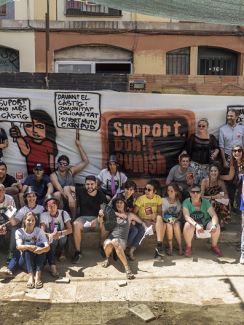
Des militants de Metzineres en action |

The survey is available in: Arabic, English, French, Portuguese, Russian and Spanish!
Nous mettrons le site à jour avec les informations pertinantes le moment venu.
While in Sao Paulo, Brazil, you can visit the Ocupação 9 de Julho and have a collaborative meal. You can buy their products in their online store from abroad.
Visit the Association of Afro-Descendant Women of the Northern Cauca’s online store where you can find beautiful handcrafted products.
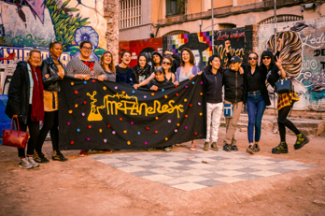
There are several ways to support Metzineres: you can make a financial donation, donate materials and services, or propose a training course, workshop, or activity (for more information, see here).

El Foro Internacional de AWID es un evento de la comunidad global y, al mismo tiempo, un espacio para una transformación personal radical. Es un encuentro único: el Foro reúne a los movimientos feministas, por los derechos de las mujeres, por la justicia de género, LBTQI+ y aliados, en toda nuestra diversidad y humanidad, para conectarnos, sanar y florecer.
El tema del Foro –Rebelándonos Juntes– es una invitación a vincularnos con todo nuestro ser, a conectarnos entre nosotrxs de forma focalizada, afectuosa y valiente, para que podamos sentir el latido de los movimientos globales y rebelarnos juntxs para enfrentar los desafíos de esta época.
Por primera vez, el Foro de AWID ofrece tres modos de participación:
 |
 |
 |
|
Presencial En el Queen Sirikit National Convention Centre en Bangkok, Tailandia |
En línea a través del espacio virtual (capacidad: 3000 participantes) |
Nodos conectades en el espacio a través de las fronteras |
Con más de 4.000 participantes, el 15º Foro Internacional de AWID en 2024 fue una fuerza colectiva arrolladora de resistencia frente a la opresión, apostando a la sanación y la liberación compartida. Mantente atente a este espacio para más historias del foro y futuras actualizaciones.
El Consejo Directivo de AWID tomó la difícil decisión de cancelar el 14° Foro Internacional que estaba programado para realizarse del 20 al 23 de septiembre de 2021 en la ciudad de Taipei.
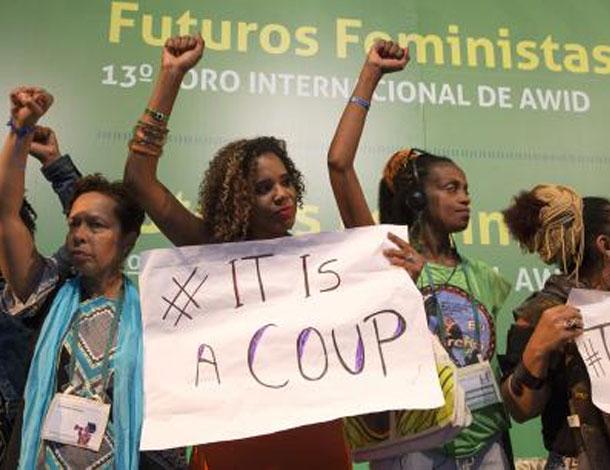
Dado el complejo mundo que enfrentamos hoy, el Foro de AWID 2016 no se centró en un ‘tema’ en particular, sino en la creación de formas más efectivas de trabajar juntxs.
Pese a las dificultades del contexto en el que se celebró este Foro (la epidemia del virus del Zika, una huelga de lxs trabajadorxs del servicio exterior brasileño, el juicio político a la presidenta Dilma Rousseff y la crisis que le siguió), se logró congregar a más de 1800 participantes de 120 países y territorios de todas las regiones del mundo.
Para el 96% de lxs participantes que respondieron a la encuesta de evaluación posterior al Foro, el evento fue una importante fuente de inspiración y energía.
El 98% de lxs participantes lo consideraron un importante espacio de convocatoria para los movimientos feministas, y manifestaron su esperanza de que AWID continúe organizado estos foros.
El 59% de quienes respondieron a la encuesta de evaluación del Foro declaró estar muy satisfechx con el Foro y el 34% algo satisfechx.
Se realizaron más de 150 sesiones en distintos formatos sobre diversos temas, desde la integridad y la libertad corporal, pasando por la violencia de género en el ámbito laboral, hasta estrategias de construcción de poder colectivo.
El primer Foro de Feminismos Negros, se celebró justo antes del Foro de AWID, y reunió a 250 feministas negrxs de todo el mundo, para crear colectivamente un espacio de poder desde donde construir y fortalecer las conexiones intergeneracionales y transnacionales.
Descargar el informe de evaluación del foro
El 12° Foro de AWID se llevó a cabo en el año 2012 en Estambul, Turquía, bajo el título “Transformando el Poder Económico para Avanzar los Derechos de las Mujeres y la Justicia”. El Foro 2012 fue el más grande y diverso que hemos organizado hasta la fecha, con la participación de 2239 activistas por los derechos de las mujeres, de 141 países. El 65% provenía del sur global y casi el 15% eran mujeres jóvenes menores de 30 años, mientras que el 75% de las personas asistían a un Foro de AWID por primera vez.
El programa del Foro se enfocó en la transformación del poder económico para promover los derechos de las mujeres y la justicia. Se ofrecieron más de 170 sesiones de lo más diversas, incluyendo las sesiones de la caja de herramientas económicas feministas para forjar habilidades, sesiones interactivas que representaron los 10 temas del Foro, discusiones en profundidad y las mesas redondas de solidaridad.
Aprovechando el impulso del Foro, hemos transformado la página web en un centro de recursos y aprendizaje que se basa en el contenido generado por las participantes mediante recursos multimedia sobre todos los componentes del Foro.
Visita el archivo web del Foro 2012
La encuesta mundial ¿Dónde está el dinero? es un pilar fundamental de la tercera edición de nuestra investigación orientada a la acción: ¿Dónde está el dinero para las organizaciones feministas? (abreviadamente, ¿Dónde está el dinero? y WITM). Los resultados de la encuesta se desarrollarán y analizarán en mayor profundidad mediante conversaciones exhaustivas con activistas y donantes, y se contrastarán con otros análisis e investigaciones disponibles acerca del estado del financiamiento para las organizaciones feministas y por la igualdad de género en todo el mundo.
El informe completo ¿Dónde está el dinero para las organizaciones feministas? se publicará en 2026.
 Para conocer más información acerca de cómo AWID ha arrojado luz sobre el dinero destinado en favor y en contra de los movimientos feministas, consulta nuestra historia ¿Dónde está el dinero? y nuestros informes anteriores aquí.
Vous N’AVEZ PAS besoin d’un visa pour assister au Forum à Taipei si vous détenez un passeport émis par l’un des pays suivants (la durée de séjour autorisée varie d’un pays à l’autre) :
Allemagne, Andorre, Australie, Autriche, Belgique, Belize, Bulgarie, Brunei, Canada, Chili, Chypre, Croatie, Danemark, Espagne, Estonie, Eswatini, État de la Cité du Vatican, États-Unis, Finlande, France, Grèce, Guatemala, Haïti, Honduras, Hongrie, Îles Marshall, Islande, Irlande, Israël, Italie, Japon*, Lettonie, Liechtenstein, Lituanie, Luxembourg, Malaisie, Malte, Monaco, Nauru, Nicaragua, Norvège, Nouvelle-Zélande, Palaos, Paraguay, Pays-Bas, Philippines, Pologne, Portugal, République de Corée, République dominicaine, République tchèque, Roumanie, Royaume-Uni, Russie, Saint-Christophe-et-Niévès, Sainte-Lucie, Saint-Marin, Saint-Vincent-et-les-Grenadines, Singapour, Slovaquie, Slovénie, Suède, Suisse, Tuvalu.
Les personnes détentrices de tout autre passeport AURONT BESOIN D’UN VISA pour se rendre à Taipei.
Remarque :
Une fois inscrit·e au Forum, il est probable que vous receviez un code relatif à l’événement vous permettant de demander un visa en ligne, quelle que soit votre nationalité.
Nous vous donnerons plus d’informations à ce sujet après l’ouverture du processus d’inscription.
The key objective of the WITM survey is to shine light on the financial status of diverse feminist, women’s rights, gender justice, LBTQI+ and allied movements globally. Based on this, we hope to further strengthen the case for moving more and better money, as well as shift power, to feminist movements.
NOUS SOMMES LA SOLUTION
Somos la Solución
