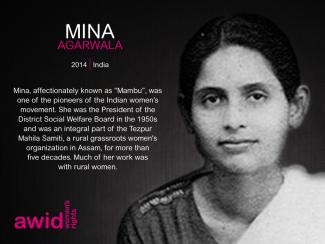
Mina Agarwala
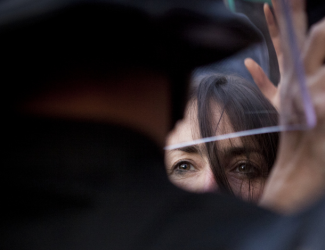
WHRDs are self-identified women and lesbian, bisexual, transgender, queer and intersex (LBTQI) people and others who defend rights and are subject to gender-specific risks and threats due to their human rights work and/or as a direct consequence of their gender identity or sexual orientation.
WHRDs are subject to systematic violence and discrimination due to their identities and unyielding struggles for rights, equality and justice.
The WHRD Program collaborates with international and regional partners as well as the AWID membership to raise awareness about these risks and threats, advocate for feminist and holistic measures of protection and safety, and actively promote a culture of self-care and collective well being in our movements.
WHRDs are exposed to the same types of risks that all other defenders who defend human rights, communities, and the environment face. However, they are also exposed to gender-based violence and gender-specific risks because they challenge existing gender norms within their communities and societies.
We work collaboratively with international and regional networks and our membership
We aim to contribute to a safer world for WHRDs, their families and communities. We believe that action for rights and justice should not put WHRDs at risk; it should be appreciated and celebrated.
Promoting collaboration and coordination among human rights and women’s rights organizations at the international level to strengthen responses concerning safety and wellbeing of WHRDs.
Supporting regional networks of WHRDs and their organizations, such as the Mesoamerican Initiative for WHRDs and the WHRD Middle East and North Africa Coalition, in promoting and strengthening collective action for protection - emphasizing the establishment of solidarity and protection networks, the promotion of self-care, and advocacy and mobilization for the safety of WHRDs;
Increasing the visibility and recognition of WHRDs and their struggles, as well as the risks that they encounter by documenting the attacks that they face, and researching, producing, and disseminating information on their struggles, strategies, and challenges:
Mobilizing urgent responses of international solidarity for WHRDs at risk through our international and regional networks, and our active membership.
Asociación de Mujeres Afrodescendientes del Norte del Cauca (ASOM)
Tenue des autres sessions de rédaction du document final d’Addis-Abeba
Pour plus d’informations, voir le « guide du routard des OSC » (le CSO Hitchhiker’s Guide – en anglais).
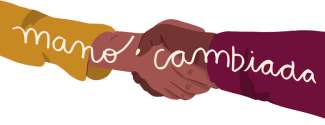
("exchange hand")
Term of the black communities of the Northern Cauca for the minga, the collective work based on solidarity and mutual support.
The 14th Forum theme is “Feminist Realities: our power in action”.
We understand Feminist Realities as the different ways of existing and being that show us what is possible, despite dominant power systems, and in defiance and resistance to them. We understand these feminist realities as reclamations and embodiments of hope and power, and as multi-dimentional, dynamic and rooted in specific contexts and historical moments.
Read more about Feminist Realities


La encuesta está disponible en árabe, español, francés, inglés, portugués y ruso.
We have always worked towards ensuring that our Forums are co-developed with partners, movements and our priority constituencies.
For our upcoming Forum, we aim to deepen and strengthen that spirit and practice of co-creation and collaboration. We also recognize the need to improve the balance between the inclusion of many voices and experiences with room for participants and staff to breathe, take pause and enjoy some downtime.
This Forum will be different in the following ways:
L’enquête WITM mondiale est un des piliers essentiels de la troisième édition de notre recherche orientée sur l’action, intitulée Où est l’argent pour l’organisation des mouvements féministes? (abrégé en Où est l’argent ou WITM, pour l’acronyme en anglais). Les résultats de l’enquête seront développés et approfondis à l’occasion de conversations profondes avec des activistes et des financeurs, et les références seront croisées avec d’autres analyses et études existantes sur la situation du financement des mouvements féministes et de l’égalité des genres à travers le monde.
Le rapport complet de la recherche Où est l’argent pour l’organisation des mouvements féministes sera publié en 2026.
 Pour en apprendre davantage sur la manière dont l’AWID met en lumière l’argent utilisé pour et contre les mouvements féministes, consultez notre dossier WITM et nos précédents rapports à ce sujet ici.
Les Femmes Maintiennent les Soins | Les Soins Soutiennent la Vie | La Vie Soutient l'Économie | Qui s'Occupe des Femmes ? | Pas Une de Moins1 | Ensemble | Déjeuner du Dimanche
1Nenhuna a menos se traduit littéralement par « pas une femme de moins » ou « ni una menos » en espagnol - un célèbre slogan féministe en Amérique latine qui a émergé en Argentine en réponse à l'augmentation de la violence sexiste.
Please visit the "Funding ideas" page to get some ideas and inspiration for how you can fund your participation at the next Forum, including the limited support AWID will be able to provide.
Related content
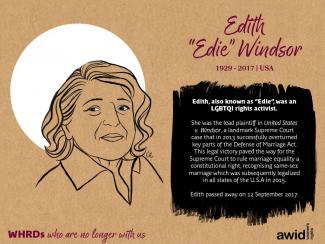
The Guardian: Edith Windsor, icon of gay rights movement, dies aged 88
Rolling Stone: Edith Windsor, Same-Sex Marriage Activist, Dead at 88
BBC: Edie Windsor: Gay rights trailblazer dies aged 88
The New Yorker: Postscript: Edith Windsor, 1929-2017
The Guardian: Goodbye, Edie Windsor. Thank you for never giving up
Love and Justice: Edith Windsor talks with Ariel Levy - The New Yorker Festival - The New Yorker (Video)
Remembering Edie Windsor (Video)