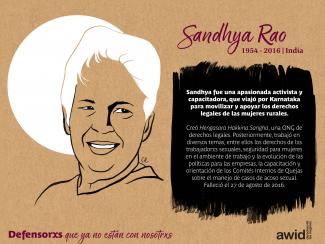
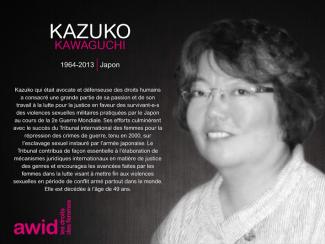
Contenido relacionado
C.R.I.C Consejo Regional Indígena del Cauca: Cauca: Denuncian Nuevo Homicidio de una Defensora de Derechos Humanos


WHRDs are self-identified women and lesbian, bisexual, transgender, queer and intersex (LBTQI) people and others who defend rights and are subject to gender-specific risks and threats due to their human rights work and/or as a direct consequence of their gender identity or sexual orientation.
WHRDs are subject to systematic violence and discrimination due to their identities and unyielding struggles for rights, equality and justice.
The WHRD Program collaborates with international and regional partners as well as the AWID membership to raise awareness about these risks and threats, advocate for feminist and holistic measures of protection and safety, and actively promote a culture of self-care and collective well being in our movements.
WHRDs are exposed to the same types of risks that all other defenders who defend human rights, communities, and the environment face. However, they are also exposed to gender-based violence and gender-specific risks because they challenge existing gender norms within their communities and societies.
We work collaboratively with international and regional networks and our membership
We aim to contribute to a safer world for WHRDs, their families and communities. We believe that action for rights and justice should not put WHRDs at risk; it should be appreciated and celebrated.
Promoting collaboration and coordination among human rights and women’s rights organizations at the international level to strengthen responses concerning safety and wellbeing of WHRDs.
Supporting regional networks of WHRDs and their organizations, such as the Mesoamerican Initiative for WHRDs and the WHRD Middle East and North Africa Coalition, in promoting and strengthening collective action for protection - emphasizing the establishment of solidarity and protection networks, the promotion of self-care, and advocacy and mobilization for the safety of WHRDs;
Increasing the visibility and recognition of WHRDs and their struggles, as well as the risks that they encounter by documenting the attacks that they face, and researching, producing, and disseminating information on their struggles, strategies, and challenges:
Mobilizing urgent responses of international solidarity for WHRDs at risk through our international and regional networks, and our active membership.
Contenido relacionado
C.R.I.C Consejo Regional Indígena del Cauca: Cauca: Denuncian Nuevo Homicidio de una Defensora de Derechos Humanos
Thanks to our global feminist community! From May to August 2024, nearly 1,200 organizations working for Women's rights, gender justice, and LBTQI+ equality shared their experiences in the WITM survey. The results offer a unique picture of how feminist movements are resourced and where gaps remain.
EN CHIFFRES
Desk research can be done throughout your research. It can assist you with framing, help you to choose survey questions and provide insights to your results.
In this section
- Giving context
- Building on existing knowledge
- Potential sources for desk research
1. Donors’ websites and annual reports
2. Online sources of information
Conducting desk research throughout your research process can assist you with framing, help you to choose survey questions and provide contextual clarity or interesting insights to your survey results, such as comparing similarities and differences between your survey results and information produced by civil society and donors.
Perhaps you notice trends in your survey data and want to understand them.
For example, your survey data may reveal that organization budgets are shrinking, but it cannot tell you why this is happening. Reviewing publications can give you context on potential reasons behind such trends.
Desk research also ensures you are building your research on the existing knowledge regarding your topic, confirming the validity and relevance of your findings.
They may be complimentary or contradictory to existing knowledge, but they must speak to existing data on the topic.
To ensure comprehensive research of the entire funding landscape related to your topic, look at a diverse set of funding sectors.
You can consider:
- Women’s Funds
- Private and Public Foundations
- International Non-Governmental Organizations (INGOs)
- Bilateral and Multilateral Agencies
- Private Sector Actors
- Individual Philanthropists
- Crowdfunders
Include any other relevant sectors to this research.
For example, you may decide that it is also important to research local non-governmental organizations (NGOs).
These are direct sources of information about what funders are actually doing and generally contain information on policies and budgets. Researching this before interviewing donors can result in more focused questions and a stronger interview.

• 1-2 months
• 1 or more research person(s)
7. Synthesize your research findings


Para darle visibilidad a la complejidad de la dotación de recursos para las diversas formas de organización feministas.
Pensamos que la economía, el mercado, el sistema financiero y las premisas sobre las que se basan son todas áreas fundamentales para la lucha feminista.
Por eso, nuestra visión de una economía justa va más allá de promover los derechos y el empoderamiento de las mujeres en una economía de mercado, sino que busca evaluar el rol que juegan las opresiones de género en dar forma al modelo económico y ver como podemos transformarlo para garantizar la justicia de género y económica.
No estamos comenzando de cero ni estamos solas en nuestro intento de presentar propuestas feministas para una economía justa. Muchas de nuestras propuestas ya han sido presentadas o existen en la práctica de las diversas comunidades que confrontan y desafían a los sistemas económicos dominantes basados en el mercado y el crecimiento.
También somos concientes de las limitaciones que algunas alternativas presentan para abordar las injusticias del actual sistema capitalista a escala global. No siempre las propuestas a nivel micro son la respuesta a los problemas macro, si bien representan espacios importantes de resistencia y construcción de movimientos.
Sin embargo, las alternativas feministas para una economía justa son fundamentales para socavar el sistema y para aprender a generar cambios transformadores y sistémicos. No podemos presumir de ofrecer un relato exhaustivo ni completo acerca de cómo crear un modelo económico feminista justo, o varios modelos de esa clase. Lo que sí podemos hacer es recoger elementos de diálogos con otros movimientos (sindicales, ambientales, rurales y de campesinxs) para formular propuestas que nos permitan acercanos a esa visión.
El modelo neoliberal que dirige la economía global ha demostrado una y otra vez su incapacidad para hacer frente a las causas estructurales de la pobreza, las desigualdades y la exclusión. Lo que en realidad ha hecho el neoliberalismo ha sido contribuir a crear y exacerbar esas injusticias.
En estas últimas tres décadas, las políticas dominantes para el desarrollo se han caracterizado por la globalización, liberalización, privatizaciones, financialización y ayudas condicionadas, y han destrozado los medios de vida de la población. El recorrido de estas políticas también ha estado marcado por la profundización de desigualdades, las injusticias con marca de género y la destrucción ambiental que el mundo ya no puede continuar soportando.
Hay quienes no dudan en sostener que el crecimiento económico, que debe ser facilitado dando plena libertad a las grandes corporaciones y empresas, puede generar y sostener una una marea alta que (con el tiempo) levante todos los barcos.
Sin embargo, la noción de desarrollo que ha prevalecido durante las últimas décadas, construida sobre la premisa de un crecimiento económico ilimitado, está atravesando una crisis ideológica.
El mito del crecimiento económico como panacea para todos nuestros problemas está perdiendo cada vez más prestigio.
Related content
African Women's Development Fund: Remembering a Warrior: Prudence Mabele
BBC: Prudence Mabele: The life of the South African HIV campaigner
Mail and Guardian: The Pied Piper of the broken-hearted: HIV activist Prudence Mabele
Face2Face Africa: Prudence Mabele, 1st Black SA Woman To Reveal HIV Positive Status Dies At 46
Ms. Prudence Mabele - I'm committed to respond to HIV! (Video)
AWLN Interview with Prudence Mabele of South Africa (Video)
Sangoma: Why I take ARVs (Video)

La Cooperativa Textil Nadia Echazú lleva el nombre de una pionera en la lucha por los derechos de las personas trans y travesti en Argentina. En muchos sentidos, el trabajo de la cooperativa celebra la vida y el legado de Nadia Echazú, que tuvo una notable trayectoria activista.
Era una de las cofundadoras de "El Teje", el primer periódico trans de América Latina, junto a Lohana Berkins, Diana Sacayán y Marlene Wayar. Nadia formó parte de la Asociación de Travestis, Transexuales y Transgéneros de Argentina (ATTTA) y fundó la Organización de Travestis y Transexuales de Argentina (OTTRA).
Poco después de su muerte, sus compañeras activistas fundaron la cooperativa en su nombre, para honrar la profunda huella que dejó en el activismo trans y travesti en Argentina.
La recherche de moyens alternatifs de production alimentaire fondés sur la durabilité environnementale gagne du terrain dans toutes les régions du monde. Cette quête mondiale présente une caractéristique centrale : la nécessité de mobiliser les populations rurales, en particulier les femmes, tenant compte de leurs priorités et de leurs connaissances locales par le truchement de l’agroécologie.
L’agroécologie est une façon de pratiquer l'agriculture ou de faire appel aux technologies qui ne nuit pas à l'environnement. Cette approche propose de rompre avec le modèle de développement rural hégémonique reposant sur les grandes exploitations et la monoculture qui profitent essentiellement aux entreprises agricoles et renforcent l'exclusion sociale.
Dans le contexte de l'agriculture familiale, l'agroécologie représente une forme de résistance au modèle de développement actuel et aux problèmes sociaux, culturels, environnementaux et économiques que ce modèle implique. L’agroécologie se pose en alternative face au manque d'autonomie financière des agriculteur-trice-s et symbolise une résistance face au modèle d'agroentreprises actuel.
Il se pourrait que les efforts uniquement axés sur l'agroécologie ne suffisent pas à résoudre tous les problèmes de la marginalisation et de l'invisibilité des femmes. Il est alors crucial d’adopter une perspective féministe afin d'analyser les normes associées à la notion de famille telle qu'actuellement constituée en tant qu'institution parfaite, ainsi que les normes relatives à la condition de subordination des femmes.
Plus simplement, il importe d'inclure une réflexion sur les rôles de genre socialement construits pour faire avancer le potentiel émancipateur de l'agroécologie dans ce débat.