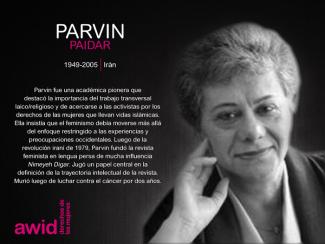
Parvin Paidar
WHRDs are self-identified women and lesbian, bisexual, transgender, queer and intersex (LBTQI) people and others who defend rights and are subject to gender-specific risks and threats due to their human rights work and/or as a direct consequence of their gender identity or sexual orientation.
WHRDs are subject to systematic violence and discrimination due to their identities and unyielding struggles for rights, equality and justice.
The WHRD Program collaborates with international and regional partners as well as the AWID membership to raise awareness about these risks and threats, advocate for feminist and holistic measures of protection and safety, and actively promote a culture of self-care and collective well being in our movements.
WHRDs are exposed to the same types of risks that all other defenders who defend human rights, communities, and the environment face. However, they are also exposed to gender-based violence and gender-specific risks because they challenge existing gender norms within their communities and societies.
We work collaboratively with international and regional networks and our membership
We aim to contribute to a safer world for WHRDs, their families and communities. We believe that action for rights and justice should not put WHRDs at risk; it should be appreciated and celebrated.
Promoting collaboration and coordination among human rights and women’s rights organizations at the international level to strengthen responses concerning safety and wellbeing of WHRDs.
Supporting regional networks of WHRDs and their organizations, such as the Mesoamerican Initiative for WHRDs and the WHRD Middle East and North Africa Coalition, in promoting and strengthening collective action for protection - emphasizing the establishment of solidarity and protection networks, the promotion of self-care, and advocacy and mobilization for the safety of WHRDs;
Increasing the visibility and recognition of WHRDs and their struggles, as well as the risks that they encounter by documenting the attacks that they face, and researching, producing, and disseminating information on their struggles, strategies, and challenges:
Mobilizing urgent responses of international solidarity for WHRDs at risk through our international and regional networks, and our active membership.
Dado que la encuesta ¿Dónde está el dinero? se centra en las realidades de la dotación de recursos para las organizaciones feministas, la mayoría de las preguntas indagan acerca del financiamiento de tu agrupación entre 2021 y 2023. Para responder la encuesta, necesitarás tener a mano cierta información como, por ejemplo, presupuestos anuales y las fuentes clave de financiamiento.
AGROÉCOLOGIE ET SOUVERAINETÉ ALIMENTAIRE EN TANT QUE RÉSISTANCE |
Aujourd'hui, la production alimentaire industrielle à grande échelle utilise des plantations à culture unique, des organismes génétiquement modifiés et d'autres pesticides qui détruisent la terre et les connaissances des communautés locales. |
L'agroécologie est une résistance à l'agriculture hyper-industrialisée qu’utilisent les multinationales. L'agroécologie donne la priorité à l'agriculture à plus petite échelle, aux cultures multiples et à la production alimentaire diversifiée, tout en centrant les connaissances et pratiques traditionnelles locales. L'agroécologie va de pair avec les revendications de souveraineté alimentaire, ou le "droit des peuples à une alimentation saine et culturellement appropriée produite par des méthodes écologiquement rationnelles et durables, et leur droit de définir leurs propres systèmes alimentaires et agricoles" (Via Campesina, Déclaration de Nyéléni).
Le rôle des femmes, des communautés indigènes et rurales et des personnes racialisées des pays du Sud Global est essentiel dans la préservation des systèmes alimentaires.
Les agroécologistes féministes s'efforcent aussi de démanteler les rôles de genre oppressifs et les systèmes patriarcaux intégrés à la production alimentaire. Comme le montrent les héroïnes de Nous Sommes la Solution, elles génèrent une agroécologie libératrice en renforçant la résilience des communautés, en autonomisant les femmes paysannes et agricultrices tout en en préservant les traditions locales, les territoires et les connaissances des communautés productrices de nourriture.
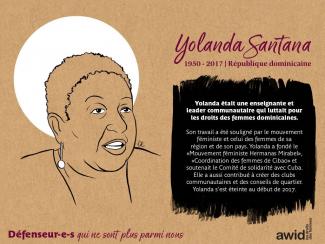
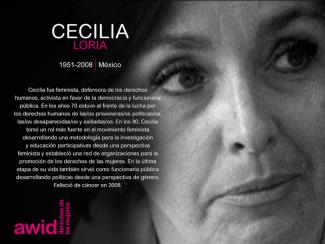
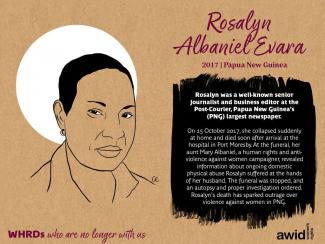
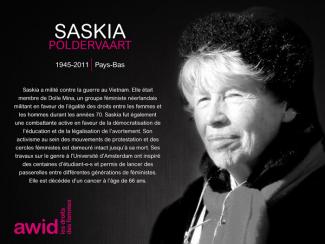
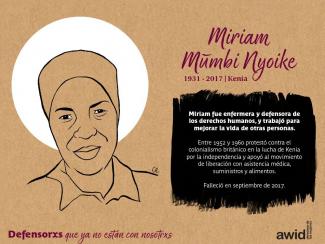
Estudiantes, escritoras, lideresas, activistas. Cada una de las cuatro mujeres que honramos a continuación encaró el activismo a su manera. Sin embargo, todas tuvieron en común la promoción y defensa de los derechos de lesbianas, gays, personas bisexuales, trans*, queer e intersex. Únete a nosotras para recordar y honrar a estas defensoras de derechos humanos, su trabajo y su legado, compartiendo los memes aquí incluidos con tus colegas, amistades y redes; y tuiteando las etiquetas #WHRDTribute y #16Días.
Por favor, haz click en cada imagen de abajo para ver una versión más grande y para descargar como un archivo.


Tout à fait. Vos réponses seront supprimées à la fin du processus de traitement et d’analyse des données. Elles ne seront utilisées qu’à des fins de recherche. Les données ne seront JAMAIS partagées en dehors de l’AWID et ne seront traitées que par le personnel de l’AWID et des consultant·es qui collaborent avec nous à la recherche WITM.
La confidentialité de votre vie privée et votre anonymat sont nos priorités. Notre politique de confidentialité est disponible ici.
Nous Sommes la Solution uplifts and grows the leadership of rural women working towards African solutions for food sovereignty.
Ces femmes transgenres ont été assassinées en raison de leur activisme et de leur identité de genre. Les lois reconnaissant les droits des personnes trans* sont insuffisantes et, lorsqu’elles existent, les mesures prises pour protéger les droits de ces personnes sont quasi inexistantes. Nous vous invitons à vous joindre à nous pour honorer la mémoire de ces défenseuses, leur activisme et l’héritage qu’elles nous ont laissé. Faites circuler ces mèmes auprès de vos collègues et amis ainsi que dans vos réseaux et twittez en utilisant les hashtags #WHRDTribute et #16Jours.
S'il vous plaît cliquez sur chaque image ci-dessous pour voir une version plus grande et pour télécharger comme un fichier



The survey is open until the end of August 2024. Please complete it within this timeframe to ensure your responses are included in the analysis.
Cooperativa Textil Nadia Echazú
Cette section présente les principales ressources que l’AWID recommande afin que vous puissiez mener votre propre recherche WITM.
Dans cette section
Outils en ligne
Quand vous aurez rassemblé ces ressources, vous pourrez estimer les coûts de votre recherche à l’aide de notre Fiche de travail « Êtes-vous prêts-es ? »