Fariha Al Berkawi
Over the past few years, a troubling new trend at the international human rights level is being observed, where discourses on ‘protecting the family’ are being employed to defend violations committed against family members, to bolster and justify impunity, and to restrict equal rights within and to family life.
The campaign to "Protect the Family" is driven by ultra-conservative efforts to impose "traditional" and patriarchal interpretations of the family, and to move rights out of the hands of family members and into the institution of ‘the family’.
Since 2014, a group of states have been operating as a bloc in human rights spaces under the name “Group of Friends of the Family”, and resolutions on “Protection of the Family” have been successfully passed every year since 2014.
This agenda has spread beyond the Human Rights Council. We have seen regressive language on “the family” being introduced at the Commission on the Status of Women, and attempts made to introduce it in negotiations on the Sustainable Development Goals.
AWID works with partners and allies to jointly resist “Protection of the Family” and other regressive agendas, and to uphold the universality of human rights.
In response to the increased influence of regressive actors in human rights spaces, AWID joined allies to form the Observatory on the Universality of Rights (OURs). OURs is a collaborative project that monitors, analyzes, and shares information on anti-rights initiatives like “Protection of the Family”.
Rights at Risk, the first OURs report, charts a map of the actors making up the global anti-rights lobby, identifies their key discourses and strategies, and the effect they are having on our human rights.
The report outlines “Protection of the Family” as an agenda that has fostered collaboration across a broad range of regressive actors at the UN. It describes it as: “a strategic framework that houses “multiple patriarchal and anti-rights positions, where the framework, in turn, aims to justify and institutionalize these positions.”
As we are submitting the application almost one year before the actual event.
Yes! Currently the form requests to list presenters even if they are not confirmed yet. We understand that changes are likely to occur within a year.
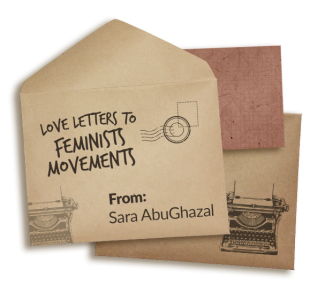
How does a movement start?
we get expelled by ghosts from a house, a family, and a nation
we arrive fatigued to a space (sometimes an actual address) but mainly to a state of being
preceded by a fallen star
perhaps our arrival isn’t accompanied by fatigue,
maybe accompanied by fear
perhaps our arrival isn’t accompanied by fear
maybe accompanied by anger
from issues that keep on repeating themselves:
a stab in the heart (read heartache)
a bullet in the back (read betrayal)
forced disappearances
bodies sentenced by marriage, disfiguration, and chronic fatigue
yet when we arrive, we gather, whisper, speak and weep.
This is how our movements begin when we arrive at each other
We become seeds,
This is how our movements start when we plant each other
Becoming flowers, sometimes just thorns, sometimes fruits,
we are each other’s oasis
to sing for the battles
to make remedies
to place the faces of our lovers, the shape of their smiles, the sound of their laughter
the secret of turning silences into language
the detailed instructions of witches
our movement is: for all of us
when we arrive as seeds with the purpose of flowering.
Sara AbuGhazal
www.badiya.blog
ภาษาที่ AWID ใช้งานคือ ภาษาอังกฤษ ภาษาฝรั่งเศส และภาษาสเปน โดยภาษาไทยจะถูกเพิ่มเข้ามาในฐานะภาษาท้องถิ่น รวมถึงภาษามือและมาตราการในการช่วยให้เข้าถึงอื่นๆ โดยภาษาอื่นๆอาจถูกเพิ่มเข้ามาหากมีงบประมาณเพียงพอ สามารถเข้ามาดูการอัปเดทว่ามีการเพิ่มภาษาอื่นใดบางได้เรื่อยๆ เราใส่ใจในความยุติธรรมด้านภาษาและจะพยายามให้มีภาษามากที่ที่สุดเท่าที่งบประมาณจะสามารถครอบคลุมได้ เราหวังว่าเราจะสามารถสร้างโอกาสมากมายให้พวกเราสามารถสื่อสารกันหรือนำเสนอในภาษาของตัวเองได้
Margarita Salas, AWID
Nazik Abylgaziva, Labrys
Amaranta Gómez Regalado, Secretariado Internacional de Pueblos Indígenas frente al VIH/sida, la Sexualidad y los Derechos Humanos
Cindy Weisner, Grassroots Global Justice Alliance
Lucineia Freitas, Movimento Sem Terra
Lorsque des milliers de féministes se réunissent, nous créons une grande force de solidarité qui a le pouvoir de changer le monde. Le Forum de l’AWID sera pour nous un moment de repos et de guérison ensemble, de connexion au-delà des frontières et de découverte de nouvelles orientations stratégiques courageuses.
La date et le lieu seront annoncés l'année prochaine, dès que possible. Nous sommes ravi.es et nous savons que vous le serez aussi. Restez à l'écoute!
Assurez-vous de nous suivre sur les médias sociaux et de vous inscrire à notre liste de diffusion pour rester informé!

กรุณาคำนวณค่าใช้จ่ายโดยรวมถึงค่าเดินทางมายังกรุงเทพมหานคร ค่าที่พัก ค่าเบี้ยเลี้ยง ค่าวีซ่า ค่าสนับสนุนในการเข้าถึงต่างๆ และอื่นๆ ยังไม่รวมถึงค่าลงทะเบียนที่จะมีการประกาศเร็วๆนี้ โรงแรมในบริเวณสุขุมวิท กรุงเทพฯ มีราคาตั้งแต่ 1,700-6,800 บาทต่อคืน สำหรับการพักสองคน
โดยหากเป็นสมาชิก AWID จะได้รับส่วนลดค่าลงทะเบียน หากคุณยังไม่ได้เป็นสมาชิก เราขอเชิญชวนให้คุณสมัครสมาชิกและเข้าร่วมชุมชนเฟมินิสต์ระดับโลก
Contenu lié
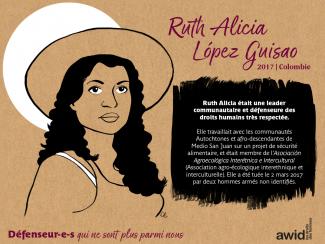
Front Line Defenders: Assassinat de Ruth Alicia Lopez Guisao
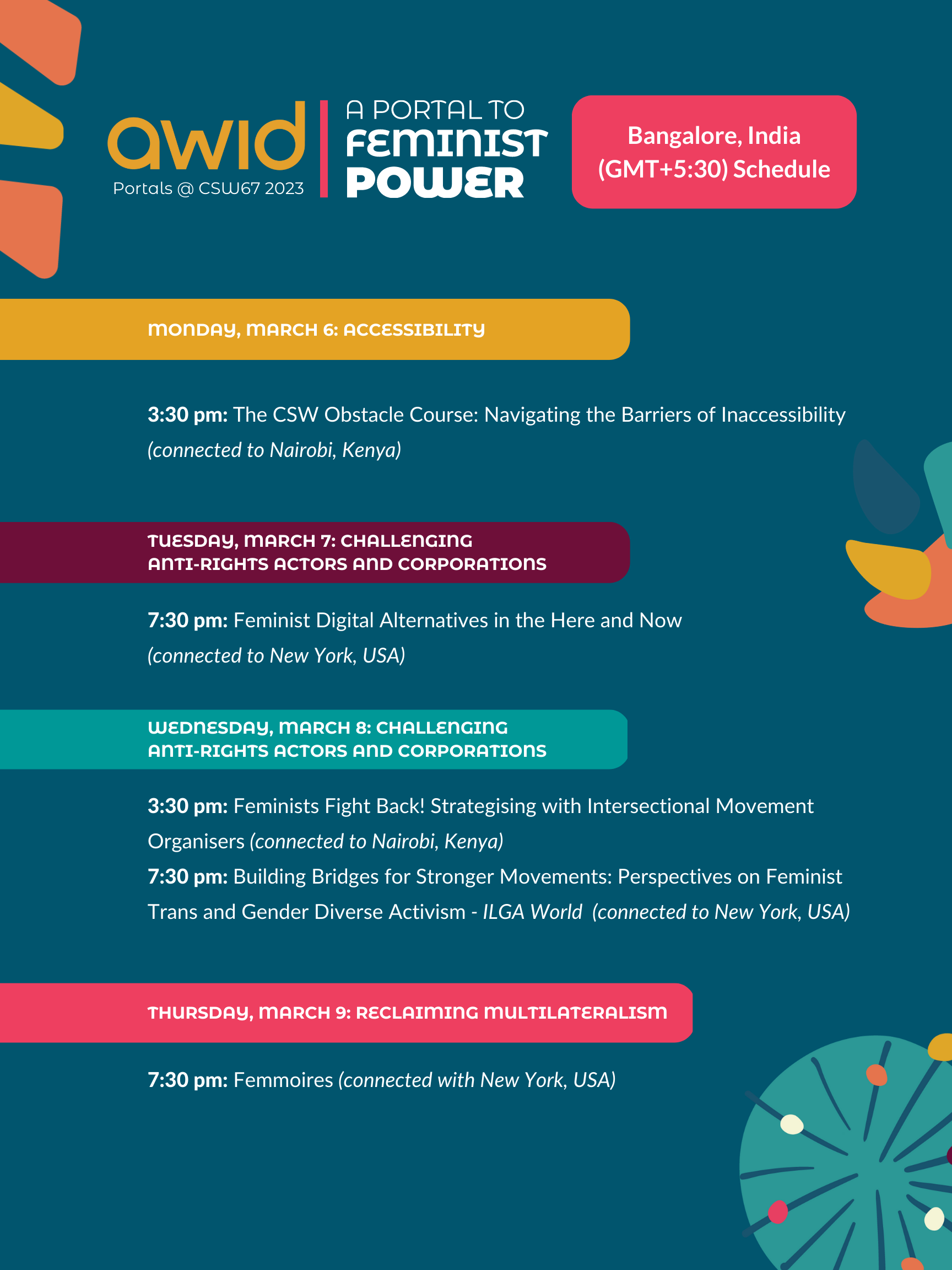
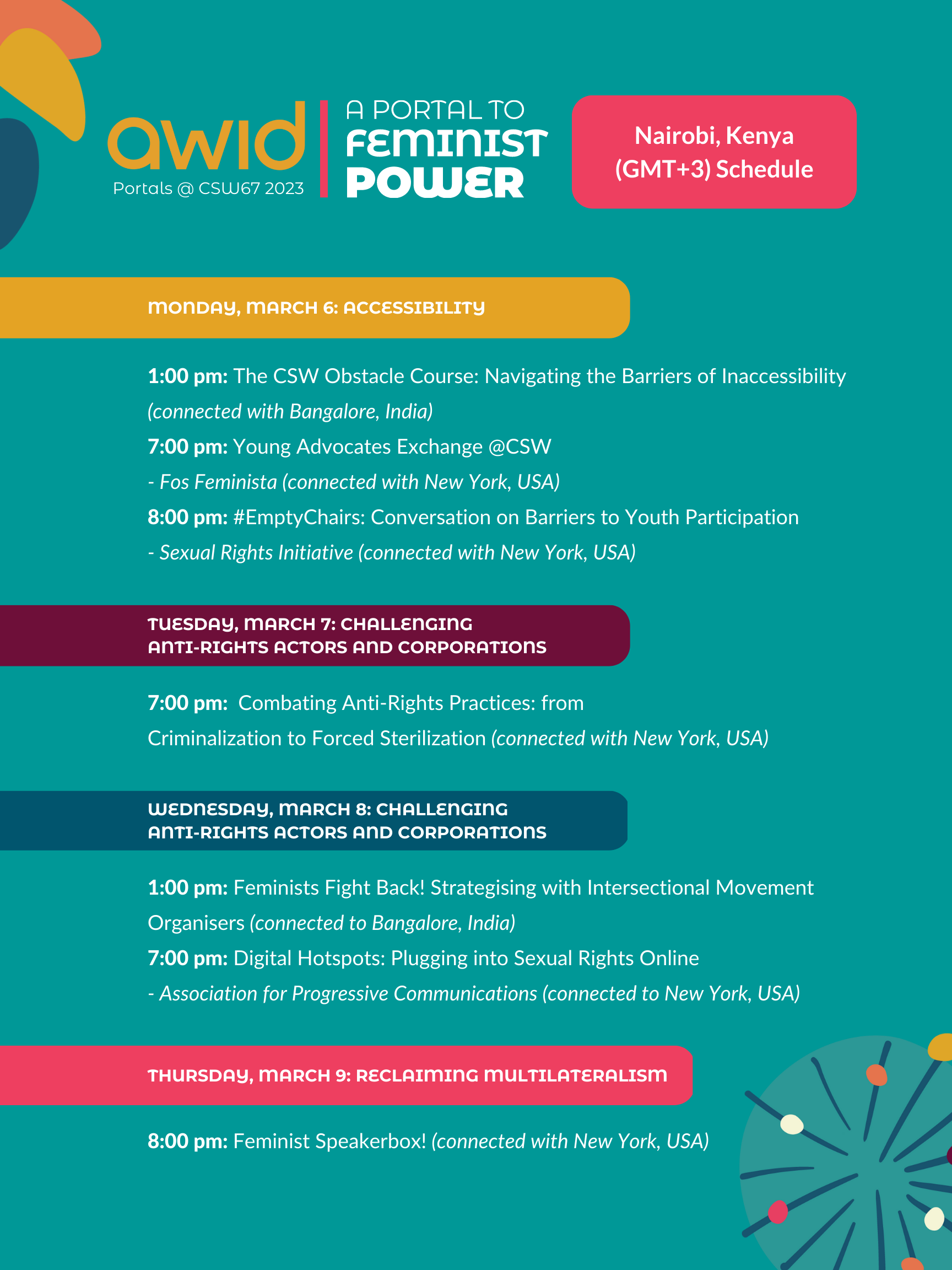
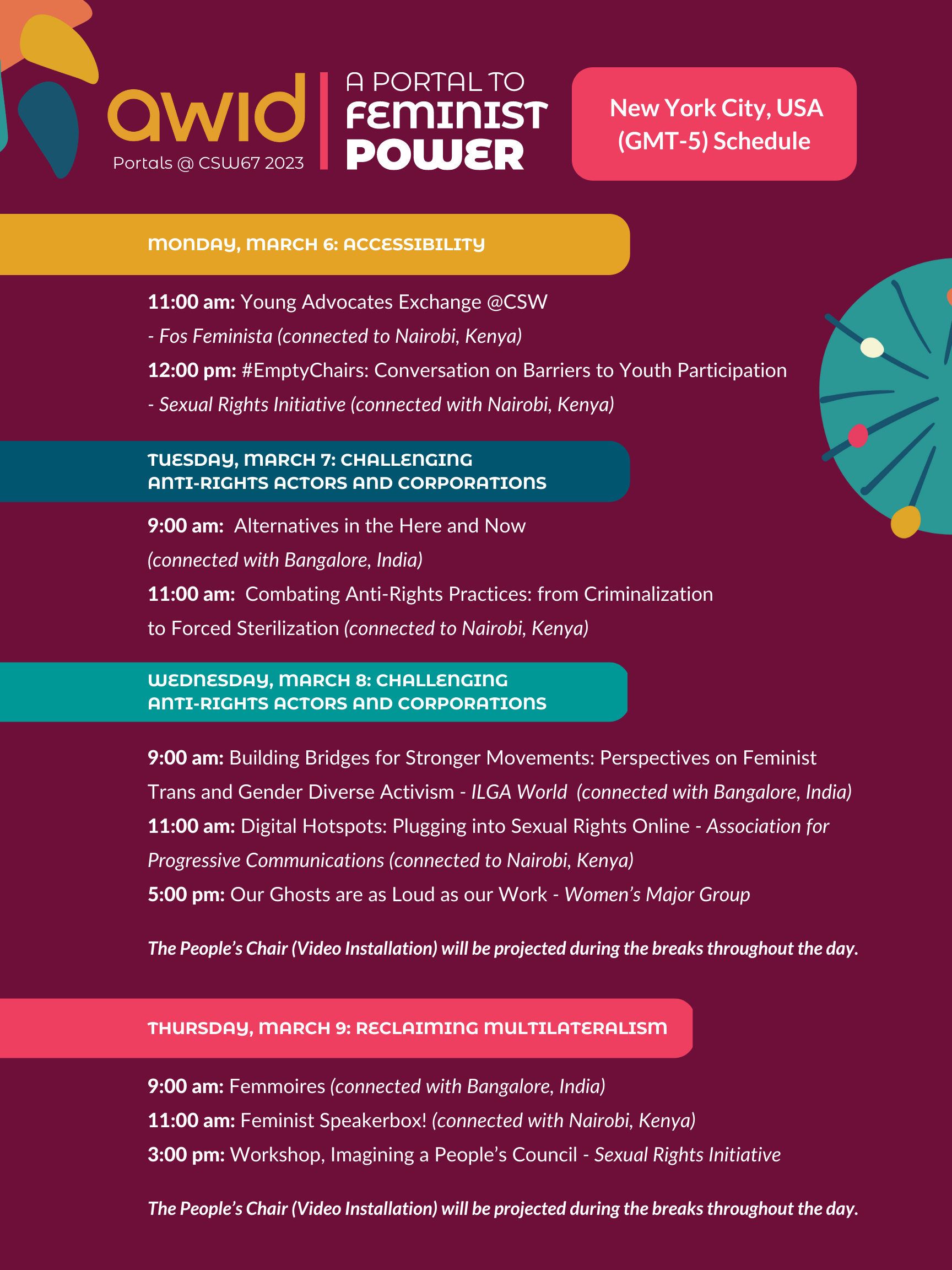
Imagine opening a door which takes you into a conversation with feminist activists in other continents. This portal will transcend the barriers of UN CSW by pushing beyond language barriers, unaffordable travel, unequal protection from COVID19, and racist visa regimes.
This week, we’re putting a virtual spin on CSW by connecting and amplifying feminist activists' voices, to challenge the discriminatory barriers that limit participation and influence. By setting up connecting “portals” in New York City, Nairobi & Bangalore, we'll host a physical-virtual hybrid space for feminists to connect their struggles and build collective power.
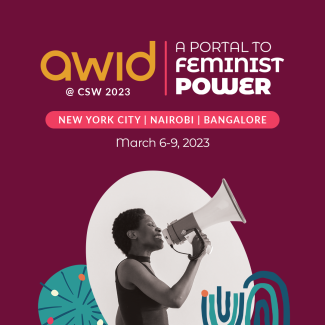
Day 1: March 6 - Accessibility
Day 2: March 7- Challenging Anti-Rights Actors And Corporations
Day 3: March 8 - Challenging Anti-Rights Actors And Corporations
Day 4: March 9- Reclaiming Multilateralism
Download full program here (PDF)
Bangalore Schedule (PNG) Nairobi Schedule (PNG) New York City Schedule (PNG)
AWID ฟอรัม ตลอดมาเป็นพื้นที่ที่ไม่กลัวการสนทนาที่จำเป็น หรือหัวข้อที่ท้าทาย เรายินดีรับข้อเสนอเหล่านี้เมื่อผู้จัดกิจกรรมสามารถรักษาพื้นที่สำหรับผู้เข้าร่วมด้วยความเคารพ ปลอดภัย และอย่างระมัดระวัง
Facebook: @AWIDWomensRights
Instagram: @awidwomensrights
Twitter ENG: @awid
LinkedIn: Association for Women's Rights in Development (AWID)
.
Esta historia es sobre la manera en que un grupo cada vez más diverso de feministas del Pacífico se organizaron a lo largo de los años para asistir a los Foros de AWID, y el modo en que ese proceso lxs transformó en forma personal, como organizaciones y como movimiento a través de lo que aprendieron, descubrieron y experimentaron. Ilustra la importancia de los Foros como espacio que permitió que una región que tiende a ser marginada o ignorada a nivel global pueda construir una presencia sólida en el movimiento feminista, que luego es replicada en otros espacios internacionales de derechos de las mujeres.