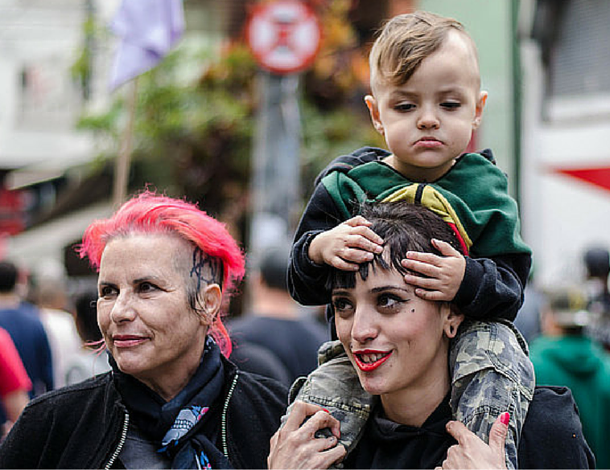
Flickr/Leonardo Veras (CC BY 2.0)

Special Focus

AWID is an international, feminist, membership organisation committed to achieving gender equality, sustainable development and women’s human rights

Protection of the Family

The Issue

Over the past few years, a troubling new trend at the international human rights level is being observed, where discourses on ‘protecting the family’ are being employed to defend violations committed against family members, to bolster and justify impunity, and to restrict equal rights within and to family life.

The campaign to "Protect the Family" is driven by ultra-conservative efforts to impose "traditional" and patriarchal interpretations of the family, and to move rights out of the hands of family members and into the institution of ‘the family’.

“Protection of the Family” efforts stem from:

  • rising traditionalism,
  • rising cultural, social and religious conservatism and
  • sentiment hostile to women’s human rights, sexual rights, child rights and the rights of persons with non-normative gender identities and sexual orientations.

Since 2014, a group of states have been operating as a bloc in human rights spaces under the name “Group of Friends of the Family”, and resolutions on “Protection of the Family” have been successfully passed every year since 2014.

This agenda has spread beyond the Human Rights Council. We have seen regressive language on “the family” being introduced at the Commission on the Status of Women, and attempts made to introduce it in negotiations on the Sustainable Development Goals.


Our Approach

AWID works with partners and allies to jointly resist “Protection of the Family” and other regressive agendas, and to uphold the universality of human rights.

In response to the increased influence of regressive actors in human rights spaces, AWID joined allies to form the Observatory on the Universality of Rights (OURs).  OURs is a collaborative project that monitors, analyzes, and shares information on anti-rights initiatives like  “Protection of the Family”.

Rights at Risk, the first OURs report, charts a map of the actors making up the global anti-rights lobby, identifies their key discourses and strategies, and the effect they are having on our human rights.   

The report outlines “Protection of the Family” as an agenda that has fostered collaboration across a broad range of regressive actors at the UN.  It describes it as: “a strategic framework that houses “multiple patriarchal and anti-rights positions, where the framework, in turn, aims to justify and institutionalize these positions.”


Related Content

Nuestras socias

Este proyecto se desarrolla en colaboración con:

Logo for African Women's Development and Communication Network
Logo for Rutgers Center for Women's Global Leadership

Snippet - if the positions have closed

If the positions advertised have closed, or just don’t match your area of interest and expertise, we suggest the following resources for your job search.

Snippet The revolution will be feminist_Fest (FR)

Session plénière:

La révolution sera féministe — ou il n’y aura pas de révolution

Manal Tamimi Palestine
Bubulina Moreno, Colombia
Karolina Więckiewicz, Poland
Anwulika Ngozi Okonjo, Nigeria

Regardez la vidéo (anglais)


Snippet - WCFM Registration status - EN

icon-registration status

Registration status:

Search for funders based on their requirements for groups to be registered.

Snippet Elimination of Discrimination_Fest (EN)

The Elimination of Discrimination Against Sex Workers

Kay Thi Win, Asia Pacific Network of Sex Workers (APNSW)
Thin Pa Pa Htun, Aye Myanmar Association
Xiao Shuang, Northeast Transgender Support Network
Cathy Ketepa, Friends Frangipani Inc. PNG
Rajeshwari Prajapati, Society for Women Awareness Nepal (SWAN)

watch panel

Clone of Snippet - WITM About the survey - ES

Acerca de la encuesta

  • GLOBAL Y DIVERSA: Reflexiona acerca de las realidades de la dotación de recursos entre las organizaciones feministas a escala mundial y desglosada por regiones.
  • CONTEXTUALIZADA: Se centra en las voces, perspectivas y experiencias de los movimientos feministas en toda su riqueza, audacia y diversidad, en sus respectivos contextos.
  • DE CREACIÓN CONJUNTA: Desarrollada y puesta a prueba en consulta estrecha con lxs afiliadxs y movimientos aliados de AWID.
  • COMPLEMENTARIA: Contribuye a la evidencia disponible acerca del estado de la dotación de recursos para las organizaciones feministas, por los derechos de las mujeres y la justicia de género por parte de activistas, donantes feministas y aliadxs, y la difunde.
  • PLURILINGÜE: Disponible en árabe, español, francés, inglés, portugués y ruso.
  • CONFIDENCIAL: Damos prioridad a tu privacidad y anonimato. En ningún caso, AWID divulgará información acerca de una organización en particular ni exhibirá información que permita identificar a una organización por su ubicación o características. Los detalles de nuestra política de privacidad se encuentran disponibles aquí.
  • ACCESIBLE: Es accesible a personas con distinto grado de capacidades auditivas, de movilidad, visuales y cognitivas, y responderla toma aproximadamente 30 minutos.
  • REPLICABLE: Es susceptible de ser replicada por los movimientos en sus respectivos contextos; las herramientas y los conjuntos de datos de la encuesta estarán disponibles al público como forma de apoyar una mayor investigación y la promoción colectiva.

Snippet Feminist Art Walk_fest (ES)

Paseo de las Artes Feministas

Como parte de nuestro compromiso de lograr una interacción más profunda con artistas y la práctica de la creación conjunta de las Realidades Feministas, AWID colaboró con un grupo de trabajo de artisvistas para promover y fortalecer las agendas y realidades feministas en sus comunidades y movimientos a través de sus expresiones creativas. Nuestra intención en este punto es reunir a creativxs feministas en un espacio pujante y valiente donde puedan desarrollarse y vivir en libertad, y donde puedan romper las narrativas tóxicas para sustituirlas por alternativas transformadoras.

Paseo de las Artes Feministas

WITM - Refreshed INFOGRAPHIC 3 EN

How feminists resource themselves

Feminist and women’s rights organizations don’t just rely on institutional funding, we resource ourselves. Our organizing is powered by passion, political commitment, solidarity and collective care.
These resources are self- generated and autonomous, and often invisible in our budgets, but they are the backbone of our organizing.

 Explore the data on autonomous resourcing

Snippet Feminist Art_Fest (EN)

Arte Feminista

Snippet - COP30 - Radical Democracy - EN

Radical Democracy and Climate Justice - the missing debate of COP30

As the world struggles with multiple intersecting crises, local communities and collectives of various kinds are resisting as also creating constructive alternatives.

📅 Wednesday, November 12, 2025
📍 Seminario Mar Nossa Sra Da Assunção, Pará, Brazil

More info here

Snippet “Gender Ideology” Narratives (FR)

Les discours sur l’ « Idéologie du Genre » :

Pendant des décennies, les universitaires et défenseur·euse·s féministes ont développé d’importantes notions liées au genre afin de comprendre et combattre l’oppression et la discrimination. Ces notions sont maintenant devenues la cible d’acteur·ice·s antidroits qui prétendent que les rôles de genre patriarcaux oppressifs relèvent du « bon sens », peignant stratégiquement toutes les autres idées, normes culturelles et formes de vie sociale comme une idéologie dangereuse et conspirationniste.

Lisez le dossier sur Les Discours Sur L’ « Idéologie Du Genre » : Une Menace Pour Les Droits Humains

Téléchargez ici

Snippet - COP30 - Actions - ES

Eventos y acciones en la COP30

8-16 de noviembre de 2025

Snippet FEA A Caring Economy (EN)

A CARING

ECONOMY

Feminists Centering Care in the Economy:
A Cross-Movement Dialogue

What if we reimagined ways of caring for our communities?

What if the economy was not about someone else’s profit but about care for our individual and collective wellbeing? These stories are about building communities of care with and for people who are historically and presently excluded, disenfranchised and dehumanized by both state and society. These are the stories of feminists centering care in the economy.

Snippet - COP30 - Our Tools title - EN

Herramientas de organización para la COP30