Memory as Resistance: A Tribute to WHRDs no longer with us
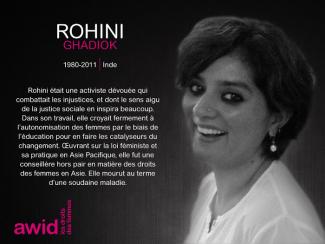
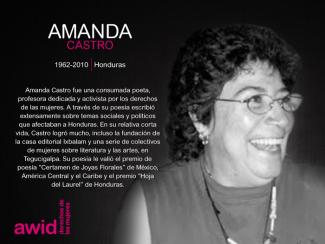
AWID’s Tribute is an art exhibition honouring feminists, women’s rights and social justice activists from around the world who are no longer with us.
In 2020, we are taking a turn
This year’s tribute tells stories and shares narratives about those who co-created feminist realities, have offered visions of alternatives to systems and actors that oppress us, and have proposed new ways of organising, mobilising, fighting, working, living, and learning.
49 new portraits of feminists and Women Human Rights Defenders (WHRDs) are added to the gallery. While many of those we honour have passed away due to old age or illness, too many have been killed as a result of their work and who they are.
This increasing violence (by states, corporations, organized crime, unknown gunmen...) is not only aimed at individual activists but at our joint work and feminist realities.
The stories of activists we honour keep their legacy alive and carry their inspiration forward into our movements’ future work.
The portraits of the 2020 edition are designed by award winning illustrator and animator, Louisa Bertman.
AWID would like to thank the families and organizations who shared their personal stories and contributed to this memorial. We join them in continuing the remarkable work of these activists and WHRDs and forging efforts to ensure justice is achieved in cases that remain in impunity.
“They tried to bury us. They didn’t know we were seeds.” - Mexican Proverb
The Tribute was first launched in 2012
It took shape with a physical exhibit of portraits and biographies of feminists and activists who passed away at AWID’s 12th International Forum, in Turkey. It now lives as an online gallery, updated every year.
To date, 467 feminists and WHRDs are featured.
Related Content
Do I need a visa to attend the Forum in Taipei?
You DO NOT need a visa to attend the Forum in Taipei if you hold a passport from one of the following countries (the allowed length of your stay varies from one country to another):
Andorra, Australia, Austria, Belgium, Bulgaria, Brunei, Canada, Chile, Croatia, Cyprus, Czech Republic, Denmark, Estonia, Eswatini, Finland, France, Germany, Greece, Guatemala, Haiti, Honduras, Hungary, Iceland, Ireland, Israel, Italy, Japan*, Republic of Korea, Latvia, Liechtenstein, Lithuania, Luxembourg, Malta, Marshall Island, Monaco, Netherlands, New Zealand, Nicaragua, Norway, Palau, Paraguay, Philippines, Poland, Portugal, Romania, Russia, San Marino, Slovakia, Slovenia, Spain, Sweden, Switzerland, Tuvalu, the United Kingdom, the United States of America,and Vatican City State, Belize, Dominican Republic, Malaysia, Nauru, St. Kitts and Nevis, Saint Lucia, Saint Vincent and the Grenadines, Singapore.
People with any other passport WILL NEED A VISA to come to Taipei.
Please note:
It is likely that, once you have registered to attend the Forum, you will get an event-related code that will allow you to apply for your visa electronically regardless of your citizenship.
We will let you know more about this when the Registration opens.
Snippet - WITM To share - RU

Чтобы поделиться опытом финансирования в вашей организации
Barin Kobane
Barin integraba la unidad de batalla formada íntegramente por mujeres de la Unidad de Protección del Pueblo Kurdo (YPG).
La mataron cuando estaba en servicio activo.
La periodista libanesa Hifaa Zuaiter escribió: «Barin representa todo lo que hemos oído acerca del coraje de las combatientes kurdas, y su muerte es mucho más que el matar a un rival o el resultado de una lucha política o étnica. El horror de exhibir su cuerpo sólo porque es una mujer surge del hecho de que ella se atrevió a amenazar la hegemonía masculina al convertirse en una combatiente en un campo de batalla que se suponía era solo para hombres».
Lutter pour les droits humains et affronter l'injustice en Amérique latine et dans les Caraïbes
Cette année, nous rendons hommage à dix-neuf défenseuses des droits humains originaires de la région Amérique latine et Caraïbes. Parmi elles, seize ont été assassinées, dont six journalistes et quatre défenseuses des droits des personnes LGBT*QI. Nous vous invitons à vous joindre à nous pour commémorer la vie et le travail de ces femmes. Faites circuler les mèmes figurant ci-dessous auprès de vos collègues et amis ainsi que dans vos réseaux et twittez en utilisant les hashtags #WHRDTribute et #16Jours.
S'il vous plaît cliquez sur chaque image ci-dessous pour voir une version plus grande et pour télécharger comme un fichier


Albertina Sisulu
Snippet FEA argentina history cooperatives (FR)
L'Argentine a une longue histoire d’autogestion et de coopérativisme, avec des lieux de travail dirigés par et pour les travailleur·euses.
En 2001, le pays a connu l'une des pires crises économiques de son histoire.
En réponse à la récession et comme forme de résistance et de résilience, les travailleur·euses de tout le pays ont commencé à occuper leurs lieux de travail.
La Coopérative Textile Nadia Echazú a été la première coopérative créée par et pour les personnes trans et travesti en quête d'autonomie économique et de conditions de vie dignes.
Elle offre des opportunités d'emploi, l’accès à la sécurité sociale, des revenus durables et des droits économiques aux communautés qu'elle sert.
Snippet - WITM Start the survey 1 - PT
![]()
O inquérito está disponível em árabe, inglês, francês, português, russo e espanhol!
Jacqueline Coulibaly Ki-Zerbo
Jacqueline était une éducatrice malienne pionnière de la cause féministe et nationaliste.
Elle a d’abord enseigné l'anglais au Sénégal avant d'être recrutée en 1961 par le Lycée Philippe Zinda Kaboré à Ouagadougou, au Burkina Faso. Etant donné son engagement militant, elle a pris part au soulèvement populaire du 3 janvier 1966. Entre 1961 et 1966, Jacqueline était par ailleurs responsable de la presse syndicale, La voix des enseignants. Elle a été nommée directrice du Cours normal des jeunes filles (aujourd’hui connu sous le nom de lycée Nelson Mandela) jusqu'en 1974 et s'est consacrée à l'éducation des filles et à la promotion des droits des femmes.
En 1984, elle a reçu le prix Paul G. Hoffmann pour sa contribution remarquable en matière de développement national et international.
Defensoras de la región de Asia meridional y Sudeste asiático
Este año, el Tributo Virtual honra a 7 defensoras de derechos humanos de la región de Asia meridional y Sudeste asiático. Son defensoras que han hecho aportes fundamentales para lograr avances en los derechos humanos y de las mujeres, los derechos de los pueblos indígenas y el derecho a la educación. Estas defensoras se desempeñaron como abogadas, activistas de derechos de las mujeres, académicas y políticas. Únete a AWID para conmemorar a estas defensoras de derechos humanos, su trabajo y su legado, compartiendo los memes aquí incluidos con tus colegas, amistades y redes; y tuiteando las etiquetas #WHRDTribute y #16Días.
Por favor, haz click en cada imagen de abajo para ver una versión más grande y para descargar como un archivo.


Adelinda Gomez
Snippet FEA Lohana Berkins (EN)
One of the founding leaders of the cooperative was Lohana Berkins, an activist, defender and promoter of transgender identity. Lohana played a crucial role in the struggle for the rights of trans and travesti people.
This brought about, among many other things, the passing of the Gender Identity Law. It is one of the most progressive legislations in the world, guaranteeing fundamental rights to trans and travesti people. Now, people can change their names and genders only with an affidavit, and have access to comprehensive healthcare without judicial or medical intervention/approval (Outright International, 2012).
Snippet - WITM about research - AR
عن استطلاع "أين المال"
استطلاع "اين المال" (أين التمويل للتنظيمات النسوية) هو ركيزة أساسية للنسخة الثالثة لأبحاثنا الموجهة نحو العمل. سيتم بحث وتوسيع نتائج الاستطلاع من خلال المحادثات العميقة مع النشطاء/ الناشطات والممولين/ات وسيتم مقارنة النتائج مع تحليلات وبحوث أخرى عن وضع التمويل للحركات النسوية وحركات العدالة الجندرية.
سيتم نشر تقرير أين المال للتنظيمات النسوية في العام
2026.
لمعرفة المزيد عن كيف تسلّط جمعية حقوق المرأة في التنمية الضوء على على تمويل التنظيمات النسوية أو ضدها، انظروا إلى قصة "أين المال" وتقارير سابقة هنا
Annaliza Dinopol Gallardo Capinpin
Known as “Ate Liza,” Annaliza was the president of the Agrarian Reform Council for Mindanao Pioneers, an umbrella group in Tacurong City, Philippines.
A loved mother of four, teacher and community leader, Annaliza is remembered by her community as “she who leads when no one wants to lead, she who talks when no one wants to talk, she who stood with courage to help the agrarian reform beneficiaries to own lands.”
Annaliza was shot dead by unknown assailants in front of the Sultan Kudarat State University (SKSU) while on her way to Salabaca National High School in Esperanza.
Her family have said “Naghihintay pa rin kami ng hustisya para sa kanya” (we are still waiting justice for her).
Antes de comenzar
Antes de comenzar a aplicar la metodología de investigación WITM, es importante que te prepares y que sepas con qué te vas a encontrar.
Capacidad
Antes de implementar la metodología de investigación WITM de AWID, te recomendamos que leas el Manual completo.
Si bien el propósito de este Manual es democratizar las investigaciones sobre WITM, tu organización podrá usar esta metodología en la medida de su capacidad, es decir, sus recursos y experiencia en investigación.
Utiliza la Planilla «¿Estoy listx?» para evaluar en qué medida estás preparadx para comenzar la investigación WITM. Cuantas más preguntas de la planilla puedas responder, más preparadx estarás para embarcarte en la investigación.
Confianza
Antes de comenzar cualquier investigación, te recomendamos evaluar los lazos que tiene tu organización con la comunidad y la confianza que ha generado en ella.
En muchos contextos, algunas organizaciones tal vez no quieran compartir abiertamente información financiera por distintos motivos que van desde la preocupación acerca de cómo se utilizará la información hasta el miedo frente a la «competencia» por el financiamiento o la ansiedad ante las restricciones cada vez mayores que impone el gobierno a las organizaciones de la sociedad civil.
Cuando desarrolles vínculos con otras organizaciones y te pongas en contacto con ellas de manera informal en el estadio previo a dar inicio a la investigación, ser clarx acerca de tus objetivos te ayudará a generar confianza. La transparencia permitirá que quienes participen en la investigación sepan por qué estás recogiendo información y qué beneficios podrá esperar la comunidad de tu trabajo.
Recomendamos asegurarte de que la información se recoja de manera confidencial, preservando el anonimato de quienes respondan. Esto permitirá que lxs participantes se sientan más cómodxs compartiendo información delicada contigo.
Primer paso
También recomendamos que consultes la Planilla «¿Estoy listx?» para evaluar tus avances.