Memory as Resistance: A Tribute to WHRDs no longer with us
AWID’s Tribute is an art exhibition honouring feminists, women’s rights and social justice activists from around the world who are no longer with us.
In 2020, we are taking a turn
This year’s tribute tells stories and shares narratives about those who co-created feminist realities, have offered visions of alternatives to systems and actors that oppress us, and have proposed new ways of organising, mobilising, fighting, working, living, and learning.
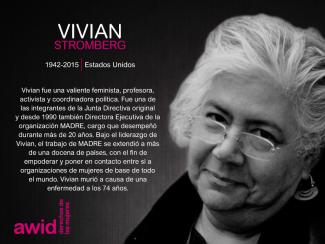
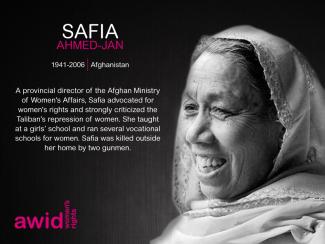
49 new portraits of feminists and Women Human Rights Defenders (WHRDs) are added to the gallery. While many of those we honour have passed away due to old age or illness, too many have been killed as a result of their work and who they are.
This increasing violence (by states, corporations, organized crime, unknown gunmen...) is not only aimed at individual activists but at our joint work and feminist realities.
The stories of activists we honour keep their legacy alive and carry their inspiration forward into our movements’ future work.
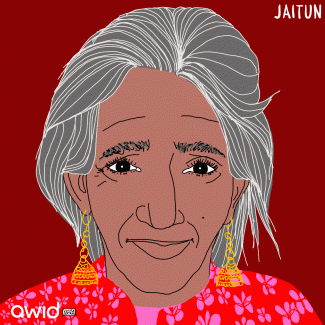
The portraits of the 2020 edition are designed by award winning illustrator and animator, Louisa Bertman.
AWID would like to thank the families and organizations who shared their personal stories and contributed to this memorial. We join them in continuing the remarkable work of these activists and WHRDs and forging efforts to ensure justice is achieved in cases that remain in impunity.
“They tried to bury us. They didn’t know we were seeds.” - Mexican Proverb
The Tribute was first launched in 2012
It took shape with a physical exhibit of portraits and biographies of feminists and activists who passed away at AWID’s 12th International Forum, in Turkey. It now lives as an online gallery, updated every year.
To date, 467 feminists and WHRDs are featured.
Related Content
Fadila M.
Fadila M. fue una activista tribal soulaliyate de Azrú, en la región Ifrane de Marruecos. Luchó contra una forma específica de discriminación territorial dirigida a las mujeres tribales.
Como parte del Movimiento de Mujeres Soulaliyate por el Derecho a la Tierra, trabajó para reformar el marco legislativo relacionado con la administración de la propiedad comunitaria, a través de la adopción, en 2019, de tres proyectos de ley que garantizan la igualdad de mujeres y varones.
Según las leyes consuetudinarias vigentes, las mujeres no tenían derecho a beneficiarse de la tierra, en especial aquellas que eran solteras, viudas o divorciadas. En Marruecos, los derechos a las tierras colectivas eran transmitidos tradicionalmente entre los varones de la familia mayores de 16 años. Desde 2007, Fadila M. ha sido parte del movimiento de mujeres, la primera movilización nacional de base por los derechos a la tierra. Una de sus conquistas ha sido que, en 2012, las mujeres soulaliyate pudieron registrarse por primera vez en las listas de beneficiarixs, y recibir compensaciones relacionadas con la cesión de tierras. El movimiento también logró la enmienda del dahir (decreto del Rey de Marruecos) de 1919, para garantizar el derecho a la igualdad de las mujeres.
Fadila M. falleció el 27 de septiembre de 2018. Las circunstancias de su muerte no son claras. Participó en una marcha de protesta relacionada con el tema de las tierras colectivas y, si bien las autoridades informaron que su muerte fue accidental y que tuvo un paro cardíaco camino al hospital, la sección local de la Asociación de Derechos Humanos de Marruecos (AMDH) señaló que Fadila fue sofocada por un miembro de la fuerza policial utilizando una bandera marroquí. Su familia solicitó una investigación, pero los resultados de la autopsia no fueron dados a conocer.
Más información sobre el Movimiento de Mujeres Soulaliyate por el Derecho a la Tierra (en inglés)
Nota: Como no ninguna fotografía/imagen de Fadila M. disponible, la obra de arte (en lugar de un retrato) pretende representar por lo que luchó y trabajó: la tierra y los derechos a vivir y tener acceso a esa tierra y lo que crece en ella.
Où et quand se déroulera le Forum ?
Du 2 au 5 décembre 2024, à Bangkok, en Thaïlande ! Nous nous rassemblerons au Centre national de convention de la Reine Sirikit (QSNCC) et aussi virtuellement en ligne.
Snippet - Impactmapper’s Database blurb - En

2025 Funding Database by ImpactMapper
Explore 150+ regularly updated funding opportunities in this searchable database, created in response to cuts in development aid. Filter by issue, region, funder type, and eligibility.
Snippet example from training video
Big banner heading
some text some text some text some text some text some text some text some text some text some text some text some text
¿Qué labor realiza AWID?
Ana Maria Marcela Yarce Viveros
Rosa Candida Mayorga Muñoz
Rosa Candida Mayorga Muñoz était une travailleuse sociale, leader syndicale et défenseure des droits humains du Guatemala. On la surnommait affectueusement Rosita.
Dans les années 1980, Rosa devient la première femme à siéger au comité exécutif du syndicat de l’Institut d’électrification nationale (STINDE), syndicat qu’elle avait rejoint en premier lieu pour défendre les droits des femmes au travail. Cela signifiait, à ses yeux, de lutter pour l’égalité des chances dans une entreprise où de nombreuses femmes affrontaient un système discriminatoire et violent mis en place par la direction de l’entreprise. Rosa avait également subi du harcèlement sexuel sur son lieu de travail, tant de la part de collègues que de responsables. Elle n’entendait cependant pas rester silencieuse.
Rosa a continué à se battre et fait partie des efforts pour façonner la lutte afin qu’elle prenne la forme du « Pacte collectif pour les conditions de travail du INDE-STINDE ». Ce pacte était le premier du genre et le premier au Guatemala à caractériser le concept de harcèlement (sexuel). Il fait désormais référence dans la loi guatémaltèque pour les questions de travail, et sert d’encouragement aux autres syndicats.
« Elle n’avait d’autres outils pour se battre que ses propres idéaux... Elle a été intimidée à plusieurs reprises, harcelée pour abandonner la lutte, mais son courage a fait naître l’espoir chez les syndicalistes de la base. Rosita a créé une image de respect non seulement au sein de son syndicat mais également face aux autorités de l’institution et au sein du mouvement des femmes. Elle a été reconnue comme une pionnière du mouvement des femmes du syndicat, dans un espace qui avait davantage été dominé par les hommes. » - Maritza Velasquez, ATRAHDOM
Rosa est décédée le 4 avril 2018, elle avait 77 ans.
ours chapter 3 fr
Chapitre 3
Les discours antidroits
Les discours antidroits continuent à évoluer. Outre le recours à des arguments religieux, culturels et traditionnels, les acteur·rice·s antidroits s’approprient le langage de la justice sociale et des droits humains pour travestir leurs véritables programmes et gagner ainsi en légitimité.
Les hommes peuvent-ils adhérer à l’AWID ?
Oui, l’adhésion à l’AWID est ouverte à tous ceux et à toutes celles qui partagent nos valeurs.
Nombre d’hommes qui partagent notre engagement vis-à-vis du féminisme et des droits humains des femmes sont membres de l’AWID.
Ummaya Gabbara
Mirna Teresa Suazo Martínez
Mirna Teresa Suazo Martínez was part of the Garifuna (Afro-descendent and Indigenous) Masca community, living on the North Caribbean coast of Honduras. She was a community leader and a fervent defender of the Indigenous territory, a land that was violated when the National Agrarian Institute of Honduras gave territorial licenses to people outside of the community.
This deplorable deed resulted in repeated harassment, abuse and violence against the Masca, where economic interests of different groups met those of Honduran armed forces and authorities. According to the Black Fraternal Organization of Honduras (OFRANEH), the strategy of these groups is to evict and exterminate the Indigenous population.
“Masca, the Garifuna community located next to the Cuyamel Valley, is part of the area of influence of one of the supposed model cities, a situation that has triggered territorial pressures along the Garifuna coast.” - OFRANEH, 8 September 2019
Mirna Teresa, president of the Board of Trustees of the Masca Community in Omoa, was also firmly rejecting the construction of two hydroelectric plants on the river that carries the same name as her community, Masca.
“The Garífuna community attributes the worsening of the situation in their region to their opposition to tourist exploitation, the monoculture of African palm and drug trafficking, at the same time that it seeks to build an alternative life through the cultivation of coconut and other products for self-consumption.” - Voces Feministas, 10 September 2019
Mirna Teresa was murdered on 8 September 2019 in her Restaurant “Champa los Gemelos”.
She was one of six Garifuna women defenders murdered between September and October 2019 alone. According to OFRANEH, there was no investigation by the authorities into these crimes.
“In the case of the Garífuna communities, a large part of the homicides are related to land tenure and land management. However, squabbles between organized crime have resulted in murders, such as the recent ones in Santa Rosa de Aguán.” - OFRANEH, 8 September 2019
¿AWID proporciona becas para asistir al Foro?
Nuestro Fondo de Acceso ofrecerá un número limitado de becas para financiar la participación de activistas que de otra manera no podrían asistir y que no tienen relaciones con donantes que puedan cubrir su participación. Por lo tanto, si tienes otras posibilidades, te animamos a explorarlas. Haremos todo lo posible para ofrecer la mayor cantidad de becas y compartiremos más información sobre este proceso y cómo postular a principios de 2024.
sinppet-annual-budget-size-4-4
Key factors impacting
budget size
→Region
→Level of organizing
→Registration status
→Priorities and Agendas
Rights at Risk: Time for Action
Report:
Rights at Risk: Time for Action
The most recent report from the Observatory on the Universality of Rights unpicks discourses like “gender ideology”, “prenatal genocide”, and “cultural imperialism”. It also digs into CitizenGo, Alliance Defending Freedom, and anti-rights funding flows. You’ll also find analysis on regional human rights systems and successful feminist strategies and wins!
I am interested in working for women’s rights. How do I get started?
Losana McGowan
Barbara Allimadi
Barbara Allimadi fue una activista política y defensora de los derechos humanos de Uganda. En 2012, co-organizó una protesta contra la agresión policial a Ingrid Turinawe, una figura política de la oposición, que fue televisada y muestra cómo un policía le aprieta el pecho. Durante la protesta, Barbara, junto con otras compañeras activistas, se quitaron la ropa hasta quedarse en sujetador frente a la Estación Central de Policía de Kampala. Este hecho pasó a conocerse en Uganda como la infame "protesta de los sujetadores".
"Nos decidimos por la protesta de los sujetadores. Pensamos que sería lo más apropiado para lo que había sucedido. Con esta acción, no es que estuviésemos diciendo que no nos respetásemos a nosotras mismas. Estábamos indignadas con lo que había sucedido." - Barbara Allimadi, 2013 (Daily Monitor, en inglés)
Barbara se licenció en Ingeniería Electrónica y de Comunicaciones en la Universidad Metropolitana de Londres, y ejerció como ingeniera de redes en el Reino Unido. Era,además, una fan entusiasta de la música reggae. Regresó a Uganda en 2007, cuando su madre falleció.
En 2019, fue nombrada Coordinadora de Asuntos Internacionales y de la Diáspora de la Alianza para la Transformación Nacional (ANT, por sus siglas en inglés), un partido político lanzado ese año por un líder de la oposición.
"Queremos garantizar la seguridad de la vida y la propiedad, no el dolor, las lesiones o incluso la muerte a manos de unas fuerzas de seguridad que se supone deberían protegernos. Y lo más importante, queremos un entorno estable y propicio donde podamos realizar nuestros sueños y aspiraciones". - Barbara Allimadi, video de ANT (en inglés)
Barbara falleció el 27 de abril de 2020.
Tributos:
"Estaba muy orgullosa de mi hermana por muchas razones, pero, en particular, por su intrépida búsqueda de la paz, la democracia, la justicia y la igualdad en Uganda. En los momentos más álgidos de su activismo, Barbara lideró muchas marchas por las calles de Kampala, hacia las comisarías de policía y el Parlamento". - Doris Allimadi, hermana de Barbara
"Nos enteramos con profunda tristeza del prematuro fallecimiento de Barbara Allimadi. Ella ha sido una fuerza valiente, implacable y valerosa para el movimiento de liberación de Uganda. Queremos dar nuestro más sentido pésame a su familia. La echaremos mucho de menos". - Akina Mama wa Afrika (tweet, 28 April 2020)
"El fallecimiento de Barbara es una noticia muy triste para nosotrxs y para toda su familia. Barbara dedicó su vida a luchar por la justicia, la libertad y los derechos de las personas desde la sociedad civil, hasta que se unió, recientemente, al partido." Maj Gen Mugisha Muntu, coordinador nacional de la ANT (por sus siglas en inglés)
"Una hermana hermosa, encantadora, divertida, carismática e inspiradora. Mis hijxs han perdido a su tía. Uganda ha perdido a una audaz y valiente defensora de la libertad. Barbara dijo una vez: "Mientras siga habiendo aliento en ti, sigue trabajando por conseguir tus sueños". - Doris Allimadi, hermana de Barbara.
Y aura-t-il des rassemblements régionaux, thématiques ou autres avant le Forum ?
Nous pensons que oui ! Le processus de planification n'en est qu'à ses débuts, alors restez à l'écoute car les plans sont en pleine préparation.
WITM - Refreshed Intro Text (EN)
Where is the Money? An Evidence-Driven Call to Resource Feminist Organizing
This new report shines a light on the resourcing realities of feminist and women’s rights organizations amid unprecedented political and financial upheaval. Drawing on over a decade of analysis since AWID last Where is the Money? report it takes stock of the gains, gaps, and growing threats in the funding landscape.