Left
Half
Left

Special Focus

AWID is an international, feminist, membership organisation committed to achieving gender equality, sustainable development and women’s human rights

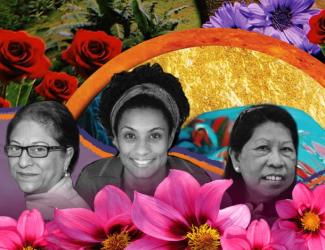
Memory as Resistance: A Tribute to WHRDs no longer with us

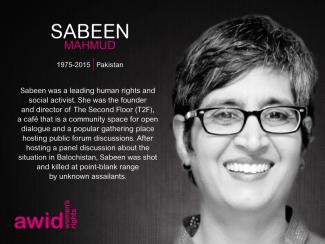
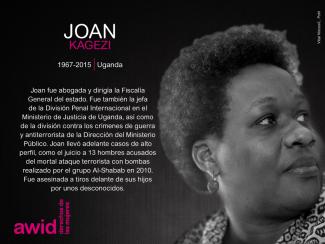
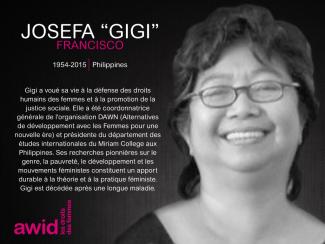
AWID’s Tribute is an art exhibition honouring feminists, women’s rights and social justice activists from around the world who are no longer with us. 


In 2020, we are taking a turn

This year’s tribute tells stories and shares narratives about those who co-created feminist realities, have offered visions of alternatives to systems and actors that oppress us, and have proposed new ways of organising, mobilising, fighting, working, living, and learning.

49 new portraits of feminists and Women Human Rights Defenders (WHRDs) are added to the gallery. While many of those we honour have passed away due to old age or illness, too many have been killed as a result of their work and who they are.

This increasing violence (by states, corporations, organized crime, unknown gunmen...) is not only aimed at individual activists but at our joint work and feminist realities.

The stories of activists we honour keep their legacy alive and carry their inspiration forward into our movements’ future work.

Visit the online exhibit

The portraits of the 2020 edition are designed by award winning illustrator and animator, Louisa Bertman

AWID would like to thank the families and organizations who shared their personal stories and contributed to this memorial. We join them in continuing the remarkable work of these activists and WHRDs and forging efforts to ensure justice is achieved in cases that remain in impunity.

“They tried to bury us. They didn’t know we were seeds.” - Mexican Proverb 


The Tribute was first launched in 2012

It took shape with a physical exhibit of portraits and biographies of feminists and activists who passed away at AWID’s 12th International Forum, in Turkey. It now lives as an online gallery, updated every year.

To date, 467 feminists and WHRDs are featured.

Visit the online exhibit

Related Content

Qui devrait participer à cette enquête?

Les groupes, organisations et mouvements qui travaillent spécifiquement, ou principalement, à la défense des droits des femmes et des filles, pour la justice de genre, pour la défense des droits des personnes LBTQI+ et des allié·es dans toutes les régions et à tous les niveaux, que ces structures soient récentes ou non.

Snippet FEA Audio Land and Agroecology (EN)

Listen to the story here:

Our group, organization and/or movement has not taken or mobilized funding from external funders, should we take the survey?

Yes! We recognize and appreciate different reasons why feminists, in their respective contexts, don’t have external funding: from being ineligible to apply for grants and/or receive money from abroad, to relying on resources generated autonomously as a political strategy in its own right. We want to hear from you regardless of your experience with external funding.

Snippet FEA Objectives NSS - Traditional Knowledge (ES)

CONOCIMIENTOS TRADICIONALES

Brown hands with yellow seeds in the palms
Utilizar y promover los conocimientos y prácticas tradicionales transmitidos de generación en generación, que apoyen la soberanía alimentaria y la preservación de las semillas campesinas

¿Cuáles son los idiomas oficiales de ¿Dónde está el dinero?

Por el momento, la encuesta en KOBO está disponible en árabe, español, francés, inglés, portugués y ruso. Tendrás oportunidad de seleccionar el idioma de preferencia al inicio de la encuesta.

AWID IN 2015: Building Collective Impact

In 2015 AWID grew and diversified.

We ramped up preparations for the 13th AWID international Forum, focused a lot of energy on the Post 2015 Development Agenda and Financing for Development processes, and continued the core work of our priority areas:


A sneak peak inside the report

The context

  • We continue witnessing the rapid breakdown in democracy and democratic institutions, with spaces for dissent shrinking.
  • Multiple and concurrent systemic crises (energy, food, finance and climate) continue to deepen inequalities and pose major challenges.
  • Corporations are a leading power in determining the development agenda.
  • Violence against WHRDs remains an urgent problem.
  • Religious fundamentalisms are pervasive and increasingly powerful.
  • New forms of online gender-based violence have emerged.

In response, we are moving out of our silos.

Increasingly, women’s rights and other movements worldwide are articulating the systemic and intersectional nature of these and other problems. We are making better connections with the agendas of other social and environmental movements for solidarity, alliance building and collective responses. We are also seeing greater visibility of these movements fighting for justice on the ground.


Our Impact

  • For effective strategizing and advocacy, we need facts
  • To exchange knowledge and join hands in solidarity, we need  a strong online community
  • To build our collective power, we need to work together
  • To influence international processes,  we need to increase our access and voice
  • To reposition power we need to give visibility and emphasize  the important role that feminist and women’s rights movements  are already playing
     

Our Members

As at 31st December, 2015 we had:


Read the full report


Snippet FEA NSS Quote (FR)

« Les savoirs et pratiques indigènes ont toujours soutenu la souveraineté alimentaire, et ce savoir-faire est entre les mains des femmes [...] L'écoféminisme pour moi, c'est le respect de tout ce que nous avons autour de nous » -

Mariama Sonko

Abby Lippman

Abby fue una feminista y activista por los derechos humanos pionera, y antes epidemióloga de McGill University.

Abby era conocida por defender causas sociales, y por sus lúcidas críticas a las tecnologías reproductivas y otros temas médicos. En particular, hizo campaña contra lo que ella denominó la «genetización» de las tecnologías reproductivas, contra la terapia de reemplazo hormonal, y a favor de más y mejor investigación antes de la aprobación de descubrimientos tales como las vacunas contra el virus del papiloma humano.

Cuando falleció, sus amigxs y colegas la describieron afectuosamente como una «ardiente defensora» de la salud de las mujeres.


Abby Lipman, Canada

Y a-t-il une préparation particulière à suivre avant de répondre aux questions de l’enquête?

L’enquête WITM portant sur les réalités du financement des organisations féministes, la plupart des questions traitent du financement de votre groupe entre 2021 et 2023. Vous aurez besoin de disposer de ces informations pendant que vous répondez aux questions de l’enquête (vos budgets annuels et principales sources de financement, par exemple)

Annual Report 2010

AWID 2010 Annual Report Cover

Our 2010 Annual Report highlights the major accomplishments of each of our strategic initiatives during the year.

Along with activity highlights, we include a brief analysis of the impact of our initiatives as well as reflections from our members and partners that further illustrate the relevance of AWID’s work and its connection to broader women’s rights movements. 

This interactive document is complete with links to our websites and recent publications with in-depth information on the issues we address in the report.

Read online

Snippet FEA argentina history cooperatives (EN)

Argentina has a long history of worker-run cooperatives and workplaces.

In 2001, the country experienced one of the worst economic crises in its history.

As a response to the recession and a form of resistance and resilience, workers across the country started occupying their workplaces.

The Nadia Echazú Textile Cooperative was the first cooperative created by and for trans and travesti people in search of economic autonomy and decent living conditions.

It provides work opportunities, access to social security, sustainable income and economic rights for the communities it serves.

Marielle Franco

Marielle était une femme politique brésilienne, féministe lesbienne et militante des droits humains.

Marielle était une critique virulente de la brutalité policière et des exécutions extrajudiciaires. Sa politique, ouvertement féministe, centrée sur les personnes noires et les favelas était une source d’espoir pour les groupes marginalisés de Rio de Janeiro, actuellement gouvernée par un gouvernement conservateur et un maire évangélique.

Le 14 mars 2018, après avoir prononcé un discours à Rio de Janeiro, Marielle Franco et son chauffeur ont été assassinés, abattus par balles. Suite à la nouvelle de leur mort, les foules sont descendues dans les rues en criant « Marielle presente! » (Marielle est ici !) et ont exigé que justice soit faite.

En savoir plus sur Marielle et la situation au Brésil


Marielle Franco, Brasil