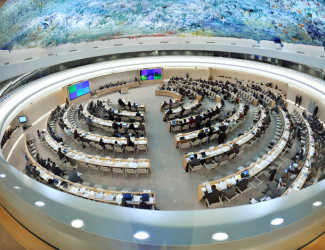
The Human Rights Council (HRC) is the key intergovernmental body within the United Nations system responsible for the promotion and protection of all human rights around the globe. It holds three regular sessions a year: in March, June and September. The Office of the UN High Commissioner for Human Rights (OHCHR) is the secretariat for the HRC.
The HRC works by:
Debating and passing resolutions on global human rights issues and human rights situations in particular countries
Examining complaints from victims of human rights violations or activist organizations on behalf of victims of human rights violations
Appointing independent experts (known as “Special Procedures”) to review human rights violations in specific countries and examine and further global human rights issues
Engaging in discussions with experts and governments on human rights issues
Assessing the human rights records of all UN Member States every four and a half years through the Universal Periodic Review
AWID works with feminist, progressive and human rights partners to share key knowledge, convene civil society dialogues and events, and influence negotiations and outcomes of the session.
With our partners, our work will:
◾️ Monitor, track and analyze anti-rights actors, discourses and strategies and their impact on resolutions
Member states and women's rights advocates and organisations are gathering at the United Nations Headquarters in New York from 13 - 24 March for the 61st Commission on the Status of Women to address ‘women’s economic empowerment’ in the context of Sustainable Development Goal 5.
Whilst AWID is looking forward to physically meeting those of you who will be in New York, we want to engage with all those who cannot attend CSW, and as much as possible, amplify your voices in relevant spaces.
Continue reading to find out how to engage with AWID around CSW, whether you are attending physically or not.
Participate in an artistic takeover!
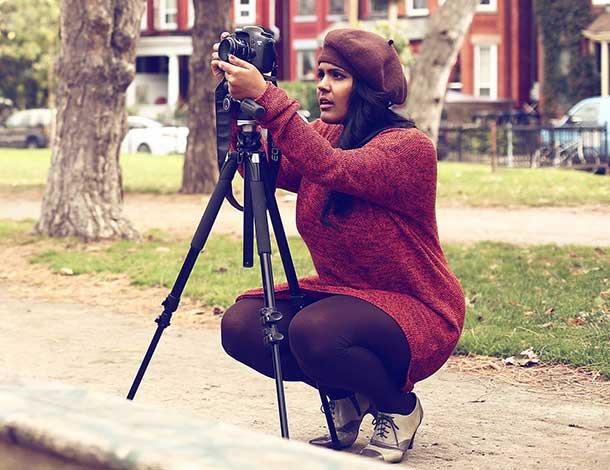
We are thrilled that AWID member Nayani Thiyagarajah is attending CSW this year and will take over the AWID Instagram. She will be available onsite to connect with other members for a possible feature on our Instagram. She will also explore possibilities of including some AWID members in a short film on the theme, ‘The personal is political’, a story of Nayani’s participation in this year’s CSW.
Nayani Thiyagarajah
Who is Nayani?
Nayani Thiyagarajah is a director, producer, and writer, dedicated to stories for the screen. A daughter of the Tamil diaspora, she calls Toronto home. For over 10 years, Nayani has worked in the arts and cultural industries. Her first independent feature documentary Shadeism: Digging Deeper (2015) had its World Premiere at the 2015 Zanzibar International Film Festival, where it won a Special Jury Prize. Nayani recently launched [RE]FRAME, with her producing partner Camaro West, a production company based out of Atlanta and Toronto, focused on re-framing the narratives around Black, Indigenous, and other people of colour through storytelling on screen.
On a more serious note, it should be noted that Nayani has a strange laugh, she's quite awkward, and her head is always in the clouds. She feels blessed beyond belief to create stories for the screen and play make believe for a living. Above all else, she believes in love.
Interested in meeting Nayani and being considered for inclusion in the film?
Send an email to membership@awid.org with the subject line “CSW Artistic Takeover”
By 13 March 2017
Please include your full name and country information.
Can't attend? Voice it!
If you are not able to attend CSW61 because of a travel ban, either due to the one imposed by the Trump administration or one you are facing from your own government, please share your story with us.
Send us messages you want heard in the United Nations spaces concerning funding, the impact of the reinstatement of the Global Gag Rule, and the need to push back against all types of religious fundamentalisms. You can send these in the following formats:
Video: no longer than two minutes and sent through a file sharing folder (for example dropbox, google drive)
Audio: no longer than two minutes and sent through a file sharing folder (for example dropbox, google drive)
Image: you can share a photo or a poster of your message
Text: no longer than 200 words and sent in the body of an email or in a word document
AWID members tell us that connecting with other members at CSW is valuable. In such a huge advocacy space, it is useful to connect with others including activists working on similar issues, or originating from the same country or region. Recognising the importance of connecting for movement building, we invite you to:
Interested in connecting with other members @CSW61?
If you are attending the CSW, we’d love to see what’s going on through your eyes!
Show us by capturing a moment you find speaks to the energy in the CSW space, be it on or off site. We hope to publish some of your ‘images’ on our social media channels and share on awid.org.
You can send us:
colour and/ or black and white photographs with a title (if you wish) and
a caption (no longer than 100 words) about the story your image tells.
Please also include:
your full name and country of origin and
let us know if we can publish the information you shared (in part or in full).
الاستطلاع هذا مخصّص للمجموعات، المنظمات والحركات التي تعمل بالأساس أو فقط على حقوق النساء، أفراد مجتمع الميم - عين، والحقوق الجندرية، في جميع السياقات، على جميع المستويات، وفي جميع المناطق. إن كان واحد من هذه المبادئ اساسًا لمجموعتكم/ن، تنظيمكم/ن أو شبكتكم/ن، أو أي نوع تنظيم آخر، إن كان مسجلاً أم لا، جديداً أو طويل العمر، ندعوكم/ن للإجابة على الاستطلاع.
*في الوقت الحالي، لا نطلب من الأفراد أو الصناديق النسوية أو النسائية تعبئة الاستطلاع.
تعرف على المزيد حول الاستطلاع: راجع/ي الأسئلة الشائعة
¡Sigue el trabajo de la cooperativa en Facebook e Instagram, comparte sus campañas y mantente al tanto de sus acciones y eventos de recaudación de fondos!
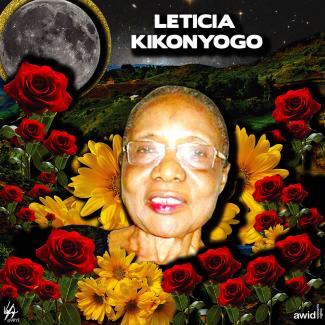
Avant de prendre sa retraite, elle a occupé de nombreux postes de haut niveau, notamment celui de membre de la cour d’appel et juge en chef adjointe de l’Ouganda. Elle a été la première femme ougandaise à occuper le poste de magistrat en chef entre 1973 et 1986 et la première femme à être nommée juge à la Haute Cour de justice en 1986.
Elle fut l'une des premières femmes à recevoir le titre de chevalier pontifical de l'histoire de l'Église catholique en Afrique. Elle est morte d'une crise cardiaque.
Background
Why this resource?
While active participants on the front lines of protests and uprisings in the Middle East and North Africa (MENA), women became invisible, absent from processes of formation of the new states, and excluded from decision-making roles, responsibilities, and positions in the aftermath of the uprisings. Except in rare cases, men dominated leadership positions in transitional structures, including the constitutional reform and electoral committees[i]. Subsequent elections brought very few women to parliamentary and ministerial positions.
Additionally, a strong and immediate backlash against women and women’s rights has clearly emerged in the aftermath. The rise of new religious fundamentalist groups with renewed patriarchal agendas aiming to obliterate previous gains of the women’s movements even in countries with longer histories of women’s rights, such as Tunisia, has been very alarming.
The varying contexts of governance and transition processes across the MENA countries presents an important opportunity for women human rights defenders to shape the future of these democracies. However, the lack of prioritization of women’s rights issues in the emerging transitions and the aforementioned backlash have posed a variety of complex challenges for the women’s movements. Faced with these enormous challenges and possibilities, women’s rights activists have been struggling to forge ahead a democratic future inclusive and only possible with women’s rights and equality. The particular historical and contextual legacies that impact women’s movements in each country continue to bear on the current capacities, strategies, and overall preparedness of the women’s movements to take on such a challenge. Burdened with daily human rights violations in one context, with lack of resources and tools in another, with organizational tensions in a third, in addition to the constant attacks on them as activists, women human rights defenders have voiced their desire to be more equipped with knowledge and tools to be effective and proactive in engaging with these fast-changing environments. Conceptual clarity and greater understanding of notions and practices of democratization, transitional justice tools and mechanisms, political governance and participation processes, international and local mechanisms, movement building strategies, constitutional reform possibilities, and secularization of public space and government are important steps to defining future strategic action.
It is clear that feminists and women’s rights activists cannot wait for women’s rights to be addressed after transitions – issues must be addressed as the new power configurations are forming. Experiences of earlier moments of transition, namely from colonial rule, have clearly demonstrated that women’s rights have to be inherently part of the transition movement towards a more just and equal society.
What is included?
This publication represents a research mapping of key resources, publications and materials on transitions to democracy and women’s rights in different countries of the world that have undergone such processes, such as: Indonesia, Chile, South Africa, Nepal, Mexico, Argentina, Poland, Ukraine, as well as within the Middle East and North Africa (MENA). It provides bibliographic information and short summaries of resources which succinctly identify the contextual changes and challenges facing women in those particular transitional moments, as well as clearly delineates the ways in which women’s rights activists sought to confront those challenges and what lessons were learned.
A key criterion in the selection process was the primacy of a women’s rights/feminist perspective; the few exceptions to this rule offer a unique and, we hope, useful, perspective on the issues that women’s rights organizations and activists face in the region. The texts have been selected to provide a wide range of information, relevant to women human rights defenders working from the grassroots to the international level, across issues (including different case studies and examples), from different perspectives (international human rights bodies, academic institutions, NGO contributions, activists’ experiences, etc.), and at a wide range of levels of complexity, in order to respond to the needs of as many readers as possible.
The mapping clusters resources under six major categories:
Transitions to Democracy
Political Participation
Movement Building
Transitional Justice
Constitutional/Legal Reform
Responses to Fundamentalisms
[i]This and other context points are drawn from the report from Pre AWID Forum meeting on Women’s Rights in Transitions to Democracy: Achieving Rights, Resisting Backlash, collaboratively organized by AWID, the Equality Without Reservation Coalition, Global Fund for Women and Women’s Learning Partnership
Укрепить наш коллективный голос и влияние на увеличение и улучшение финансирования феминистских организаций, организаций по защите прав женщин, ЛГБТКИ+ и смежных организаций по всему миру
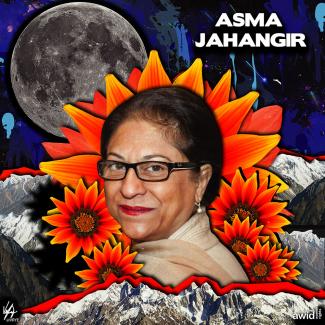
Asma was a leading Pakistani rights activist, fearless critic of the military’s interference in politics and a staunch defender of the rule of law.
She was the founding chairwoman of the Human Rights Commission of Pakistan, an independent group, and was a trustee of the International Crisis Group. She won international awards and served as the United Nations rapporteur on human rights and extrajudicial killings.
“With her life, Asma rewrote the history that many of us were told as women. Asma changed the world. She changed it in Pakistan, and she changed it in our imaginations."
Twitter Test
@shalinikonanur sharing a comment by her colleague debbie @salco "we can talk about shattering the glass ceiling, but we have to talk about who are sweeping those broken glasses?" challenging the #G7 to truly see who's vulnerable domestically & globally #W7Canada@kramdas@AWIDpic.twitter.com/1rs0SpLYHp
عالمي ومتنوع يعكس وقائع التمويل للتنظيم النسوي على المستوى العالمي ومقسّم حسب المناطق
مقسم حسب النطاق يضع أصوات، وجهات النظر والتجارب المعاشة للحركات النسوية في المركز ويسلط الضوء على ثروتها، شجاعتها وتنوّعها، كل واحدة في نطاقها
مشترك: تم تطوير وتجربة الاستطلاع باستشارة أعضاء/ عضوات جمعية حقوق المرأة في التنمية والشركاء/ الشريكات في الحركة
تكميلي يساهم ويعزّز الأدلة المتواجدة عن وضع التمويل للحركات النسوية والنسائية وحركات العدالة الجندرية من النشطاء/ الناشطات، الممولين/ات النسويين/ات والحلفاء/ الحليفا
متعدد اللغات متاح باللغة العربية، الانجليزية، الفرنسية، البرتغالية، الروسية والاسبانية
إعطاء الأولوية للخصوصية والأمان نحن ملتزمون/ات بالحفاظ على سرية وسلامة بياناتك. اقرأ/ي سياسة الخصوصية الخاصة بنا لمعرفة المزيد حول التدابير التي نتخذها لضمان حماية معلوماتك.
متاح متاح لأشخاص مع درجات سمع، حركة، رؤية، وقدرات فكرية مختلفة، ويحتاج تقريباً 30 دقيقة لإتمامه.
قابل للنسخ يمكن للحركات نسخ الاستطلاع لما يتناسب مع نطاقاتها. ستكون أدوات الاستطلاع متاحة لإجراء أبحاث إضافية ومناصرة مشتركة.
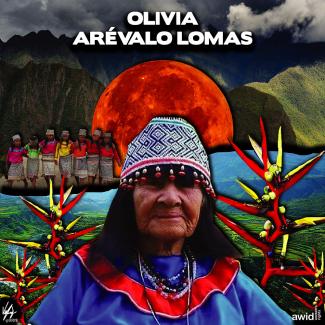
Olivia era la líder espiritual del pueblo indígena Shipibo Konibo.
Sabia mujer indígena y abuela, era conocida por practicar la medicina tradicional y cantar las canciones sagradas de su pueblo (Íkaros). Olivia Arévalo fue una activa defensora de los derechos culturales y ambientales de su pueblo. Su asesinato tuvo lugar en un contexto de conflicto territorial entre la comunidad shipibo y las empresas que quieren apropiarse de sus tierras para cultivar palma aceitera.
Integrantes de su comunidad han dicho: «Su muerte es una agresión contra toda la comunidad shipibo. Ella era la memoria viviente de su pueblo».