
Leila Alaoui
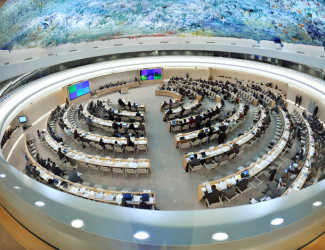
The Human Rights Council (HRC) is the key intergovernmental body within the United Nations system responsible for the promotion and protection of all human rights around the globe. It holds three regular sessions a year: in March, June and September. The Office of the UN High Commissioner for Human Rights (OHCHR) is the secretariat for the HRC.
Debating and passing resolutions on global human rights issues and human rights situations in particular countries
Examining complaints from victims of human rights violations or activist organizations on behalf of victims of human rights violations
Appointing independent experts (known as “Special Procedures”) to review human rights violations in specific countries and examine and further global human rights issues
Engaging in discussions with experts and governments on human rights issues
Assessing the human rights records of all UN Member States every four and a half years through the Universal Periodic Review
AWID works with feminist, progressive and human rights partners to share key knowledge, convene civil society dialogues and events, and influence negotiations and outcomes of the session.

We welcome applications across the full range of thematic areas and intersections important to feminist and gender justice movements. In the application form, you will be able to mark more than one theme that fits your activity.

En 2016, nous nous sommes réuni-e-s pour le 13e forum international de l’AWID, à Bahia au Brésil, qui a accueilli 1 800 participant-e-s venu-e-s de 120 pays et territoires à travers le monde. Le Forum a servi d’espace essentiel pour la mise en place de stratégies et la constitution d’alliances au sein des mouvements féministes et d’autres mouvement de justice.
Nous savons que les droits des femmes et les mouvements féministes sont des éléments moteurs pour l’instauration d’un changement transformateur durable. Au sein de nos mouvements, l’organisation, la résistance et la réponse au difficile contexte se précisent, et dans ce monde de plus en plus connecté, le potentiel des actions collectives de mouvements divers s’est fortement accru. C’est précisément là le travail essentiel que l’AWID cherche à amplifier et à soutenir.
Nous cherchons à informer et outiller les organisations et mouvements de droits des femmes afin de les aider à être en mesure de répondre aux opportunités qui se présentent et de contrecarrer les menaces. Nous appuyons une visibilité accrue et une meilleure compréhension des initiatives pour les droits des femmes et les menaces auxquelles elles font face, et nous oeuvrons également à influer sur les acteur-trice-s et les institutions qui façonnent le devenir des droits de la personne et du développement.
Le 13e forum international innovant de l’AWID s’est tenu du 8 au 11 septembre 2016 à Bahia, au Brésil, sur le thème : « Horizons féministes ; Construire un
pouvoir collectif pour les droits et la justice ».
Bien qu’une grande partie de l’énergie de l’AWID ait été investie en 2016 dans la tenue du Forum, la réflexion et l’énergie de près de 500 partenaires, intervenant-e-s, animateur-trice-s, artivistes, facilitateur-trice-s, écrivain-e-s, innovateur-trice-s en TI, performeur-euse-s, dont beaucoup sont des meneur-euse-s dans leur domaine, ont été mises à profit. Et en reconnaissance du passé et du combat de Bahia, nous avons accueilli deux jours de Forum des Féminismes Noirs , à l’initiative d’un groupe de travail de féministes Noires du monde entier.
À propos du défi au pouvoir corporatif : Nous avons publié Contester le pouvoir corporatif : Les luttes pour les droits des femmes, la justice économique et la justice de genre avec le Solidarity Center, qui dévoile la portée et l’ampleur du pouvoir corporatif et souligne comment la collusion qu’entretiennent les entreprises nationales et transnationales avec les élites et autres puissant- e-s acteur-trice-s influence les vies des femmes et des peuples opprimés. Ce rapport présente des clés de stratégies de résistances, en soulignant cinq combats qui se sont saisis de la collaboration entre mouvements pour contester le pouvoir corporatif.
Sur les économies féministes : Nous avons publié Propositions féministes pour une économie juste avec le Centre pour le leadership mondial des femmes (CWGL en anglais) et le Réseau de Développement et de Communication des Femmes Africaines FEMNET.
Sur l’opposition aux fondamentalismes : Le Diable est dans les détails : à la croisée du développement, des droits des femmes et des fondamentalismes religieux détaille la façon dont les fondamentalismes religieux entravent le développement et les droits des femmes en particulier, et offre des recommandations aux acteur-trice-s du développement pour le renforcement des droits des femmes.
Sur le thème de l’activisme des jeunes féministes : Avec FRIDA, nous avons lancé Courageuses, créatives, résilientes : les organisations de jeunes féministes dans le monde : un état de lieux à l’occasion du Pôle d’activisme des jeunes féministes lors du Forum de l’AWID. Ce projet de cartographie des jeunes féministes s’appuie sur les données collectées dans 1 360 demandes de subventions reçues par FRIDA entre 2012 et 2014, qui incluaient 694 interlocutrices issues de 118 pays différents !
l’AWID, en partenariat avec d’autres organisations féministes et de droits des femmes, a lancé des actions de plaidoyer et de dialogue afin de rechercher de meilleures solutions pour les programmes de droits des femmes, dont le travail avec le consortium .Count Me In!
Les expériences des femmes en situation de handicap, les femmes Noires et Afro-descendantes, les travailleuses du sexe, les femmes Autochtones, les personnes trans et intersexes, les travailleuses domestiques, et la manière dont leurs vies sont impactées par les nombreuses oppressions et la violence ont été placées au centre et au premier plan du processus du Forum.
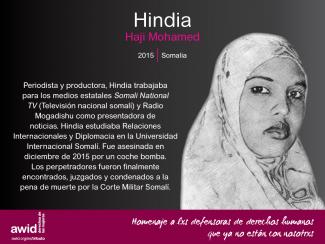
Au cours des 16 jours d’activisme, et grâce aux contributions de nos incroyables membres, nous avons lancé l’Hommage aux défenseur-e-s des droits humains des femmes 2016 pour honorer la mémoire des défenseur-e-s qui nous ont quitté- e-s.
Notre partenariat avec The Guardian et Cash Mama : la section sur les droits des femmes et l’égalité de genre (en anglais) sur le portail du développement dans le monde du Guardian a permis d’attirer davantage d’attention sur les groupes et les problématiques qui ne font généralement pas l’objet d’une couverture médiatique adéquate.

by Chinelo Onwualu
On September 2nd, 2021, the amazing feminist and social justice activists of AWID’s Crear | Résister | Transform festival came together not only to share resistance strategies, co-create, and transform the world, but also to talk dirty on Twitter.
Les afiliades de AWID analizarán y evaluarán críticamente el rol que la ayuda mutua puede cumplir en la dotación de recursos de nuestros movimientos, a través de la creación de collages colectivos.
📅 Miércoles, 12 de noviembre de 2025
📍 Espacio de la COP Popular
Participants will come together in Bangkok, Thailand. We can’t wait!
En 2021, l’AWID, comme beaucoup d’autres organisations, a dû faire face aux répercussions de la pandémie mondiale en cours sur notre façon de travailler et notre rôle en ces temps particuliers. L’année nous a appris trois leçons essentielles sur la façon de traverser cette période en tant qu’organisation mondiale de soutien au mouvement féministe.
Téléchargez le rapport annuel 2021
Notre expérience en 2021 nous a permis de constater que l’AWID jouait un rôle important et quelque peu unique dans la création et le maintien d’une communauté féministe mondiale transcendant les identités et les thèmes.

Si quieres esta concha, déjame ver ese papel (En serio, ¿dónde está el resultado de tu prueba? En versión digital está bien)
Cette année, aux côtés de militant.e.s féministes du monde entier, nous serons à la CSW68 à New York. Nous serons là pour contester les discours capitalistes et néolibéraux et les fausses solutions autour de la pauvreté, du développement et de la finance. À travers des événements en présentiel, des lives sur nos réseaux sociaux, un stand d'exposition et bien plus encore, nous visons à nous rassembler, amplifier et soutenir les voix et la participation de nos membres et allié.e.s.
Apprenez-en davantage sur notre programme cette année ci-dessous.
ใหม่
ผู้เข้าร่วมประชุมจะได้เข้าร่วมตามสถานที่ต่างๆนอกเพื้นที่ในการจัดงานที่กรุงเทพฯ และตามส่วนต่างๆของ โลกในแต่ละวันของการประชุม สถานที่ประชุมที่ผู้เข้าร่วมจัดการเองทั้งหมดนั้นจะเชื่อมต่อกับสถานที่จัดงาน
จริงในกรุงเทพฯเช่นเดียวกับบุคคลที่เชื่อมต่อทางออนไลน์ ผู้เข้าร่วมในจุดศูนย์กลาง Hub นี้จะสามารถ ดำเนินรายการในหัวข้อกิจกรรมต่างๆ เข้าร่วมอภิปราย แลกเปลี่ยน และเพลิดเพลินไปกับโปรแกรม ที่หลากหลาย
ที่ตั้งจุดศูนย์กลาง Hub จะประกาศในปี 2567
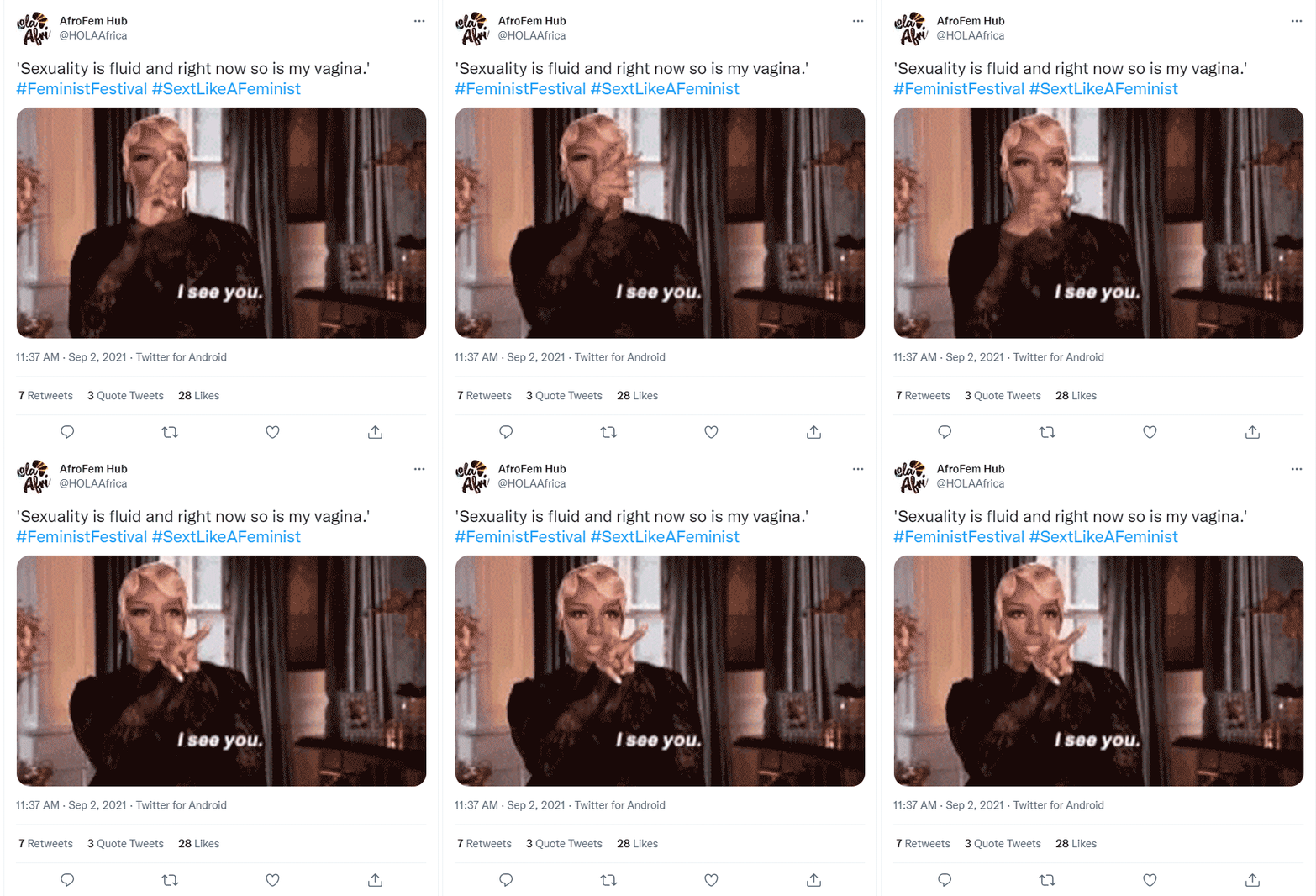
« La sexualité est fluide, et là mon vagin aussi. »
#FeministFestival #SextLikeAFeminist
High-level panel discussion on the commemoration of the twenty-fifth anniversary of the adoption of the Durban Declaration and Programme of Action Concept note
Annual high-level panel discussion on human rights mainstreaming
Theme: Role of new and emerging digital technologies in preventing and eliminating female genital mutilation Concept note
Panel discussion on human rights and a culture of peace Concept note
Panel discussion on financing sustainable development in line with economic, social and cultural rights obligations. Concept note
Annual interactive debate on the rights of persons with disabilities
Theme: Disability-inclusive infrastructure, including transport and housing Concept note
Anual full-day meeting on the rights of the child Theme: Rights of the child and violations of the human rights of children in armed conflicts Concept note
Margarita est une militante féministe et LGBTIQA d'Amérique latine. Elle est passionnée de transformation sociale et de bien-être collectif. Elle est titulaire de diplômes en psychologie, communication et en administration publique, ainsi que de certificats en politiques publiques, leadership, gestion et prise de décision. Durant son parcours professionnel, Margarita a acquis une vaste expérience auprès d'organisations de terrain, d'ONG nationales et régionales, d'universités et du secteur public, développant la facilitation, le renforcement des capacités, le plaidoyer politique, la communication et l'évaluation des politiques.
Communicating Desire
Host: We tend to think about communicating desire as something that is limited to the private intimacy of the bedroom and our personal relationships. But can we also think of this kind of communication as a structure, a praxis that informs our work, and how we are, how we do in the world?
Lindiwe
I believe that unfortunately in the past, expressing your sexuality has been limited. You were allowed to express it within the confines of your marriage, which was permitted, there have always been taboo and stigmas attached to expressing it any other way. When it comes to communicating, obviously the fact that certain stigmas are attached to expressing your sexuality or expressing your desire makes it a lot harder to communicate that in the bedroom or intimately with your partner. From my personal experience, I do believe that obviously if I feel more comfortable expressing myself outside of the bedroom on other matters or other topics, it’s easier for me to build that trust, because you understand conflict resolution with that particular person, you understand exactly how to make your communication special towards that particular person. It’s not easy. It’s something that is consistently done throughout whatever your engagement is, whether it’s your relationship or whether it’s casual and just in the moment. But I believe that confidence outside can definitely translate to how you communicate your desire.
Manal
Since childhood, a woman is raised with that, “you’re not allowed to talk about your body, you’re not allowed to talk about your desire,” which puts a heavy responsibility on women, especially girls in their teens when they need to express themselves and talk about these issues. So for me I think this is a big problem. You know, I have been married for more than 25 years, but still, until now, I cannot talk about my desires. I cannot say what I want or what I prefer, because it’s like I’m not allowed to go beyond this line. It’s like haram, despite it being my right. This is the case for all my friends, they just can’t express themselves in the right way.
Louise
Personally, I find that expressing our desires, my desires, however that expression comes in hand, has to do with the other, and the gaze that the other would have on me. So this is also something that we can link to cinema. And the gaze I would have on myself as well: what I think I am as an individual, but also what society expects of me and my sexuality. In the past, I somehow did the analogy between what happens in the bedroom and what happens in the workplace, because there is sometimes this dynamic of power, whether I want it or not. And oftentimes, verbal communication is harder than we think. But when it comes to representation in film, that’s a totally different game. We are very far away from what I guess all of us here would like to see on screen when it comes to just communicating sexual desires inside or outside the bedroom.
Host: We can think about the digital world as embodied: while it might be virtual, it is not less real. And this was made clear in the context of AWID’s feminist realities festival, which took place entirely online. What does it mean then to talk about sexuality, collectively, politically, in online spaces? Do we navigate virtual spaces with our bodies and affects, and in this case, what are the different considerations? What does it do to communication and representation?

Lindiwe
Social media makes you feel community-based. When you express what it is that you want or like, there is someone who’s either going to agree or disagree, but those who do agree make you feel that you belong to a community. So it’s easier to throw it out into the universe, or for others to see, and potentially not get as much judgment. And I say this very loosely because sometimes, depending on what it is that you’re expressing, it either will get you vilified or celebrated. But when it comes to the bedroom, there is an intimacy and almost a vulnerability that is exposing you and different parts of you that is not as easy to give your opinion on. When it comes to expressing your desire, speaking it and saying it and maybe putting a Tweet or a social media post, or even liking and reading other communities that are same-minded is a lot easier than telling your partner, “this is how I want to be pleasured” or “this is how what I want you to do next,” because of the fear of rejection. But not only that, just the vulnerability aspect – allowing yourself to be bare enough to let the other person see into what you are thinking, feeling, and wanting – I think this is where the difference would come in for me personally. I feel it is a lot more community-based on social media, and it’s easier to engage in discourse. Whereas in the bedroom, you don’t want to necessarily kill the moment. But I think that also kind of helps you understand going forward, depending on the relationship with the person, how you would engage thereafter. So I always know that if I try to communicate something and I fail to do so in the moment, I can always try to bring it up outside of that moment and see what the reaction would be so I know how to approach it going forward.
Louise
You know the question in films is, I don’t know if the male gaze is done intentionally or not. Like we don’t really know that. What we know is that the reason why sexuality in general has been so heternormative and focused on penetration and not giving any space for women to actually ask for anything in films, is because most of the people who have been working in this industry and making decisions in terms of, you know, storytelling and editing have been white men. So rape revenge is this very weird film genre that was birthed in the 70s, and half of the story would be that a woman is being raped by one or multiple people, and in the other half, she would get her revenge. So usually she would murder and kill the people who have raped her, and sometimes other people next to them. At the beginning of the birth of this genre and for 30 years at least, those films were written, produced, and directed by men. This is why we also want so much representation. A lot of feminists and pioneers in queer filmmaking also used the act of filming in order to do that and to reclaim their own sexuality. I’m thinking about Barbara Hammer, who’s a feminist and queer pioneer in experimental cinema in the U.S. where she decided to shoot women having sex on 16mm, and by doing so reclaimed a space within the narrative that was exposed in film at that time. And there is also then the question of invisibilization: we know now, because of the internet and sharing knowledge, that women and queer filmmakers have been trying and making films since the beginning of cinema. We only realize it now that we have access to databases and the work of activists and curators and filmmakers.
Host: And this opens up the conversation on the importance of keeping our feminist histories alive. The online worlds have also played a crucial role in documenting protests and resistance. From Sudan to Palestine to Colombia, feminists have taken our screens by storm, challenging the realities of occupation, capitalism, and oppression. So could we speak of communicating desire – the desire for something else – as decolonization?
Manal
Maybe because my village is just 600 residents and the whole village is one family – Tamimi – there are no barriers between men and women. We do everything together. So when we began our non-violent resistance or when we joined the non-violent resistance in Palestine, there was no discussion whether women should participate or not. We took a very important role within the movement here in the village. But when other villages and other places began to join our weekly protests, some men thought that if these women participate or join the protests, they will fight with soldiers so it will be like they’re easy women. There were some men who were not from the village who tried to sexually harass the women. But a strong woman who is able to stand in front of a soldier can also stand against sexual harassment. Sometimes, when other women from other places join our protest, they are shy at first; they don’t want to come closer because there are many men. If you want to join the protest, if you want to be part of the non-violent movement, you have to remove all these restrictions and all these thoughts from your mind. You have to focus on just fighting for your rights. Unfortunately, the Israeli occupation realizes this issue. For example, the first time I was arrested, I wear the hijab so they tried to take it off; they tried to take off my clothes, in front of everybody. There were like 300-400 people and they tried to do it. When they took me to the interrogation, the interrogator said: “we did this because we want to punish other women through you. We know your culture.” So I told him: “I don’t care, I did something that I believe in. Even if you take all my clothes off, everybody knows that Manal is resisting.”
Lindiwe
I think even from a cultural perspective, which is very ironic, if you look at culture in Africa, prior to getting colonized, showing skin wasn’t a problem. Wearing animal skin and/or hides to protect you, that wasn’t an issue and people weren’t as sexualized unless it was within context. But we conditioned ourselves to say, “you should be covered up” and the moment you are not covered up you are exposed, and therefore it will be sexualized. Nudity gets sexualized as opposed to you just being naked; they don’t want a little girl to be seen naked. What kind of society have we conditioned ourselves to be if you’re going to be sexualizing someone who is naked outside of the context of a sexual engagement? But environment definitely plays a big role because your parents and your grannies and your aunts say “no, don’t dress inappropriately,” or “no, that’s too short.” So you hear that at home first, and then the moment you get exposed outside, depending on the environment, whether it’s a Eurocentric or more westernized environment to what you are used to, then you are kind of free to do so. And even then, as much as you are free, there’s still a lot that comes with it in terms of catcalling and people still sexualizing your body. You could be wearing a short skirt, and someone feels they have the right to touch you without your permission. There is so much that is associated with regulating and controlling women’s bodies, and that narrative starts at home. And then you go out into your community and society and the narrative gets perpetuated, and you realize that you get sexualized by society at large too, especially as a person of color.

Host: And finally, in what ways can our resistance be more than what we are allowed? Is there a place for pleasure and joy, for us and our communities?
Louise
Finding pleasure as resistance and resistance in pleasure, first for me there is this idea of the guerrilla filmmaking or the action of filming when you’re not supposed to or when someone told you not to, which is the case for a lot of women and queer filmmakers in the world right now. For example, in Lebanon, which is a cinema scene that I know very well, most of the lesbian stories that I’ve seen were shot by students in very short formats with “no production value” as the west would say – meaning with no money, because of the censorship that happens on an institutional level, but also within the family and within the private sphere. I would think that filming whatever, but also filming pleasure and pleasure within lesbian storytelling is an act of resistance in itself. A lot of times, just taking a camera and getting someone to edit and someone to act is extremely hard and requires a lot of political stance.
Lindiwe
I have a rape support group. I’m trying to assist women to reintegrate themselves from a sexual perspective: wanting to be intimate again, wanting to not let their past traumas influence so much how they move forward. It’s not an easy thing, but it’s individual. So I always start with understanding your body. I feel the more you understand and love and are proud of it, the more you are able to allow someone else into that space. I call it sensuality training, where I get them to start seeing themselves as not sexual objects, but as objects of pleasure and desire that can be interchangeable. So you’re worthy of receiving as well as giving. But that’s not only from a psychological point of view; it is physical. When you get out of the shower, you get out of the bath, and you’re putting lotion on your body, look at every part of your body, feel every part of your body, know when there are changes, know your body so well that should you get a new pimple on your knee, you are so aware of it because just a few hours ago it wasn’t there. So things like that where I kind of get people to love themselves from within, so they feel they are worthy of being loved in a safe space, is how I gear them towards claiming their sexuality and their desire.
Manal
You know we began to see women coming from Nablus, from Jerusalem, from Ramallah, even from occupied 48, who have to drive for 3-4 hours just to come to join the protests. After that we tried to go to other places, talk with women, tell them that they don’t have to be shy, that they should just believe in themselves and that there is nothing wrong in what we are doing. You can protect yourself, so where is the wrong in participating or in joining? Once I asked some women, “why are you joining?” And they said, “if the Tamimi women can do it, we can do it also.” To be honest I was very happy to hear this because we were like a model for other women. If I have to stand for my rights, it should be all my rights, not just one or two. We can’t divide rights.

Durante Women Deliver, los Movement Hubs en Fiji y Georgia están diseñando su propio programa basado en su comunidad para conectarse virtualmente a la Conferencia Women Deliver. ¡Conoce su programa!
¿Te interesa organizar Movement Hubs para otros eventos de movimientos globales y espacios de políticas públicas? Ponte en contacto con el equipo de membresía de AWID: membership @ awid.org