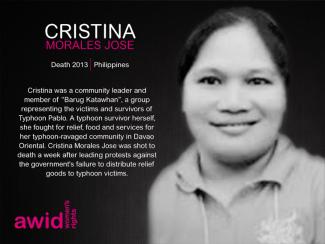
Cristina Morales Jose
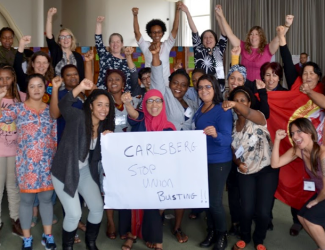
Women human rights defenders (WHRDs) worldwide defend their lands, livelihoods and communities from extractive industries and corporate power. They stand against powerful economic and political interests driving land theft, displacement of communities, loss of livelihoods, and environmental degradation.
Extractivism is an economic and political model of development that commodifies nature and prioritizes profit over human rights and the environment. Rooted in colonial history, it reinforces social and economic inequalities locally and globally. Often, Black, rural and Indigenous women are the most affected by extractivism, and are largely excluded from decision-making. Defying these patriarchal and neo-colonial forces, women rise in defense of rights, lands, people and nature.
WHRDs confronting extractive industries experience a range of risks, threats and violations, including criminalization, stigmatization, violence and intimidation. Their stories reveal a strong aspect of gendered and sexualized violence. Perpetrators include state and local authorities, corporations, police, military, paramilitary and private security forces, and at times their own communities.
AWID and the Women Human Rights Defenders International Coalition (WHRD-IC) are pleased to announce “Women Human Rights Defenders Confronting Extractivism and Corporate Power”; a cross-regional research project documenting the lived experiences of WHRDs from Asia, Africa and Latin America.
"Women Human Rights Defenders confronting extractive industries: an overview of critical risks and Human Rights obligations" is a policy report with a gender perspective. It analyses forms of violations and types of perpetrators, quotes relevant human rights obligations and includes policy recommendations to states, corporations, civil society and donors.
"Weaving resistance through action: Strategies of Women Human Rights Defenders confronting extractive industries" is a practical guide outlining creative and deliberate forms of action, successful tactics and inspiring stories of resistance.
The video “Defending people and planet: Women confronting extractive industries” puts courageous WHRDs from Africa, Asia, and Latin America in the spotlight. They share their struggles for land and life, and speak to the risks and challenges they face in their activism.
Challenging corporate power: Struggles for women’s rights, economic and gender justice is a research paper outlining the impacts of corporate power and offering insights into strategies of resistance.
AWID acknowledges with gratitude the invaluable input of every Woman Human Rights Defender who participated in this project. This project was made possible thanks to your willingness to generously and openly share your experiences and learnings. Your courage, creativity and resilience is an inspiration for us all. Thank you!
Tendo em conta que o inquérito WITM foca-se nas realidades do financiamento de organizações feministas, a maioria das perguntas aborda o tópico do financiamento do seu grupo entre 2021-2023. Será preciso ter essas informações facilmente acessíveis para preencher o inquérito (por exemplo, os seus orçamentos anuais e as principais fontes de financiamento).
Jemimah Naburri-Kaheru est une stratège internationale accomplie en matière de ressources humaines à impact profond dans la région de la Corne de l'Afrique. Jemimah était auparavant responsable régionale des ressources humaines et du bureau de l'Initiative stratégique pour les femmes dans la Corne de l'Afrique (SIHA) . Son influence s’est étendue jusqu’à la direction des ressources humaines de plus de 70 employé·e·s régionaux·ales, alors que l'organisation connaissait une croissance rapide, avec une augmentation de 40 % de ses revenus annuels. Tout au long de sa carrière, Jemimah a orchestré avec succès des efforts de recrutement, introduit des systèmes de performance basés sur le mérite, de même que supervisé les relations avec les employé·e·s et les politiques RH. Elle a joué un rôle central dans le soutien aux stratégies mondiales de personnel. Avec une formation universitaire en Études de Développement de l'Université de Makerere (Ouganda) et un Master en Gestion des Ressources Humaines, Jemimah est évidemment engagée envers le développement professionnel. Sa contribution à des effectifs hautement performants et à un leadership international en matière de ressources humaines la positionne comme un atout inestimable dans toute entreprise mondiale.
When you do a search for “Female Genital Mutilation” or “FGM” online, an image of four line-drawings of the female anatomy pop up next to its Wikipedia entry. It illustrates four types of violence. The first being a partial cut to the clitoris. The second, a more invasive cut with the entire clitoris removed. The third is progressively worse with the removal of the clitoris, labia majora and minora. And the fourth box illustrates a series of hash marks to symbolize stitches over the vaginal opening to allow only for urination and menstruation.
As a survivor of FGM, most questions about my story fixate on the physical. The first question I usually get asked is what type of FGM I underwent. When I told a journalist once that I went through Type 1, she said “oh, that’s not so bad. It’s not like type three which is far worse.” She was technically right. I had the least invasive form. And for many years, I gaslighted myself into feeling a sense of relief that I was one of the lucky ones. I comforted myself noting that I could have been less fortunate with all of my genitalia gouged out, not just the clitoral tip. Or worse I could have been one of the ones who didn’t survive at all. Like Nada Hassan Abdel-Maqsoud, a twelve year old, who bled to death on a doctor’s operating table earlier this year in Upper Egypt. Nada is a reminder to me that for every data point -- 200 million women and girls who live with the consequences of FGM globally -- there is a story. Nada will never be able to tell hers.
As much as I find the label “survivor” suffocating at times -- I also realize there is privilege embedded in the word. By surviving, you are alive. You have the ability to tell your story, process the trauma, activate others in your community and gain insights and a new language and lens to see yourself through.
The act of storytelling can be cathartic and liberating, but it can also shatter the storyteller in the process.
Without integrating the psychosocial support of trained clinicians into storytelling and healing retreats, well-intentioned interventions can result in more trauma. This is all the more important as FGM survivors navigate the double pandemic of their own PTSD from childhood trauma, and the indefinite COVID-19 global shutdown.
In many anti-FGM advocacy spaces, I have seen this insatiable hunger to unearth stories -- whatever the cost to the storyteller. The stories help activate funding and serve as a data point
for measuring impact.
Survivor stories then become commodities fueling a storytelling industrial complex. Storytellers, if not provided proper mental health support in the process, can become collateral damage.
My motivation in writing this piece is to flip the script on how we view FGM survivors, prioritizing the storyteller over the story itself.
FGM survivors are more than the four boxes describing how the pieces of our anatomy were cut, pricked, carved, or gouged out. In this essay, I’ll break down the anatomy of an FGM survivor’s story into four parts: stories that break, stories that remake, stories that heal, and stories that reveal.
I was sitting in the heart of Appalachia with a group of FGM survivors, meeting many for the first time. As they shared their traumas, I realized we all belonged in some way or another to the same unenviable club. A white Christian survivor from Kentucky - who I don’t think I would have ever met if we didn’t have FGM survivorship connecting us - told the contours of her story.
There were so many parallels. We were both cut at seven. She was bribed with cake after her cut. I was bribed with a jumbo-sized Toblerone chocolate bar when mine was over. Absorbing her trauma overwhelmed me. And I imagine when I shared my story, others in the circle may also have been silently unraveling. We didn’t have a clinician or mental health professional in a facilitation role and that absence was felt. The first night, I was sharing a room with six other survivors and tried hard to keep the sounds of my own tears muffled. By the last day, I reached breaking point. Before leaving for the airport, my stomach contracted and I convulsively vomited. I felt like I was purging not only my pain, but the pain of the others I’d absorbed that week. We all dutifully produced our stories into 90 second social media friendly soundbites with narration and photos. But at what cost?
On February 6, 2016, the Guardian published my story as a survivor. The second it was released, I was remade. My identity transformed from nondescript, relatively invisible mid-level Foreign Service Officer to FGM survivor under a public microscope. That same day, then-U.S. Ambassador to the United Nations Samantha Power tweeted my story with the introduction: “I was seven years old” before linking to the article. The tweet symbolized a moment for me where my personal and professional worlds collided. Since then, they have been forever intertwined.
Even though I spent ten years of my career as a diplomat focused on other issues -- I lived in Cairo during the early days of the Arab Spring in 2011 and served in Baghdad and Erbil when the Syrian revolution turned from an uprising to civil war -- all of those past experiences that began to make mefeel erased. When I spoke on panels, my identity would be reduced to “survivor.” Like other survivors, I have worked hard to rewrite the script on how others see me.
I reinsert pieces of my other identities when speaking to underscore to the broader public that while yes, I am a survivor of childhood trauma and while my FGM story may have remade a part of my identity, it doesn’t define me.
With the guidance of a mental health expert, I have spent the last few months doing a deep dive into my FGM survivor story. I have told and retold my story over dozens of times in public venues. My goal is to break the culture of silence and inspire action. At this point, the telling of my story has almost become mechanized, as though I am reciting a verse from the Quran I memorized as a kid. I would always start with: “I was sitting an anthropology class when a fellow student described her research project on Female Genital Mutilation. And that’s when I had the memory jolt. A memory I had suppressed since childhood came flooding to the foreground.” I go into the details of what happened in granular detail -- the color of the floor, the feelings of confusion and betrayal in the hazy aftermath. And then I go on to talk about the afternoon I confronted my mother about the summer she and my father shipped my brother and off to India to stay with my aunt. The summer it happened. I later found out my aunt cut me without my parents’ consent. In my years of telling and retelling this story, I would have moments I felt nothing, moments I would break down, and moments of relief. It was a mixed bag, often contradictory emotions happening all at once.
When I began to take apart the story, I discovered the core moment where I felt most gutted. It wasn’t the cut itself. It was the aftermath. I remember sitting in a corner alone, feeling confused and ashamed. When I looked at my aunt on the other side of the room, she was whispering to my cousin and they both pointed and laughed at me. Unearthing the moment of shame - the laughter - has haunted me since childhood. The piece that was carved out of me is called “haram ki boti” which translates into sinful flesh. Over time, the physical scar healed. But for many FGM survivors, the psychological wounds remain
Last year, I decided to take a sabbatical from the Foreign Service. I was burning out on both ends -- I had just completed a really tough assignment in Pakistan and was also doing anti-FGM
advocacy in my personal capacity. When I came home, an acquaintance from graduate school approached me to capture my story on film. As part of the process, she would send a camera
crew to shadow me. Sometimes while giving speeches, other times filming mundane interactions with friends and family. On a visit to my home in Texas, I’ll never forget the moment where my mom told me her story of survival. As part of the film, we went on a roadtrip to Austin to visit the university where I first had the memory jolt. My mom is patiently waiting for the cameraman to set up his tripod. My father is standing next to her.
In the end, we eventually had the conversation I never had the courage to have with either of my parents face to face. Looking them both in the eye, retelling my story with a camera as witness, we discussed how FGM ripped our family apart (specifically my dad’s relationship with his sister). For the first time, I heard my mom talking about her own experience and the feeling of betrayal when she discovered my aunt cut me without her consent. When I later told her that FGM was actually indigenous to the U.S. and Europe and that it was a cure for hysteria (prescribed by doctors) up until the 19th century, my mother exclaimed “that’s crazy to me, this was a cure for hysteria. I’m going to educate other doctors to speak out.” And in that moment, my mother, a survivor who had never shared her story before, became an activist.
My story, intertwined with her story, revealed a tightly woven fabric of resistance. With our voices, we were able to break the cycle of intergenerational structural violence. We were able to rewrite the stories of future generations of girls in our own family and hopefully one day, the world.
This is a woman breaking free from her mundane reality, devoid of color. She dreams in a colorful, "nonsensical" way that people in her life would not understand. She could be considered insane, yet her dreams are more vivid and imaginative than actual life. This is frequently how schizophrenia occurs to me, more engaging and exciting than real life.

< United against the violence, by Karina Ocampo
Freeing the Church, Decolonizing the Bible for West Papuan Women, by Rode Wanimbo >
Étant donnée la situation mondiale, notre Conseil d’administration a pris la décision difficile d’annuler le Forum, qui devait avoir lieu en 2021 à Taipei.
Nadine fue un ejemplo para muchxs por su trabajo en apoyo de las mujeres y lxs más vulnerables de su comunidad. Estaba comprometida con ayudar a l pobres, especialmente a las personas sin techo.
Aunque su muerte se informó como accidente, la familia Ramaroson, encabezada por su padre, André Ramaroson, llevó adelante una investigación que arrojó evidencias de que había sido asesinada. Se informó que había muerto en un accidente fatal ocurrido entre Soanierano - Ivongo y Ste Marie, una historia que fue desmentida por su familia. Ella había recibido numerosas amenazas de muerte por sus audaces posiciones políticas. Su caso todavía está en la corte de Antananarivo (la capital de Madagascar).

أكيد. سيتم محي اجوبتك بعد عملية معالجة المعطيات وتحليلها وسيتم استعمالها لأهداف بحثية فقط. لن تتم أبداً مشاركة المعطيات خارج AWID وسيتم معالجتها فقط عن طريق طاقم AWID والمستشارات/ين اللواتي/ اللذين يعملن/وا في مشروع "أين المال" معنا. خصوصيتكم/ن وسرّيتكم/ن هي في أعلى سلم أولوياتنا. سياسة الخصوصية متواجدة هنا.
Khaoula Ksiksi is a passionate advocate for justice, equity, and liberation. As a Gender, Equality, Diversity, and Inclusion (GEDI) Advisor, she works to make inclusivity a lived reality, not just a policy, across humanitarian programs and crisis contexts. She collaborates with teams to challenge structural oppression using bold, transformative tools rooted in lived experience.
Her activism began on the frontlines of Tunisia’s anti-racism movement. With Mnemty, she helped push through the country’s first anti-discrimination law, forcing a national reckoning with racial injustice. She later co-founded Voices of Black Tunisian Women to amplify Black women’s leadership, build solidarity networks, and demand visibility in a society that often silences them.
Khaoula is also a founding member of Falgatna, a radical queer-feminist movement fighting for SOGIESC rights and supporting LGBTQI+ communities through direct action, digital resistance, and survivor-centered advocacy.
Previously, she led regional feminist and climate justice projects at the Rosa Luxemburg Foundation in North and West Africa.
At the heart of her work is a deep belief: no one is free until we all are. Her activism is both a fight and a love letter to her people, her communities, and the world we deserve.
Welcome to Crear | Résister | Transform: a festival for feminist movements!
AWID is committed to creating an online space that invites and challenges us all to operate from a place of courage, curiosity, generosity and shared responsibility.
We invite you to co-create spaces with us that are free of harassment and violence, where everyone is respected in their gender identity and expression, race, ability, class, religion, language, ethnicity, age, occupation, type of education, sexuality, body size, and physical appearance. Spaces where we recognize inequalities in our world and strive to transform them in our own interactions with each other.
This means that we are able to listen, understand and relate to each other. To feel close, in spite of it all being virtual. For this, we will make interpretation available and open channels (like chat and other tools) for you to react and share. To hear each other better, we invite you to wear headphones during the conversation. If it is possible for you , we suggest that you close your email and any other likely source of distraction while you are in the conversation.
Let us celebrate the multiple ways in which knowledge shows up in our lives. We invite you to approach the conversation with curiosity and openness to learn from others, allowing ourselves to unlearn and relearn through the exchange, as a way to start collectively building knowledge.
We are committed to holistically approaching accessibility by being mindful of different physical, language, mental and safety needs. We want a space that is welcoming of folks from various backgrounds, beliefs, abilities and experiences. We will be proactive but we also ask that you communicate your needs with us, and we will do our best within our capacity to address these needs.
We all commit individually and collectively to respect each other’s privacy and to seek people’s consent before sharing any images or content generated during the conversation that involves them.
Creating a safer, respectful and enjoyable environment for the conversations, is everybody's responsibility.
If you notice that someone is behaving in a discriminatory or offensive manner, please contact the reference person who will be indicated at the beginning of the session.
Any participants that express oppressive language or images, will be removed from the call and will not be readmitted. We will not engage with them in any way.
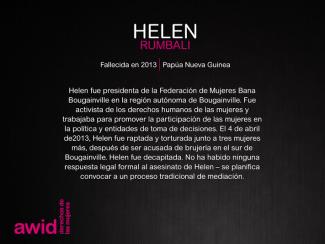
"He dado testimonio de la discriminación que vi en las calles, he sufrido burlas y abusos verbales ahí. También he hecho numerosas amistades y he conocido a mucha gente. Puede que haya peligros ahí fuera, pero soy una sobreviviente y aquí es donde estaré por ahora." - Sainimili Naivalu
Exigió a las autoridades políticas y a otras partes interesadas que proporcionaran políticas y servicios favorables a la movilidad de las personas con discapacidad, como la construcción de rampas en pueblos y ciudades para aumentar su accesibilidad. Sin embargo, las barreras físicas no fueron las únicas que Sainimili se esforzó por cambiar. Por experiencia propia, sabía que era necesario que se produjeran cambios más complejos en las esferas sociales y económicas. Muchos de los retos a los que se enfrentan las personas con discapacidad tienen su origen en actitudes que llevan a la discriminación y al estigma.
Como sobreviviente y luchadora, Sainimili contribuyó a la creación conjunta de realidades feministas que fomentasen la inclusión y cambiasen las actitudes hacia las personas con discapacidad. Como afiliada a la Asociación de Lesiones de la Espina Dorsal de Fiji (SIA, por sus siglas en inglés) y a través del proyecto del Foro para Personas con Discapacidades del Pacífico “Pacífico Habilita”, Sainimili asistió a la formación de la Organización Internacional del Trabajo "Inicie su Negocio" en Suva, lo que le permitió transformar sus ideas en su propio negocio. Fue emprendedora en el puesto 7 del mercado de Suva, donde ofrecía servicios de manicura, y también se encargaba del puesto del mercado de las mujeres de SIA, donde vendía artesanías, sulus y otros objetos. El plan de Sainimili era expandir su negocio y convertirse en una importante empleadora de personas con discapacidad.
Además de su activismo, también fue medallista y campeona juvenil de tenis de mesa.
Sainimili era única, con una personalidad vivaz. Siempre podías saber si Sainimili estaba en una habitación porque su risa y sus historias eran los primero que notabas. - Michelle Reddy
Sainimili falleció en 2019.
Опрос будет доступен до конца августа 2024 года. Пожалуйста, заполните его в течение этого срока, чтобы ваши ответы были включены в анализ.
Cinthia has collaborated with NGOs in Mexico, Peru, and Ecuador on projects related to human mobility, the environment, and political advocacy through transmedia storytelling and web development. She holds a Master’s in Visual Anthropology from FLACSO Ecuador and a degree in Animation and Digital Art from Tecnológico de Monterrey. She loves experimenting with code and visual media to craft new forms of storytelling and keep exploring the intersection between art, technology, and social change.
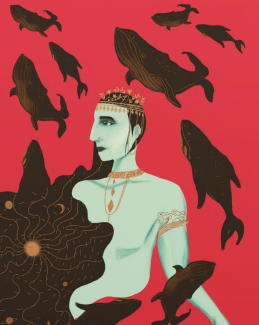
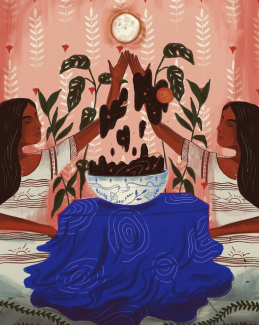
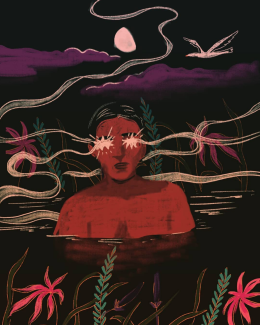
por Karina Ocampo
A un rincón escondido de Chiapas, México, llegamos mujeres y disidencias sexuales para organizar nuestras acciones. (...)
< arte: «Proyecto fotográfico: La muerte sale por el Oriente», de Sonia Madrigal