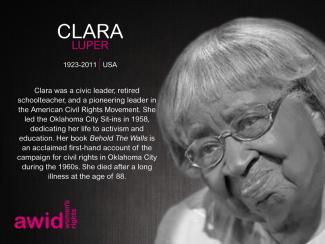
Clara Luper
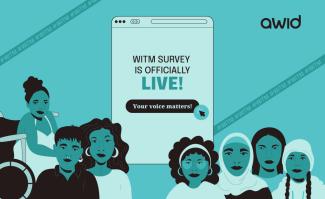
The “Where is the Money?” #WITM survey is now live! Dive in and share your experience with funding your organizing with feminists around the world.
Learn more and take the survey
Around the world, feminist, women’s rights, and allied movements are confronting power and reimagining a politics of liberation. The contributions that fuel this work come in many forms, from financial and political resources to daily acts of resistance and survival.
AWID’s Resourcing Feminist Movements (RFM) Initiative shines a light on the current funding ecosystem, which range from self-generated models of resourcing to more formal funding streams.
Through our research and analysis, we examine how funding practices can better serve our movements. We critically explore the contradictions in “funding” social transformation, especially in the face of increasing political repression, anti-rights agendas, and rising corporate power. Above all, we build collective strategies that support thriving, robust, and resilient movements.
Create and amplify alternatives: We amplify funding practices that center activists’ own priorities and engage a diverse range of funders and activists in crafting new, dynamic models for resourcing feminist movements, particularly in the context of closing civil society space.
Build knowledge: We explore, exchange, and strengthen knowledge about how movements are attracting, organizing, and using the resources they need to accomplish meaningful change.
Advocate: We work in partnerships, such as the Count Me In! Consortium, to influence funding agendas and open space for feminist movements to be in direct dialogue to shift power and money.
In the 30 years since the adoption of the Beijing Declaration & Platform for Action, a rising tide of fascisms is exerting significant power and influence within multilateral spaces, backpedalling gender justice gains and human rights protections globally.
Around CSW69, we're co-organizing horizontal, brave spaces on-ground and online, to share strategies and build feminist power beyond Beijing+30. Our collective presence disrupts institutional practices of exclusion in such spaces while supporting movements to organize around feminist alternatives to systems of oppression.
Join the conversations from March 10-21, 2025, as we collectively transform CSW69 into spaces for and about resistance and solidarity.
المستشفيات مؤسسات، ومواقع حيّة للرأسمالية، وما يحدث عندما يكون من المفترض أن يستريح شخصٌ ما ليس إلّا نموذجاً مصغّراً من النظام الأكبر.
Our collective presence disrupts institutional practices of exclusion in such spaces while supporting movements to organize around feminist alternatives to systems of oppression.
Join the conversations from March 10-21, 2025, as we collectively transform CSW69 into spaces for and about resistance and solidarity.
مع استمرار الرأسمالية الأبوية الغيريّة في دَفعِنا نحو الاستهلاكية والرضوخ، نجد نضالاتنا تُعزَل وتُفصَل عن بعضها الآخر من خلال الحدود المادّية والحدود الافتراضية على حدٍّ سواء.

Explore 150+ regularly updated funding opportunities in this searchable database, created in response to cuts in development aid. Filter by issue, region, funder type, and eligibility.
للجنسانيّة تدفّقات متعدّدة ومتبدّلة كحال الغمد الملتهب بين فخذَيّ
Our collective power, wisdom, and commitment have no boundaries, but our bank accounts do.
Data snapshots are based on the responses of 1,174 feminist, women’s rights, LGBTQI+, and allied organizations (hereafter referred to as “feminist and women's rights organizations”) from 128 countries to the Where is the Money for Feminist Organizing? survey.
The rights of the child (EU & GRULAC)
Birth registration and the right of all to recognition as a person before the law (Mexico, Turkiye)
Adequate housing as a component of the right to an adequate standard of living and the right to non-discrimination in this context (Germany, Finland)
Negative impact of unilateral coercive measures on the enjoyment of human rights (Non-Aligned Movement)
Effects of foreign debt and other international financial obligations on the enjoyment of human rights (mandate renewal) (Cuba)
Rights of persons with disabilities, digital technologies, and inclusive disability infrastructure (Mexico, New Zealand)
Rights of the child (focus: Children in armed conflict) (Uruguay on behalf of a group of States from Latin America and the Caribbean and European Union)
Right to work (Egypt, Greece)
Right to food (Cuba)
Promotion of the enjoyment of cultural rights of all and respect for cultural diversity (Cuba)
Human rights situation in the Occupied Palestinian Territory, including East Jerusalem and the obligation to ensure accountability and justice (Organisation of Islamic Cooperation)
Right of the Palestinian people to self-determination (Organisation of Islamic Cooperation)
Israeli settlements in the Occupied Palestinian Territory, including East Jerusalem and in the occupied Syrian Golan (Organisation of Islamic Cooperation)
AWID is pleased to share our 2016 Annual Report.
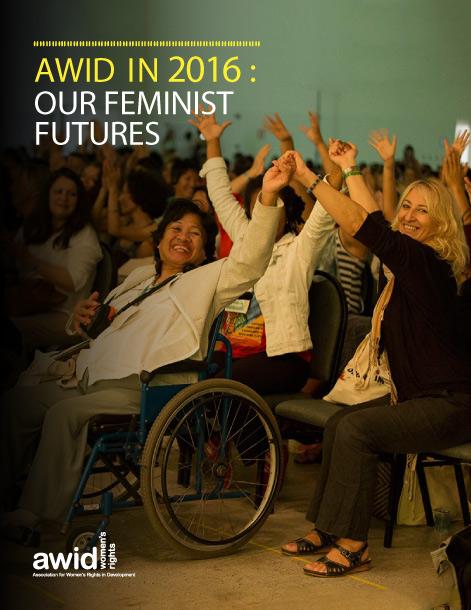
2016 was an incredible year for AWID, we convened the 13th International AWID Forum in Bahia, Brazil, a space for strategizing and alliance building with feminists and other justice movements, which was attended by over 1800 participants from 120 countries and territories across the globe.
We know that women’s rights and feminist movements are key actors in creating sustainable transformative change. Within our movements, organizing, resisting and responding to the challenging context is sharpening, and in our increasingly connected world, the potential for collective action across diverse movements has dramatically grown.
This is the crucial work that AWID seeks to amplify and support every day.
A highlight of 2016 was our ground-breaking 13th International Forum with the theme: “Feminist Futures: Building Collective Power for Rights and Justice”, where we harnessed the thinking and energy of nearly 500 partners, presenters, panelists, moderators, artivists, writers, facilitators, IT innovators, and performers, many of them leaders in their movements. We also supported the convening of the first and historical Black Feminisms Forum (BFF) organised by a working group of Black Feminists from across the world.
AWID, in partnership with other feminist and women’s rights organisations, engaged in advocacy and dialogue to explore better solutions for women’s rights agendas including our work with the Count Me In! consortium .
The experiences of women with disabilities, Black and Afro-descendant women, sex workers, Indigenous women, trans and intersex people, domestic workers and how their lives are impacted by multiple oppressions and violence were placed front and center of the Forum process.
We also launched the 2016 WHRD Tribute to commemorate defenders who are no longer with us, during the 16 Days of activism, and thanks to the contributions from our members,
We drove attention to groups and issues that do not usually receive adequate mainstream media coverage through our partnership with The Guardian and Mama Cash.
Movement Hubs are locally organized spaces where AWID member organizations come together to engage with global feminist processes from their own territories. The Hubs in Fiji and Georgia are organizing workshops and dialogue that connect to conversations at Women Deliver around feminist resourcing, intersectional solidarity, climate justice and collective care. Check out their program and follow AWID on social media for live updates!
Isabel is a feminist from the United Kingdom with over a decade of experience in feminist responses to fascisms, fundamentalisms, and anti-rights trends. At AWID, her work centers on knowledge-building and has included leading the production of the Rights at Risk series in collaboration with the Observatory on the Universality of Rights (OURs). She holds a Master’s degree in Gender Studies from the School of Oriental and African Studies (SOAS) and previously worked with Women Living Under Muslim Laws (WLUML). She is passionate about cross-movement work, movement-centered knowledge-building, and the use of creative expression to disrupt systems of oppression. Outside of work, Isabel is active in various disability justice spaces for collective care, learning, and advocacy.
WHRDs are self-identified women and lesbian, bisexual, transgender, queer and intersex (LBTQI) people and others who defend rights and are subject to gender-specific risks and threats due to their human rights work and/or as a direct consequence of their gender identity or sexual orientation.
WHRDs are subject to systematic violence and discrimination due to their identities and unyielding struggles for rights, equality and justice.
The WHRD Program collaborates with international and regional partners as well as the AWID membership to raise awareness about these risks and threats, advocate for feminist and holistic measures of protection and safety, and actively promote a culture of self-care and collective well being in our movements.
WHRDs are exposed to the same types of risks that all other defenders who defend human rights, communities, and the environment face. However, they are also exposed to gender-based violence and gender-specific risks because they challenge existing gender norms within their communities and societies.
We work collaboratively with international and regional networks and our membership
We aim to contribute to a safer world for WHRDs, their families and communities. We believe that action for rights and justice should not put WHRDs at risk; it should be appreciated and celebrated.
Promoting collaboration and coordination among human rights and women’s rights organizations at the international level to strengthen responses concerning safety and wellbeing of WHRDs.
Supporting regional networks of WHRDs and their organizations, such as the Mesoamerican Initiative for WHRDs and the WHRD Middle East and North Africa Coalition, in promoting and strengthening collective action for protection - emphasizing the establishment of solidarity and protection networks, the promotion of self-care, and advocacy and mobilization for the safety of WHRDs;
Increasing the visibility and recognition of WHRDs and their struggles, as well as the risks that they encounter by documenting the attacks that they face, and researching, producing, and disseminating information on their struggles, strategies, and challenges:
Mobilizing urgent responses of international solidarity for WHRDs at risk through our international and regional networks, and our active membership.
Michelle is a Southeast Asian feminist who enjoys conspiring to bring people together and spark conversations for social change and feminist knowledge sharing, through art, poetry, music and games. With a background in digital advocacy and communications strategy development, she has contributed to initiatives in digital rights, human rights research, and civil society coalition building throughout Southeast Asia. She has an LLB from National University of Singapore, enjoys following her feet down random city streets and likes coffee a little too much.
Khaoula Ksiksi is a passionate advocate for justice, equity, and liberation. As a Gender, Equality, Diversity, and Inclusion (GEDI) Advisor, she works to make inclusivity a lived reality, not just a policy, across humanitarian programs and crisis contexts. She collaborates with teams to challenge structural oppression using bold, transformative tools rooted in lived experience.
Her activism began on the frontlines of Tunisia’s anti-racism movement. With Mnemty, she helped push through the country’s first anti-discrimination law, forcing a national reckoning with racial injustice. She later co-founded Voices of Black Tunisian Women to amplify Black women’s leadership, build solidarity networks, and demand visibility in a society that often silences them.
Khaoula is also a founding member of Falgatna, a radical queer-feminist movement fighting for SOGIESC rights and supporting LGBTQI+ communities through direct action, digital resistance, and survivor-centered advocacy.
Previously, she led regional feminist and climate justice projects at the Rosa Luxemburg Foundation in North and West Africa.
At the heart of her work is a deep belief: no one is free until we all are. Her activism is both a fight and a love letter to her people, her communities, and the world we deserve.
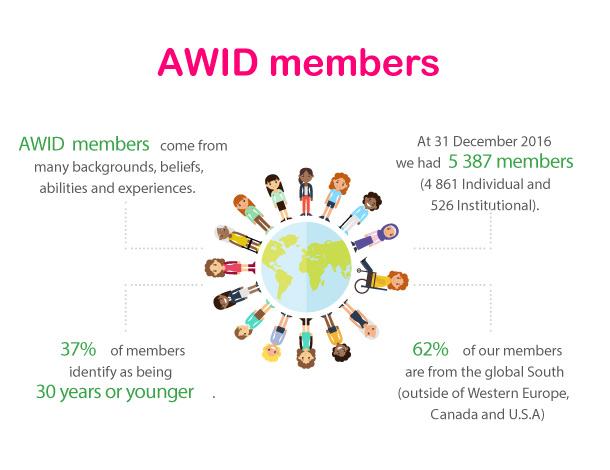
AWID currently has hundreds of prominent, innovative organizations working on issues related to women’s rights and development as members. Criteria for membership are the same as for individuals, although membership fees and membership benefits are different, and are geared to address the needs of our member organizations.