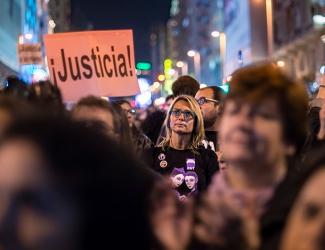
Adolfo Lujan | Flickr (CC BY-NC-ND 2.0)
Mass demonstration in Madrid on International Women's Day
Multitudinaria manifestación en Madrid en el día internacional de la mujer

Priority Areas

Supporting feminist, women’s rights and gender justice movements to thrive, to be a driving force in challenging systems of oppression, and to co-create feminist realities.

Advancing Universal Rights and Justice

Uprooting Fascisms and Fundamentalisms

Across the globe, feminist, women’s rights and gender justice defenders are challenging the agendas of fascist and fundamentalist actors. These oppressive forces target women, persons who are non-conforming in their gender identity, expression and/or sexual orientation, and other oppressed communities.


Discriminatory ideologies are undermining and co-opting our human rights systems and standards,  with the aim of making rights the preserve of only certain groups. In the face of this, the Advancing Universal Rights and Justice (AURJ) initiative promotes the universality of rights - the foundational principle that human rights belong to everyone, no matter who they are, without exception.

We create space for feminist, women’s rights and gender justice movements and allies to recognize, strategize and take collective action to counter the influence and impact of anti-rights actors. We also seek to advance women’s rights and feminist frameworks, norms and proposals, and to protect and promote the universality of rights.


Our actions

Through this initiative, we:

  • Build knowledge: We support feminist, women’s rights and gender justice movements by disseminating and popularizing knowledge and key messages about anti-rights actors, their strategies, and impact in the international human rights systems through AWID’s leadership role in the collaborative platform, the Observatory on the Universality of Rights (OURs)*.
  • Advance feminist agendas: We ally ourselves with partners in international human rights spaces including, the Human Rights Council, the Commission on Population and Development, the Commission on the Status of Women and the UN General Assembly.
  • Create and amplify alternatives: We engage with our members to ensure that international commitments, resolutions and norms reflect and are fed back into organizing in other spaces locally, nationally and regionally.
  • Mobilize solidarity action: We take action alongside women human rights defenders (WHRDs) including trans and intersex defenders and young feminists, working to challenge fundamentalisms and fascisms and call attention to situations of risk.  


Related Content

40 Years of AWID: The Scrapbook

Gather, Seed, and Disrupt.

In 2022, AWID celebrates 40 years since our founding. We’re using this moment to reflect on our past and learn from the road traveled as we prepare to look forward, and to forge the journey ahead. As we move through cycles of progress and pushback, we know that struggles for women’s rights and gender justice are iterative and non-linear. In collaboration with artist Naadira Patel, we created a scrapbook that highlights a handful of snapshots from AWID’s last four decades of feminist movement support.

We have not done all this on our own. We share this with deep appreciation for the constellation of feminist activists and groups that have made this work possible. In this context of so many converging crises, we embrace the opportunity to celebrate the power and resilience of feminist movements around the world.

Explore our scrapbook below:

You can also explore in full-screen mode.

Download the Scrapbook

Snippet - CSW69 On anti-rights resistance - EN

On anti-rights resistance

رسالة حب إلى الحركات النسوية # 6

عن الحب لحركة

Kraft paper envelop that says Love letters to feminist movements from Sara AbuGhazal

هكذا تبدأ الحركات
أشباحا تطردنا من البيت والعائلة والوطن
فنصل متعبات إلى مساحة (أيضا مكان) وغالبا حالة
وصلت إليها قبلنا نجمة سقطت
ربما نصل أكثر من متعبات
مذعورات
ربما أكثر من مذعورات نصل
غاضبات
من أمور لا تنفك تعيد نفسها
طعنة في القلب (أيضا كسور) 
رصاصة في الظهر (أيضا خيانة)
اختفاء قسري
جسد محكوم عليه بزواج أو تشويه أو تعب مزمن
لكننا حين نصل نتجمع ونهمس ونبوح وننوح
هكذا تبدأ حركاتنا، حين نصل إلى الأخريات
فنصبح بذورا
هكذا تبدأ الحركات، حين نزرع بعضا زهورا وأيضا أشواكا وأيضا ثمارا
نحن واحات
لنا كلنا نصنع منها ما نشاء
أغنيات للمعارك
وصفات للشفاء
مخازن لوجوه عشيقاتنا وشكل ابتسامتهن وضحكة انتصاراتهن اليومية
السر لتحويل الصمت الى لغة
تعاليم كل الساحرات
هكذا تكون حركاتنا: لنا كلنا
حين نصل بذورا فنزهر. 

سرى أبو غزال
www.badiya.blog

Snippet - Title WCFM Landing - EN

Who Can Fund Me?

Reclaim Power to #FreezeFascisms: Resources for Feminists to Survive & Thrive 

Feminist and gender justice movements continue to be chronically underfunded in the face of global funding cuts and freezes. Particularly in Global South regions with shrinking civic spaces, resource scarcity has impacted the most vulnerable communities. 

In the face of these setbacks, AWID has updated the Who Can Fund Me? Database - an easy-to-use, practical tool for movements looking for funders from philanthropic foundations, multilateral funders to women’s and feminist funds to support vital lifesaving efforts. 

Explore now Get the user guide

Coming Out at the Highest Point in My Life: The Black Feminisms Forum

Cover image for Coming Out at the Highest Point in My Life: The Black Feminisms Forum


Many participants experience the AWID Forums as a unique space of freedom where they are embraced and celebrated as they are. In a world where even the most privileged feminists often find themselves not fully fitting in, for those whose identities are criminalized or otherwise condemned in their everyday contexts this experience of freedom and celebration can be deeply transformative (and restorative). The story of how OluTimehin Kukoyi – a first time participant – experienced the Black Feminist Forum (BFF) and the AWID Forum in Bahia (2016) powerfully illustrates this.

Download this story


In their own voice: watch the interview with OluTimehin


View all stories Download Full Report

Snippet - WCFM getting the money we need - En

Getting the Money We Need | A 101 Guide on Fundraising for Small Grassroots Organizations

 From building prospect funders lists with *templates*, to understand  how to write a solid grant proposal, with ‘Getting the Money we Need’ Guide really we don't have to figure this out alone anymore

Read and download the guide hereText-only version

Also available in Arabic

WITM - Refreshed INFOGRAPHIC 1 EN

Ever wondered what budgets for feminist organizations look like?

In 2023, feminist and women's rights organizations had a median annual budget of USD 22,000. Behind that median lies disparity and inequality: while a few groups access large-scale resources, the vast majority survive on shoestring budgets. 
A closer look at actual budgets reveals major income diversity and inequality.

Explore the data on the size of feminist budgets 

Snippet - COP30 - Resistance Hubs Section Column 2 - EN

The following partners are organizing COP30 hubs:

  1. Caribbean Feminist Climate Justice Movement, Barbados
  2. Gender Interactive Alliance (GIA), Pakistan
  3. Women’s Initiative for Sustainable Environment (WISE), Nigeria
  4. Réseau des Acteurs du Développement Durable (RADD)*, Cameroon
  5. MASIPAG, The Phillippines

*Website in French

COP30: Homepage Banner

COP30: Reclaim climate action from corporate capture

As world leaders gather in Brazil, feminist movements are advocating, gathering and disrupting the status quo- at COP30 and beyond! We're heading alongside other feminists to Belém, Brazil for COP30, from 10 November – 21 November 2025, where we will continue to denounce false solutions. 

Learn more!

Young Feminist Activism

Organizing creatively, facing an increasing threat

Young feminist activists play a critical role in women’s rights organizations and movements worldwide by bringing up new issues that feminists face today. Their strength, creativity and adaptability are vital to the sustainability of feminist organizing.

At the same time, they face specific impediments to their activism such as limited access to funding and support, lack of capacity-building opportunities, and a significant increase of attacks on young women human rights defenders. This creates a lack of visibility that makes more difficult their inclusion and effective participation within women’s rights movements.

A multigenerational approach

AWID’s young feminist activism program was created to make sure the voices of young women are heard and reflected in feminist discourse. We want to ensure that young feminists have better access to funding, capacity-building opportunities and international processes. In addition to supporting young feminists directly, we are also working with women’s rights activists of all ages on practical models and strategies for effective multigenerational organizing.

Our Actions

We want young feminist activists to play a role in decision-making affecting their rights by:

  • Fostering community and sharing information through the Young Feminist Wire. Recognizing the importance of online media for the work of young feminists, our team launched the Young Feminist Wire in May 2010 to share information, build capacity through online webinars and e-discussions, and encourage community building.

  • Researching and building knowledge on young feminist activism, to increase the visibility and impact of young feminist activism within and across women’s rights movements and other key actors such as donors.

  • Promoting more effective multigenerational organizing, exploring better ways to work together.

  • Supporting young feminists to engage in global development processes such as those within the United Nations

  • Collaboration across all of AWID’s priority areas, including the Forum, to ensure young feminists’ key contributions, perspectives, needs and activism are reflected in debates, policies and programs affecting them.

Related Content

Reason to join 2

Find and create connections. There are over 9,000 AWID members, all working to address complementary, interconnected issues. This diversity supports the sustainability of feminist movements and actors.