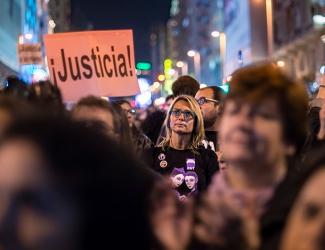
Adolfo Lujan | Flickr (CC BY-NC-ND 2.0)
Mass demonstration in Madrid on International Women's Day
Multitudinaria manifestación en Madrid en el día internacional de la mujer

Priority Areas

Supporting feminist, women’s rights and gender justice movements to thrive, to be a driving force in challenging systems of oppression, and to co-create feminist realities.

Advancing Universal Rights and Justice

Uprooting Fascisms and Fundamentalisms

Across the globe, feminist, women’s rights and gender justice defenders are challenging the agendas of fascist and fundamentalist actors. These oppressive forces target women, persons who are non-conforming in their gender identity, expression and/or sexual orientation, and other oppressed communities.


Discriminatory ideologies are undermining and co-opting our human rights systems and standards,  with the aim of making rights the preserve of only certain groups. In the face of this, the Advancing Universal Rights and Justice (AURJ) initiative promotes the universality of rights - the foundational principle that human rights belong to everyone, no matter who they are, without exception.

We create space for feminist, women’s rights and gender justice movements and allies to recognize, strategize and take collective action to counter the influence and impact of anti-rights actors. We also seek to advance women’s rights and feminist frameworks, norms and proposals, and to protect and promote the universality of rights.


Our actions

Through this initiative, we:

  • Build knowledge: We support feminist, women’s rights and gender justice movements by disseminating and popularizing knowledge and key messages about anti-rights actors, their strategies, and impact in the international human rights systems through AWID’s leadership role in the collaborative platform, the Observatory on the Universality of Rights (OURs)*.
  • Advance feminist agendas: We ally ourselves with partners in international human rights spaces including, the Human Rights Council, the Commission on Population and Development, the Commission on the Status of Women and the UN General Assembly.
  • Create and amplify alternatives: We engage with our members to ensure that international commitments, resolutions and norms reflect and are fed back into organizing in other spaces locally, nationally and regionally.
  • Mobilize solidarity action: We take action alongside women human rights defenders (WHRDs) including trans and intersex defenders and young feminists, working to challenge fundamentalisms and fascisms and call attention to situations of risk.  


Related Content

Snippet - CSW69 - What Can Feminist Movements Learn - EN

What Can Feminist Movements Today Learn from Beijing 1995?

✉️ By registration only. Register here 

📅 Wednesday, March 12, 2025
🕒 6.30–8:00pm EST

🏢 Church Center of the United Nations, 777 United Nations Plaza, New York, NY 10017

🎙️Co-facilitated by: Inna Michaeli, Co-Executive Director

Organizer: Jass, Gender at Work, and Count Me In! Consortium

Snippet - WCFM Movement and Struggle - EN

Movement in focus:

Filter your search by funders’ priority support areas that speak to your organizing efforts

Snippet - WITM INFOGRAPHIC_1_EN_2 Annual budget size

In 2023, feminist and 
women's rights organizations 
had a median annual budget of

In contrast, over $1 billion went 
to three anti-rights groups in 2021-2022, 
with funding for anti-gender networks still rising.

Body

Resources to support feminist movements, policy-makers, and allies!

Snippet - COP30 - 6th International Rights of Nature Tribunal - EN

6th International Rights of Nature Tribunal: A New Pledge for Mother Nature

Where frontline organizers lead and corporations are held accountable.

📅 Tuesday, November 11, 2025
📍 Online and at the Universidade Federal do Pará, Belém

More info here

Body

Snippet - COP30 - Partner intro - EN

This campaign is held by 8 partner organizations across continents, building feminist alternatives to the climate crisis, ecocides and genocides.

English article

English article created from Spanish site

Snippet - Intro WD2026_EN

Co-Creating a Political Home for Feminist Movements

From 27 - 30 April, 2026, AWID will be at the Women Deliver 2026 Conference, co-creating a political home with feminist and gender justice movements that is rooted in transnational care and solidarity. 

In a time when fascism and militarization continue to rise globally, feminist connection and solidarity across borders is what we truly need.  We are organizing multiple spaces at Women Deliver and online to connect movements with each other in conversations to build feminist agendas of solidarity and action. 

2. Frame your research

A framework for your research will guide throughout your research process, and the framing document you develop can also serve as a concept note to advisors and partners, and a funding proposal to potential donors.

Before conducting any research:

Your research framing may evolve over time as you refine your questions and gather new information. However, building an initial research framing will allow you to work from a solid foundation.


Goals

To create a strong foundation for your WITM research, it is important to clarify what you hope to accomplish.

For example, one goal of AWID’s WITM global research was to provide rigorous data to prove what we already knew anecdotally: that women’s rights organizations are discrepantly underfunded. With this data, we felt we would be better positioned to influence funders in their decision-making.

Your goals could be to:

  • Generate hard data on funding realities and trends to prove or disprove existing myths.
  • Gain deeper insight into differences between the perspectives of donors and women’s rights organizations.
  • Influence donors in grant-making.
  • Add crucial input to key funding debates.
  • Explore collaboration between donors and women’s rights organizations on issues that emerge from the research.

Back to top


Key questions

Frame your research process with key questions that only your research can answer and limit those questions to a specific time frame (e.g. past five years, past year, etc.).

Consider the following points:

  • What exactly do you want to learn more about and what is the hypothesis you would like to test? Writing this out will assist you in your thought process.
  • Is there existing research on this? If research already exists, it may not make sense to conduct new WITM research unless you feel like the existing research is not extensive or specific enough.  
  • What time frame do you want to cover in your analysis? For example, will your research analyze only the past year, or several previous years, such as the past five years?
  • Are you planning to repeat your survey to collect data in the future?

Choosing a specific timeframe for your research can result in more precise findings than working with an open-ended timeframe. Also, deciding whether you will repeat this research at regular intervals will allow you to set up data collection benchmarks for easy replication and comparison over time.

These were the key questions that guided AWID’s WITM research process:

  • What is the current state of women’s organizations’ financial sustainability across the world?
  • What external and internal trends are impacting donors’ funding decisions to support women’s organizations and movements?

Back to top


Type of data

Now that you determined your key questions, you can determine what kind of data will help you answer your key questions. This will allow you to plan the rest of your schedule for your WITM research.

For example, will you conduct a survey that covers an extensive portion of your priority population? Will you analyze the applications that funders are receiving from a certain region? Will you also conduct interviews (recommended)? By determining the types of data you need, you can reach out to external parties who will provide this data early on, and plot out your full schedule accordingly. Some suggested sources of data could be:

  • Surveys you create for women’s rights organizations and donors
  • Application and grantmaking data from donors funding cycles
  • Interviews of prominent activists, organizations, and donors
  • Donor data from membership organizations and networks, such as  the Foundation Center, regional or national donor affinity groups.

Diverse data sets are a great way to create robust and rich analysis.

The data from AWID’s 2011 Global Survey formed the backbone of our analysis in Watering the Leaves, Starving the Roots report. However, we also collected data from interviews and interactions with several actors in the field, ranging from donors to activists and women’s rights organizations.

Back to top


Final products

In addition to allowing you to set your schedule, creating an initial plan of what products you will develop will also allow you to work out what resources you need.

For example, will you only produce a long research report or will you also create infographics, brochures and presentations? Depending on your products, you may need to hire a design firm, plan events and so on.

These products will also be the tools you use to achieve your goals, so it is important to keep those goals in mind. For example, is your WITM research exclusively intended as an advocacy tool to influence funders? In that case, your products should allow you to engage with funders at a deep level.

 Some sample products:

  • Long report for dissemination with key funders and organizations.
    Historically, AWID WITM research has centered on a long report, from which AWID distilled other smaller products  - see rest of list.
  • Infographic for viral distribution online
  • Short animation demonstrating key findings
  • Short brochure(s) distilling your findings and messages
  • Articles and blog posts on key findings to draw interest to your larger report
  • Seminars or webinars presenting key findings.

Back to top


Conclusion: Framing your research will give you the big picture

Framing your research to cover goals, key questions, types of data, and final products will allow you to create a well-planned schedule, prepare your resources in advance, and plan a realistic budget.

This will make interactions with external partners easier and allow you to be nimble when unexpected setbacks occur.


Previous step

1. Gather your resources

Next step

3. Design your survey


Estimated time:

• 1 month

People needed:

• 1 or more Research person(s)

Resources available:

AWID Research Framing: sample 1
AWID Research Framing: sample 2


Previous step

1. Gather your resources

Next step

3. Design your survey


Ready to Go? Worksheet

Download the toolkit in PDF

AWID Forum: Co-creating Feminist Futures

In September 2016, the 13th AWID international Forum brought together in Brazil over 1800 feminists and women’s rights advocates in a spirit of resistance and resilience.

This section highlights the gains, learnings and resources that came out of our rich conversations. We invite you to explore, share and comment!


What has happened since 2016?

One of the key takeaways from the 2016 Forum was the need to broaden and deepen our cross-movement work to address rising fascisms, fundamentalisms, corporate greed and climate change.

With this in mind, we have been working with multiple allies to grow these seeds of resistance:

And through our next strategic plan and Forum process, we are committed to keep developing ideas and deepen the learnings ignited at the 2016 Forum.

What happens now?

The world is a much different place than it was a year ago, and it will continue to change.

The next AWID Forum will take place in the Asia Pacific region (exact location and dates to be announced in 2018).

We look forward to you joining us!

About the AWID Forum

AWID Forums started in 1983, in Washington DC. Since then, the event has grown to become many things to many peoples: an iterative process of sharpening our analyses, vision and actions; a watershed moment that reinvigorates participants’ feminisms and energizes their organizing; and a political home for women human rights defenders to find sanctuary and solidarity.

Learn more about previous Forums

Related Content

Vie Féminine et Handicap : lutter contre les discriminations au Sénégal

Vie Féminine et Handicap : lutter contre les discriminations au Sénégal

L’association Vie Féminine et Handicap est devenue membre de l’AWID en 2008 « pour mieux défendre nos idées, mieux sensibiliser sur les discriminations dont les femmes en situation de handicap sont victimes en Afrique et offrir une meilleure visibilité de nos actions », confie la Présidente de l’association, Ndoya Kane. 


Prendre en compte les besoins spécifiques des femmes en situation de handicap 

Créée en 2008, Vie Féminine et Handicap se donne pour mission de lutter contre la pauvreté des femmes en situation de handicap au Sénégal et de façon plus globale sur tout le continent africain. Dans le cadre d’une vision où le handicap ne devrait pas constituer un frein à la dignité et au bien-être des femmes, l’association se donne pour objectifs principaux de lutter contre la pauvreté, les Infections Sexuellement Transmissibles et le Sida chez les femmes en situation de handicap, tout en renforçant leur accès aux nouvelles technologies de l’information. 

Vie Féminine et Handicap a été créée pour que les problématiques des femmes handicapées soient gérées à partir d’une perspective qui prenne en compte leurs besoins spécifiques, liés à la fois à leurs statuts de femme et de personne handicapée, et pour que leur situation économique évolue de façon positive et que la société soit mieux sensibilisée aux questions du handicap sans préjugés négatifs. 
Constituée d’une cinquantaine de membres et agissant principalement sur les départements de Pikine et de Guédiawaye dans la région de Dakar, Vie Féminine et Handicap entreprend des activités de sensibilisation et de formation des femmes en situation de handicap ainsi que de plaidoyer envers les autorités, qui portent à la fois sur la question de l’exercice des droits humains des femmes handicapées, leur pouvoir économique et leur santé sexuelle et reproductive.  « Nous organisons des activités de sensibilisation sur le handicap dans les quartiers en y invitant les autorités communales, les jeunes et les personnes « valides » car le handicap est entouré de beaucoup de préjugés négatifs dans la culture sénégalaise et africaine en général. Nous participons aussi à des conférences aux niveaux africain et international pour débattre de la situation des femmes handicapées en Afrique et dans le monde pour une meilleure harmonisation de nos stratégies », souligne Ndoya Kane.

« Sans faire preuve de solidarité, sans comprendre que notre combat n’est pas mené pour défendre les intérêts d’une seule organisation de personnes handicapées, mais de tou-te-s, nous n’obtiendrons jamais de résultats. Toutes les organisations de personnes handicapées doivent comprendre que le combat que nous menons est plus important que les rivalités internes et que nous devons avancer ensemble pour réussir à obtenir des résultats durables », expliquait Ndoya Kane en 2010 dans un rapport de l'AWID.

Mutualisation des ressources et autofinancement des membres

L’association a mis en place depuis février 2010 une caisse d’autofinancement (CAF), qui consiste à mettre en commun les cotisations des membres pour permettre à chacune de disposer de financements de petits projets personnels et d’initier des activités génératrices de revenus pour ses membres, axées notamment autour du petit commerce. L’idée de créer cette CAF est née de la volonté des membres elles-mêmes, qui constituent un groupe très précaire disposant de faibles ressources économiques et dont l’accès aux crédits formels s’avère par conséquent impossible.

La CAF a par exemple permis à Marétou Diop, une habitante de Guédiawaye, d’ouvrir une boutique dans le marché de son quartier pour y vendre des denrées alimentaires. « Maintenant, les autres femmes viennent adhérer à notre Caisse d’Autofinancement pour trouver du crédit et financer leurs activités », souligne Ndoya Kane. 

« Les discussions de groupe sont d’autant plus importantes qu’elles permettent de nous retrouver entre femmes handicapées et renforcent la confiance chez certaines pour parler de leur condition de femme en toute aisance. Nous choisissons ensemble quel problème existe et essayons d’avoir recours à des spécialistes pour nous entretenir sur la question », raconte Ndoya Kane.

Source
AWID

Feminine Life and Disability: Fighting against the discrimination in Senegal

Feminine Life and Disability: Fighting against the discrimination in Senegal

The organization Vie Féminine et Handicap (Feminine Life and Disability) became an AWID member in 2008 “to better defend our ideas, to better promote awareness of the discrimination faced by women living with disability in Africa, and to increase visibility of our work,” says President of the organization, Ndoya Kane. 


Considering the specific needs of women living with disability

Launched in 2008, the mission of Vie Féminine et Handicap is to fight against poverty among women living with disability in Senegal and globally, but especially across the African continent. With a vision where disability is no longer a barrier to a woman’s dignity or well-being, the main objectives of the organization are to combat poverty, sexually transmitted infections, and AIDS among women living with disability, while strengthening their access to new information technologies.    

Vie Féminine et Handicap was created to address the issues of disabled women from a perspective that considers their specific needs, related to both their status as a woman and as a person living with a disability – and to ensure that their economic situation evolves in a positive way and to better sensitize society to disability issues without the negative prejudice. 

Comprised of some fifteen members and working mainly across the Pikine and Guédiawaye departments in the Dakar region, the work of Vie Féminine et Handicap includes awareness raising and training for women living with disability, as well as advocacy with decision-makers around the human rights of women living with disability, their economic empowerment, and their sexual and reproductive health. “We do awareness raising on the issue of disability in neighbourhoods by inviting community authorities, youth and ‘able-bodied’ people, because disability is surrounded by a lot of negative prejudice in the Senegalese and African context in general. We also participate in conferences at the African and International level to discuss the situation of disabled women in Africa and around the world to better align our strategies,” highlights Kane. 

 “Without solidarity, without an understanding that the fight that we lead is not done in the interest of a sole disabled people’s organization, but in the interest of all, we will never achieve any results. Each disabled people’s organization to understand that the fight that we lead outweighs the competition and that we have to go forward together to succeed in getting long lasting results,” explained Ndoya Kane in 2010, in a repport produced by AWID

Pooling resources and the self-financing of members

Since February 2010, the organization has established a self-financing fund, which consists of pooling member contributions to allow each one to finance small personal projects and to initiate income-generating activities for its members, mainly focused on small business. The idea to create the fund originated from our members themselves, a vulnerable group with limited economic resources and for which access to credit is nearly impossible.

The Fund for example allowed Marétou Diop, a resident of Guédiawaye, to open a shop in her neighbourhood market and sell foodstuffs. “Now the other women are joining our self-financing fund to receive credit and finance their activities,” highlights Ndoya Kane.  

“Group discussions are even more important as they give us the opportunity to meet among women living with disability and build confidence in some to comfortably talk about the issues they face as women. Together we decide which challenges exist and try to engage specialists in addressing the issue,” says Kane.    

Source
AWID

Género y discapacidad: la lucha contra la discriminación en Senegal

Género y discapacidad: la lucha contra la discriminación en Senegal

La organización Vie Féminine et Handicap [vida femenina y discapacidad] se afilió a AWID en el año 2008. La Presidenta de la organización, Ndoye Kane, afirma que esto se hizo  « con el fin de defender mejor nuestras ideas, mejorar la concientización  sobre la discriminación experimentada por las mujeres que viven con discapacidad en África y para dar mayor visibilidad a nuestro trabajo». 


Tener en cuenta las necesidades específicas de las mujeres que viven con discapacidad

Vie Féminine et Handicap comenzó a operar en 2008 y su misión es luchar contra la pobreza que sufren las mujeres que viven con discapacidad en Senegal y en todo el mundo –aunque   especialmente en el continente africano. En su visión, la discapacidad dejar de ser una barrera para la dignidad o el bienestar de las mujeres. Los principales objetivos de la organización son la lucha contra la pobreza, las infecciones de transmisión sexual y el sida entre las mujeres que viven con diversidad funcional, fortaleciendo su acceso a las nuevas tecnologías de la información.

Vie Féminine et Handicap se creó para abordar cuestiones relevantes a las  mujeres con diversidad funcional — desde una perspectiva que toma en cuenta sus necesidades específicas como mujeres y personas que viven con una discapacidad —;   para garantizar que su situación económica evoluciona de manera positiva;  y para mejorar la sensibilidad social a temas relacionados con la discapacidad, eliminando los prejuicios negativos.

La organización cuenta con 15 integrantes y trabaja, principalmente,  en los departamentos de Pikine y Guédiawaye de la región de Dakar. Su tarea incluye crear conciencia y capacitar a mujeres que viven con diversidad funcional;  y también hacer incidencia con tomadores de decisión por los derechos humanos de las mujeres que viven con discapacidad, su empoderamiento económico y su salud sexual y reproductiva. «Creamos conciencia sobre el tema de la diversidad funcional en las comunidades, invitando a las autoridades, a la juventud y a las personas sin discapacidades, porque en Senegal y en el contexto africano hay, por lo general, muchos prejuicios negativos en torno a las capacidades diferentes. También participamos en conferencias regionales e internacionales para hablar de la situación de las mujeres discapacitadas en África y en el mundo; y para alinear mejor nuestras estrategias», subraya Kane.

«Sin solidaridad, sin una comprensión de que la lucha que nosotras lideramos no es para una sola organización de personas discapacitadas, sino para todas, nunca lograremos ningún resultado. Cada organización de personas con diversidad funcional debe comprender que la lucha que estamos librando es más importante que la competencia y que debemos avanzar juntas para seguir obteniendo resultados duraderos.», explicó Ndoya Kane,  en el 2010 en un informe de AWID.

Recursos combinados y el financiamiento autónomo de la membresía

En febrero de 2010, la organización creó un fondo de autofinanciamiento,  que combina los aportes de su membresía para que cada integrante financie pequeños proyectos personales y para iniciar actividades de generación de ingresos, particularmente bajo la forma de pequeños negocios. La idea de crear este fondo surgió de la propia membresía –un  grupo vulnerable con recursos económicos limitados y para  el que resulta casi imposible acceder al crédito.

Un ejemplo de este trabajo es la historia de Marétou Dio, quien vive en Guédiawaye: el fondo le permitió instalar un puesto en el mercado de su comunidad y vender productos alimenticios. «Ahora hay mujeres que se están sumando a nuestro fondo autofinanciado para obtener crédito y costear sus actividades», indica Ndoya Kane.

«Las conversaciones grupales son todavía más importantes porque  abren la oportunidad de reunirnos con otras mujeres que viven con discapacidad y  generar relaciones de confianza para hablar cómodamente sobre los problemas que nosotras enfrentamos. Decidimos colectivamente cuáles son los desafíos que afrontamos e intentamos traer especialistas para abordarlos», explica Kane.

Source
AWID

Movilización por las mujeres y las niñas víctimas de la violencia de la guerra en RDC

Movilización por las mujeres y las niñas víctimas de la violencia de la guerra en RDC

La organización Initiatives des Femmes en Situations Difficiles pour le Développement Intégré [Iniciativas de las mujeres en situaciones precarias por el desarrollo integrado] se afilió a AWID en 2012 porque consideraron que era «una red a través de la cual IFESIDI podía beneficiarse de la enorme experiencia acumulada en la promoción y la protección de los derechos de las mujeres».


«¡Juntas en la lucha por los derechos de las mujeres y las niñas!»

Durante más de veinte años, las guerras que afectaron a la República Democrática del Congo (RDC) han sido la causa de violaciones masivas a los derechos humanos —especialmente los derechos de las mujeres, las adolescentes y la niñez—, entre ellas la violación y otras formas de violencia contra mujeres y niñas. La apropiación de sus recursos y su consiguiente empobrecimiento, así como el estar en situaciones de vulnerabilidad como desplazadas tras ataques contra sus aldeas, son todos factores que contribuyen a la situación precaria en que viven las mujeres y las niñas. Frente a esa realidad, IFESIDI fue creada en 2002 para mejorar la situación social de las mujeres y niñas víctimas de la violencia relacionada con la guerra, incluidas aquellas que viven en zonas rurales, y para promover y proteger sus derechos. Esta organización no confesional y sin fines de lucro está formada por 35 integrantes; sus actividades cubren al menos la totalidad de la provincia de Kivu Sur, en el este de la RDC. Con el lema «¡Juntas en la lucha por los derechos de las mujeres y las niñas!», IFESIDI espera que las congoleñas de todas las edades puedan vivir con dignidad algún día.

Fortalecer las capacidades económicas y educativas de las mujeres víctimas de la guerra

Además de servicios de consejería para mujeres y niñas víctimas de violencia en diferentes esferas —doméstica, académica y profesional—, IFESIDI está implementando un programa de desarrollo de capacidades económicas y educativas para mujeres víctimas de la guerra. Este programa incluye capacitación laboral, como la fabricación artesanal de jabón, y corte y confección.

Una de las beneficiarias del programa explica: «Antes de que IFESIDI me invitara y me capacitara, yo acarreaba bolsas pesadas de arena para los trabajadores de la construcción en la ciudad de Bukavu y me pasaba el día entero yendo y viniendo con esas bolsas en la espalda. Como mujer desplazada que vivía sin recursos financieros en esta ciudad, no tenía esperanza de seguir viviendo y nadie me miraba al pasar a mi lado... Pero hoy, gracias a IFESIDI, puedo hablar, y cuando paso la gente sabe que «Ahí va la ‘'mamá’ Ponga Musema ».

Movilización como parte de los 16 Días de activismo

Como parte de la campaña «16 Días de activismo contra la violencia de género», que comienza el 25 de noviembre y termina el 10 de diciembre, IFESIDI está organizando actividades para crear conciencia, un panel de debate, estrategias de incidencia, intercambios y una evaluación con las mujeres y las niñas con las que trabaja la organización.


Conéctate:

Source
IFESIDI

Pour les femmes et les filles victimes de violences de guerre en RDC

Pour les femmes et les filles victimes de violences de guerre en RDC

L’association Initiatives des Femmes en Situations Difficiles pour le Développement Intégré (IFESIDI) est devenue membre de l’AWID en 2012, considérant cette dernière comme « un réseau à travers lequel l’IFESIDI pourrait bénéficier de beaucoup d’expériences dans le cadre de promotion et de protection des droits des femmes. »


« Ensemble dans la lutte pour les droits des femmes et des filles ! »

Depuis plus de vingt ans, les guerres frappant l’Est de la République démocratique du Congo (RDC) sont à l’origine de violations massives de droits humains – notamment ceux des femmes, des filles et des enfants – incluant des viols et d’autres formes de violences faites aux femmes et aux filles. La situation précaire des femmes et des filles se trouve exacerbée par l’appropriation de leurs ressources, leur paupérisation conséquente ainsi que par leur mise en situation de vulnérabilité liée aux déplacements, suite aux attaques dans leur village. Face à cette réalité, IFEDISI s’est créée en 2002 pour améliorer les conditions sociales des femmes et des filles victimes de violences liées aux guerres, notamment de celles qui vivent en milieu rural, ainsi que pour promouvoir et protéger leurs droits. Cette association non confessionnelle et à but non lucratif est composée de 35 membres et ses activités couvrent au moins toute la province du Sud Kivu à l’Est de la RDC.  Porteuse du slogan « Ensemble dans la lutte pour les droits des femmes et des filles ! »,  IFEDISI souhaite que les femmes et les filles congolaises puissent vivre un jour dans la dignité.

Renforcement des capacités économiques et éducatives des femmes victimes de guerre

En plus de ses activités d’écoute des femmes et des filles victimes de violences dans divers milieux – notamment domestique, scolaire et professionnel –, l’association mène actuellement un programme de renforcement des capacités économiques et éducatives des femmes victimes de guerre. Ce programme comprend des activités d’apprentissage de métiers, liés entre autres à la savonnerie artisanale, la coupe de tissu et la couture.

L’une des bénéficiaires du programme raconte : « Avant d’être  invitée par l’IFESIDI et d’être formée, je transportais de lourds sacs de sable pour les constructeurs de bâtiments dans la ville de Bukavu et faisais des vas-et-viens avec ces sacs sur mon dos à longueur de journée.  Femme déplacée que je suis dans cette ville, sans ressources financières, j’étais sans aucun espoir de pouvoir continuer à vivre et personne ne me regardait quand je passais… Mais aujourd’hui, grâce à l’IFESIDI, je peux parler, je peux passer et les gens sauront que c’est  « mama » Ponga Musema qui passe ! »

Mobilisée dans le cadre des 16 jours d’activisme 

Dans le cadre de la Campagne des 16 jours d’activisme contre la violence basée sur le genre qui débute le 25 novembre et se termine le 10 décembre, l’IFESIDI organise cette année des activités de sensibilisation, conférence-débat, stratégies de plaidoyer, échanges et évaluation en présence des femmes et des filles ciblées par l’association.


Connectez-vous:

Source
IFESIDI

Agroecology and Food Sovereignty

Context

The search for alternative means of food production based on environmental sustainability is gaining ground across regions. This worldwide search comes with a common characteristic: the need to involve rural people and particularly women, building on their local priorities and knowledge by employing the principle of agroecology.

Definition

Agroecology is a way of practicing agriculture or using technologies that do not harm the environment. It proposes breaking with the hegemonic rural development model based on large landed estates and single-crop plantations that benefit mostly agricultural businesses and entrenches social exclusion.   

In family farming, agroecology manifests as a resistance to the current development model and its social, cultural, environmental, and economic problems. It opposes the lack of the farmer’s financial capital autonomy; and it symbolizes a resistance to the current agribusiness model.

Feminist perspective

Efforts based solely on agroecology may not be sufficient to solve all problems of women’s marginalization and invisibility. A feminist perspective is then crucial to analyze the norms associated with the idea of family as currently constituted as the perfect institution, as well as with the condition of women’s subordination.

In simpler terms, it is important to include in this debate a reflection on socially constructed gender roles to advance the emancipatory potential of agroecology.


Learn more about this proposition

Part of our series of


  Feminist Propositions for a Just Economy

Seven feminist policy recommendations to curb illicit financial flows

The growing dominance of international financial markets and institutions in defining global economic policies has resulted in the capture of people’s power in the interest of global elites and big corporations. 


Our policy brief on Illicit Financial Flows explores their disproportional gender impact and unveils the current legal and political frameworks that allow multinational corporations to benefit from tax abuse to the detriment of people and planet.

The brief concludes with these seven feminist policy recommendations to demand transparency and corporate accountability in order to curb illicit financial flows.


Our recommendations for advocacy

Illicit financial flows are gaining unprecedented attention: whether in development negotiations, like those leading to Agenda 2030 and the Addis Ababa Financing for Development Conference in 2015; or making headlines in mainstream media with the release of leaked documents on offshore finance known as the ‘Panama Papers’. In another example, the Ecuadorean people voted to bar politicians and civil servants from having assets, companies or capital in tax havens, in a referendum in February 2017. The Ecuadorian government is now a leading voice within the group of G77, in the United Nations, to create a UN global tax body to end tax havens.

This public attention potentially builds momentum for feminists, social movements and tax justice advocates to pressure for the transformation of the global financial system, which entrenches global inequalities, including gendered inequalities.

We offer below a set of seven policy asks as a contribution to growing advocacy efforts from social justice, feminist, women’s rights and gender equality actors:

1.  Address IFFs as a violation of human rights and women’s rights:

  • Illicit financial flows are hindering the fulfillment of the obligation of States to mobilise the maximum available resources for the realisation of human rights, including long agreed commitments on women’s rights and gender equality.
  • Strengthening corporate accountability is a possibility on the table at the UN Human Rights Council. An open-ended intergovernmental working group is in place to elaborate an international legally binding instrument to regulate, in international human rights law, the activities of transnational corporations and other business enterprises. This process has the potential to address corporate tax evasion as a violation of human rights, including women’s rights, and should be greater supported by countries in the global North and South.

2.  Ensure multinational corporations pay their share of taxes:

  • Develop international mechanisms that curb abusive tax practices and prevent corporate tax exemptions. UN member states should initiate negotiations to draft a UN convention to combat abusive tax practices. The convention should adopt a consolidation and apportionment system for taxing global corporate profits.
  • Revise specifically national regulations in wealthy countries that demand MNCs pay taxes only in the resident country, rather than in the countries of economic activity. This practice hinders developing countries the most, as they increasingly lose taxable base to low and zero tax jurisdictions. Proposals like the Unitary Taxation approach should be considered in this regard.

3.  Support the establishment of a United Nations intergovernmental tax body:

  • A UN tax body with equal voting rights and universal membership should have the power to review national, regional and global tax policy and ensure states comply with long agreed commitments on human rights, including women’s rights and gender equality.

4.  Promote transparency and gender-sensitive data gathering:

  • Greater efforts must be made at the global level to refine comparable data on tax abuse, for example with gender disaggregated data that shows the gender biases of certain tax systems.
  • Countries must ensure a framework for automatic information exchange, which guarantees public and global access to key data that affects the resources available for the realization of human rights.
  • Implement country-by-country reporting obligations for multinational corporations to publicly disclose, as part of annual reports, profits made and taxes paid for each country in which they operate.
  • Among other financial information, there must be greater cooperation from governments to share their national public registries that disclose beneficial owners of companies, trusts, foundations and similar legal structures.

5.  Promote tax justice through progressive fiscal policies at the national level:

  • Promote tax justice through progressive fiscal policies. This requires increasing the weight of direct taxes on income capital and highly profitable sectors of society, while reducing and removing the burden on women and poor people. Poor segments of society, of which women are overrepresented, should not end up paying more taxes, in relation to their income, than the richest segments that often benefit from government tax subsidies, tax holidays and reductions.
  • Governments must critically review the harmful trade and investment agreements that grant tax incentives and exemptions that perpetuate inequality and gender biases.

6.  Ensure participation of women’s rights organisations, social movements and progressive civil society broadly:

  • Economic and fiscal policy decisions often lack a gender sensitive perspective. Engagement between the ministries of Gender and Finance, and both with civil society and women human rights defenders, is key to better understand the impact that revenue decisions are having on women’s rights and gender equality.
  • An enabling environment should be in place to protect women human rights defenders and others (including whistle-blowers, tax justice activists) that expose tax abuse and report corruption.

7.  Stop the impunity of criminal activities associated with IFFs and ensure accountability:

  • Establish a global coordinated mechanism across national tax authorities, human rights and gender equality machineries, and intelligence units, to ensure criminal activities associated with IFFs do not continue with impunity.
  • Strengthen national and global justice systems to be able to hold individuals and entities to account for funding criminal activities through IFFs.

Read the full report

The AWID Forum Access Fund

We strive to make the AWID Forum a truly global gathering with participation from a diverse array of movements, regions and generations. To this end, AWID mobilizes resources for a limited Access Fund (AF) to assist some participants with the costs of attending the Forum. 

The 14th AWID International Forum will take place 11-14 January 2021, in Taipei, Taiwan. 


How will  the Access Fund be allocated?

For this AWID Forum, there will be no application process. 

Access Fund grants will be allocated by invitation only to:

  • Two  persons per activity selected for the Forum program (decided by those organizations, groups or individuals organizing the activity) 
  • Participants who identify as part of Priority Forum  Constituencies (PFCs) recommended by the organizations, networks and groups who are co-creating the Forum with AWID. 
  • PFCs are those which we consider would strengthen our collective power as movements, are not centered in mainstream feminist movements, and whose Feminist Realities we would like to honor, celebrate and visibilize: 
    - Black feminists 
    - Indigenous feminists
    - Trans, gender non-conforming and intersex feminists
    - Feminists with disabilities 
    - Feminist sex workers and informal workers, including migrant workers
    - Feminists affected by migration 
    - Women affected by drug policy
    - Feminists from the Forum regions (with a focus on the Pacific and mainland China) 

In addition, AWID will fund approximately 100 participants from the Forum’s location. Forum Committee Members (Content and Methodology, Access and Host) as well as those in the Artists Working Group [link] are also granted Access Fund support.

What does the Access Fund cover?

For selected participants, the Access Fund will cover the cost of their:

  • Flight
  • Accommodation
  • Visa
  • Local transportation in Taipei
  • Travel medical insurance

The Access Fund will NOT cover their: 

  • Forum registration fee
  • Transportation to and from the airport in their city of departure
  • Other incidental costs

Apart from the Access Fund, how can I fund my participation at the Forum?

We have listed other ideas on how to fund your participation at the AWID Forum on the Funding Ideas page. 

More Funding Ideas