Organizing creatively, facing an increasing threat
Young feminist activists play a critical role in women’s rights organizations and movements worldwide by bringing up new issues that feminists face today. Their strength, creativity and adaptability are vital to the sustainability of feminist organizing.
At the same time, they face specific impediments to their activism such as limited access to funding and support, lack of capacity-building opportunities, and a significant increase of attacks on young women human rights defenders. This creates a lack of visibility that makes more difficult their inclusion and effective participation within women’s rights movements.
A multigenerational approach
AWID’s young feminist activism program was created to make sure the voices of young women are heard and reflected in feminist discourse. We want to ensure that young feminists have better access to funding, capacity-building opportunities and international processes. In addition to supporting young feminists directly, we are also working with women’s rights activists of all ages on practical models and strategies for effective multigenerational organizing.
Our Actions
We want young feminist activists to play a role in decision-making affecting their rights by:
Fostering community and sharing information through the Young Feminist Wire. Recognizing the importance of online media for the work of young feminists, our team launched the Young Feminist Wire in May 2010 to share information, build capacity through online webinars and e-discussions, and encourage community building.
Researching and building knowledge on young feminist activism, to increase the visibility and impact of young feminist activism within and across women’s rights movements and other key actors such as donors.
Promoting more effective multigenerational organizing, exploring better ways to work together.
Supporting young feminists to engage in global development processes such as those within the United Nations
Collaboration across all of AWID’s priority areas, including the Forum, to ensure young feminists’ key contributions, perspectives, needs and activism are reflected in debates, policies and programs affecting them.
Related Content
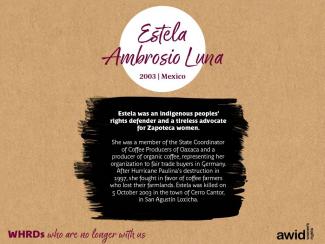
Les défenseuses mexicaines
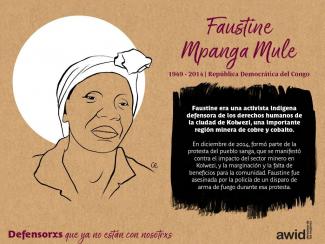
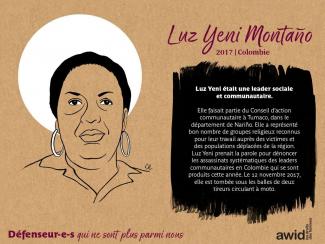
Les données que nous avons recueillies pour élaborer notre hommage montrent à quel point le Mexique est un pays dangereux pour les défenseuses. Sur les 12 femmes mexicaines défenseuses des droits humains que nous commémorons cette année, 11 ont été assassinées. Elles étaient des journalistes ou des activistes, des défenseuses des droits des femmes ou de ceux des personnes trans*. Nous vous invitons à vous joindre à nous pour rendre hommage à ces défenseuses, à leur travail et à l’héritage qu’elles nous ont laissé. Faites circuler ces mèmes auprès de vos collègues et amis ainsi que dans vos réseaux et twittez en utilisant les hashtags #WHRDTribute et #16Jours.
S'il vous plaît cliquez sur chaque image ci-dessous pour voir une version plus grande et pour télécharger comme un fichier
Match up your favourite messages below with these images for Facebook. These messages may also be used on Twitter via private Direct Messages, which don’t have character limits.
Facebook messages for your personal profile
The wait is over! We can all register for the 2016 AWID Forum. So excited to reconnect with fellow activists and re-imagine our feminist futures. See you there, in Brazil!http://forum.awid.org/forum16/
Loving the thought of re-imagining feminist futures with 2,000 people from lots of amazing women's rights and social justice movements at the AWID Forum. Register and meet me in Brazil!http://forum.awid.org/forum16/
Facebook messages for your organization’s page
Registration is now open for the 2016 AWID Forum in Costa do Sauípe, Brazil! This is not just any event - it’s a key space for women’s rights and social justice activists to come together and re-imagine our feminist futures. You won’t want to miss it!http://forum.awid.org/forum16/
Join us at the 2016 AWID Forum in Brazil! Activists and movements from all over the world will come together to celebrate, strategize, inspire and renew ourselves and our collective struggles. Register now!http://forum.awid.org/forum16/
The 2016 AWID Forum will be a historic global gathering of women’s rights and social justice activists and movements. Join us there to break the silos, strengthen solidarity and leverage our collective power. Register now!http://forum.awid.org/forum16/
The 2016 AWID Forum will be a historic global gathering of women’s rights and social justice activists and movements. Join us to celebrate, strategize, inspire and renew ourselves and leverage our collective power. Registration is now open!http://forum.awid.org/forum16/
This is Mariama Sonko, an inspiring small-scale rural farmer, eco-feminist and a woman human rights defender.
She lives in Niaguiss, a town in the southwest of Senegal. Growing up in a family and community of rural farmers, she witnessed the essential role of women in food production and seed preservation from a very early age, while also being immersed in the rhythms and working of the land. Mariama has been defending local agricultural knowledge and peasant practices since the 1990s. As a mother of five children, the food she grows herself is the main source of sustenance for her family.
She is currently the president of “Nous Sommes la Solution'' and is involved in promoting agroecological practices and family farming, encouraging food sovereignty, biodiversity and farmer seed preservation, and demanding equitable access to resources and land for women across West Africa.
Source: AWID’s Feminist Realities Festival Crear | Résister | Transform - Day 2/ 2ème jour/ 2º día
I have responded to the survey but changed my mind and want our response to be withdrawn, what do I do?
If, for any reason, you want your response to be withdrawn and deleted, you have the right to do so. Please contact us via the form here, indicating “WITM Survey” as the title of your message, and we will withdraw and delete your response.
Pourquoi et comment renouveler votre adhésion de l'AWID
Rencontrez d'autres membres
Nos membres individuel-le-s et institutionnels viennent de 163 pays situés dans TOUTES les régions du monde. Les dernier-ère-s membres à avoir rejoint notre association viennent de l’Inde, du Royaume-Uni, du Sri Lanka et du Kirghizistan. Nos membres contribuent un éventail riche et diversifié de perspectives, d’expériences, de connaissances, d’énergie et d’inspiration !
Connaissez-vous nos profils hebdomadaires de membres ?
En tant que membre de l’AWID, vous pourrez, entre autres avantages, voir votre propre histoire figurer dans la newsletter que nous envoyons à 35,000 abonné-e-s et que nous diffusons par le biais des médias sociaux auprès de 60,000 personnes.
Récemment en vedette :
Rencontrez Angila Ashitua, une jeune femme du comté de Vihiga, situé dans l’ouest du Kenya.
en entrant en contact avec d’autres membres par le biais de notre forum des membres et de notre annuaire en ligne.
en en apprenant davantage sur le travail de l’AWID et sur les questions relatives aux droits des femmes et à la justice sociale grâce à nos publications et ressources, et notamment grâce à notre dernière vidéo en date “Changing Systems, Changing Lives“.(uniquement disponible en anglais).
en prenant part à nos sessions de formation en ligne. Vous pouvez consulter ici les points principaux de notre webinaire sur la Puissance des entreprises et la justice de genre. (uniquement disponible en anglais)
Et bien plus encore !
Vous pouvez renouveler votre adhésion pour une période d’1, 2 ou 3 ans. Nous offrons la possibilité d’une adhésion individuelle ou institutionnelle gratuite à ceux et celles dont les revenus ou budgets sont restreints.
Si vous rencontrez des difficultés lors de votre identification en ligne et avez besoin d’aide, n’hésitez pas à me contacter à l’adresse suivante : membership@awid.org
Les témoignages de nos membre
«Nous trouvons que l’AWID est un réseau particulièrement stimulant et nous nous impliquons dans beaucoup de ses plateformes. » – Engabu Za Tooro (membre institutionnel de l’AWID)
« Je me réjouis d’entamer une collaboration fructueuse avec l’équipe. J’en suis très heureuse. Merci de m’avoir acceptée parmi vos membres. » – R. Chakraborty (membre individuelle de l’AWID)
« Je tiens à remercier infiniment l’AWID ! Vous accomplissez un travail gigantesque. Vos efforts sont grandement appréciés. » – E. Khan (membre individuelle de l’AWID)
Snippet FEA Objectives NSS Advocacy (EN)
INCIDENCIA POLITICA
Influir en tomas de decisiones políticas y promover un acceso más equitativo a la tierra para las mujeres que trabajan en la agricultura
¡Sí, por favor! Te alentamos a compartir el enlace a la encuesta con tus redes. Cuanto más diversas sean las opiniones que recolectemos, más completa será nuestra comprensión del panorama financiero para las organizaciones feministas.
Your comprehensive research product is now all organized and edited. You now want to ensure your findings are visually accessible and appealing to facilitate the dissemination.
Consider developing smaller products along with your long report.
As mentioned in the “Synthesize your research findings,” AWID often pulls smaller products from the lengthy research report. This allows for wider and easier distribution specialized for key audiences.
Always keep your targeted population in mind: who will read your report?
Examples of smaller products distilled from a larger report:
Infographics
Online gallery
An animation presenting your arguments
1. Think as your audience thinks
People are bombarded with information constantly. Your product will have to be visually compelling to maintain the interest of your audience. Again, having an idea of what you hope to accomplish and who you hope to reach, will allow the designer to create targeted products.
A lengthy written PDF report may seem the only way to present your research, but it could appear overwhelming to most people – especially online.
If you want to share your product with an online community, think about creating memes and infographics to use on social media, blogs and web platforms.
When deciding whether to create smaller products, consider dividing your results into several smaller products that you could share with targeted populations or at different times of the year to reactivate the interest on your product.
2. Work with a professional designer
If you have limited time and a little bit of budget, we recommend hiring a design firm.
It can be tempting for economic reasons to use in-house staff to package your report. However, a professional graphic designer can make a huge difference on how your final product looks and thus on how much impact it will have!
The designer (in-house or hired) must be able to:
Show you samples of their previous work that is similar to what you seek.
Provide you clear advice on how to present your research based on the content you provide and the audience you are targeting.
Suggest additional or different pieces to package your product.
What the designer will need from you:
A general idea on what you would like the lengthy report to highlight through visuals and graphics (what are the most important pieces of information, the key findings, for example) and some ideas on the types of smaller products you want to create (brochure, an infographic, a series of viral memes, for example). If possible, show the designer examples of similar documents developed by other organizations.
Your budget and time frame.
Your organization’s visual guidelines if you have any (logo, official colours, fonts, etc...).
A few photos copyright free or access to your photo bank if you have one.
Key visuals that need to be included – graphs, tables and other visual graphics drawn from your research.
The designer is a graphic expert. S/he is not necessarily familiar with women’s issues and does not know the results of your research, especially if you hire an external firm.
Communicate what elements of this report is important to you and who is your target. The designer will propose a way to highlight these elements and make the whole piece appealing to your users.
3. Make sure it's consistent
While creating a set of smaller information products, do not forget to link them all together:
A shorter version of the report that focuses only on your final results and recommendations should present a link to the final, full report
A visually compelling infographic that sends a message on the state of funding for your particular research can link to your website and the related section of the full report. It should be associated with a call to share on social media.
A short animation video that uses the data, findings and recommendations from your report should link back to your organization website and social media
A series of viral memes that can be distributed online should link back to your report, infographic, shorter report, etc.
It is also important to keep the research staff involved, so they can ensure any offshoot products stay true to the actual findings of the research.
After the design and packaging of the final research report is complete, if any of the wording of content was changed, be sure to re-send to translators.
If you create smaller products, once designed and packaged, you will also need to get the copy translated for those pieces. The translations should be clear enough so the designer can apply to the design, even if she/he does not speak the language.
Once translated, make sure to have your design proofread by a native speaker before sharing it!
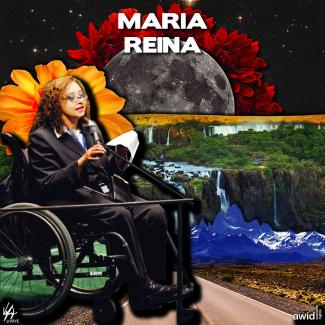
María was recognized globally for her extraordinary leadership in the disability community.
She represented the International Disability and Development Consortium during the negotiation of the United Nations Convention on the Rights of Persons with Disabilities (2001-2006).
Her work was devoted to the implementation of the goal of the Convention - realization of universal human rights by, for and with persons with disabilities for an inclusive, accessible and sustainable world.
In her words, her leadership was about “...serving the disability community, starting with small tasks that others may not wish to do”.
She passed away on October 27, 2017 in her hometown of Rosario, Argentina.