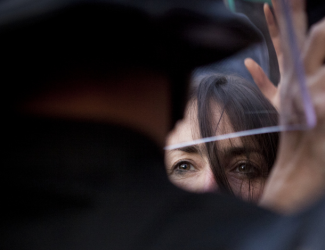
Philippe Leroyer | Flickr (CC BY-NC-ND 2.0)

Special Focus

AWID is an international, feminist, membership organisation committed to achieving gender equality, sustainable development and women’s human rights

Women Human Rights Defenders

WHRDs are self-identified women and lesbian, bisexual, transgender, queer and intersex (LBTQI) people and others who defend rights and are subject to gender-specific risks and threats due to their human rights work and/or as a direct consequence of their gender identity or sexual orientation.

WHRDs are subject to systematic violence and discrimination due to their identities and unyielding struggles for rights, equality and justice.

The WHRD Program collaborates with international and regional partners as well as the AWID membership to raise awareness about these risks and threats, advocate for feminist and holistic measures of protection and safety, and actively promote a culture of self-care and collective well being in our movements.


Risks and threats targeting WHRDs  

WHRDs are exposed to the same types of risks that all other defenders who defend human rights, communities, and the environment face. However, they are also exposed to gender-based violence and gender-specific risks because they challenge existing gender norms within their communities and societies.

By defending rights, WHRDs are at risk of:

  • Physical assault and death
  • Intimidation and harassment, including in online spaces
  • Judicial harassment and criminalization
  • Burnout

A collaborative, holistic approach to safety

We work collaboratively with international and regional networks and our membership

  • to raise awareness about human rights abuses and violations against WHRDs and the systemic violence and discrimination they experience
  • to strengthen protection mechanisms and ensure more effective and timely responses to WHRDs at risk

We work to promote a holistic approach to protection which includes:

  • emphasizing the importance of self-care and collective well being, and recognizing that what care and wellbeing mean may differ across cultures
  • documenting the violations targeting WHRDs using a feminist intersectional perspective;
  • promoting the social recognition and celebration of the work and resilience of WHRDs ; and
  • building civic spaces that are conducive to dismantling structural inequalities without restrictions or obstacles

Our Actions

We aim to contribute to a safer world for WHRDs, their families and communities. We believe that action for rights and justice should not put WHRDs at risk; it should be appreciated and celebrated.

  • Promoting collaboration and coordination among human rights and women’s rights organizations at the international level to  strengthen  responses concerning safety and wellbeing of WHRDs.

  • Supporting regional networks of WHRDs and their organizations, such as the Mesoamerican Initiative for WHRDs and the WHRD Middle East and North Africa  Coalition, in promoting and strengthening collective action for protection - emphasizing the establishment of solidarity and protection networks, the promotion of self-care, and advocacy and mobilization for the safety of WHRDs;

  • Increasing the visibility and recognition of  WHRDs and their struggles, as well as the risks that they encounter by documenting the attacks that they face, and researching, producing, and disseminating information on their struggles, strategies, and challenges:

  • Mobilizing urgent responses of international solidarity for WHRDs at risk through our international and regional networks, and our active membership.

Related Content

Razan Al-Najar

Razan était une infirmière palestinienne bénévole âgée de 21 ans.

Elle a été tuée par balle à l'est de la ville de Khan Younis, au sud de Gaza, alors qu'elle courait vers une clôture de la frontière fortifiée dans le but de porter secours à une victime.

Dans son tout dernier post sur Facebook, Razan avait déclaré : « J’y retourne et ne reculerai pas », ajoutant: « Frappez-moi de vos balles. Je n'ai pas peur ».


Razan Al-Najjar, Palestine

J’ai répondu aux questions de l’enquête mais j’ai changé d’avis et souhaite annuler notre participation, comment puis-je faire?

Si, quelle qu’en soit la raison, vous souhaitez que votre participation soit annulée et vos réponses supprimées, vous en avez le droit. Merci de nous contacter par le biais de ce formulaire, en indiquant « Enquête WITM (Où est l’argent?) » dans l’objet de votre message. Nous annulerons votre participation et supprimerons vos réponses.

2002: Discussions on the Financing for Development agenda begin

The Monterrey Conference on Financing for Development marked the beginning of discussions on the Financing for Development agenda.

  • The Monterrey Consensus was adopted at this first international conference on Financing for Development. It was the first United Nations hosted summit-level meeting to address key financial and related issues on global development.
  • The Conference and its preparatory process saw unprecedented cooperation between the United Nations and the World Bank (WB), the International Monetary Fund (IMF) and the World Trade Organization (WTO) as part of efforts to promote greater coherence and consistency among the international monetary, trade and financial systems and institutions.
  • Monterrey also marked the first time that financing for development debates took place between governments, representatives of civil society and the business sector. These actors moved the discussion beyond a ‘technical’ focus, to look at how to mobilize and channel financial resources to fulfill the internationally agreed development goals of previous UN conferences and summits of the 1990s, including the Millennium Development Goals (MDGs).
  • The Women’s Caucus noted the historical significance of the conference stating that it had the potential to address structural challenges that continue to hamper development but also raised concern over the effects of increased militarisation and fundamentalism on women, despite the fact that the Monterrey Consensus assumed that the global economic and financial system worked for all.
  • Learn more about the six Monterrey themes and the conference follow up mechanisms: Gender Issues and Concerns in Financing for Development by Maria Floro, Nilufer Çagatay, John Willoughby and Korkut Ertürk (INSTRAW, 2004) 

Snippet FEA Avellaneda, Gran Buenos Aires (FR)

Avellaneda, Gran Buenos Aires, Argentina

Coopérative Textile Nadia Echazú

TISSAGE

DES VIES

Jacqueline Coulibaly Ki-Zerbo

Jacqueline was a pioneering Malian/Burkinabe feminist, nationalist and educator.

She taught English in Senegal, before being recruited in 1961 as an English teacher at the Lycée Philippe Zinda Kaboré in Ouagadougou, Burkina Faso. Through her activism, she was involved in the popular uprising of January 3, 1966. Between 1961 and 1966, Jacqueline was also responsible for the trade union press, Voices of the Teachers. She was appointed as the head of the Normal Course for Young Girls (now known as Nelson Mandela High School) until 1974, and dedicated herself to girls’ education and advancing women’s rights.

In 1984 she was awarded the Paul G. Hoffmann Award for outstanding work in national and international development.


Jacqueline Coulibaly Ki-Zerbo, Mali/ Burkina Faso

Can I contact someone if I have questions or concerns?

If you have any questions or concerns, please contact us via the form here, indicating “WITM Survey” as the title of your message. You can also write to us at witm@awid.org.

2009: la ONU celebra una Conferencia sobre el impacto de la crisis económica

Conferencia de la ONU sobre la crisis financiera y económica mundial y sus efectos sobre el desarrollo

  • Esta conferencia de 2009 fue un producto de la Conferencia de Doha realizada en 2008. La Declaración de Doha le había encargado a la ONU que el Presidente de su Asamblea General organizara una conferencia sobre la crisis financiera y económica mundial y su impacto sobre el desarrollo.
  • En esta conferencia los grupos de mujeres, a través del WWG, destacaron el impacto de la crisis financiera mundial sobre los grupos en situación de vulnerabilidad. En su declaración ante los Estados Miembros, el WWG les propuso acciones que consideraba necesarias para remediar los efectos de la crisis sobre las mujeres. También observó que otros grupos sociales afectados por la crisis son clave para una respuesta que esté en consonancia con los estándares y compromisos internacionales en materia de igualdad de género, derechos de las mujeres, derechos humanos y empoderamiento.

Snippet FEA 1 of 3 trans and travesti people (EN)

This is an illustration that depicts a burgundy building next to a duck blue building

1 of 3 trans and travesti people in Argentina live in a poor household

Lara Kruger

Lara fue una muy conocida y querida DJ de radio en la FM Motsweding, en Sudáfrica.

Fue una de las primeras conductoras abiertamente transgénero en una estación de radio comercial. Trabajó mucho para echar luz sobre los temas LGTBI.

El activismo de Lara comenzó a temprana edad, cuando defendía vivamente su derecho a vestirse y comportarse de una forma que le resultara cómoda y lo hacía frente a integrantes de su comunidad que todavía no entendían qué significaba ser transgénero.


Lara Kruger, South Africa

Snippet - WITM To share - PT

Para partilhar a sua experiência vivida com o financiamento da sua organização;

Janvier 2015: 1ère session de rédaction du document final de la 3ème Conférence sur le FdD

La première session de rédaction du document final de la troisième Conférence sur le financement du développement

  • À partir de janvier 2015, les sessions de rédaction du document final se sont succédé au siège de l’ONU à New York.
  • Avant la première de ces sessions, les co-facilitateurs du processus préparatoire de la Conférence d’Addis Abeba ont présenté un document récapitulatif (en anglais) en vue de la rédaction de la dite « version zéro » du document final. Ce document avait vocation à servir de base aux négociations intergouvernementales relatives au contenu du document final.
  • Pendant les sessions, des organisations de défense des droits des femmes ont mis l’accent sur la nécessité, au cours des processus relatifs à l’après-2015, d’aborder séparément le FdD et les modalités de mise en œuvre. À leurs yeux, le FdD offre une occasion unique aux États de s’attaquer aux causes structurelles des inégalités.  

Snippet FEA Trans and Travesti people (ES)

This image represents a faceless person with short dark hair, and dark skin, with a navy blue shirt, and yellow sweater, working behind a burgundy sewing machine on a navy blue piece of fabric

EL CUPO LABORAL TRANS
no está siendo respetado por las empresas

María Cecilia Alfaro Quesada

Maria a consacré la majeure partie de sa vie à l’intégration d’une perspective féministe et de la parité hommes-femmes dans les activités institutionnelles et organisationnelles, ainsi qu’au renforcement des capacités. 

Enfant, Maria s'intéressait beaucoup à l'art, à la communication, à la nature, à la littérature et à la justice, en particulier pour les femmes et les groupes marginalisés. 

Elle a milité en faveur droits sexuels et reproductifs et était membre du Conseil national pour une éducation intégrale à la sexualité. Celleux qui l’aimaient se souviennent d’elle comme d’une « combattante passionnée et infatigable », résolument engagée en faveur des droits des femmes et des enfants


María Cecilia Alfaro Quesada, Guatemala

Snippet - WITM Why now_col 1 - RU

Почему сейчас?

A monochromatic orange illustration of a woman with curly hair with her hand on her chin. She seems to inquisitive or posing a question.

Феминистские движения, движения за права женщин, гендерную справедливость, ЛГБТКИ+ и смежные движения по всему миру переживают критический момент, сталкиваясь с мощной негативной реакцией на ранее завоеванные права и свободы. Последние годы привели к быстрому росту авторитаризма, жестоким репрессиям в отношении гражданского общества и криминализации правозащитниц(-ков) с разнообразной гендерной самоидентификацией, эскалации войн и конфликтов во многих частях света, продолжающейся экономической несправедливости, – и все это на фоне кризиса в области здравоохранения, экологии и климата.

What is the United Nations Financing For Development Process?

The United Nations (UN) Financing for Development (FfD) process seeks to address different forms of development financing and cooperation. As per the Monterrey Consensus it focuses on six key areas:

  • Mobilizing domestic financial resources for development
  • Mobilizing international resources for development: foreign direct investment and other private flows
  • International trade as an engine for development
  • Increasing international financial and technical cooperation for development
  • External debt
  • Addressing systemic issues: enhancing the coherence and consistency of the international monetary, financial and trading systems in support of development.