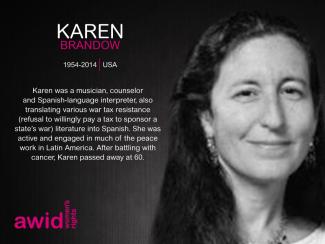
Karen Brandow

WHRDs are self-identified women and lesbian, bisexual, transgender, queer and intersex (LBTQI) people and others who defend rights and are subject to gender-specific risks and threats due to their human rights work and/or as a direct consequence of their gender identity or sexual orientation.
WHRDs are subject to systematic violence and discrimination due to their identities and unyielding struggles for rights, equality and justice.
The WHRD Program collaborates with international and regional partners as well as the AWID membership to raise awareness about these risks and threats, advocate for feminist and holistic measures of protection and safety, and actively promote a culture of self-care and collective well being in our movements.
WHRDs are exposed to the same types of risks that all other defenders who defend human rights, communities, and the environment face. However, they are also exposed to gender-based violence and gender-specific risks because they challenge existing gender norms within their communities and societies.
We work collaboratively with international and regional networks and our membership
We aim to contribute to a safer world for WHRDs, their families and communities. We believe that action for rights and justice should not put WHRDs at risk; it should be appreciated and celebrated.
Promoting collaboration and coordination among human rights and women’s rights organizations at the international level to strengthen responses concerning safety and wellbeing of WHRDs.
Supporting regional networks of WHRDs and their organizations, such as the Mesoamerican Initiative for WHRDs and the WHRD Middle East and North Africa Coalition, in promoting and strengthening collective action for protection - emphasizing the establishment of solidarity and protection networks, the promotion of self-care, and advocacy and mobilization for the safety of WHRDs;
Increasing the visibility and recognition of WHRDs and their struggles, as well as the risks that they encounter by documenting the attacks that they face, and researching, producing, and disseminating information on their struggles, strategies, and challenges:
Mobilizing urgent responses of international solidarity for WHRDs at risk through our international and regional networks, and our active membership.
Search for funders based on their requirements for groups to be registered.
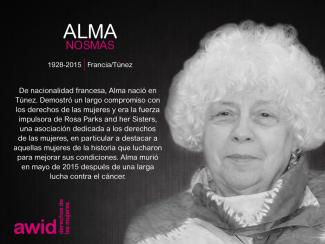
Las 3 defensoras de derechos humanos del Pacífico que honramos en el Tributo Virtual de este año trabajaron en los medios, defendieron los derechos de las personas con discapacidad y promovieron los derechos de las mujeres. Extrañamos sus contribuciones y las honramos mediante este Tributo. Únete a AWID para honrar a estas defensoras de derechos humanos, su trabajo y su legado, compartiendo los memes aquí incluidos con tus colegas, amistades y redes; y tuiteando las etiquetas #WHRDTribute y #16Días.
Por favor, haz click en cada imagen de abajo para ver una versión más grande y para descargar como un archivo.


Le Forum international de l'AWID est un rassemblement de quelque 2 000 leaders et militant-e-s pour les droits des femmes du monde entier. Ce Forum de l'AWID est la manifestation récurrente de ce type la plus importante au monde. Il a lieu chaque fois dans un pays du Sud différent.
Le Forum international de l'AWID est à la fois un événement communautaire mondial et un espace de transformation personnelle radicale. Rassemblement unique en son genre, le Forum réunira nos mouvements féministes, de défense des droits des femmes, de justice de genre, LBTQI+ et alliés, dans toute leur diversité et leur humanité, afin de nous connecter, nous apaiser et nous épanouir.
Rejoignez-nous à Bangkok, en Thaïlande et en ligne en décembre 2024.
No, you don't have to be an AWID member to participate but AWID members receive a discounted registration fee as well as a number of other benefits. Learn more on how to become an AWID member.
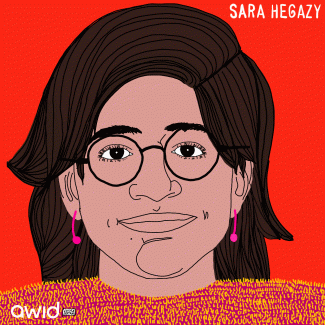
Sara Hegazy, a bold Egyptian LGBTQI+ rights activist, lived in a society where the members of her community, their bodies and lives often face lethal prejudice. The roots of Sara’s resistance were in the deconstruction of a dominant, oppressive and patriarchal system, and its anti-rights actors.
"[In Egypt], every person who is not male, Muslim, Sunni, straight, and a supporter of the system, is rejected, repressed, stigmatized, arrested, exiled, or killed. This matter is related to the patriarchal system as a whole, since the state cannot practice its repression against citizens without a pre-existing oppression since childhood." - Sara Hegazy wrote on March 6, 2020
The suppression of Sara’s voice by the Egyptian government reached its violent peak in 2017, when she was arrested for raising a rainbow flag at the Mashrou’ Leila (Lebanese band whose lead vocalist is openly gay) concert in Cairo. What followed were charges of joining an illegal group along with “promoting sexual deviancy and debauchery”.
"It was an act of support and solidarity — not only with the [Mashrou' Leila] vocalist but for everyone who is oppressed...We were proud to hold the flag. We wouldn't have imagined the reaction of society and the Egyptian state. For them, I was a criminal — someone who was seeking to destroy the moral structure of society." - Sara Hegazy
Sara was jailed for three months, where she was tortured and sexually assaulted. In January 2018, after being released on bail, she sought asylum in Canada where she was safe but imprisoned by the memories of the abuse and violence her body and soul had gone through.
"I left this experience after three months with a very intense, serious case of PTSD [post-traumatic stress disorder]. Prison killed me. It destroyed me." - Sara Hegazy told NPR
Sara took her own life on 14 June 2020, leaving a handwritten note in Arabic:
“To my siblings – I tried to find redemption and failed, forgive me.”
“To my friends – the experience [journey] was harsh and I am too weak to resist it, forgive me.
“To the world – you were cruel to a great extent, but I forgive.”
Her legacy and courage will be carried forward by those who love her and believe in what she fought for.
“To Sarah: Rest, just rest, spared from this relentless violence, this state-powered lethal patriarchy. In rage, in grief, in exhaustion, we resist.” - Rasha Younes, an LGBT rights researcher at Human Rights Watch. Read the complete text
Mashrou’ Leila’s lead vocalist sings tribute to Sara Hegazy
À la Commission africaine et au Système interaméricain, les antidroits promeuvent les notions essentialistes de culture et de genre pour miner les avancées en matière de droits et décrédibiliser la redevabilité. Les antidroits gagnent en influence dans les systèmes de protection des droits humains régionaux et internationaux.
Ce kit inclut des messages types adaptés pour Twitter, Facebook LinkedIn et Instagram ainsi que des images qui peuvent être utilisées pour accompagner ces messages.
L’utilisation de ce kit est simple, il vous suffit de suivre les étapes suivantes :
Choisissez ci-dessous vos messages favoris :
Twitter
Facebook
LinkedIn
Faites correspondre vos messages préférés avec les images types adaptés pour Twitter
Rejoignez-moi au #AWIDForum, LE lieu pr se connecter ac D mouvements 2 droits D femmes & 2 justice sociale http://forum.awid.org/forum16/fr
Hâte 2 repenser les #HorizonsFéministes ac D activistes D droits D femmes & 2 la justice sociale au #AWIDForum ! http://forum.awid.org/forum16/fr
Je suis tellement ravie 2 participer au #AWIDForum en mai prochain. Nous pouvons désorms ns inscrire. Rejoignez-moi ! http://forum.awid.org/forum16/fr
Inscriptions désormais ouvertes pour le #AWIDForum! Costa do Sauípe, Brésil, 8-11 sept. 2016 http://forum.awid.org/forum16/fr
Participez au #AWIDForum, 1 rassemblement historique mondial d'activistes 2 la justice sociale & D droits D femmes http://forum.awid.org/forum16/fr
Participez au #AWIDForum pour célébrer les acquis de nos mouvements & analyser les leçons tirées pour aller de l’avant : http://forum.awid.org/forum16/fr
#AWIDForum : bien plus qu’un simple événement, la possibilité de rompre l’oppression & faire avancer la justice http://forum.awid.org/forum16/fr
Participez au #AWIDForum pour célébrer, repenser et renouveler nos mouvements & nos réflexions. http://forum.awid.org/forum16/fr
Créons ensemble des #HorizonsFéministes. Inscrivez-vous au #AWIDForum 2016. Costa do Sauípe, Brésil http://forum.awid.org/forum16/fr
Rejoignez-nous pour ré-imaginer & co-créer des #HorizonsFéministes au #AWIDForum 2016. Inscrivez-vous: http://forum.awid.org/forum16/fr
#HorizonsFéministes: saisir l'opportunité au #AWIDForum de faire avancer nos visions pour un monde juste http://forum.awid.org/forum16/fr
Nous serons 2000 activistes D mouvements sociaux au #AWIDForum, élaborant des stratégies sur nos #HorizonsFéministes http://forum.awid.org/forum16/fr
Nous sommes bien plus qu’une lutte à enjeu unique. Rejoignez-nous au #AWIDForum: http://forum.awid.org/forum16/fr
Participez au #AWIDForum, un espace de stratégies entre mouvements et d’influence pour notre pouvoir collectif: http://forum.awid.org/forum16/fr
Mobiliser la solidarité & le pouvoir collectif à travers les mouvements sociaux au #AWIDForum: http://forum.awid.org/forum16/fr
Briser les cloisons entre nos mouvements. Ré-imaginer & co-créer nos futurs. Tou-te-s au #AWIDForum http://forum.awid.org/forum16/fr
« Etre solidaire » est un verbe. Mettons-le en action au #AWIDForum: http://forum.awid.org/forum16/fr
Les bailleurs qui s’engagent avec les mouvements sociaux & de droits des femmes au #AWIDForum: http://forum.awid.org/forum16/fr
Médias et mouvements: amplifier les #HorizonsFéministes au #AWIDForum: http://forum.awid.org/forum16/fr
Faites correspondre vos messages préférés avec les images types adaptés pour Facebook
Vous pouvez aussi envoyer ces messages via les messages privés de Twitter qui n’ont pas de limite de caractères.
Téléchargez vos images préférées pour Instagram
First High-level Dialogue on Financing for Development, 29-30 October 2003
One of the follow up mechanisms to the Monterrey conference are the UN General Assembly High-level Dialogues on Financing for Development held every two years. In total eight roundtable meetings took place following the Dialogue on various issues including agricultural subsidies, trade, debt relief and funding of the MDGs. All the discussions focused on dealing with the structural hindrances on these issues that disadvantaged ‘developing’ nations.
Other follow up mechanisms to Monterrey included:
¡Sí! Actualmente estamos explorando tecnologías innovadoras que permitan una conexión y participación significativas.
Want to bring people together to strengthen resistance? This methodology for workshops offers group exercises to increase collective knowledge and power, with options to adapt to your needs.
Feminist and women’s rights organizations don’t just rely on institutional funding, we resource ourselves. Our organizing is powered by passion, political commitment, solidarity and collective care.
These resources are self- generated and autonomous, and often invisible in our budgets, but they are the backbone of our organizing.
Después de haber evaluado la capacidad de la organización y fijado los objetivos de la investigación, tal vez decidas realizar una encuesta como uno de los métodos de recolección de datos para analizar.
En esta sección:
- ¿Por qué realizar una encuesta?
- Define la población a la que vas a entrevistar
1. Encuesta en línea
2. Encuesta en papel- Elabora las preguntas
1. Preguntas claras y breves
2. Lenguaje simple y universal
3. Preguntas «cerradas» y «abiertas»
4. Estructura lógica
5. Duración: menos de 20 minutos
6. Simple e interesante- Prueba la encuesta y tradúcela
1. Lxs consultorxs
2. Borrador y puesta a prueba
3. Traducción- Dirígela a la población adecuada
1. Tamaño de la muestra
2. Grado de participación
3. Base de datos y lista de contactos
Una encuesta es una excelente forma de reunir información sobre organizaciones específicas para identificar tendencias a nivel colectivo.
Por ejemplo, el tamaño del presupuesto de una organización no te dice demasiado acerca de una tendencia en el financiamiento para los derechos de las mujeres, pero si conoces los presupuestos de 1000 organizaciones por los derechos de las mujeres e incluso de 100, puedes comenzar a darte una idea de la situación del financiamiento para los derechos de las mujeres en su conjunto.
Cuando elabores las preguntas de la encuesta, ten presente el marco de investigación que elaboraste en la sección previa.
Recuerda: El marco te ayuda a decidir qué información intentarás obtener a través de la encuesta. La información que recojas de ella debería permitirte cumplir con las metas, responder a las preguntas principales y generar los productos finales.
Este es un paso importante: cuanta más claridad tengas acerca de las poblaciones a las que quieres encuestar, más podrás refinar las preguntas.
Según cuáles sean los objetivos de la investigación, tal vez quieras crear encuestas separadas para organizaciones por los derechos de las mujeres, fondos de mujeres y donantes. O tal vez quieras centrar la encuesta en los grupos de mujeres y hacer entrevistas con los fondos de mujeres y lxs donantes, dado que hacer una encuesta con cada una de esas poblaciones podría demandar demasiados recursos.
Las preguntas que formules a los grupos de mujeres pueden ser diferentes que las dirigidas a los fondos de mujeres. Si piensas encuestar a más de una población, te sugerimos que adaptes la recolección de datos a cada una de ellas.
Al mismo tiempo, algunas de las principales preguntas para cada población pueden y deben ser comunes, para poder hacer análisis comparativos de las respuestas.
Si puedes llegar a través de Internet a la población que quieres entrevistar, te será útil y eficiente generar una encuesta en línea.
Te recomendamos dos herramientas en línea que tienen versiones gratuitas:
Survey Gizmo te permite convertir la información para el SPSS, un programa estadístico que se usa para análisis avanzado de información.
La persona o el equipo que analice la información podrá determinar qué herramienta es la mejor para la encuesta, según la capacidad humana de tu organización y cómo piensan analizar los datos.
Para hacerla más accesible, piensa en producir una versión en PDF de la encuesta que puedas enviar por correo electrónico. Con esto te asegurarás de que las organizaciones con conexión inestable a Internet o las que deben pagar su conexión por minuto puedan descargar la encuesta y completarla sin tener que estar conectadas en forma permanente.
Tal vez decidas que la encuesta en línea no resulta lo suficientemente accesible o incluyente para la población a la que quieres relevar.
En ese caso, tendrás que crear una encuesta en papel y métodos para contactarte con la o las poblaciones relevantes (mediante eventos muy concurridos o por correo, incluyendo sobres con estampillas para que puedan enviarte la respuesta sin que hacerlo les ocasione gastos).
Haz que a lxs participantes les resulte fácil responder la encuesta.
Si las preguntas son confusas o requieren respuestas complejas, corres el riesgo de que lxs participantes la dejen sin completar o que las respuestas que obtengas te resulten inútiles para el análisis.
Asegúrate de que cada una de las preguntas pida solo una información.
Por ejemplo:
- ¿Cuál es el presupuesto de la organización para este año?
Pregunta fácil de responder: es una información que lxs participantes pueden encontrar con facilidad y solo pide una información.
- ¿Para qué porcentaje del presupuesto has identificado probables fuentes de financiamiento para tu organización pero todavía no las tienes confirmadas?
Pregunta confusa y difícil de responder: ¿estás pidiendo una lista de las fuentes de financiamiento aún sin confirmar, o de los financiamientos que son probables pero todavía no están confirmados?
Esta información es difícil de obtener: La persona que completa la encuesta tendrá que calcular el porcentaje, y tal vez no tenga esta información a mano. Con esto, se incrementa el riesgo de que abandone la encuesta sin haberla completado.
Muchas palabras y siglas que a ti te resultan familiares pueden no serlo para las personas que responden la encuesta, como por ejemplo «movilización de recursos», «M&E» o «IVE», así que asegúrate de utilizar un lenguaje más universal en la redacción de las preguntas.
Si no tienes más remedio que utilizar la jerga de tu sector — frases o palabras que tú y tus colegas manejan pero no la población en general — entonces ofrecer una definición hará que resulte más fácil entender las preguntas de la encuesta.
Asegúrate de explicar las siglas que utilices. Por ejemplo, si escribes «IVE», aclara que se trata de «Interrupción voluntaria del embarazo».
Preguntas cerradas:
Solo admiten una respuesta (por ejemplo «sí», «no» o una cifra). No es posible responder con las propias palabras, sino que se debe optar entre categorías predeterminadas o ingresar una cifra específica. Las respuestas a las preguntas cerradas son más fáciles de cuantificar como un todo y suelen ser cuantitativas.
Ejemplo de pregunta cerrada: ¿Cuál es el presupuesto de tu organización?
Preguntas abiertas:
Son preguntas cualitativas y muchas veces son descriptivas. Se responden con las propias palabras. Son más adecuadas para entrevistas que para encuestas.
Resultan más difíciles de analizar como un todo, en comparación con las preguntas cerradas, sobre todo si tienes una muestra grande. Pero si formulas las preguntas abiertas en forma muy precisa, te resultará más fácil analizar las respuestas.
Siempre que te sea posible, diseña las preguntas de la encuesta de forma tal que quienes la respondan deban optar por una o más opciones de una lista en lugar de ofrecerles preguntas abiertas. Esto te ahorrará tiempo y esfuerzo en la limpieza y el análisis de la información.
Ejemplo de pregunta abierta: ¿Qué desafíos específicos enfrentaron este año para movilizar recursos?
Familiarízate con los distintos tipos de preguntas
Existen diferentes formas de formular preguntas cerradas. A continuación te ofrecemos algunos ejemplos para que los estudies y decidas cuál encaja mejor con el tipo de información que quieres obtener:
Si piensas realizar esta investigación a intervalos regulares (por ejemplo, una vez cada dos años), te recomendamos elaborar una encuesta de línea de base que puedas repetir y que te permita seguir la evolución de las tendencias a lo largo del tiempo.
Grupo 1: Preguntas-filtro
Las preguntas-filtro determinan si la persona/organización que responde forma parte de la población que quieres encuestar.
Las opciones de encuestas en línea que te proporcionamos te permiten poner fin a la encuesta si quien la responde no cumple con los criterios de elegibilidad que fijaste. En ese caso, quien responde pasará directamente a una página que le agradecerá su interés pero le explicará que esta encuesta está destinada a una población diferente.
Imagina que solo quieres que respondan la encuesta los grupos por los derechos de las mujeres de una zona determinada. Las preguntas-filtro te pueden ayudar a saber dónde está ubicada la organización que responde e impedir que las ubicadas en otras zonas sigan adelante con la encuesta.
Grupo 2: Preguntas estandarizadas y básicas sobre características de la población encuestada
Estas preguntas recogen información específica sobre cada organización que responde la encuesta, tal como su nombre y dónde está ubicada. Pueden superponerse con las preguntas-filtro.
Si cuentas con los recursos necesarios, puedes guardar estas respuestas en una base de datos y pedir que las respondan solo el primer año que cada organización participe de la encuesta.
Así, cuando repitas la encuesta en los años subsiguientes, las organizaciones podrán responder la encuesta en menos tiempo, lo que incrementa la probabilidad de que la completen.
Grupo 3: Preguntas estandarizadas y de respuesta obligatoria sobre financiamiento
Estas preguntas te permitirán indagar acerca de los ingresos y la sostenibilidad en términos de financiamiento. Si formulas estas preguntas una vez por año, o una vez cada dos años, podrás identificar tendencias a lo largo de los años.
Grupo 4: Preguntas sobre temas especiales
Estas preguntas tienen que ver con el contexto. Pueden referirse a cambios en el clima político o económico, o también pueden ser preguntas de respuesta no obligatoria sobre financiamiento, como por ejemplo acerca de las actitudes frente a la movilización de recursos.
Por ejemplo, la Encuesta Global WITM 2011 de AWID incluyó preguntas sobre la nueva tendencia a «invertir en las mujeres y las niñas» por parte del sector privado.
Cuanto más corta, mejor: responder tu encuesta no debería llevar más de 20 minutos. Esto garantizará que quienes comiencen a responderla la completen y también es una señal de respeto al tiempo de esas personas.
Es natural apasionarse y dejarse llevar pensando en todas las preguntas que podrías formular y en toda la información que podrías obtener. Pero las encuestas largas cansan, hacen que las personas dejen la encuesta sin terminar o que no quieran tener nada más que ver con tu organización.
Cada pregunta que agregues a la encuesta, implicará también más tiempo y esfuerzo para su análisis posterior.
Consejos generales
- Pide los presupuestos exactos en lugar de solicitar que elijan dónde se ubica el suyo dentro de un rango determinado (nuestra experiencia nos indica que las cantidades específicas son más útiles para el análisis).
- ¡Especifica la moneda! Si es necesario, pide que conviertan las cantidades a una moneda determinada o que digan claramente en qué moneda están expresados los montos para las preguntas referidas a finanzas.
- Asegúrate de recoger la suficiente información sobre las características de cada organización que responda la encuesta para contextualizar los resultados y poder extraer tendencias que reflejen más matices.
Por ejemplo, si estás analizando dónde está el dinero para un país determinado, te resultará útil saber de qué región proviene cada organización o en qué ámbito (rural, urbano, nacional, local) trabaja para poder identificar tendencias importantes como por ejemplo si hay más financiamiento disponible para los grupos urbanos o para temáticas determinadas.
Involucrar desde el comienzo a las organizaciones con las que te asocias para la investigación te permitirá construir un vínculo más profundo con ellas y te garantizará una investigación más incluyente, de mejor calidad.
Estas organizaciones y también personas a título individual (lxs «consultorxs») te harán llegar comentarios sobre la versión borrador de la encuesta, la responderán como parte del piloto y revisarán el análisis preliminar de los resultados de la encuesta y de los otros tipos de información que hayas recogido.
También difundirán la encuesta en sus ámbitos de acción una vez que esté lista. Si planeas difundir la encuesta en varios idiomas, asegúrate de asociarte con organizaciones que utilicen esos idiomas en su trabajo.
Si decides hacer tanto una encuesta como entrevistas, lxs consultorxs-organizaciones asociadas que te hayan asesorado en el diseño de la encuesta también podrán ser tus entrevistadas.
Una vez que tengas lista la versión borrador de la encuesta, ponla a prueba con las organizaciones con las que te has asociado antes de difundirla entre la población a la que quieres entrevistar. Esto te permitirá identificar los problemas técnicos o las preguntas confusas de la encuesta.
También te dará una idea realista del tiempo que lleva completar la encuesta.
Una vez que cuentes con una versión final de la encuesta y la hayas puesto a prueba, puedes traducirla.
Asegúrate de poner a prueba las versiones traducidas de la encuesta. Por lo menos algunas de las personas con las que la pruebes deben ser hablantes nativxs de los idiomas en los que la encuesta se tradujo, para garantizar su claridad.
El tamaño de la muestra es la cantidad de personas que responden la encuesta.
La muestra a la que le apliques la encuesta debe reflejar las características de la población a la que intentas analizar.
Por ejemplo, supongamos que quieres analizar los millones de grupos por los derechos de las mujeres que existen en Valyria (país imaginario) pero no tienes tiempo ni recursos para entrevistar a cada uno de ellos. Entonces puedes entrevistar a una cantidad más reducida – que será el tamaño de tu muestra – que, tomada como un todo, refleje las características de los grupos por los derechos de las mujeres en ese país.
Tamaño recomendado de la muestra
Aunque no es necesario que decidas el tamaño exacto de la muestra antes de comenzar a difundir la encuesta, tener un tamaño en mente te permitirá decidir en qué momento ya cuentas con una cantidad suficiente de respuestas y si deberás o no extender el plazo si consideras que todavía no alcanzaste la cantidad ideal.
Todavía más importante que el tamaño de la muestra es en qué medida la población meta a la que quieres estudiar tiene la posibilidad de responder la encuesta.
Si segmentos grandes o importantes de esa población están sistemáticamente excluidos (por razones de idioma, accesibilidad, tiempo, problemas con la base de datos, acceso a Internet u otro factor), resultará imposible evaluar con precisión la confiabilidad estadística de la información proporcionada por la encuesta.
En nuestro ejemplo: necesitarás asegurarte de que todos los grupos de mujeres de Valyria tengan la oportunidad de participar en la encuesta.
Si un segmento de los grupos de mujeres de Valyria no utiliza Internet, y la encuesta solo se puede responder en línea, te estarás perdiendo a un segmento importante y la muestra definitiva no representará en forma adecuada a todos los grupos de mujeres de Valyria.
Si la muestra no incluye a segmentos de la población que quieres estudiar, no podrás derivar de ella conclusiones apropiadas; garantizar una muestra representativa te permitirá no cometer ese error.
Para darte una idea de cómo es el panorama de los grupos de mujeres dentro del área que estás investigando (por región, población, temática, etc.), te puede resultar útil estudiar bases de datos.
Si tienes claro el panorama general de los grupos de mujeres a los que vas a estudiar, podrás darte una idea de cómo tendrá que ser la muestra, que debería ser una versión más pequeña de esa población en general.
Una vez que cuentes con respuestas a la encuesta, podrás evaluar si la población a la que llegaste (el tamaño de la muestra) refleja la composición general de la población que estás estudiando. Si no lo refleja, puedes salir a buscar a los sectores que consideras que están ausentes o extender el período durante el cual será posible responder a la encuesta.
Si no tienes certeza de cuán representativa es tu muestra, no te paralices: intenta de la mejor manera expandirla lo máximo que puedas, en todos los sentidos.
2. Prepara el marco para la investigación

• 1 persona (o más) de investigación
• Traductores si ofrecer encuesta en varios idiomas
• 1 persona (o más) para ayudar en la difusión de la encuesta a la población objetivo
• 1 persona (o más) para la análisis de los datos
• Lista de asesores deseados: organizaciones, donantes y activistas
• Opcional:incentivo(sà para convencer a la gente para completar la encuesta
• Opcional: incentivo(s) para asesores
• Survey Monkey o Survey Gizmo (en inglés)
• Encuesta Global WITM de AWID
2. Prepara el marco para la investigación
4. Recoge la información y analízala
Nous nous posons la même question et nous pensons qu'elle n’admet pas de réponse simple. Le Forum de l’AWID pourrait être, pour de nombreux participant·e·s, l'un des rares voyages internationaux qu'ils·elles effectueront au cours de leur vie. La pandémie nous a révélé les possibilités mais aussi les limites des espaces virtuels pour la construction de mouvements : rien ne vaut une rencontre en personne. Les mouvements ont besoin de connexions transfrontalières pour renforcer leur pouvoir collectif face aux menaces qui pèsent sur eux, notamment la crise climatique. Nous sommes d'avis que le prochain Forum de l'AWID pourrait ouvrir un espace stratégique afin d'organiser ces conversations et explorer les alternatives qui se posent aux voyages internationaux. L'élément hybride du Forum est une composante importante de cette exploration.
As heteropatriarchal capitalism continues to force us into consumerism and compliance, we are finding that our struggles are being siloed and separated by physical as well as virtual borders.
And with the additional challenges of a global pandemic to overcome, this divide-and-conquer strategy has been favorable for the proliferation of exploitation across many areas.
Yet, From September 1 to September 30, 2021, Crear | Résister | Transform: a festival for feminist movements! took us on a journey of what it means to embody our realities in virtual spaces. At the festival, feminist activists from across the world came together, not only to share experiences of hard-won freedoms, resistances, and cross-borders solidarities, but to articulate what a transnational form of togetherness could look like.
It is this togetherness that has the potential to defy borders, weaving a vision for a future that is transformative because it is abolitionist and anti-capitalist. Spread out over a month, across digital infrastructures that we occupied with our queerness, our resistance, and our imaginaires, the festival showed a way to deviate from the systems that make us complicit in the oppression of others and ourselves.
Though Audre Lorde taught us that the master’s tools will never dismantle the master’s house, Sara Ahmed showed us that we can misuse them. Because we had to make space for assembly, in spite of all the other demands on our time, it became possible to imagine a disruption to the reality of heteropatriarchal capitalism.
Now, if we understand assembly as a form of pleasure, then it becomes possible to make the link between transgressive pleasure and transnational/transdigital resistance. Between the kinds of pleasure that challenges borders on the one hand, and queerness, campiness, land and indigenous struggle, anti-capitalism, and anti-colonial organizing on the other.
This issue attempted to capture a sense of how the festival’s exercise in assembly took on multiple shapes and imaginations. Beyond direct collaborations with some of its speakers and dreamers, we brought on a plethora of other voices from the Global South to be in conversation with many of its themes and subjects. Below is a map of some of the festival’s panels that most inspired us.
As the world struggles with multiple intersecting crises, local communities and collectives of various kinds are resisting as also creating constructive alternatives.
📅 Wednesday, November 12, 2025
📍 Seminario Mar Nossa Sra Da Assunção, Pará, Brazil