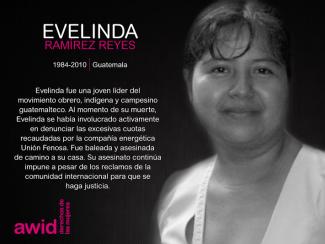
Evelinda Ramirez Reyes
WHRDs are self-identified women and lesbian, bisexual, transgender, queer and intersex (LBTQI) people and others who defend rights and are subject to gender-specific risks and threats due to their human rights work and/or as a direct consequence of their gender identity or sexual orientation.
WHRDs are subject to systematic violence and discrimination due to their identities and unyielding struggles for rights, equality and justice.
The WHRD Program collaborates with international and regional partners as well as the AWID membership to raise awareness about these risks and threats, advocate for feminist and holistic measures of protection and safety, and actively promote a culture of self-care and collective well being in our movements.
WHRDs are exposed to the same types of risks that all other defenders who defend human rights, communities, and the environment face. However, they are also exposed to gender-based violence and gender-specific risks because they challenge existing gender norms within their communities and societies.
We work collaboratively with international and regional networks and our membership
We aim to contribute to a safer world for WHRDs, their families and communities. We believe that action for rights and justice should not put WHRDs at risk; it should be appreciated and celebrated.
Promoting collaboration and coordination among human rights and women’s rights organizations at the international level to strengthen responses concerning safety and wellbeing of WHRDs.
Supporting regional networks of WHRDs and their organizations, such as the Mesoamerican Initiative for WHRDs and the WHRD Middle East and North Africa Coalition, in promoting and strengthening collective action for protection - emphasizing the establishment of solidarity and protection networks, the promotion of self-care, and advocacy and mobilization for the safety of WHRDs;
Increasing the visibility and recognition of WHRDs and their struggles, as well as the risks that they encounter by documenting the attacks that they face, and researching, producing, and disseminating information on their struggles, strategies, and challenges:
Mobilizing urgent responses of international solidarity for WHRDs at risk through our international and regional networks, and our active membership.
@shalinikonanur sharing a comment by her colleague debbie @salco "we can talk about shattering the glass ceiling, but we have to talk about who are sweeping those broken glasses?" challenging the #G7 to truly see who's vulnerable domestically & globally #W7Canada @kramdas @AWID pic.twitter.com/1rs0SpLYHp
— Tenzin Dolker cyclone (@T_Dolker) 25 de abril de 2018
استطلاع "اين المال" (أين التمويل للتنظيمات النسوية) هو ركيزة أساسية للنسخة الثالثة لأبحاثنا الموجهة نحو العمل. سيتم بحث وتوسيع نتائج الاستطلاع من خلال المحادثات العميقة مع النشطاء/ الناشطات والممولين/ات وسيتم مقارنة النتائج مع تحليلات وبحوث أخرى عن وضع التمويل للحركات النسوية وحركات العدالة الجندرية.
سيتم نشر تقرير أين المال للتنظيمات النسوية في العام  2026.
2026.
لمعرفة المزيد عن كيف تسلّط جمعية حقوق المرأة في التنمية الضوء على على تمويل التنظيمات النسوية أو ضدها، انظروا إلى قصة "أين المال" وتقارير سابقة هنا
Anna grew up in Lewes, Sussex (UK) and, after deciding not to pursue her English degree at Sheffield University, she moved to Bristol and became a plumber.
She spent much of her time defending the marginalised and under-privileged, attending anti-fascist rallies, and offering support to the women of Dale Farm when they were threatened with eviction. A vegan and animal lover, she attended hunt sabotages and her name is honoured on PETA's 'Tree of Life' Memorial. Anna went to Rojava in May 2017 with a strong commitment to women's empowerment, full representation of all ethnicities and protection of the environment.
Anna died on March 15, 2018 when she was hit by a Turkish airstrike in the town of Afrin, northern Syria. Anna was fighting with the Women's Protection Forces (YPJ), when she was killed.

As you plan the activity you would like to do at the Forum, please also consider how you will fund your participation. Typical Costs include: accommodation, travel, visa, forum registration fees, etc.
It is important to note that this Forum will have many ‘open spaces’ and moments for movements to learn and exchange, but fewer formal sessions. (See “Ways to describe the Forum in your fundraising” below for language to use in your outreach.)
Reach out to your current donors first : Your best option is always a current funder that you have.
Make sure to do it in advance : We recommend contacting them by early 2020 at the latest. Many funders who support feminist organizations have some budget allocated for Forum travel. Others may be able to include it in renewal grants or through other travel funds.
If your group has funders, tell them that you want to attend the AWID Forum to learn, experience, exchange and network- even if your activity does not get selected for the final program. In order to be able to support your participation, your donors will need to know about it well in advance so tell them right away! (they are already deciding which funds they will distribute in 2020).
If you do not currently have donor support or are not able to secure grants for Forum travel, consider reaching out to new donors.
Deadlines and requirements vary by funder, and a grant review process can take many months. If you’re considering applying for new grants, do so as soon as possible.
Feminist movements have long gotten creative with funding our own activism. Here are some ideas that we have gathered to inspire alternative ways of fundraising:
For more inspiration, see AWID’s ongoing series on autonomous resourcing, including specific ideas for conference raising participation funds.
AWID strives to make the Forum a truly global gathering with participation from diverse movements, regions and generations. To this end, AWID mobilizes resources for a limited Access Fund (AF) to assist Forum participants with the costs of attending the Forum.
AWID’s Access Fund will provide support to a limited number of Forum participants and session/activity facilitators. You can indicate in your application if you would like to apply to the AWID Access Fund. This is not guaranteed, and we strongly encourage you to seek alternative funding for your participation and travel to the Forum.
Even if you apply for the AWID Access Fund, we encourage you to continue to explore other options to fund your participation in the Forum. Access Fund decisions will be confirmed by the end of June 2020. Please remember that these resources are very limited, and we will be unable to support all applicants.
As you reach out to funders or your own networks, here is some sample messaging that may be helpful. Feel free to adapt it in whatever way is useful for you!
The AWID Forum is a co-created feminist movement space that energizes participants in their own activism, and strengthens connections with others across multiple rights and justice movements. Participants get to draw from wells of hope, energy and radical imagination, as well as deepen shared analysis, learning, and build cross-movement solidarity to develop more integrated agendas and advance joint strategies.
Our organization is seeking funds to attend the Forum in order to connect with other activists and movements from around the world, strengthen our strategies, and share our work. We are inspired by past participants, who have described the power of this global feminist gathering:
“Over four days … voices weaved together into a global perspective on the state of gender equality. And when I say global, I mean simultaneous translation into seven languages kind of global ....”
“It was reminding us that we are not alone. The Forum provided a means of translating collectivity into our movements. Whether across ideologies, identities or borders, our strength is in our vision and our support of one another.”
It is important to note that this Forum will have many ‘open spaces’ and moments for movements to learn and exchange, but fewer formal sessions. While many attendees will not be presenting in formal sessions, there will be invaluable space to learn, strategize, and experience feminist movements’ collective power in action.
When calculating your costs and how much you need to raise, it is important to factor in costs that may come up. Here’s an example of key items to consider:
The AWID Forum will now take place 11-14 January 2021 in Taipei .
It is more than a four-day convening. It is one more stop on a movement strengthening journey around Feminist Realities that has already begun and will continue well beyond the Forum dates.
Existem várias razões pelas quais a sua resposta ao inquérito WITM é importante. Por exemplo, tem a oportunidade de partilhar a sua experiência vivida com a mobilização de financiamento para apoiar a sua organização; de reivindicar o seu poder como especialista sobre como o dinheiro circula e os bolsos em que entra; e de contribuir para a defesa coletiva e consistente junto de financiadores para mover mais recursos de maior qualidade. Ao longo das últimas duas décadas, o inquérito WITM da AWID tem-se revelado um recurso fundamental para ativistas e financiadores. Convidamo-lo a juntar-se a nós na sua terceira edição para destacar o estado efetivo do financiamento, desafiar soluções falsas e apontar a forma como o financiamento precisa de mudar para que os movimentos prosperem e enfrentem os desafios complexos do nosso tempo.
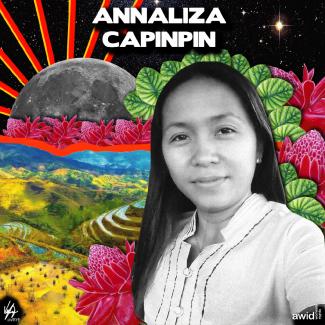
Conocida como «Ate Liza», Annaliza era la presidenta del Consejo de la Reforma Agraria para lxs Pionerxs de Mindanao, un grupo coodinador general en Tacurong City, Filipinas.
Querida madre de cuatro hijxs, maestra y líder comunitaria, Annaliza es recordada por su comunidad como «la que lidera cuando nadie quiere liderar, la que habla cuando nadie quiere hablar, la que se puso de pie con coraje para ayudar a lxs beneficiarxs de la reforma agraria a ser dueñxs de sus tierras».
Atacantes desconocidos la ultimaron a balazos en frente de la Universidad Estatal Sultán Kudarat (SKSU), mientras se dirigía a la Escuela Secundaria Nacional Salabaca, en Esperanza.
Su familia ha dicho: «Naghihintay pa rin kami ng hustisya para sa kanya» (todavía estamos esperando justicia para ella).
Te presentamos el Sindicato Red de Solidaridad, un sindicato de servicios y salud liderado en su mayoría por mujeres. Surgiendo como respuesta a la creciente precariedad, salarios insuficientes y entornos laborales hostiles que enfrentan diariamente lxs trabajadorxs en Georgia, el Sindicato Red de Solidaridad lucha por lugares y condiciones de trabajo dignos.
¿Su objetivo? Crear un movimiento obrero democrático nacional. Para hacerlo, se ha asociado con otros sindicatos locales y regionales y ha creado lentamente una red de sindicatos, empoderando por el camino a cada vez más trabajadoras para que se conviertan en líderes sindicales.
Su enfoque político es holístico. Para el Sindicato Red de Solidaridad, los temas de derechos laborales están directamente conectados con agendas y reformas políticas y económicas nacionales más amplias. Por eso están presionando por la justicia fiscal, los derechos de las mujeres y personas LGBTQIA+, y luchando contra el desmantelamiento del estado de bienestar georgiano.
Solidarity Network también forma parte de Huelga Social Transnacional (Transnational Social Strike, TSS), una plataforma política e infraestructura inspirada en la organización de migrantes, mujeres y trabajadores esenciales que trabaja para construir conexiones entre los movimientos laborales a través de las fronteras y fomentar la solidaridad global.
Ressources en soutien aux mouvements féministes, aux décideur·euse·s et aux allié·e·s pour résister aux tendances antidroits.
Sobre la base de una investigación documental inicial y de consultas con aliadxs (que nos llevaron a eliminar muchas otras opciones de la región), organizamos una serie de visitas exhaustivas a Nepal, Malasia, Sri Lanka, Tailandia, Indonesia y, más tarde, Taiwán.
Cada visita incluyó, no solo la evaluación de la infraestructura logística, sino también encuentros con grupos y activistas feministas locales para entender mejor el contexto y conocer su percepción de las oportunidades y los riesgos potenciales de organizar un Foro de AWID en sus contextos.
Estos movimientos expresaron, en varias ocasiones, sentimientos encontrados respecto de las oportunidades y los riesgos que podría acarrearles la visibilidad de un evento como el Foro. En una de las visitas, durante los primeros treinta minutos de la reunión, escuchamos a lxs activistas presentes decir, en forma unánime, que un Foro de AWID sufriría una enorme reacción, que los derechos LGBTQ son un asunto particularmente candente, y que los grupos fundamentalistas aparecerían con toda su fuerza a interrumpir el evento.
Cuando respondimos, «De acuerdo, entonces ustedes no creen que sea una buena idea», nuevamente la respuesta unánime fue «Por supuesto que es una buena idea, ¡queremos cambiar la narrativa!». En algunos de estos lugares nos resultó difícil oír y ver que muchxs activistas feministas querían aprovechar la oportunidad de un evento grande y visible, y que estaban preparadxs a enfrentar los riesgos locales; pero nuestras consideraciones, como anfitrionxs de casi dos mil personas de todo el mundo, nos imponen un cálculo distinto del riesgo y la factibilidad.
También tuvimos que analizar qué significa organizar un foro feminista que a sea coherente con los principios de inclusión, reciprocidad y autodeterminación, en aquellos casos en que la política y la práctica de Estado son, en general, contrarias a estos principios (aunque lxs funcionarixs de los ministerios de turismo hayan trabajado arduamente para atenuar estas características).
En muchos de estos lugares, monitorear el contexto nos resultó un ejercicio pendular: de un momento abierto y seguro para los debates feministas podíamos pasar a otro de brutal represión y xenofobia, capaz de sacrificar las prioridades feministas como piezas de negociación política para tranquilizar a las fuerzas antiderechos del ala derechista.
Nuestras dificultades en la región Asia-Pacífico nos llevaron a preguntarnos si no sería más fácil mover el Foro a una región distinta. Sin embargo, hoy en día no podríamos organizar un Foro de AWID en Estambul como lo hicimos en 2012, ni podríamos hacerlo en Brasil como lo hicimos en 2016.
Al organizar el Foro de AWID, estamos tratando de construir y sostener, de la mejor manera posible, un espacio para las diversas expresiones de solidaridad, indignación, esperanza e inspiración que son el núcleo de los movimientos feministas.
En este momento, creemos que Taipéi es la sede, dentro de la región Asia-Pacífico, que mejor nos permitirá construir ese espacio seguro y rebelde para nuestra comunidad feminista global.
De hecho, en el mundo contemporáneo no existe una ubicación ideal para un Foro centrado en las Realidades Feministas. Donde sea que vayamos, ¡debemos construir ese espacio juntxs!

كلا. نقدّر عملكم/ن لكننا لا نطلب في هذه المرحلة من الصناديق النسوية والنسائية تعبئة الاستطلاع. نشجعكم/ن على مشاركة الاستطلاع مع شركائكم/ن و شبكاتكم/ن النسوية.
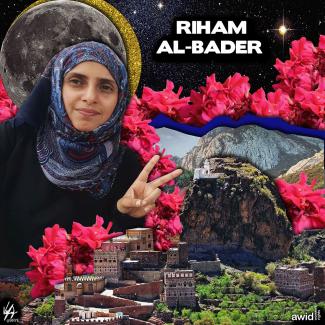
Riham était avocate et activiste engagée à suivre de près la question des violations des droits au Yémen.
Elle a travaillé avec d'autres activistes pour fournir de la nourriture et de l'eau aux civils piégés par les milices houthies dans la banlieue de la ville de Taiz.
Riham a été tuée en février 2018. La cause de son décès, soit par la main d’un tireur d'élite ou par un tir de mortier, n’a pas été confirmée. Personne n'a été tenu responsable de son meurtre.
En rejoignant l’AWID, vous intégrez l’organisation féministe mondiale, un pouvoir collectif qui se fonde sur la solidarité et puise ses racines dans le travail entre les mouvements.